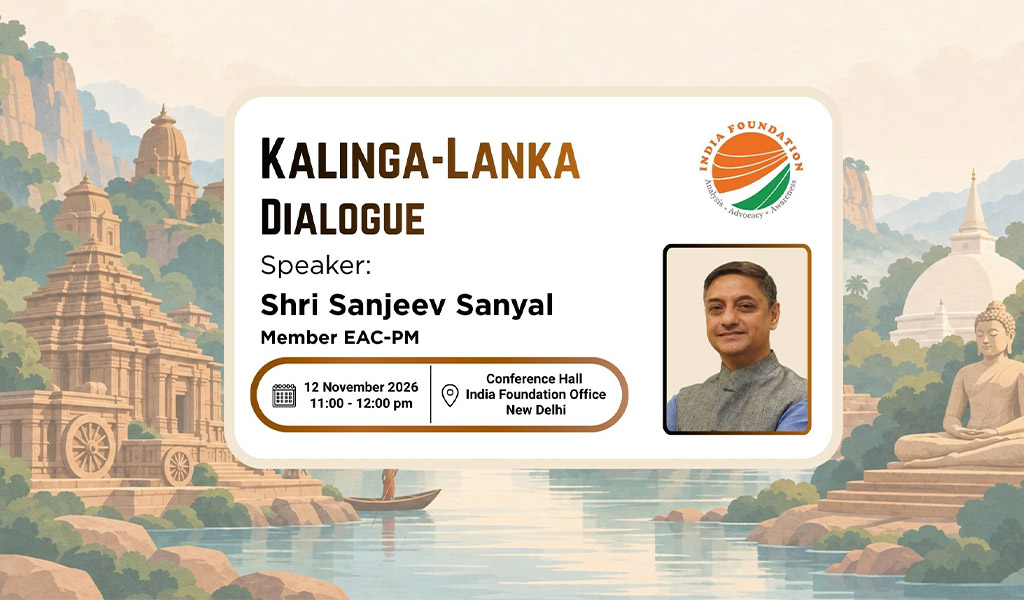
Event: Kalinga-Lanka Dialogue
Date: 12 November 2026
Time: 11:00 AM – 12:00 PM
Venue: Conference Hall India Foundation Office New Delhi
Concept Note
Historical references, inscriptions and excavations speak in volumes about the transmission of Indian culture from Kalinga (Odisha) to Lanka (Sri Lanka). Maritime trade since ancient times have led to trade networks and political alliances between the two regions. Matrimonial ties between the royals also abound our mythologies. Stories about the spread of Buddhism from Kalinga to Lanka are mentioned in scriptures and depicted in major historical sites of Sri Lanka. Along with religion, it also introduced art and architecture; language and literature; social customs and folk traditions; political system and state structure in Sri Lanka.
A review of the documentary sources reveals that the current scholarship on Kalinga Lanka relationship remains under-rated. Most of the existing studies are historical and lack the linkages with the current geo-political developments. Except for few studies by geographers and cartographers, they are mostly lopsided focusing only on the narratives based on mythological sources. The methodological gaps related to qualitative textual analysis and its limited integration with the quantitative sources has been a major limitation.
In this backdrop, India Foundation proposes to organise a dialogue on Kalinga-Lanka linkages. Highlighting upon the historical network, the Dialogue will present India-Sri Lanka relations and dynamics of cultural diplomacy between two countries in recent times. The proposed dialogue will examine the shared sacred geography, ancient maritime networks, Buddhism, pilgrimage traditions, art and architecture, literature, political linkages and cultural exchanges that connected the two regions across the Bay of Bengal and the Indian Ocean.
By bringing together distinguished scholars, policymakers and subject experts, the Dialogue seeks to encourage discussion on these historical relationships and their continuing relevance to cultural diplomacy, people-to-people engagement and contemporary India-Sri Lanka relations. Their participation would enrich the ongoing study and deepen understanding of the Kalinga-Lanka civilisational connections.