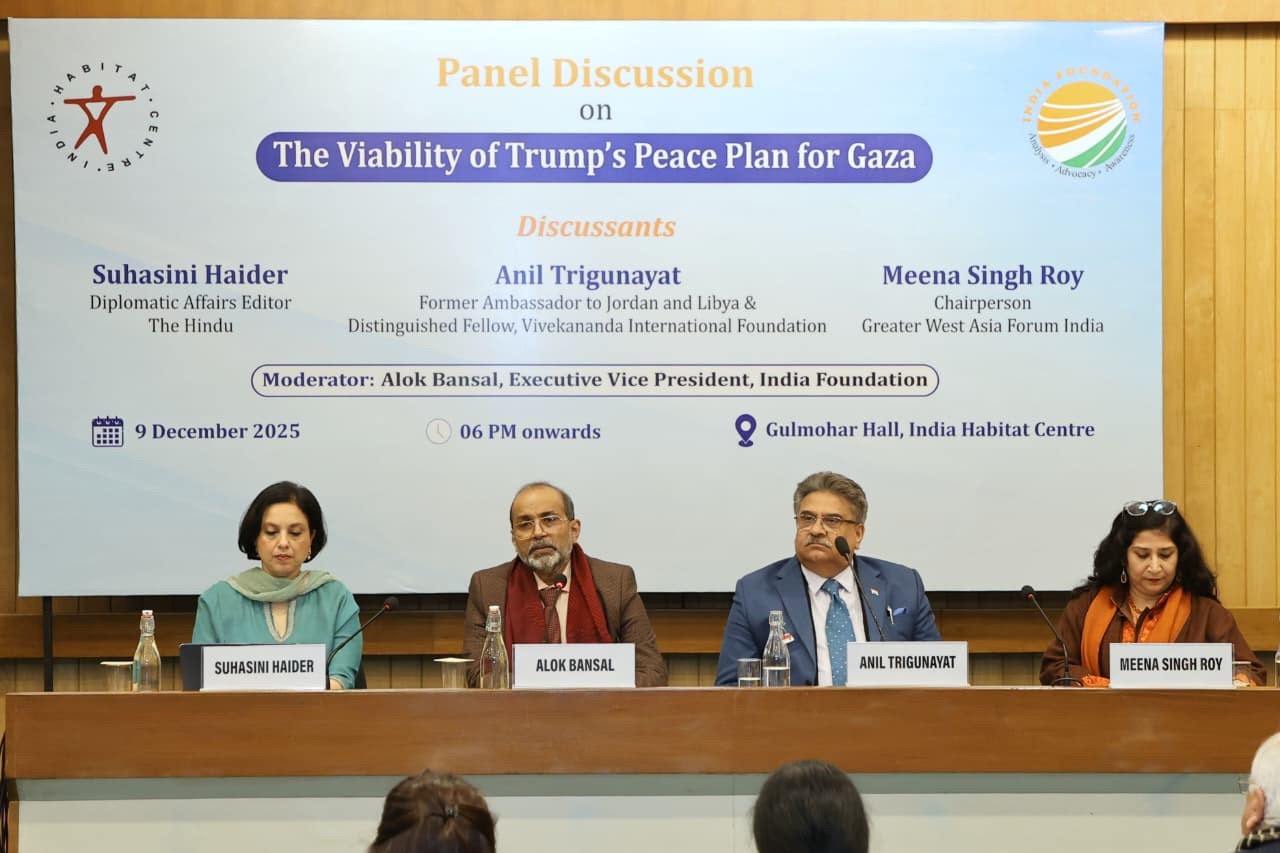
On 9 December 2025, India Foundation, in collaboration with the India Habitat Centre, hosted a Panel Discussion on ‘The Viability of Trump’s Peace Plan for Gaza’. The panel featured Ms Suhasini Haidar (Diplomatic Affairs Editor, The Hindu), Amb (Retd) Anil Trigunayat (former Ambassador to Jordan and Libya), and Dr Meena Singh Roy (Chairperson, Greater West Asia Forum). The session was moderated by Capt Alok Bansal (Executive Vice President, India Foundation).
Suhasini Haidar outlined the plan’s key elements: de-radicalisation and redevelopment of Gaza as a “new Gaza” for its people (not explicitly Palestinians), an international stabilisation force, Hamas demobilisation and disarmament, hostage release, Israeli prisoner release and full humanitarian aid, amnesty and safe passage for surrendering Hamas leaders, a technocratic transitional Palestinian government with international oversight (Board of Peace), U.S.-led economic reconstruction, phased Israeli withdrawal, and eventual U.S.-facilitated dialogue toward Palestinian statehood. She highlighted major concerns: one-sided optics (announced alongside Israeli PM Netanyahu), lack of evidence of Hamas demobilisation, minimal Palestinian agency, unclear funding, uncertain guarantees for displaced Gazans’ return, and absence of mechanisms for truth, reconciliation or war crimes accountability. She questioned whether the plan truly reflects a balanced solution given the scale of destruction and loss of life.
Amb Anil Trigunayat described the plan as a temporary ceasefire blending elements of Trump’s 2020 proposal, the Abraham Accords, and Israeli priorities, with U.S. security guarantees for Israel remaining non-negotiable. He credited Trump’s personal push for progress before re-entering office but noted breaches, especially Israeli strikes on Qatar that shifted dynamics. He pointed out that Phase one (hostage exchange and ceasefire) is nearly complete, but phase two faces hurdles: unclear composition of the international stabilisation force (proposed contributors include Turkey, Pakistan, Azerbaijan, Indonesia, although Israel rejects Turkey), persistent trust deficits, and unrealistic expectations of de-radicalisation after massive casualties. He stressed that lasting peace requires eventual resolution of Palestinian statehood, warning that without it, violence will recur. India, he said, maintains its traditional support for a two-state solution, condemns terrorism, provides humanitarian aid to Palestinians, and balances strong ties with Israel.
Dr Meena Singh Roy framed the plan within a shifting regional narrative observed at recent dialogues (Manama, Doha). Positives include halted hostilities and broad acceptance (backed by UN Security Council resolution). However, she highlighted that the viability of this plan is undermined by lack of timeline, sequencing, concrete funding commitments, and clarity on the stabilisation force’s mandate. Gulf states (Qatar, Saudi Arabia) refuse to foot major reconstruction bills, prioritising their own development and humanitarian aid only. Regional perceptions have evolved: declining confidence in unconditional U.S. security guarantees, multifactor foreign policies, and surprisingly reduced Iran-bashing (e.g., Omani FM called Israel, not Iran, the threat). She described the plan as currently a “wish list” on life support, with no agreement on disarming Hamas or forming an interim technocratic government. Despite challenges, a ray of hope persists as no party has abandoned the process.
Audience questions addressed India’s balancing act between condemning Hamas terrorism and supporting Palestinian self-determination, the feasibility of a Palestinian state without East Jerusalem, the impact on the India–Middle East–Europe Economic Corridor (IMEC), prospects for broader West Asian peace, and the shift away from traditional UN peacekeeping toward U.S.-led forces.