
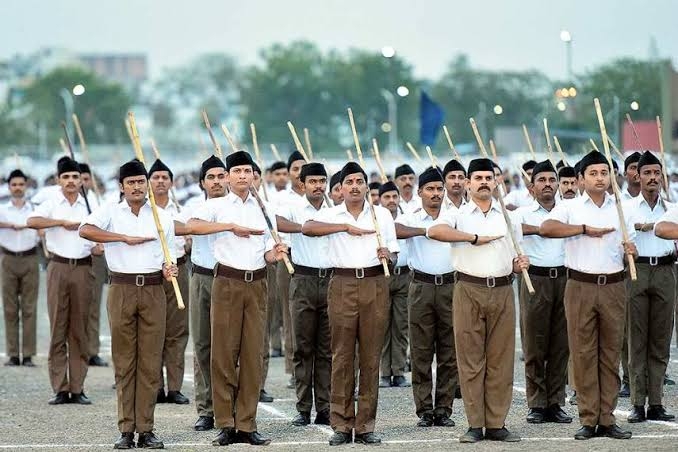
The centenary celebrations of the Rashtriya Swayamsevak Sangh (RSS) have resonated widely, captivating the imagination of people not just in India but globally. The organisation’s recent visibility, driven by its nation-building initiatives and the selfless dedication of its Swayamsevaks, has drawn considerable attention to India’s profound heritage and civilisational strengths. For me, a life dedicated to soldiering reveals an essential truth: the ethos and very soul of this unique organisation and its flagbearers reflect values remarkably similar to those that define a soldier.
This deep realisation has inspired me to write this article: a personal account sharing the pivotal role the RSS played in my father’s life and, by extension, in our own formative years. The RSS, through its vision, disciplined action, and structured activities, profoundly impacts individuals. It undeniably fosters empathy for fellow humans and instils a deep-seated desire to respect, understand, and absorb the rich values and vast knowledge of our civilisational heritage.
This article is also a tribute to my father, Lt Col Varinder Kumar Sahni. A dedicated nationalist and army officer, he carried the indelible scars of the Partition, having grown up in Rawalpindi. After his retirement, he once again became a committed karyakarta, joining the RSS shakha in Jagadhri/Yamuna Nagar. I believe he later transitioned into a pracharak, engaging actively in all Sangh activities across the Jagadhri-Ambala region. Furthermore, he was involved in some capacity with the esteemed publication, the Organiser, at the regional level.
The article recounts what my father shared with us as we grew up and, more recently, what I discovered in his personal diary after he passed away. It aims to capture the essence of those agonising pre-partition times and his involvement with the emerging but influential RSS. It was during those challenging moments that his personal association with this unparalleled organisation began. Their vision and impartial engagement with society drew him into their fold. Being an emotional person, he was deeply affected by the events leading to and including the partition, like most of that generation who had to endure these horrific times.
He rarely spoke about those bygone days, as they likely stirred mixed memories. To provide context for the environment and period at that time, the family, a year before partition, was somewhat unsettled, as the family’s patriarch, my grandfather, a Rai Sahib and a distinguished lawyer, died suddenly of a heart attack. Thus, when partition appeared imminent, the family elders moved to Delhi on the advice of those already working there. My father remained in Rawalpindi to manage the family’s assets and continue his work as a chemical engineer. I assume that both personal circumstances and external factors led to my father’s increased involvement with the RSS.
A brief overview of the status of RSS in the 1940s, based on historical records. It was active in Rawalpindi, establishing a network of shakhas as part of its expanding presence across undivided Punjab. During the 1947 Partition, it played a crucial role in organising relief efforts and protecting Hindu and Sikh communities, including coordinating evacuations and reuniting separated families. The organisation had founded the Punjab Relief Committee and the Hindu Sahayata Samiti, with multiple branches, to support refugees. It set up more than 300 relief and security camps across the affected regions. The youth of that generation shaped and carried out their vision.
Another factor that contributed to my father’s attraction, admiration, and respect for the RSS was his passion for history and his interest in India’s civilisational and spiritual vibrancy. His sentiments aligned more with the Sangh when he started working in the communally charged environment of the ‘Soda Ash factory of Alkali Chemical Corporation of India’ in June 1947 at Khewra, Jhelum district (now Pakistan). By then, religious polarisation had become quite marked in northern India. Although the factory was managed by the British, with most senior officials being Hindus, the British leadership favoured the other community and ignored their excesses, including threats to colleagues of different religions. It was here that he first mentioned in his diary that there were members of the RSS in the organisation, and I presume it was here that he joined.
My personal recollection of his association with the RSS dates back to the early 1960s, when we visited Delhi on holiday to see my grandmother. My father was an Army Officer, and when in Delhi, he would meet some of his old acquaintances from Rawalpindi days (before partition) and always visited the RSS office complex at Jhandewala — ‘Keshav Kunj’ at Karol Bagh, New Delhi. Being the eldest child, I often accompanied him. I was always fascinated to observe the unique bond he shared with these Rawalpindi friends, who were traders, office workers, and some entrepreneurs. Most of them were active in Sangh activities and lived near Old Delhi, Azadpur Market, and Civil Lines. They came from very different backgrounds but were united by the shared hardships they endured in Rawalpindi from August to October 1947. These emotions are understandable and relatable, as we in the army also develop unbreakable bonds with our colleagues when serving and operating in demanding environments.
His diary contains entries detailing the locations and times of violence, communal killings, and the forcible seizure of properties in Rawalpindi, particularly of those who had moved to relief camps. It also records their frustration with the biased attitude of government officials, police, and the officialdom in general, of Pakistan. In these circumstances, they were all thrown together in Rawalpindi, actively engaging with the Sangh, while offering support and solace to each other, as their families had been relocated to safer areas. The teachings and discipline of the Sangh ensured that these young, idealistic youths could protect the Hindu community remaining there while also safeguarding their assets.
What was intriguing was the way these young men selflessly gave away their expensive flight tickets to India to those less fortunate, who, in their opinion, needed to be evacuated urgently. This humane act of donating costly tickets, sent by their parents with difficulty, must be seen in the context of that era, when mobile phones were unavailable, and landline access was limited. Additionally, the communication infrastructure had been disrupted due to unceasing violence, destruction, and looting. Over time, their activism was deemed anti-national, and they came under scrutiny by local authorities. It was only when they seemed to cross a red line that they left their homes. My father finally evacuated on 07 October 1947, when his personal safety was at stake.
Fast forward to the 1980s, and I observed his enthusiasm for attending the shakaa, inspiring youth with his experiences and his unwavering dedication to the community. His post-retirement life once again became meaningful, radiating energy and joy. I did meet his colleagues of the Sangh, some of whom are now senior officials of this vibrant organisation. Being in the Army, I did not get involved with the Sangh, but I am certain that my father’s activities influenced my own opinions and dealings. I conclude by emphasising that the lives of many, like my father’s generation, were shaped by the values and discipline of the Sangh. I am confident that their collective efforts have laid the foundation for nation-building and paved the way for us to realise our national aspirations.
Author Brief Bio: Lt Gen Arun Kumar Sahni is a decorated, scholar – soldier, with 40 years of commissioned service in the Indian Army. In his last assignment, tenanting the second highest rank of the army, he was the General Officer Commanding-in-Chief of one of the six operational commands of the Indian Army.In addition to his Command assignments of leading military formations, his important staff appointments include ‘Chief Operations Officer’ of an Infantry Brigade in Sri Lanka as part of Indian Peace Keeping Force (IPKF), Colonel General Staff responsible for operations of a Counter Insurgency Force in Jammu & Kashmir, ‘Principal Staff officer’ at Army Headquarters, Delhi, and ‘Director General Information Technology.