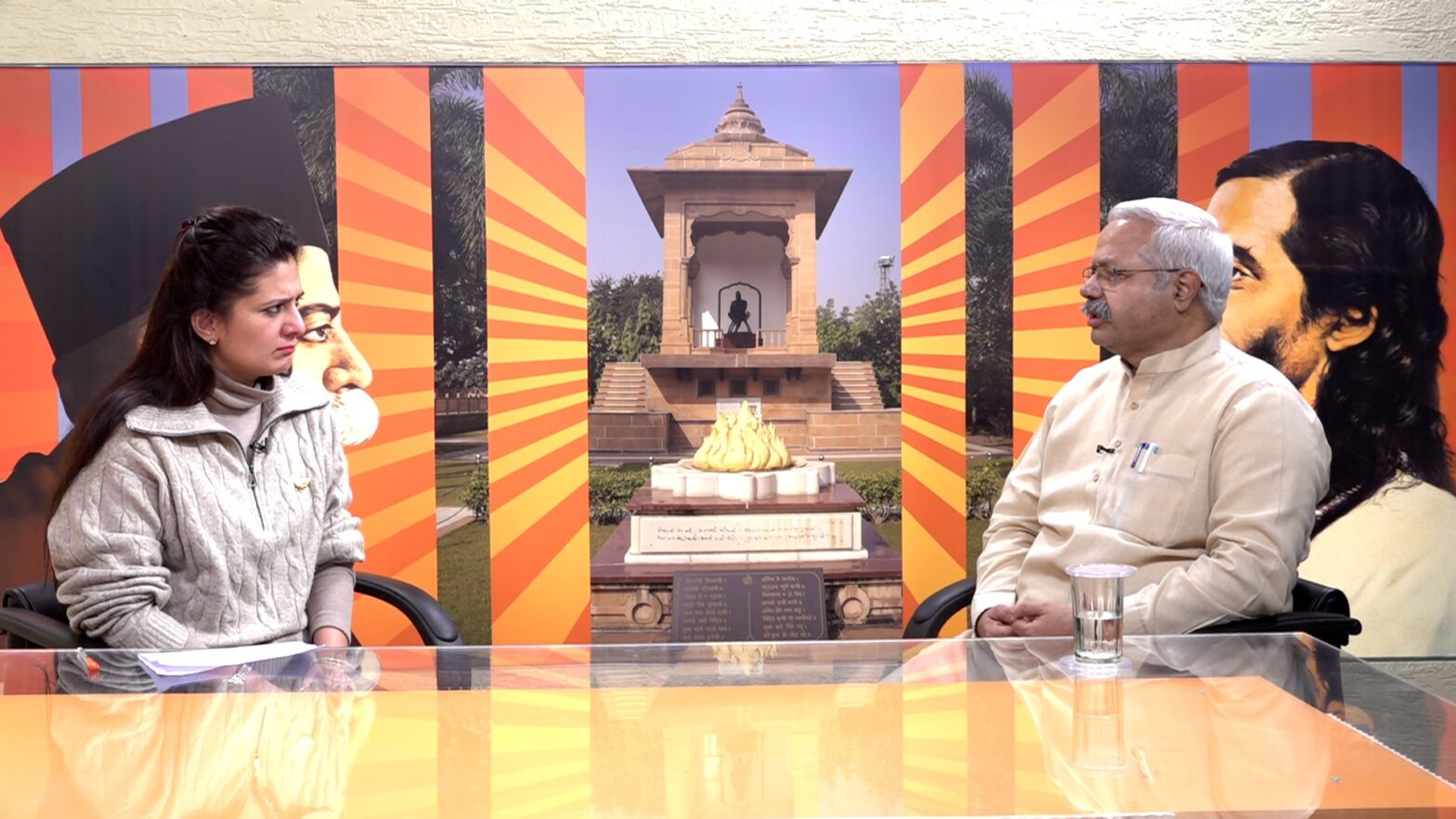
Rami Desai:
Sunil ji, let me start with a very simple question: could you explain in your own words what RSS is?
Sunil Ambekar:
RSS is an organisation where you can voluntarily contribute to the nation and society while preparing yourself for that purpose. It’s simple: just as you love your mother, it’s an extension of that love towards Bharat Mata. This entire process, this journey, is RSS. Anyone, any ordinary person, can join RSS. They come to the shakha, enter the RSS circle, and over time, through shakha exercises, learning about the country, our ancestors, and the present situation, they develop good discipline. This enables them to serve society and develop qualities like teamwork. Over time, they form a Sangha, which means working in a group. Basically, it is a network of networks. A shakha is one network that does the networking in its locality, and the association and combination of all these networks form the Sangha. So, in short, it’s a voluntary organisation. Everyone works together for the country.
Rami Desai:
Towards a common goal of safeguarding our national interests?
Sunil Ambekar:
You can say the word indicates: ‘National’ means the character is national, the goal is the nation’s glory or to make the nation better, and the way is volunteerism and working together. So, it’s called a Sangh, and the name is very indicative of what it is.
Rami Desai:
Its core ideology is Hindutva. Do you think Hindutva has changed over time or in its definition?
Sunil Ambekar:
No, the definition of Hindutva remains the same. We only change its expression or contextualise it according to the times. That means the context keeps changing when we speak of it today. For example, Hindutva is essentially the idea that there is one common element in everyone and that we are all connected. We are connected, so we have a relationship with each other; therefore, we should care for one another and create a world where people consider each other their own and care for each other. This way of living in the world is Hindutva; this is Hindu culture, basically, that’s it.
Now, when a new context arises, such as how you behave in another language, that language is also connected to you; find its commonality. If someone attacks our country, we must certainly defend it, but we should not indulge in warmongering or go around fighting unnecessarily. We will definitely protect our religion and culture in our country. If someone else attacks, then at that time we will think about defending ourselves. This means that if there are other cultures or civilisations in the world, we are not against them. So, these expressions keep changing. In today’s time, for example, caste has come into society, but Hindutva has no place for caste or discrimination. There is no place for disparity or anything like that. It is a social evil, so we have to focus on how we can eradicate this social evil or this disparity or the discrimination that happens among people. So many missions arise from this. If someone has broken or insulted our temple, then restoring it becomes a mission. So, there are many missions and expressions. But the basic idea is that we are connected to each other, living together by caring for one another. That is the essence of Hindutva.
Rami Desai:
What is the role of ‘Religion’ in Hindutva?
Sunil Ambekar:
If we look at it in the context of India, there are multiple Hindu religions based on Hindutva. In India, there are multiple religions that can be called sects, which we can also call dharma, panth, or sampradaya; there are many such traditions. That is why you can practise any religion.
But where does the role of Hindu Dharma come in? It comes in when you consider other paths as good and true, respect them, and are ready to live joyfully with them. So, this is what Hindutva is about, or you set your life in such a way that you can live with everyone and take everyone along. You also see the divine element in creation, so you do not worry about the environment only because humans are in trouble. We believe that the same element exists there too, so we are connected to it. Therefore, adjust your life to live with it. It is inclusive, and that is why we say Hindutva goes on being inclusive to the point of Vasudhaiva Kutumbakam, the world is one family. So, it goes on; the journey starts and moves towards that part.
Rami Desai:
Earlier, you spoke about caste. I’ll come back to that. But these days we’ve heard a new word: Gen-Z. We’ve also seen a certain amount of manipulation of the term Gen-Z in the neighbourhood. How much attraction does Gen-Z have towards the RSS in India, and do you visualise anything for the next 100 years to bring Gen-Z closer to the RSS structure?
Sunil Ambekar:
First of all, if we talk about the youth of India, whom you are calling Gen-Z, they are aspirational. They want to take India forward. They believe in the Constitution of India. They want to contribute to India’s progress in a constructive way. So, today’s Gen-Z is like this: they say ‘Bharat Mata ki Jai.’ They are connected to their religion and culture, and that’s why, in a way, the ideas that RSS holds are ideas that today’s youth subscribe to. And as far as Gen-Z is concerned, every generation is Gen-Z.
Those who were part of the freedom movement were also Gen-Z. They sacrificed everything for the country’s independence. When the Emergency was imposed, they were the ones who went to jail and fought to restore democracy. I think even after 2011, when corruption became a major issue and atrocities against women came to light, our country’s youth came out and said, ‘This will not work.’ They then turned it into constructive political change. So, I believe that Gen-Z in our country is on the side of building the nation, not destroying it. They are on the side of the Constitution, not of removing it. They are here to contribute to the country, not to abuse anyone. They are here for constructive contribution, and I think RSS is working along the same lines. That’s why most people subscribe to RSS ideas.
Rami Desai:
Rahul Gandhi ji sometimes says things like the RSS wants to change the Constitution. Who is he talking about?
Sunil Ambekar:
No, I think they should look at it. First of all, the Gen-Z of India, when they first became active, were against the Emergency. Who were they against? You can understand who imposed the Emergency. Then, in 2011, when corruption and atrocities against women became issues, Gen-Z in India became active again. Who were they against then? They should understand this, I feel. That’s why the youth of India is absolutely sensible and is moving forward in the right way to work positively.
Rami Desai:
You asked about the role of women in RSS. Do you believe they have a role? If so, what is it? And in the future, do you think women will ever be included in shakhas?
Sunil Ambekar:
I feel that even today, in the field shakhas, there are the Sangh’s women shakhas, the Sevika Samiti, and the men’s field shakhas, all of which essentially carry the name RSS. So, both continue to function even today. The committee was formed in 1936, and women’s involvement in all these activities, whether it’s decision-making in public life, various activities, or service initiatives, is continuously increasing. In the diverse organisations run by RSS volunteers, there is also a large number of women. They are in leadership roles, even at the top leadership level, so many people are working actively. As far as the topic of field shakhas is concerned, I feel that is a matter for society. The Sangh cannot decide that. Shakhas are held in localities. The day the people of the locality feel that such a shakha should be held, it will happen.
Rami Desai:
So, is it open?
Sunil Ambekar:
I think this depends on social norms and the circumstances of society at that time. So, in my view, that is not the important point. What is important is whether your outlook towards women is participatory or not, and whether it is equal or not; that is far more significant. If you look at it from those two criteria, I feel everything is positive.
Apart from that, see, our swayamsevaks have already started doing things like holding family shakhas at home during the COVID period. Even now, every shakha will have a monthly get-together of all the families of the swayamsevaks who attend that shakha. This has already started. So once a month, there will be a get-together at the level of each shakha. This has begun now, and it will take some time to implement fully because the Sangh grows organically. Nothing happens in one day by issuing an order; it will take its course.
By the way, every family is involved: we are family-based. The entire family participates. Without the involvement of families, the Sangh’s work cannot continue. The shakha’s work takes place at the Sangh location, such as physical exercises, but the rest of the work takes place at home. So, the whole family is involved; this has been the case from the very beginning.
Rami Desai:
So, anything is possible. Now, if we talk about caste, the Sangh’s point of view has always been that caste-based discrimination is unnecessary and should be done away with. But what is the RSS’s point of view on the caste census?
Sunil Ambekar:
No, this is something we have discussed earlier as well. I believe all Hindus are one, and in a way, there should be no discrimination or bias. However, in our country, for some time, certain people faced discrimination, and as a result, some were left behind socially in every way. Many measures are being taken for this, and they have society’s support. So, if governments need data to carry out such work, they can collect it. Beyond that, there should be no politics over this; that is the Sangh’s view. I feel that people today are sensible; we can see this in society. So, I think efforts for Hindu unity will continue, and at the same time, efforts to bring those who have been left behind socially to equality through various governmental and social schemes will also continue. Both these tasks must go hand in hand. And no one should be allowed to politicise this. To this end, we are constantly trying to make society aware.
Rami Desai:
Now, I would like to focus a little on international issues. In the neighbourhood, we have seen a situation involving minorities, especially Hindus. What is the Sangh’s view on this? And is it true, as we have observed, that their numbers have declined over time? In Bangladesh, we see their suffering increasing. Are they truly helpless? Is there no one to support them? What is their future?
Sunil Ambekar:
I feel that the incidents that have occurred in our neighbourhood, especially in Bangladesh, where atrocities were committed against Hindus and all minorities, are certainly unfortunate, and everyone will condemn them. Now, as far as the question of a solution is concerned, I feel that the stronger India becomes, the more its influence will be felt there. Because even there, it is extremely necessary to strengthen those forces that do not want such things to happen. That is why I feel we have been repeatedly telling the government that it must take a political initiative to tighten things so that these repeated incidents, which occur due to state sponsorship or government silence, can be stopped through strong political measures. We have been raising this issue repeatedly and will continue to do so. Ultimately, you see, making a country like India strong is very important to stop such forces, and we need to move in that direction. It is also very important to have clarity on this issue within India. The good thing this time is that when these atrocities happened against Hindus, everyone in India came together to oppose them. At the very least, there should be no politics over this in India, and we should speak in one voice. Efforts in this direction are absolutely necessary, and we are continuously working towards it.
Rami Desai:
So, how will this effort happen?
Sunil Ambekar:
We are speaking to everyone so that all Hindus speak with one voice and one message. Politically, an environment should be created where no one steps forward to say anything contrary, and everyone speaks positively. When a positive message is raised at the national level, only then will the government’s stance, whether raised domestically or on international platforms, carry strength and have an impact. That is why it is very important that the whole of India stands behind this. Only then will we be able to protect our people there, so that the government in Bangladesh can take concrete measures on this issue.
And those international forces that, directly or indirectly, support Pakistan’s terrorist intentions and activities, or those that help similar forces in Bangladesh, and many international powers that remain silent on such matters, because of this, incidents occur in countries like Bangladesh. This is why there is an international dimension to this issue. Such an environment should be created in India, and, at the international level, no nation can support those who engage in such activities. Only then will this stop. And those in Bangladesh who do not want this to happen, or political parties and forces there that consider this wrong, will also be strengthened by this. From that, a solution to the problem will emerge naturally.
Rami Desai:
Across the world, we have seen nationalist governments come to power, whether you call them right-wing or governments that prioritise their national interest. At one point, we felt there was some commonality with us. Do you think there can be any cooperation with such governments internationally? Will they understand what you mentioned about our neighbourhood? Or is this also part of our debate about missionary influence that sometimes comes in? How can we work together?
Sunil Ambekar:
Look, when it comes to hard diplomatic questions, the government has to create pathways through its influence and dialogue. And the country that remains strong and can present its views effectively always sees the situation move in its favour. It can put forward its points in its own way. That’s why finding new friends on the international stage and strengthening itself on that basis is important. I feel a good government always makes efforts for this, and the Government of India is doing so. So that is a good step.
But the most important thing is that India must become as capable and strong as possible in every respect. Only then will our words carry the weight we want. That’s why, as the Sangh, we are constantly working to make people across India understand the importance of unity, participation, and awareness of these issues, which we call understanding who is a friend and who is an enemy. We are continuously working to awaken this awareness in India. And we believe that through this, a very positive environment will be created in the country, and the future will be very bright.
Rami Desai:
Sunil ji, although I could ask you many more questions because this conversation is so interesting and I think those watching will hear aspects they may never have heard directly, I want to ask one last question. This is the centenary year of RSS. RSS is national, but does it have an international agenda in the coming years?
Sunil Ambekar:
Look, the Rashtriya Swayamsevak Sangh operates within India, focusing on how the unity of Hindus can help make this nation stronger and better, whether in terms of life values, prosperity, or strength. But today, the most important context is that the entire world, including developed nations, is seeking solutions to contemporary problems in a single way. In that, India’s Hindutva approach can be very useful. So, the idea is to demonstrate this approach in practice within India, because merely talking about theory will not help. We need to show it in action and then engage in dialogue with people internationally. Many people are visiting India these days, and we are already having such conversations and sharing ideas.
For example, when we talk about the environment, it cannot be solved by technology and politics alone. People will have to change their lifestyles. When our demands change, the market and technology cycles will change as well; that’s when real change will happen. Planning only for 30–40% of people will not work. We need to think about what living standards the world can sustain for 140–150 crore people in India and 700–800 crore people globally. We must bring those at the bottom up and tell those at the top who are over-consuming, “You are a burden; contribute and correct this.” So, we need to find such pathways.
Today, there is a problem in families: people are not connecting the economy and the family. This connection is necessary. If families stay together, economic prosperity will be sustainable; otherwise, it won’t. For example, if five people live in one house, that’s one house. But if the average drops to 2.5 people per house, as in the US, we will need two houses instead of one. Currently, we have 28–30 crore houses. If the family average becomes 2.5, we will need another 30 crore houses. What will that do to the economy? So, culture and the economy must be linked. This has not been done globally so far. Many topics are connected to this, including the environment, cultural understanding, family structures, and societal issues.
Take women’s issues: from feminism, people have moved to wokism because solutions are not being found. There can be solutions within family structures. We need Familism, not Feminism, actually. We don’t believe in ‘isms,’ but if I had to use a parallel term, I would say that. So, people need to adopt this. There are countless solutions. For health, the lifestyle we advocate, such as yoga, is already being adopted. So, there are solutions for the modern and developed world. And for the future world we envision, there are many solutions. If we do not accept others’ viewpoints as true or valid, the world will become enemies of one another. There cannot be peace. Even now, people say the 21st century belongs to AI, yet wars are still happening. Even near our country, there are forces that still believe in terrorism.
This can only change if we embrace India’s vision of many religions, but one dharma and one culture, which we can call human dharma, namely Hindu dharma. Everyone needs this. Only then can we live peacefully; otherwise, it’s not possible. So, I believe the experiments and explorations we have conducted here, and the collective efforts to take India forward, will be helpful in the entire world. From that perspective, we will engage in dialogue with people across the globe in the coming times.
Rami Desai:
Sunil ji, thank you for so eloquently setting out the future vision for us. Thank you very much. On behalf of India Foundation, we are very honoured to have this interview with you.
Sunil Ambekar:
Thank you.
Brief Bios:
- Shri Sunil Ambekar is the Akhil Bharatiya Prachar Pramukh of RSS.
- Rami Desai is an author, anthropologist, and scholar specializing in the North Eastern region of India. She holds degrees in Anthropology of Religion and Theology from King’s College, London. Her research focuses on ethnic identity, tribal issues, and insurgency. She is a Distinguished Fellow at the India Foundation and regularly contributes to major newspapers and news channels.