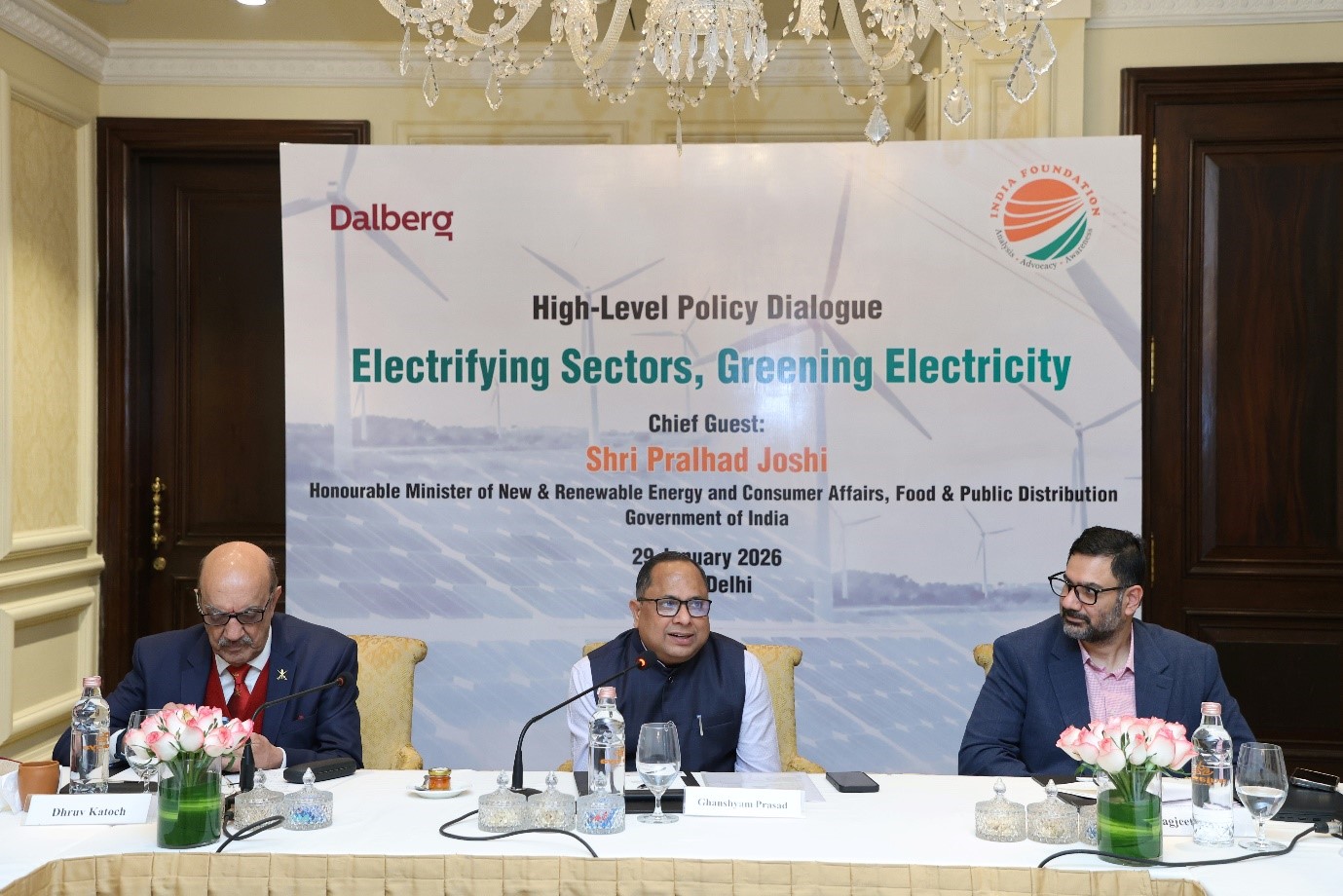

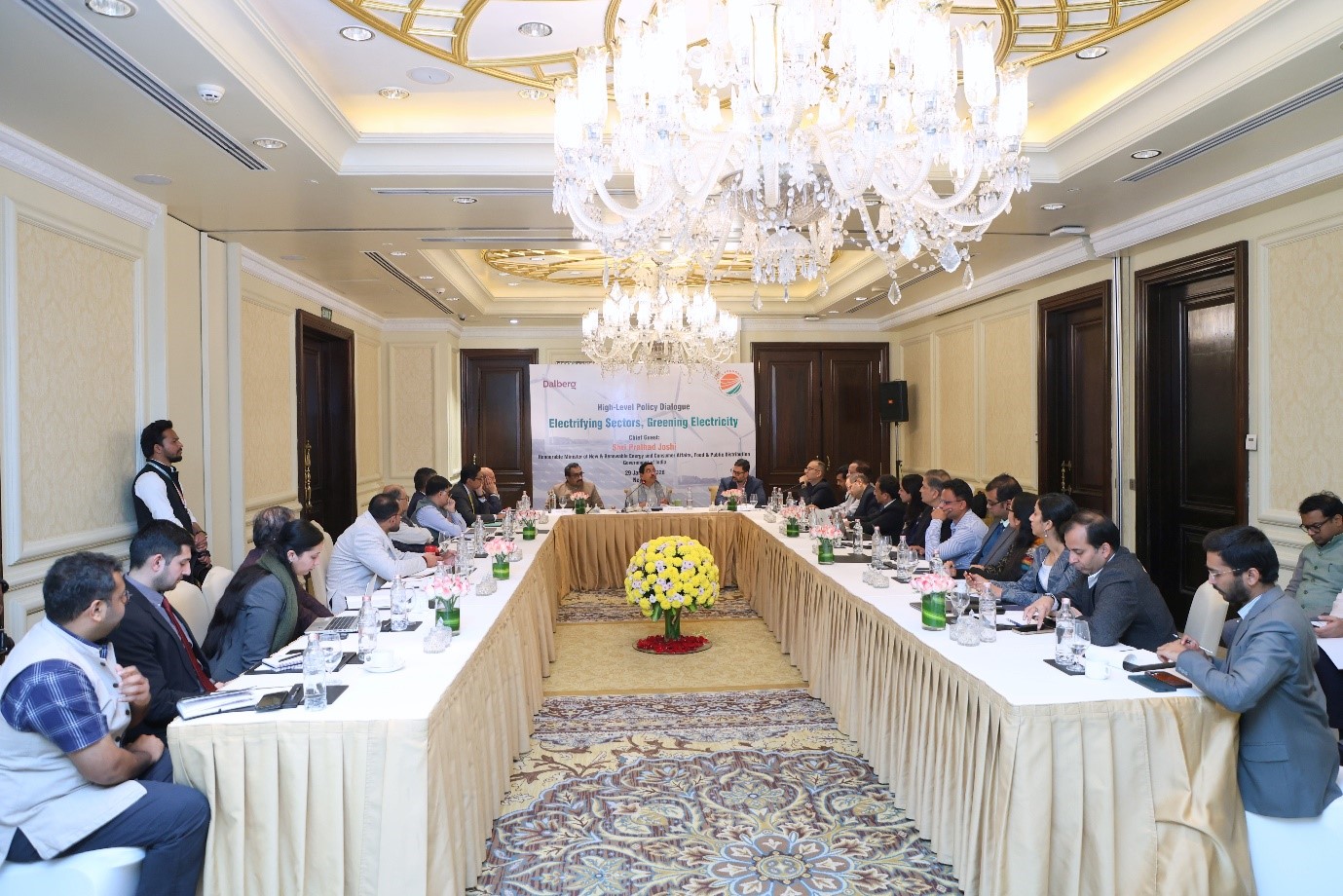
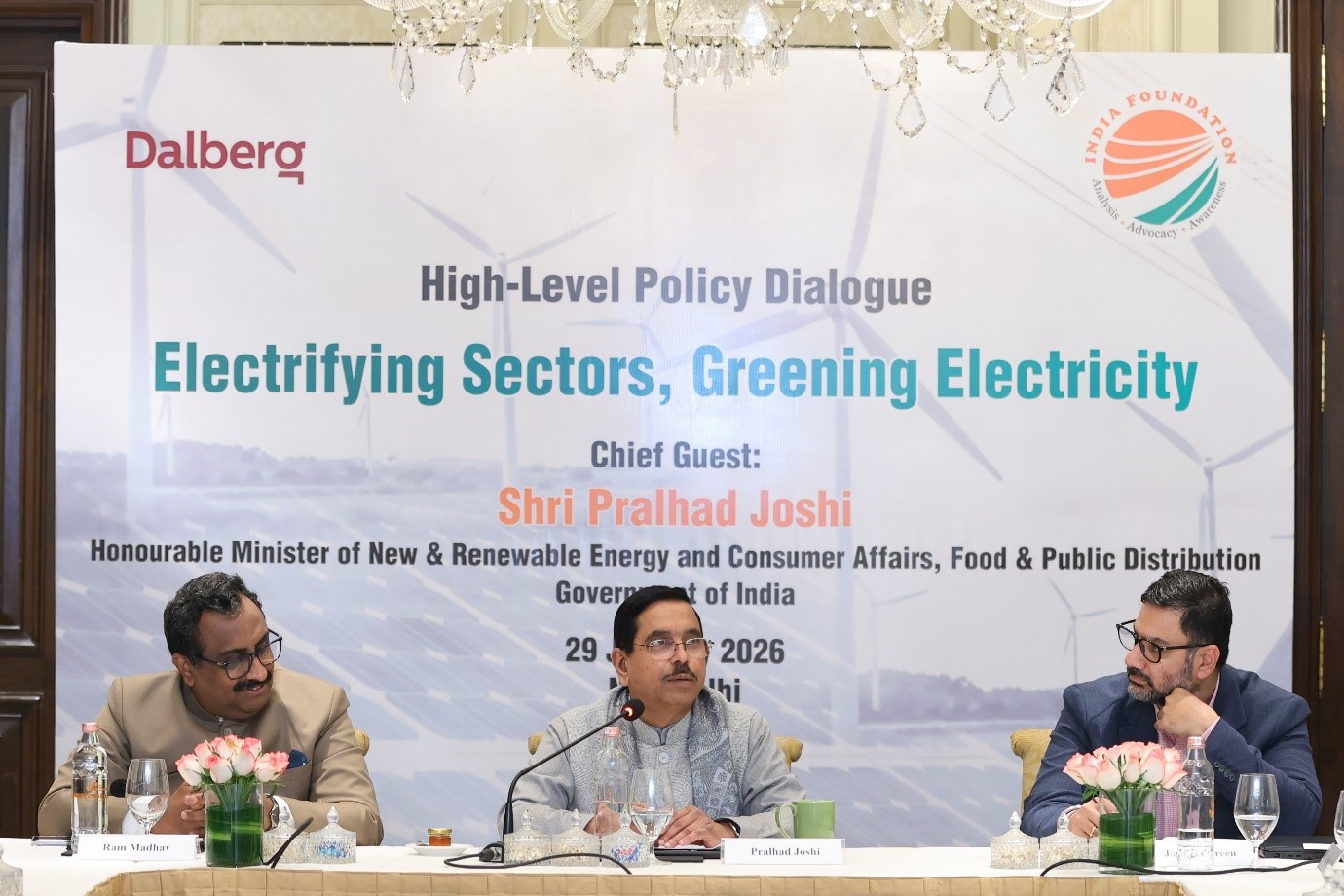
On January 29, 2026, India Foundation, in collaboration with Dalberg Advisors, hosted a “High-Level Policy Dialogue on Electrifying Sectors, Greening Electricity,” at the Leela Palace, New Delhi. Attended by over 30 representatives of industry, think tanks, and philanthropic foundations, the Policy Dialogue, underscored the need and pathways to the electrification of crucial sectors of the economy, and the combination of the goals of electrification with decarbonisation and India’s net-zero target. It featured the participation of Shri Pralhad Joshi, the Honourable Minister of New & Renewable Energy; and Consumer Affairs, Food & Public Distribution, Government of India, as the Chief Guest. Shri Ghanshyam Prasad, Chairperson, Central Electricity Authority, Government of India, joined the convening as the Guest of Honour.
The discussions commenced with outlining the goals envisaged by the Draft National Electricity Policy, 2026, viz. industrial competitiveness, affordability, and sustainability, while achieving expanded transmission networks, reliability, and increasing the reliance on renewable energy to 500 GW. The discussions underscored the distinction between states relying on hydrocarbons to fulfill their energy requirements, and states that have transitioned to electricity. While India retained the characteristics of a petro-state, it was suggested that the direction of policy to make it an electro-state is unmistakable, as revealed by its ambitious electrification agenda, encompassing terrestrial logistics, electric mobility, and the solarisation of agriculture production and processing.
Despite clear direction in policy towards electrification and decarbonisation, challenges abound. The policy thrust towards renewables has not translated into quicker decarbonisation and capacity generation of renewables, in stark contrast to the Chinese experience. Not only has the consumption of hydrocarbons increased; but shifting to renewable energy sources has not been accompanied by efficiencies and affordability. The micro-,small-, and medium-scale enterprises continue to rely on traditional sources of energy, and renewables have not tapped India’s rural economy. Although the exposure to climate assets has ballooned, transitions have increased the debt of the utility. Long approval windows and poor inter-state coordination have hampered electricity transmission and modernisation projects. The gap between the transmission and generation of electricity owes to the paucity of demand.
However, the discussants noted with optimism that India has been continuously outperforming on its energy transition targets. Optimising its vast solar potential, over 132 GW of installed capacity is being followed by 80 GW, which is currently in the pipeline. By 2030, India foresees an investment of USD 350 billion in the electrification of its sectors and energy transition. 5,00,000 sq/km oft transmission lines have already been set up, though the state transmission and reliability of discoms need to be improved. India has taken significant steps towards grid stabilisation and integration, allowing load-sharing. Investments worth INR 90,000 crores in green corridors will help achieve the concerns of a sustainable transition. The proliferation of data centres and electric mobility will push the demand for power near an 8-9% CAGR, which will inevitably impel robust and dynamic plans for achieving adequacy.
The event ended on a note of cautious optimism, emphasising that, at the current stage of development, stability of grids and achieving a balance between electrical and hydrocarbon-led energy is paramount. Dynamism in approach and implementation needs to be coupled with a more comprehensive participation of states in grid stabilisation and its sustainable transition. Building access, affordability, and adaptability, alongside boosting capabilities in grid storage and hydro-power potential will ensure a just, timely, and economically and environmentally sustainable transition.