
Introduction
As India assumes the BRICS chairmanship, the grouping stands at an inflection point. Since its inception, BRICS has evolved from a consultative platform among a small set of large emerging economies into a broader, more diverse grouping that now represents a substantial share of the global population, output, and development ambition. With this expansion has come a qualitative shift in expectations. For many countries of the Global South, BRICS is no longer viewed merely as a forum for dialogue but as a vehicle for advancing practical alternatives and reforms.
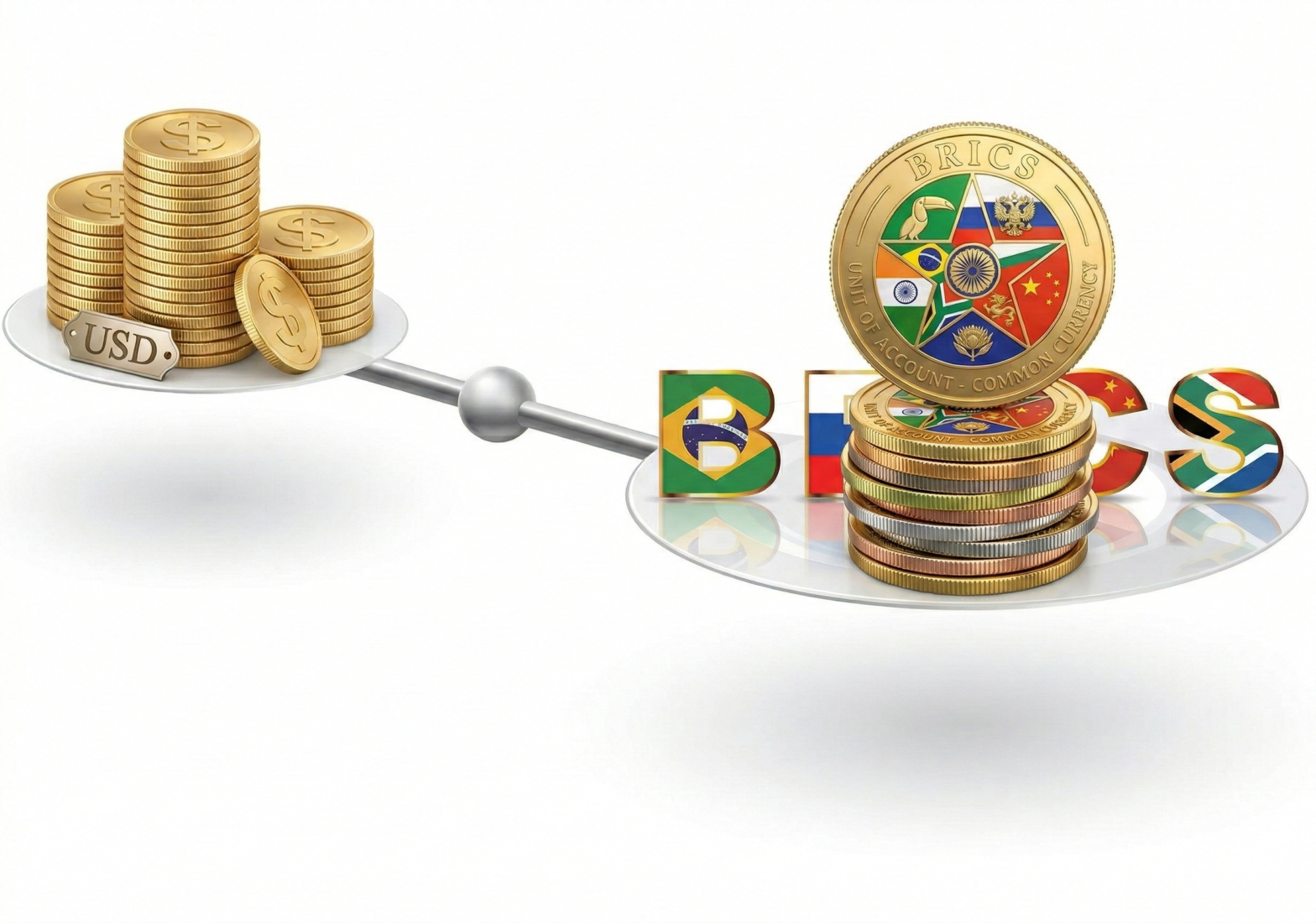
Few areas test these expectations more directly than the international monetary and financial system. For several decades, global trade, capital flows, and development finance have been anchored in a dollar-centric framework. This system has delivered undeniable benefits: deep liquidity, scale efficiencies, and a widely accepted medium of exchange. From a global stability perspective, it has underpinned the expansion of trade and investment across regions. At the same time, experience from emerging and developing economies points to persistent structural vulnerabilities. Exchange rate volatility, sudden reversals of capital flows, and exposure to external monetary tightening have repeatedly constrained macroeconomic management and development planning.
From an operational standpoint, such vulnerabilities translate into concrete development challenges. Currency depreciation raises debt-service costs, complicates infrastructure financing, and erodes fiscal space. Projects that are sound on economic grounds can become financially strained when local-currency revenue streams do not match hard-currency liabilities. These dynamics are well understood by development finance institutions. More recently, geopolitical developments have added a strategic dimension to these concerns. The growing use of financial instruments, payment systems, and access to liquidity as tools of statecraft has highlighted the risks inherent in highly concentrated monetary and settlement systems. For many economies, this has reinforced the case for diversification—not as a rejection of the existing system, but as prudent, forward-looking risk management.
It is in this context that the renewed BRICS focus on local-currency settlement should be understood: a pragmatic search for resilience that reduces friction, manages balance-sheet risk, and preserves policy space while remaining integrated into the global economy.
India’s forthcoming chairmanship, framed around “Building Resilience and Innovation for Cooperation and Sustainability,” offers an opportunity to anchor this debate in institutional realism. The challenge is not to displace the dollar or upend the global system, but to develop complementary mechanisms that better reflect the realities of a multipolar, development-driven global economy.
The Dollar-Centric International Monetary Order
Any serious discussion of alternatives must begin with recognition of why the dollar-centric system has endured. Its dominance stems from deep and liquid financial markets, robust legal and institutional frameworks, and powerful network effects built over decades. For global trade and finance, the dollar has provided scale, efficiency, and predictability that no other currency has yet matched.
From a global perspective, this system has delivered important public goods. Dollar liquidity has facilitated cross-border trade, enabled efficient capital allocation, and served as a reliable store of value during periods of crisis. In moments of global stress, the dollar’s safe-haven role has often stabilised markets, underscoring its continued centrality to the international monetary order.
Yet for emerging and developing economies, the operational consequences of this system are more complex. One of the most persistent challenges is currency mismatch. Revenues are typically earned in domestic currency, while borrowing for trade finance, infrastructure, and sovereign needs is often denominated in dollars. During periods of dollar appreciation, this mismatch can quickly translate into higher debt-service burdens, strained public finances, and heightened financial risk—even when underlying economic fundamentals remain sound.
Closely related is the global transmission of monetary policy. Tightening cycles in the United States routinely propagate across emerging markets through capital flows, exchange rates, and borrowing costs. These spillovers disrupt long-term investment planning and undermine countercyclical policy responses precisely when they are most needed.
In recent years, an additional layer of constraint has become more visible: the strategic use of financial infrastructure. Sanctions regimes, asset freezes, and restrictions on access to payment systems have highlighted the concentration of control within the global financial architecture. While such measures are targeted, their broader implication is to expose the fragility of a system with limited redundancy.
For BRICS economies, these realities underscore the importance of diversification. Reducing excessive reliance on a single currency—through greater use of local currencies in trade and settlement—offers a way to mitigate vulnerability while remaining fully engaged with global markets. The objective is to preserve the efficiencies of the existing system while introducing complementary mechanisms that enhance resilience.
BRICS Diversity and the Limits of Monetary Uniformity
One of BRICS’ defining characteristics is its diversity. The grouping brings together economies that differ markedly in size, structure, stages of development, and approaches to macroeconomic management. This diversity strengthens representativeness and legitimacy—but it limits the scope for uniform or centralised monetary cooperation. From an operational perspective, BRICS economies span a wide range of monetary and exchange rate regimes. China operates within a managed framework that balances external competitiveness and domestic stability. India follows a calibrated, market-responsive approach that combines exchange rate flexibility with macroprudential oversight. Brazil and South Africa maintain relatively open capital accounts with floating exchange rates, while Russia’s monetary framework has been reshaped by sanctions-related constraints and strategic reorientation. The inclusion of additional members further broadens this spectrum.
Experience across regions suggests that monetary arrangements succeed when institutional design aligns with economic structure and political reality. Monetary unions and tightly coordinated exchange rate regimes require deep fiscal integration, credible transfer mechanisms, and strong supranational institutions. Where these conditions are absent, such arrangements tend to amplify rather than mitigate stress. From this standpoint, a single BRICS currency or rigid exchange rate coordination would not only be impractical but also inconsistent with the grouping’s foundations.
BRICS is neither a treaty-based alliance nor a supranational entity. It operates through consensus, voluntary participation, and respect for strategic autonomy. Any attempt to impose a uniform monetary framework would risk eroding trust and undermining the flexibility that makes BRICS relevant. Local currency settlement fits more naturally within this institutional context. It enables deeper economic cooperation without surrendering monetary sovereignty or synchronising policy cycles. Participation can be bilateral or plurilateral, calibrated to trade patterns and financial readiness—enabling experimentation and gradual scaling.
Strategic Rationale for Local Currency Settlement: A Development Finance Perspective
From a development finance perspective, the strategic rationale for local currency settlement is both practical and well established. At its core, local currency settlement involves invoicing and settling cross-border trade and financial transactions in the trading partners’ domestic currencies, rather than through an intermediary reserve currency.
One immediate benefit is reduced transaction and hedging costs. When trade is invoiced in a third currency, firms face exchange rate movements unrelated to the underlying commercial transaction. Managing this risk requires hedging instruments that are often costly or unavailable, particularly for small and medium-sized enterprises. Local currency settlement aligns trade payments more closely with revenue streams, improving predictability and lowering barriers to participation in cross-border commerce.
A second advantage is reduced balance-sheet mismatch. For infrastructure projects and long-gestation investments, financing in hard currency while revenues are generated in local currency creates persistent vulnerability—often a recurring source of project distress and fiscal strain. Greater use of local currencies can better align liabilities with cash flows and improve financial sustainability.
Local currency settlement can also reduce the need for precautionary foreign exchange reserves. While reserves provide stability, they carry opportunity costs. Diversifying settlement currencies can ease these pressures, allowing resources to be deployed more productively. Strategically, local currency settlement enhances resilience by diversifying settlement channels and reducing exposure to external policy shocks. This is diversification, not disengagement: BRICS economies will continue to operate in dollar-based markets, but with greater optionality.
Existing BRICS Building Blocks: What Already Works
Discussions on local currency settlement within BRICS are sometimes framed as experimental. From an operational perspective, however, BRICS already has several functional building blocks—often developed in response to crisis rather than by design.
One such building block is bilateral currency swap arrangements among BRICS central banks. While often modest in size, they signal confidence and provide reassurance: even relatively small swap lines can stabilise expectations, support trade continuity, and reassure markets during periods of stress. Importantly, they reduce short-term reliance on third-country currencies without requiring permanent commitments or policy convergence.
The New Development Bank represents a more structural pillar. Unlike traditional multilateral development banks, the NDB has made local currency financing a stated objective. By issuing bonds in member currencies and extending local-currency loans, it seeks to align financing with revenue streams—central to the sustainability of infrastructure and urban development projects.
That said, local-currency lending remains limited relative to demand, reflecting familiar constraints: shallow domestic capital markets, higher funding costs, and limited hedging instruments. Expanding operations will require sustained market development, credit-enhancement mechanisms, and investor confidence. The NDB’s evolution should be guided by its ability to crowd in private capital, not by its potential to substitute for it.
A limited but instructive illustration is already evident in the NDB’s gradual expansion of local-currency lending and bond issuance in selected member markets. While still modest in scale, these operations have reduced foreign-exchange risk for borrowers and contributed to domestic market development, particularly in infrastructure-related sectors. Similarly, bilateral currency swap arrangements among BRICS central banks—though rarely drawn in full—have played a stabilising role during episodes of market stress by signalling liquidity support. These experiences suggest that incremental, well-designed mechanisms can deliver meaningful resilience even without large headline volumes.
A third building block is national payment system innovation. India’s Unified Payments Interface, Brazil’s PIX, and China’s Cross-Border Interbank Payment System illustrate how digital infrastructure can reduce transaction costs, accelerate settlement, and expand financial inclusion. These systems show that scale, reliability, and user trust can be achieved when governance is clear and incentives are aligned.
Yet these systems also reveal limitations: they remain largely national in scope and are not seamlessly interoperable. Private-sector uptake in cross-border trade remains uneven, reflecting concerns about liquidity, pricing transparency, and dispute resolution. Technology can enable reform, but it cannot substitute for institutional coordination and market depth. In short, BRICS does not lack instruments; it lacks integration.
A Pragmatic Roadmap: Build the Plumbing First
From an implementation perspective, local-currency settlement will succeed only if sequencing is disciplined. BRICS would benefit from prioritising the institutional and operational foundations of settlement over debates about a common currency.
First, trade invoicing must shift. Settlement systems cannot scale if contracts remain denominated in third currencies. Early pilots should focus on high-volume, predictable sectors—energy, commodities, fertilisers, and manufactured goods—where long-term contracts and established counterparties reduce uncertainty. Public financial institutions can catalyse adoption. Export–import banks, development finance institutions, and guarantee agencies can reduce first-mover hesitation by offering preferential financing, insurance, or partial credit guarantees for local-currency transactions. Once benchmarks and liquidity improve, market-driven adoption can follow.
Second, payment interoperability should be the organising principle. Attempts to create new, centralised platforms often falter over governance and adoption. A modular approach—linking national systems through common technical standards, messaging protocols, and settlement arrangements—preserves regulatory control while improving efficiency. Interoperability requires agreement on compliance standards, cybersecurity protocols, and dispute resolution. Pilot corridors—limited and evaluated—are more credible than blanket integration.
Third, risk management tools must deepen. Firms will not take on currency exposure unless hedging is accessible and affordable. Domestic bond markets, derivatives, and swap instruments are therefore not peripheral—they are foundational. This is often the binding constraint, particularly for small and medium-sized enterprises operating across borders. The NDB can help by issuing local-currency bonds, supporting liquidity, and partnering with domestic financial institutions to lower risk premiums. The aim should be to crowd in private capital, not displace it.
Fourth, volatility management must be built in. Exchange rate fluctuations are unavoidable, and stress episodes will test any system. Central bank coordination—through expanded swap lines, liquidity backstops, and structured dialogue—can improve preparedness without requiring policy convergence.
Finally, legal and regulatory frictions must be reduced. Full harmonisation is unnecessary. Mutual recognition, simplified documentation, and credible dispute resolution can significantly improve usability.
Digital Innovation and CBDCs
Digital innovation has transformed payment and settlement systems worldwide. Real-time platforms, digital public infrastructure, and distributed ledger technologies can reduce costs, accelerate settlement, and enhance transparency. However, cross-border use raises issues of data sovereignty, cybersecurity, compliance, and consumer protection.
National experience across the BRICS shows that technology succeeds when governance is clear, regulatory oversight is robust, and user trust is earned. India’s payments ecosystem illustrates how interoperability and scale can coexist with supervision. Brazil’s PIX highlight the role of regulatory clarity. China’s experience underscores both the potential and the complexity of linking domestic systems with cross-border settlement.
Central Bank Digital Currencies (CBDCs) represent a more advanced—and more sensitive—frontier. Several BRICS central banks are exploring CBDCs. From a prudential standpoint, the most relevant near-term use is wholesale and trade-related settlement between financial institutions, not retail substitution. CBDC interoperability raises complex questions—such as data sovereignty, cybersecurity, capital flows, and financial stability. Premature scaling can introduce systemic risks. As such, experimentation should be limited, supervised, and tied to defined use cases. CBDCs should complement existing banking systems, not displace them.
A structured BRICS dialogue on digital settlement could add value by focusing on governance, supervisory frameworks, and risk management. Small, time-bound pilots are the most sensible way forward.
India’s Stewardship in a Period of Transition
India’s BRICS chairmanship in 2026 coincides with heightened uncertainty in global trade and finance and rising demands from the Global South for greater voice. In this context, India’s role is less about sweeping proclamations and more about institutional stewardship. India brings economic scale, policy credibility, and diplomatic experience, along with a tradition of strategic autonomy and inclusive multilateralism. These attributes position India as a convenor—capable of bridging divergent interests and facilitating consensus without diluting sovereignty.
India’s most valuable contribution lies in shaping processes rather than prescribing outcomes. The diversity of BRICS makes uniform solutions neither feasible nor desirable. Progress is more likely when members are offered a menu of options—pilot corridors, modular frameworks, and voluntary participation—rather than a single blueprint. India can institutionalise this by prioritising technical working groups, phased schedules, and measurable pilots.
India’s domestic experience in digital public infrastructure and in managing macroeconomic stability in a large, open economy offers practical lessons for BRICS cooperation. Equally, India’s engagement with global financial institutions positions it as a bridge between BRICS initiatives and the wider system—essential for sustaining investor and partner confidence. Ultimately, India’s effectiveness as chair will be measured not by the breadth of declarations but by implementable outcomes.
Implications for Global Financial Governance: Evolution, Not Disruption
The gradual expansion of local-currency settlement within BRICS signals evolution rather than rupture. The post-war monetary system has delivered efficiency through centralisation, but it has also created concentration risks. Diversifying settlement channels introduces redundancy—a strength in a shock-prone world. For international financial institutions, this underscores the need to adapt. Local-currency settlement initiatives are consistent with country ownership and policy space—provided they are transparent and anchored in sound regulatory practice.
Coordination remains essential. Fragmentation from unaligned standards or opaque arrangements would undermine confidence and increase systemic risk. Successful diversification requires clear rules, robust supervision, and dialogue between regional initiatives and global institutions. For many developing economies beyond BRICS, the credibility of global financial reform increasingly hinges on whether large emerging economies can translate their voice into workable institutional alternatives. In this sense, BRICS local currency settlement efforts will be closely watched not as a model to be replicated wholesale, but as a signal of whether diversification can be pursued responsibly within an open global system.
A more pluralistic monetary system could reduce procyclicality in capital flows and improve alignment between financing and development needs. But these benefits will materialise only if reforms are incremental, well sequenced, and institutionally grounded.
Policy Recommendations: Focus the Agenda
Drawing on operational experience, a small number of priorities stand out: First, advance local-currency settlement through phased, voluntary pilots—not mandates. Focus on high-readiness corridors where volumes are significant and counterparties are established. Demonstrated gains will build adoption faster than communiqués.
Second, prioritise trade settlement over premature monetary integration. Expanding local-currency invoicing for intra-BRICS trade delivers measurable gains without requiring convergence of exchange-rate or monetary frameworks. Currency headlines can wait; settlement usability cannot.
Third, make interoperability of existing payment systems the organising principle. Link national platforms through common technical standards, cybersecurity protocols, and governance arrangements—preserving sovereignty while improving efficiency.
Fourth, strengthen and clarify the NDB’s catalytic role. Expand local-currency lending, bond issuance, and credit enhancement to deepen domestic markets and crowd in private capital.
Fifth, focus central bank coordination on preparedness, not on convergence: swap lines, liquidity backstops, and structured dialogue to manage stress episodes.
Finally, proceed cautiously with digital and CBDC cooperation. Begin with wholesale and trade settlement pilots, with robust safeguards for data sovereignty, cybersecurity, and financial stability. Governance must precede scaling. Across all areas, strategic communication should be consistent: local currency settlement enhances resilience and supports stability.
From Aspiration to Architecture
The renewed focus on local-currency settlement within BRICS reflects a measured response to a transforming global economy. It is not an attempt to dismantle the current system; the dollar will remain central for the foreseeable future. However, excessive concentration creates vulnerability, and carefully designed diversification can strengthen stability. For BRICS, the challenge is to move from aspiration to architecture. Diversity requires flexibility, incrementalism, and trust. Progress will depend less on headline announcements than on usability, market confidence, and disciplined sequencing. What matters most is durability.
India’s 2026 BRICS chairmanship offers a timely opportunity to translate intent into practical outcomes. By emphasising pilots, institutional coordination, and inclusive leadership, India can help BRICS contribute constructively to the evolution of global financial governance.
Ultimately, BRICS local-currency settlement initiatives will be judged by whether they reduce risk, lower costs, and expand opportunities for the economies and people they are intended to serve. That is the standard by which any durable financial architecture should be measured.
Author Brief Bio: Shri Manmohan Parkash is a development finance professional with over two decades of experience at the Asian Development Bank (ADB), where he has held senior leadership positions including Senior Advisor, Office of the President, Deputy Director General for South Asia, Country Director, Head of the Operations Management Unit, and Advisor for East Asia. His work has focused on macroeconomic policy, development finance, regional cooperation, and institutional reform across Asia and the Global South. He writes on international finance, global governance, and development challenges, and continues to engage on issues relating to financial resilience, multilateral reform, and sustainable development.
References
- Parkash, Manmohan. “It Is Time for the Global South.” The Financial Express, 18 July 2025.
- Eichengreen, Barry. Globalizing Capital: A History of the International Monetary System. Princeton University Press, 2019.
- Rey, Hélène. “International Channels of Transmission of Monetary Policy.” IMF Economic Review, 2016.
- Farrell, Henry and Abraham Newman. “Weaponized Interdependence: How Global Economic Networks Shape State Coercion.” International Security, 2019.
- De Grauwe, Paul. Economics of Monetary Union. Oxford University Press, 2020.
- Jeanne, Olivier and Romain Rancière. The Optimal Level of International Reserves. IMF Working Paper, 2011.
- New Development Bank. General Strategy 2022–2026. Shanghai, 2022.
- BIS Innovation Hub. Fast Payments and Cross-Border Interlinkages. Bank for International Settlements, 2022.
- Parkash, Manmohan. “CBDCs and Stablecoins: Set to Redefine the Financial System.” The Financial Express, 20 December 2025.