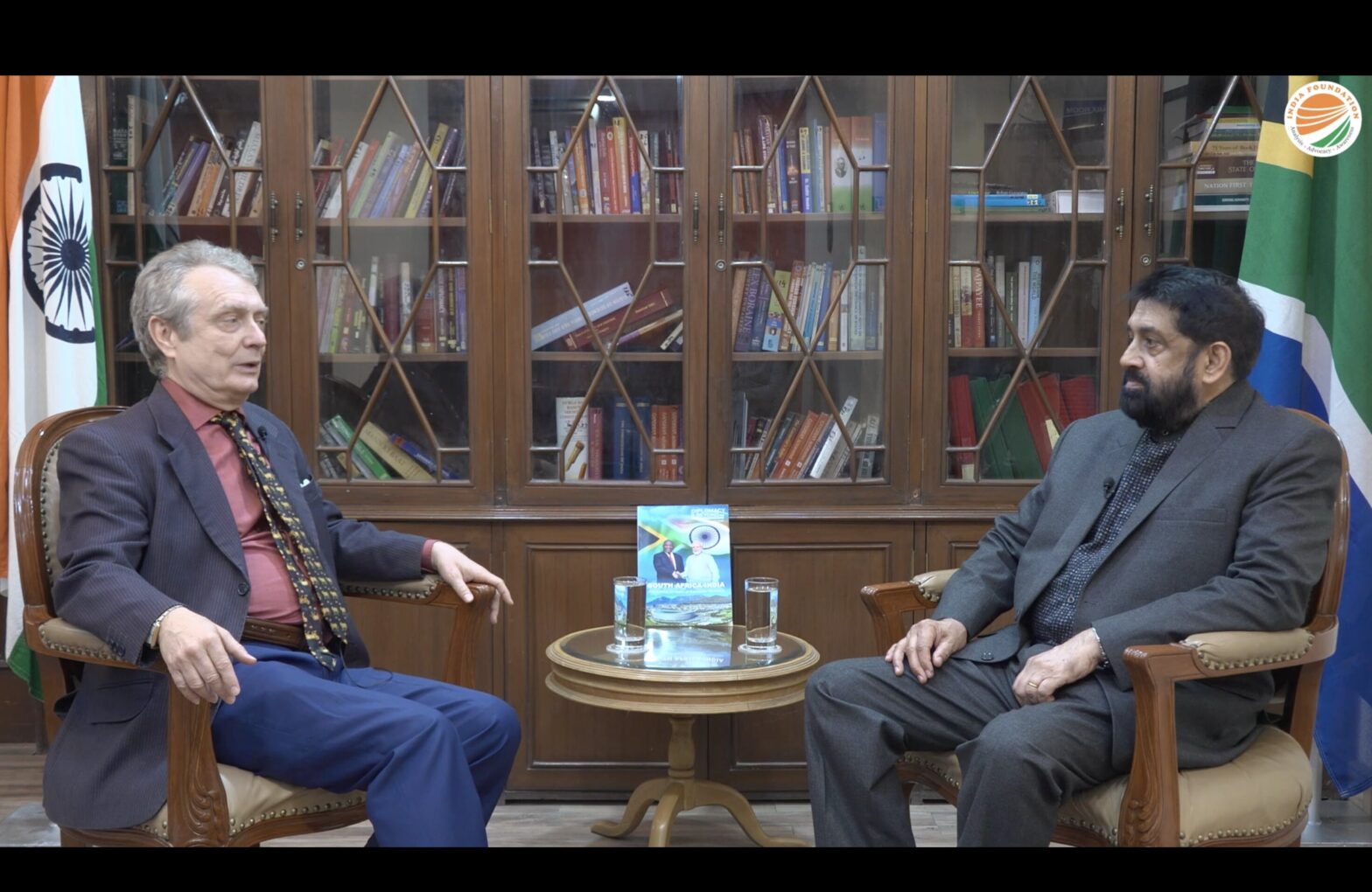
Mr. Come Carpentier:
Excellency, given your long experience in both Indian and South African diplomacy, what do you consider the major achievement that India could aim to achieve during this year of its presidency?
H.E. Prof Anil Sooklal:
India, as a founding member of BRICS, has a very important mandate this year. This is the fourth time India has hosted the BRICS Summit. They did so for the first time in 2012, and I was very privileged to be part of that meeting. India’s present chairship of BRICS in 2026 is at a very challenging time in the global context, not only in terms of the global trade architecture, which has been hit by the tariff episode, but also in terms of global geopolitics and a very fractured world. The world is looking for leadership, and, in many senses, that leadership is coming from the Global South, and more specifically from the BRICS. This is the 20th anniversary of the BRICS’ first meeting at the level of foreign ministers on the margins of the UNGA in New York in 2006, as an informal group, and it has since evolved into a summit-level meeting. Today, I think BRICS is widely respected and recognised as perhaps the most powerful formation from the Global South, championing not only issues of the Global South, although that has been the primary focus when we came together as a BRICS family, but also issues of global concern across the whole spectrum, from geopolitical security and the economic and financial situation to sustainability and people-to-people cooperation. Given the paralysis we face on the global multilateral front, this will be a major focus of India’s chairship this year.
How do we preserve the multilateral architecture, a rules-based system grounded in international law and underpinned by the UN Charter and its purposes and principles? All of which have been marginalised and eroded by the very founders of this international system, which sought to establish a rules-based global order. Yet today, many describe us as living in a period of global disorder.
India has wisely chosen a theme that plays on the BRICS acronym: Building for Resilience, Innovation, Cooperation, and Sustainability. All these are critical issues that also show continuity in the focus we have had since the outset amongst BRICS countries. India will build on what we have achieved under past presidencies. Of course, BRICS, as you know, is based on three pillars of cooperation: political and security, economic and financial, and social and people-to-people. And under each of these themes, India has elaborated specifically what it will take forward.
But I think, as I have indicated, how do we preserve an international system underpinned by international law in an architecture that is in dire need of reform? We cannot continue with the current global multilateral architecture, as even Secretary-General Guterres has indicated that the United Nations Security Council is no longer fit for purpose. It is now more than 80 years old and has become obsolete and archaic. It needs serious reform. And just recently, one of the leaders from the Global North questioned how it is possible today that India, a country with the largest global population, the fourth-largest global economy, and a major player on the international scene, is not yet a member of the Security Council? And I think this is something that we have been calling for, the reform of the United Nations system, and especially the Security Council. And I think we have seen in the recent past that the Security Council is totally paralysed. Global peace and security, which is a mandate of the Security Council, is no longer being addressed. Countries are not respecting this. They are embarking on unilateral actions, including military, financial, and economic measures, without any respect for the very institutions we all came together to create after the Second World War. So, we have rendered these institutions almost obsolete. But more importantly, unfortunately, they are our institutions. We created them. And we are now responsible for rendering them, as you have indicated, obsolete and dysfunctional. And that’s a great pity. And this is some of the issues that India, as we expect, and as they have said, will address in a very focused way.
In this era of the weaponisation of tariffs and trade, there is an increased need for us, as countries of the global South, to deepen trade amongst ourselves. India has entered into a range of free trade agreements. Most recently, we witnessed the signing of the FTA with the European Union. President of the European Union, Ursula von der Leyen, referred to it as the mother of all free trade agreements. It brings together over 2 billion people, creating a massive market. More recently, we have seen even the USA agree a framework agreement with India, and they are also working on an FTA with our region, the South African Customs Union. So we are hopeful that during the course of this year, we will be able to finalise that agreement as well. I think this is the Global South showing leadership, and India is at the centre of that. Despite all of these threats to our economies, including high tariffs, closed markets, and a move towards an introverted trade space, we have not seen this as a deterrent. We have seen it as a major opportunity. And this is what BRICS has to address comprehensively.
As you have noticed, at the 2023 summit we tasked our finance ministers with exploring the creation of a common payment system and a payment platform for BRICS countries. We also indicated that we need to deepen trading in our own currencies. That’s happening at an extended level, well beyond BRICS. Prime Minister Modi was in Malaysia this weekend. They are going to adopt the UPI system. Many countries are doing so. China has created its own platform. India, Brazil, of course, us in South Africa, and Russia as well. Because we can’t be held hostage to payment systems and payment platforms, and to a global financial system dominated by a few. And then, in times of difficulty, to unilateral sanctions that freeze our funds.
Many are saying that BRICS is responsible for de-dollarisation. That’s not the case. BRICS doesn’t have de-dollarisation as an agenda item. What it does have, and has had as a very important agenda item, including this year, is how to deepen trading in our local currencies and how to deepen the creation of payment platforms so we don’t have to depend on Western-created systems. I think this is happening at an accelerated pace. We want greater autonomy and independence, and we want the space to make choices that are, first and foremost, in the best interest of our countries, our region, and the global South. This space has been dominated for too long by certain countries and certain multinational financial houses.
I was very pleased to see that India is now going to launch its own fleet of cargo ships, not just depend on the Global North for our trade. These are all very positive developments that will be taken forward under India’s presidency. But I think the New Development Bank is doing very well, and we need to deepen its imprint.
The new members who have joined need to be taken on board as full members, and we need to deepen the loan book with them as well, because the NDB has shown that it’s possible for us to create our own financial institutions and manage them positively. So, I think you’ll also see a focus on that front. Then, of course, the environment, green energy, and the energy portfolio are critical to BRICS cooperation. Issues of disaster risk resilience, which India has brought to the table, will receive increasing attention, and how we can cooperate on the environment will also be a focus.
I think that is also a very critical issue. I think BRICS has an important role to play. When we speak of energy, we always talk about the energy transition, but we’re not seeing it in reality. So I think we will focus on that. But also, I think India will play an important role in sharing experience in digital technologies. I mean, digital public infrastructure has transformed Indian society, and we are very keen to see how we can work with India to learn from India and also provide assistance in the technology space. India is hosting the AI summit next week. That’s a major global development. We need to ensure that countries of the global south, developing countries, are the beneficiaries of developments in the AI space, and that we are not marginalised.
Mr. Come Carpentier:
India has recently concluded an FTA with the European Union and has an interim agreement with the United States. Are you concerned that such FTAs with countries that do not belong to the BRICS could, in some way, hamper or at least confuse the overall direction that the BRICS has taken? For example, very clearly, the US under President Trump has certain requirements, including the purchase of a certain amount of goods and services from the United States, which, I believe, amounts to 500 billion in five years. And while tariffs have been lowered, higher tariffs can be reinstated at any time if the US believes that India is not abiding by its demands, for example, regarding energy purchases. Do you think that this could make BRICS coordination more difficult?
H.E. Prof Anil Sooklal:
One of the strengths of the BRICS member states is the bloc’s collective power. It not only strengthens the bloc but also each of us. You would have seen this in the case of India, where, despite the imposition of 50 per cent tariffs, there were threats of 100 per cent tariffs and of stopping the purchase of Russian oil. In South Africa, we faced 50 per cent tariffs, as did many others. So did Brazil. But none of the BRICS countries buckled under this pressure. I think the days are gone when one power can dictate how we conduct our domestic affairs, who we trade with, who we buy from, and who we interact with. You have seen the resilience of BRICS countries. This pressure tactic no longer works. All it has done is reinforce the cohesion of a bloc like BRICS, and it has prompted us to expedite the deepening of our interactions at all levels.
I am not concerned that, despite our signing free trade agreements with any party, they may renege on those provisions and impose new tariffs and provisions. I think we are past that period. And the size of the economy: you would have seen just last week, in statistics we received from the IMF, that in 2026, almost 50 per cent of global GDP growth is being generated from this region. China: almost 27 per cent; India: 17 per cent; and Indonesia: 3.8 per cent. Just these three countries generate almost 50 per cent of global GDP growth. USA 9.9 per cent. Put this in perspective. European Union, about 7.5 per cent. Now, the pendulum has shifted from the global north to the global south. And this is what is keeping the global economy buoyant in a very challenging time. It is countries like us from the global south, including BRICS countries, that are powering the global economy in very difficult circumstances. So, a country that is responsible for under 10 percent of global GDP growth can no longer call the shots and determine what’s in the best interest of all of us.
As I have said, the weightage has shifted dramatically, and BRICS is at the centre of that. So, I think BRICS is in a good position. But as I indicated at the outset, India has assumed the chair at a very challenging time. India will have to show leadership as chair of BRICS, and collectively we have to show leadership as BRICS. Now, if you look at recent summit declarations, when we speak of the global system, we already speak of a multipolar world. We don’t say we are coming into a multipolar world. If you look at past BRICS summit declarations, the past two or three, we already indicate that we are living in a multipolar world. And that’s a major statement.
Regarding the agreements being signed with countries from the global north, we also have an FTA with the EU. And we have FTAs with countries from both the north and the south. I think the unique identity of BRICS is that, even though we are a formation of the global south and champion issues of core concern to us, we have always been inclusive. It’s never been an exclusive entity. The G7 is over 50 years old, formed in 1975. But it’s a closed shop.
For a short period, they brought in Russia and then pushed it out, but it’s a closed shop. Interestingly, I think President Macron has given the best answer to this dynamic. Last month, at an annual meeting with all the French ambassadors in Paris, he made a very interesting statement. He said, “Look, this year France chairs the G7, and India chairs BRICS.” He said we must ensure that the G7 doesn’t become anti-BRICS and that the BRICS doesn’t become anti-G7. He added that we would like to work closely with India during its tenure as chair of BRICS.
Now, I think this is a very positive development. BRICS has already been examining how we cooperate with our partners globally, not just in the Global South, but also in the Global North. I think this is one of the unique opportunities India has under its chairship. Besides France, the Prime Minister of Finland has made very positive statements about India playing a bridging role between the North and the South. Chancellor Merz, when he was here, said the same thing. I think this is partly due to the fractures in the transatlantic alliance. Even partners from the Global North, particularly in Europe, are looking for trusted partners from the Global South with whom they can work. And India, South Africa and Brazil come to mind immediately. For those from the Global North who want to engage with the BRICS, I think we must be open to that.
South Africa’s experience has shown that dialogue fosters common understanding. But when we stop talking to each other, we misunderstand each other. And then we see all kinds of permutations, such as that BRICS is a bloc that’s anti-West. Or BRICS is a bloc that’s anti-G7. Or BRICS is about de-dollarisation. These are all false narratives. This is not what BRICS is about. BRICS wants to create a more inclusive, just world underpinned by international law, where we truly leave no one behind. And I think this is what this unique moment is: India’s opportunity to chair BRICS in a very fractured world, to create bridges between the North and the South.
Mr. Come Carpentier:
At one point, President Macron suggested that France would like to join the BRICS. There have been policy papers by scholars on the possibility of establishing a special relationship between the European Union and the BRICS. In this regard, I would like to draw your attention to two points. The first is the trade instruments. President Trump has expressed strong opposition to the BRICS unit and, by extension, to India’s proposal and the project to link the central bank digital currencies of all BRICS members and other countries. Such an alternative system will definitely undermine the role of SWIFT and the dollar. The US will not take this lying down, because much of its prosperity depends on its role as the world’s reserve currency and, essentially, on its control over the use of the dollar. The European Union has its own interest in the euro. How do you see the BRICS confronting this, given the many different agendas among those countries?
The second point pertains to artificial intelligence. In AI, as in other fields, China is now either catching up with the US or overtaking it, and its technology could be the driving force in the coming years. China would thus increase its economic preponderance within BRICS and globally. The US has proposed a G2, which China has officially rejected, saying it does not want to be a new club of two superpowers, leaving the rest behind. How do you see BRICS facing this? Also, how would you react to the naval exercise off the coast of South Africa involving Russia, Iran, China, and South Africa? This in itself seems to orient BRICS towards the use of military force to stop certain unacceptable abuses of power.
H.E. Prof Anil Sooklal:
I would say the BRICS is a balancing force at the moment. I also think it’s important to recognise that in this multi-layered global environment, we live in an age of what some scholars have described as multi-alignment. There’s no contradiction in this. India is a member of the Quad, BRICS, and SCO. And I think this is the reality. We are going through a phase where you’ll find alliances that weren’t there before. But every country also has to take into account its national interest as it forms relationships within the region and globally. And sometimes these may seem contradictory, but in the larger picture, they are not.
In 2023, when South Africa was the BRICS chair, I was asked how we manage the five very diverse countries and how we get along as BRICS countries. I said it’s far easier than in the G20, where BRICS, the G7, and even the monarchy are part of it. In the G20, we have governance systems you don’t agree with, and they’re so diverse, but we still get on and achieve positive outcomes from G20 summits. So, in BRICS, it does not matter what type of alliance we have amongst the five of us. Now, the initiative India is taking is part of what I have said about us having greater financial choices and independence. So linking digital currencies, as India has suggested, is a natural evolution of what we’re trying to do in the financial space, like deepening trade in local currencies and creating our own payment platforms. It is important to remember that, at one point, the US accounted for over 50% of global trade. Today, that figure has fallen dramatically, under 20%. Yet, some 50% of trade is conducted in one currency, a currency that dominates the global economic space, the country.
Secondly, see what is happening with the IMF reserve basket. You have to create space for other currencies. It can’t be dominated by a few, and you’re seeing that evolution, such as the return to gold as the preferred foreign holding. Also, if you look at history, where was the dollar before the end of World War II? At that time, the pound was the most dominant global currency, but its history now. With the emergence of other major economies, reliance on the US dollar will decline. At some point, China and India will become economies equal to, or maybe even bigger than, the USA’s. So, we cannot marginalise these countries and their financial systems. It’s a natural growth. We all still deal in dollars, but there has to be space for all of us to coexist. And this is what BRICS is speaking about. The coexistence within the political space, within the security space, within the economic space and the financial space. Trying to contain the rise of countries won’t work. It’s going to fail. So, I think we need to accommodate each other.
This is what BRICS is about. It’s about how we accommodate each other, coexist, and ensure that all of us benefit from the larger economic space, the larger global security space, and the global governance architecture, so that it can’t be one or two that determine what’s in our best interest. And I think you are seeing increasingly, as I have said, that countries and leaders from the Global North are recognising this. Secretary General Guterres, when he spoke at the BRICS Summit in Johannesburg in 2023, said the Global North must learn to live with the Global South and accommodate them as they rise. So I think that selfish and hegemonic mentality is something of the past. Clinging to it is not going to take us into the future.
Mr. Come Carpentier:
There are currently three African countries that are members of BRICS, and several others are waiting to join. Now, given that organisations should not expand too quickly because they may lose cohesiveness and even the ability to communicate effectively, do you think there could be an actual agreement between the African Union (AU) and the BRICS, as India included the AU in the G20? Should India use its year of chairship to make the AU a full member of BRICS?
H.E. Prof Anil Sooklal:
Well, on the three occasions that we chaired BRICS, 2013, 18 and 23, we invited all the regional economic communities, the presiding country presidents, plus the AU commission chairperson and the AU presidency to all these summits. So the precedent is there. They have been part of past summits, and I am sure India will also have an Africa focus.
India is also hosting the India-Africa Forum Summit at the end of May this year. So Africa has always been a focal point of India’s foreign engagement, and I am sure even this year you will have that continuity. South Africa and the other member states like Egypt and Ethiopia, would like to see greater engagement between BRICS and the African continent, and I think that’s also something that will happen.
Mr. Come Carpentier:
We all do hope so. It’s a fascinating conversation, and I wish to thank you very much for your very detailed and scholarly responses. In terms of currency, trade, and high technology, the leadership is coming to the BRICS grouping. Therefore, given India’s initiatives, China’s open-source technologies, and Russia’s development of alternatives, I think the time for BRICS has come. Thank you for capturing it so well. It’s a moment that BRICS must seize, and I think India will provide that leadership this year.
H.E. Prof Anil Sooklal:
Thank you for having me.
Brief Bios:
- E. Prof Anil Sooklal is the High Commissioner of the Republic of South Africa to India. Additionally, he is the non-resident High Commissioner of South Africa to Bangladesh and Nepal.
- Come Carpentier has been, since 2003, the convener of the International Editorial Board of World Affairs – The Journal of International Issues. He has travelled and lectured in more than fifty countries. in universities and institutions of Europe, the Americas and Asia. He has written and co-authored several books and more than 200 articles and essays on subjects related to philosophy of science, geopolitics, international relations and the history of civilisations in more than thirty journals, newspapers and magazines in France, India, Italy, the USA, Russia and Switzerland. He was associated for many years with the World Public Forum Dialogue of Civilisations as a member of the founding association and a regular guest and speaker on that platform. He is a member of the Advisory Sub-Committee of the Paris-Berlin-Moscou Committee and an advisor to the International League of Phoenician, Chananean and Punic Cities (Lebanon). He has been a consultant to various American and European high-tech corporations and was between 1992 and 1999 the Secretary of the Tissot Economic Foundation (Switzerland).