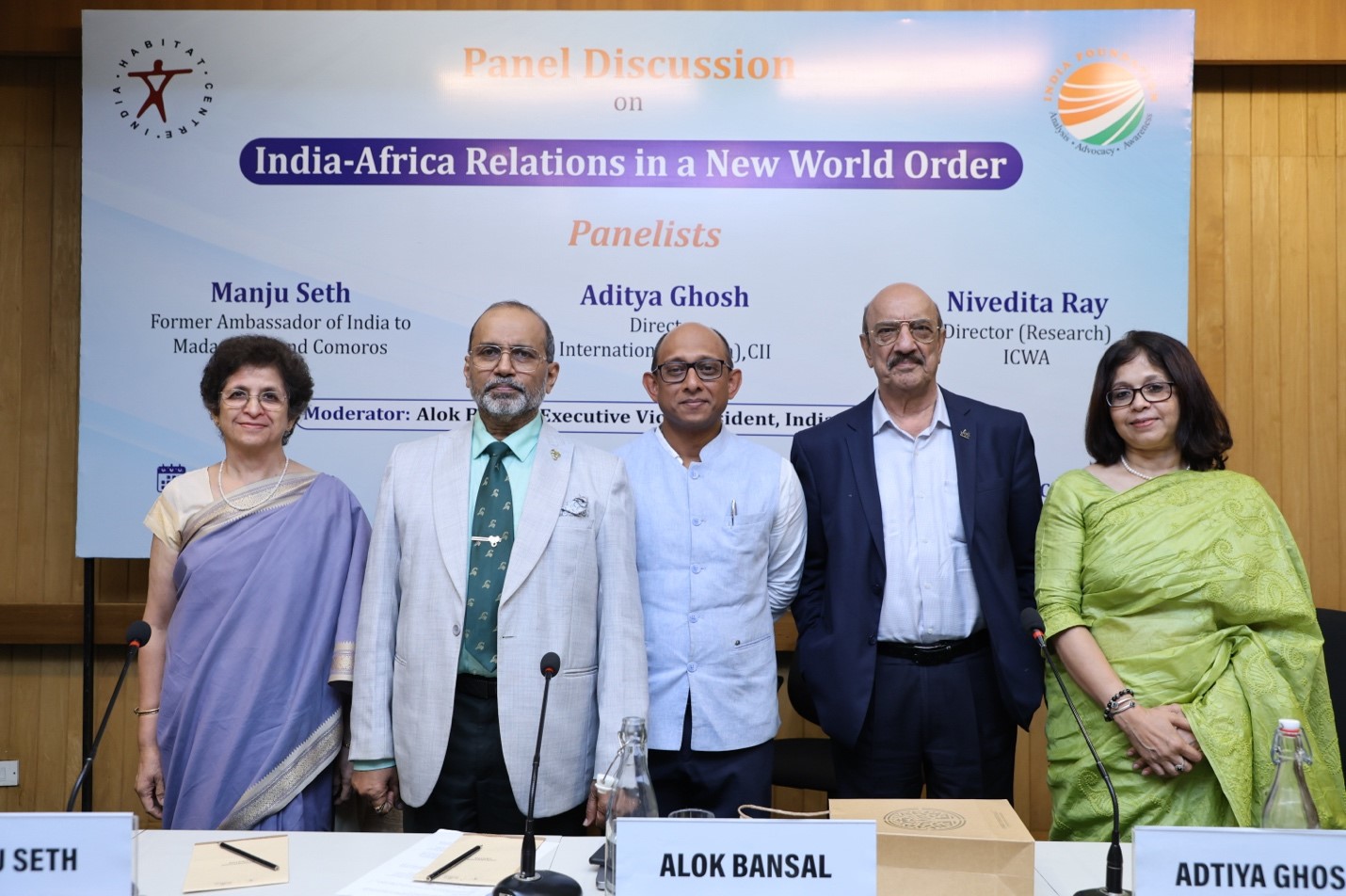
India Foundation, in collaboration with India Habitat Centre, organised a panel discussion on ‘India–Africa Relations in the New World Order’ on 24 June 2026 at India Habitat Centre, New Delhi. The panel featured Ambassador Manju Seth, Former Ambassador of India to Madagascar and Comoros; Shri Aditya Ghosh, Director International Africa, Confederation of Indian Industry (CII); and Dr Nivedita Ray, Director Research, Indian Council of World Affairs (ICWA). The session was moderated by Capt. Alok Bansal, Executive Vice President, India Foundation.
The panel discussed where India–Africa relations were fit in the current global order, with a clear preference expressed for a multipolar world in which Africa can emerge as an independent pole. India’s long engagement with the continent, built on anti-colonial solidarity, South–South cooperation, and capacity building, was contrasted with the extractive approach of colonial powers. The panel felt that India needs to move faster and be more flexible in working with Africa, making better use of what it has to offer – Digital Public Infrastructure, such as UPI and Digi Locker, affordable medicines, and support for small and medium enterprises. It was also pointed out that Africa is a continent of 54 countries, each with its own needs, and that a one-size-fits-all approach will not work. The panel called for the long-pending India–Africa Summit to be held without further delay.
The discussion also looked at how India–Africa economic ties have grown from a relationship based on goodwill into a proper strategic and economic partnership covering trade, technology, infrastructure, energy, and supply chains. The panel noted that Africa is becoming one of the world’s most important future consumer markets and also holds large reserves of critical minerals like lithium, cobalt, copper, and rare earths that are vital for clean energy and technology. There was a call for more work on digital payments, trade in Indian rupees, and building infrastructure, as well as interest in bringing in partners like Japan and European countries for joint projects.
The panel also raised the need for stronger people-to-people ties, which remains a weak link in the relationship. Areas like cinema, digital content, textiles, and gems and jewellery were suggested as practical ways to build cooperation through the creative economy, drawing on small businesses and individual enterprise rather than large government-driven projects. Defence diplomacy was also brought up as an area with growing potential, with the panel noting that India can deepen its ties with African nations through training, joint exercises, and defence equipment, building trust alongside its economic engagement. Concerns were expressed about the experiences of African students in India, and there was a strong call for the Ministry of External Affairs to play a more active role in supporting them through better orientation, cultural exchange programmes, and mechanisms to address discrimination. The session ended with the view that India’s engagement with Africa must be based on respect, fair partnership, and helping build local capacity, not on taking resources out, and that this is what sets India apart and should guide the relationship going forward.