
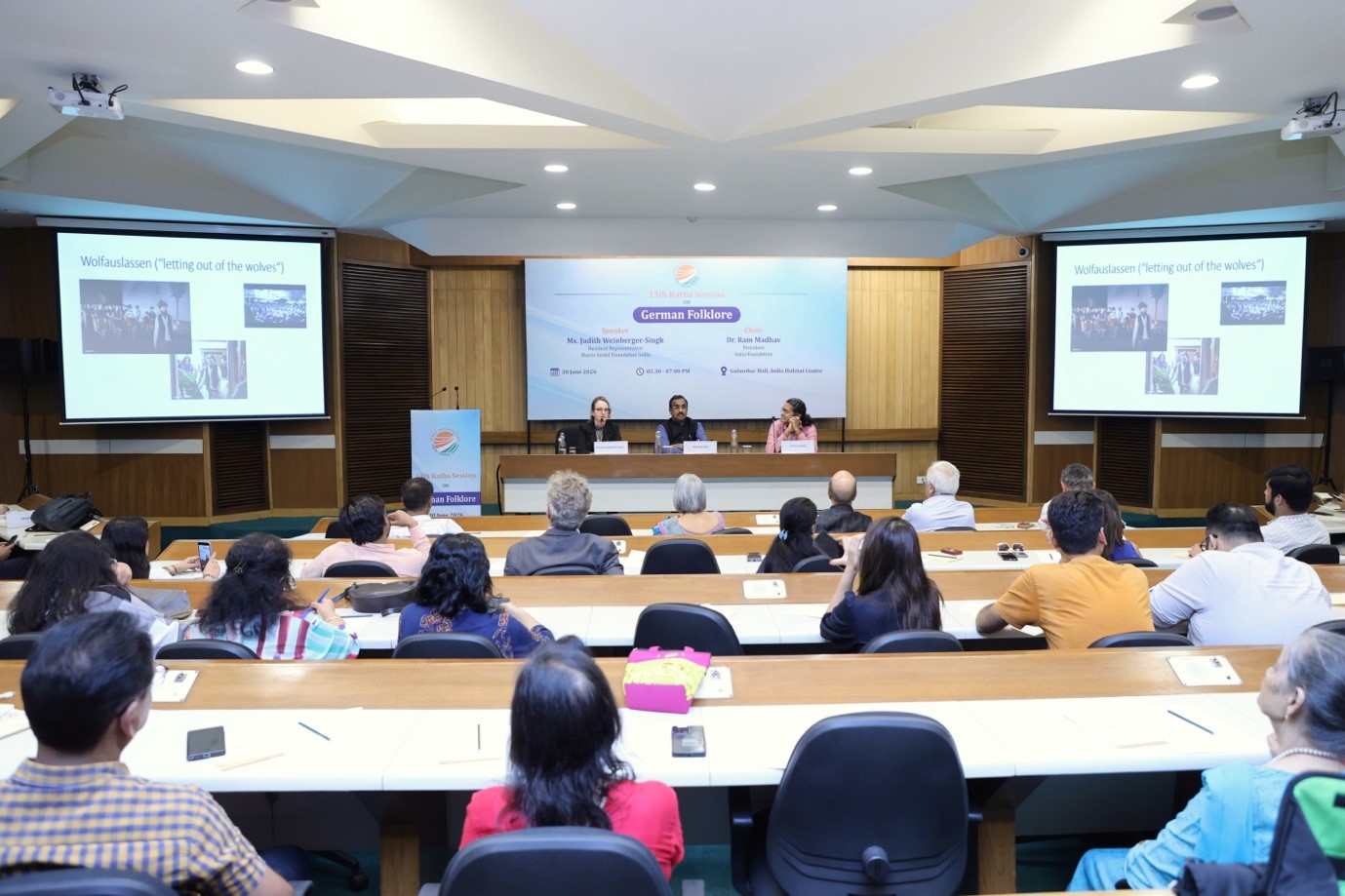
India Foundation organised the 13th edition of Katha, its storytelling session series, on the theme ‘German Folklore, Fairy Tales, and Living Traditions’, at Gulmohar Hall, India Habitat Centre, New Delhi, on 30 June 2026. The session featured Ms. Judith Weinberger-Singh, Resident Representative, Hanns Seidel Foundation India, as the lead storyteller speaker. It was chaired by Dr. Ram Madhav, President, India Foundation, and moderated by Mr. Apurv Mishra, Consultant, Economic Advisory Council to the Prime Minister. Now grown well beyond its original circle of regular attendees, the gathering retained the informal character of a club rather than a seminar, with listeners invited to sketch the tales they heard as an active part of the storytelling tradition.
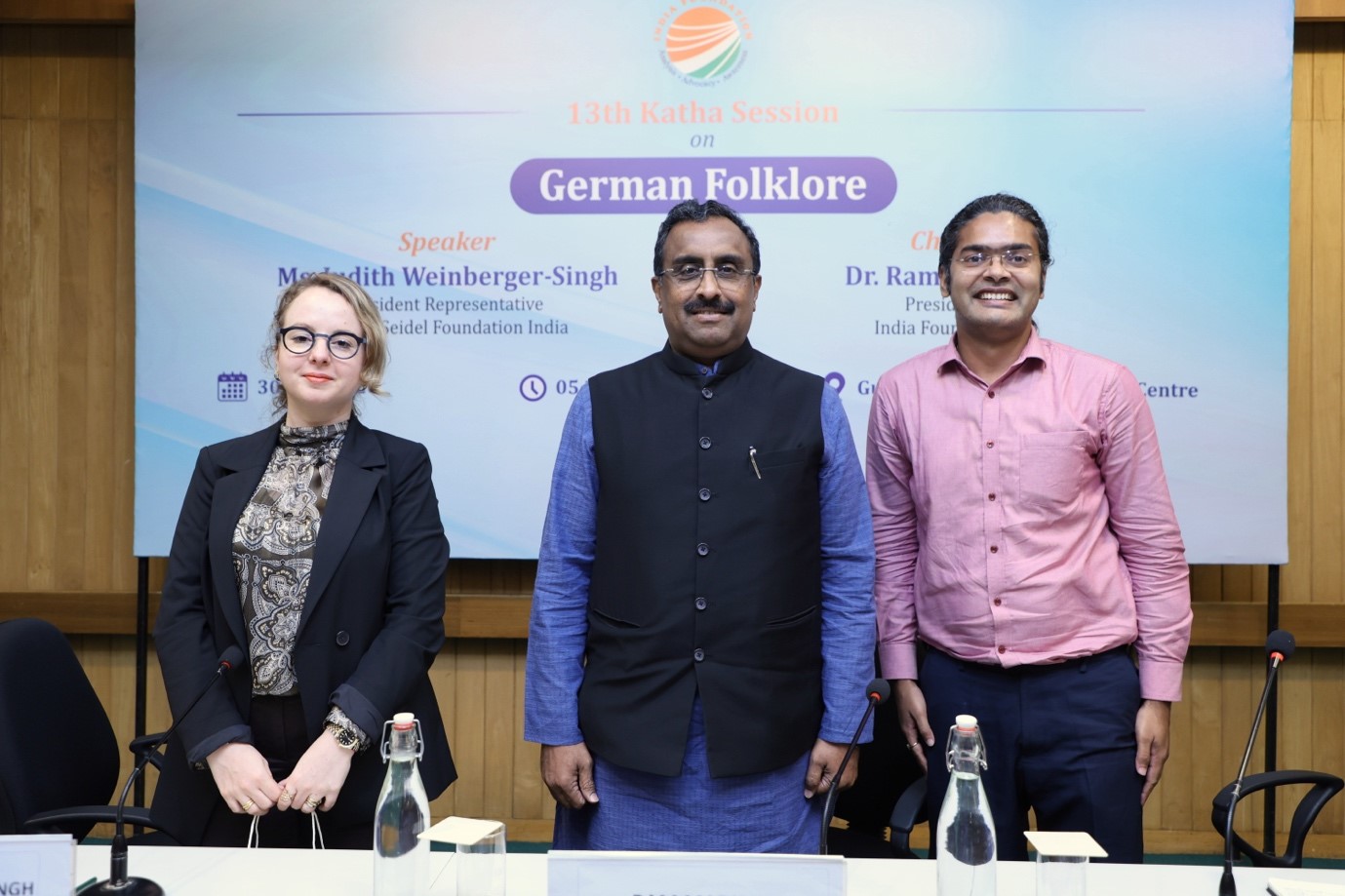
Opening the session, the chair reflected on a recurring insight from the series: that at the level of mythology and folklore, striking similarities surface across peoples, with shared themes, spirit, and moral messages transcending geographical and national boundaries. He noted that although Germany is a relatively young nation-state unified in the nineteenth century, it draws on a far older cultural inheritance, and that many stories widely assumed to be American are in fact German in origin.
Ms. Weinberger-Singh structured her talk around the forest of her native Bavaria before turning to the more familiar Grimm tradition. She introduced two lesser-known regional customs: Wolfauslassen, the “letting out of the wolves,” in which herdsmen mark the end of the grazing season and the onset of winter through processions of bells and poetry, a ritual dating to the seventeenth century and still practised in her district; and the Rauhnächte, the twelve nights between Christmas and Epiphany, when the boundary between the human and spirit worlds is believed to thin, giving rise to the Wild Hunt of ghosts and witches and to customs of incensing the home and avoiding hung laundry.

Turning to the Brothers Grimm, she explained how their collection of oral folklore in the early nineteenth century was bound up with German nation-building and linguistic identity at a time when French still dominated intellectual life. She contrasted two tales: Aschenputtel, the darker original of Cinderella first written down in 1812, in which virtue, piety, and hard work are ultimately rewarded; and Puss in Boots, a tale of French origin excluded from the definitive 1857 collection, in which cunning rather than virtue drives success, and at a moral cost. She closed by asking whether one can truly be the architect of one’s own destiny, and by what values such a pursuit should be guided.
In his concluding remarks, the chair drew a parallel with the Panchatantra and its animal fables, observing that storytelling across cultures encodes moral instruction beneath even seemingly irrational surfaces. Closing the session, the moderator drew out a thread from the talk: that the Grimms, like the compilers of the Panchatantra, the Arabian Nights, and Perrault’s tales, were not authors but custodians of an oral tradition rooted in the voice of ordinary people, a reminder of folklore’s shared human wellspring.