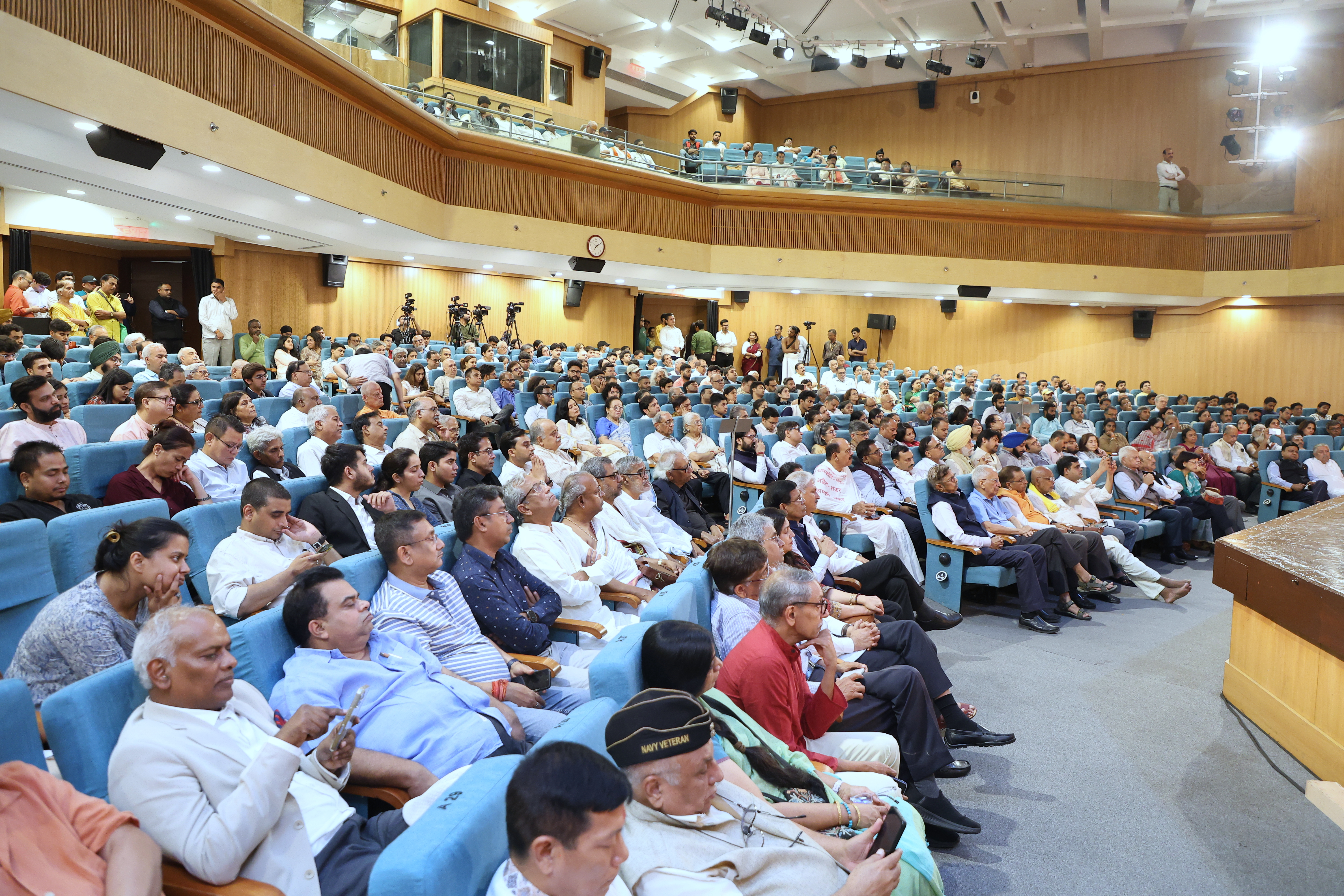

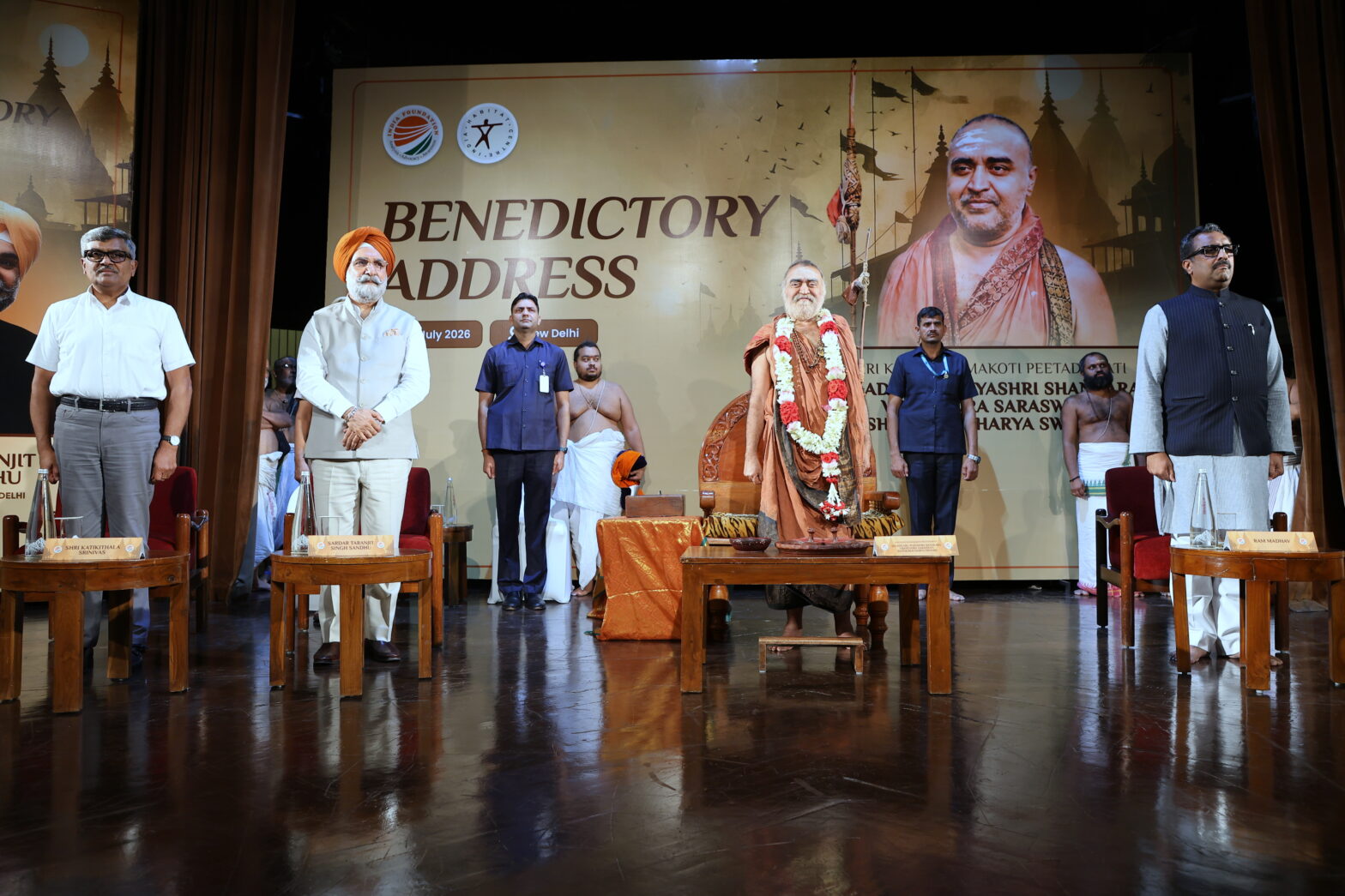
On July 06, 2026, India Foundation in collaboration with India Habitat Centre, New Delhi, organised a Benedictory Address that was delivered by Shri Kanchi Kamakoti Peetadhipati Jagadguru Pujyashri Shankara Vijayendra Saraswati Shankaracharya Swamiji. The profoundly spiritual and intellectually enriching benedictory address was organised in the Stein Auditorium, India Habitat Centre in New Delhi. The prestigious session was presided over by the Hon’ble Lieutenant Governor of Delhi, Sardar Taranjit Singh Sandhu. The session was attended by more than 400 participants comprising policymakers, diplomats, and scholars.
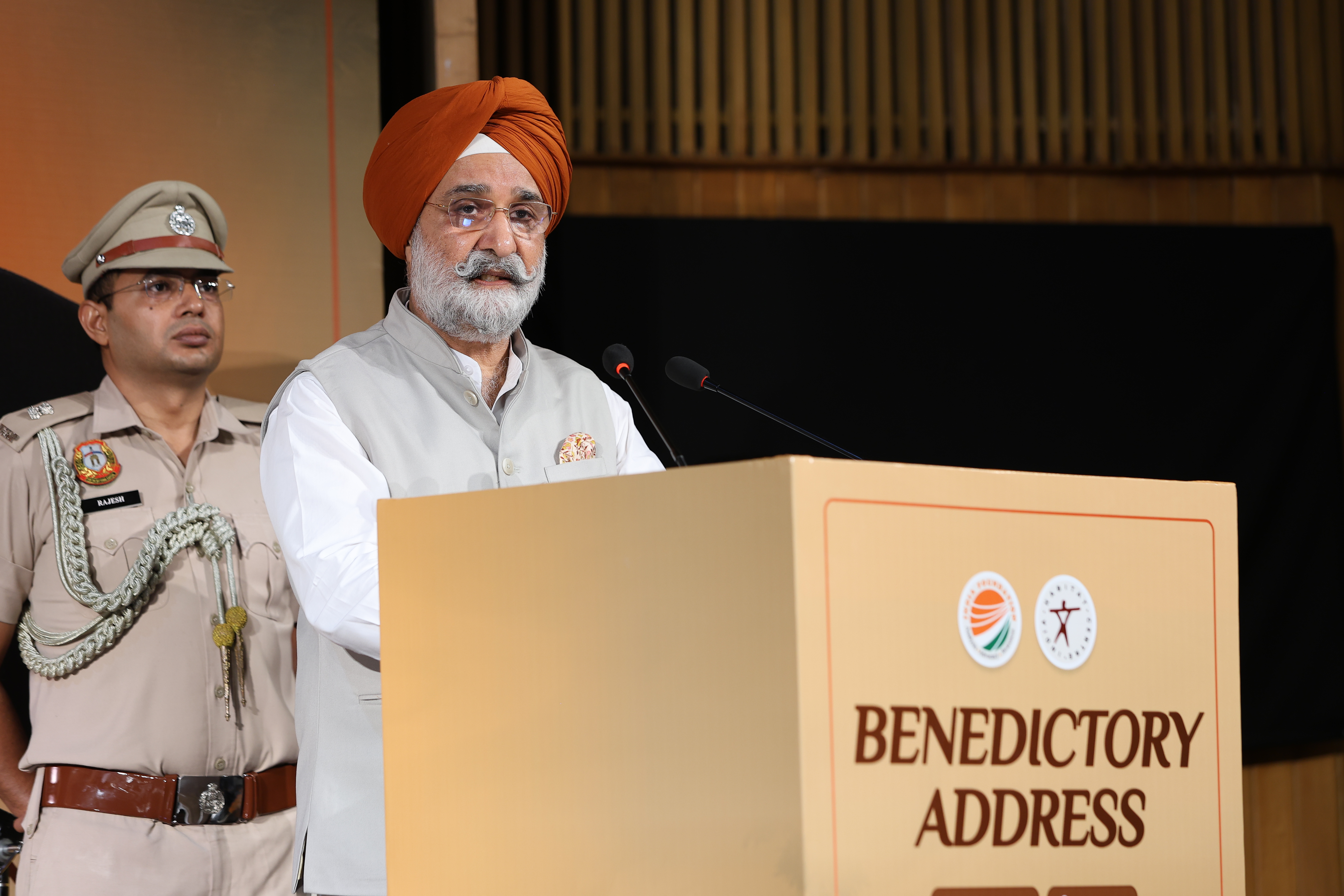
Setting a highly reverent tone for the evening, Lieutenant Governor Sardar Taranjit Singh Sandhu delivered the inaugural welcome address. He extended a warm and respectful welcome to Shankaracharya Swamiji on behalf of everyone present, emphasizing that the occasion served as a vital bridge connecting the national capital with one of India’s oldest living spiritual traditions, which represents an unbroken civilizational legacy spanning over 2,500 years. The Lieutenant Governor lauded Swamiji, noting that he accepted the path of sanyas at the age of thirteen and has since devoted more than four decades to spiritual guidance, public service, and nation-building. He also specifically mentioned the numerous Vijaya Yatras carried out by Swamiji in different parts of the country, especially North East, Jammu and Kashmir, and Punjab, and their role in national integration and social cohesion.
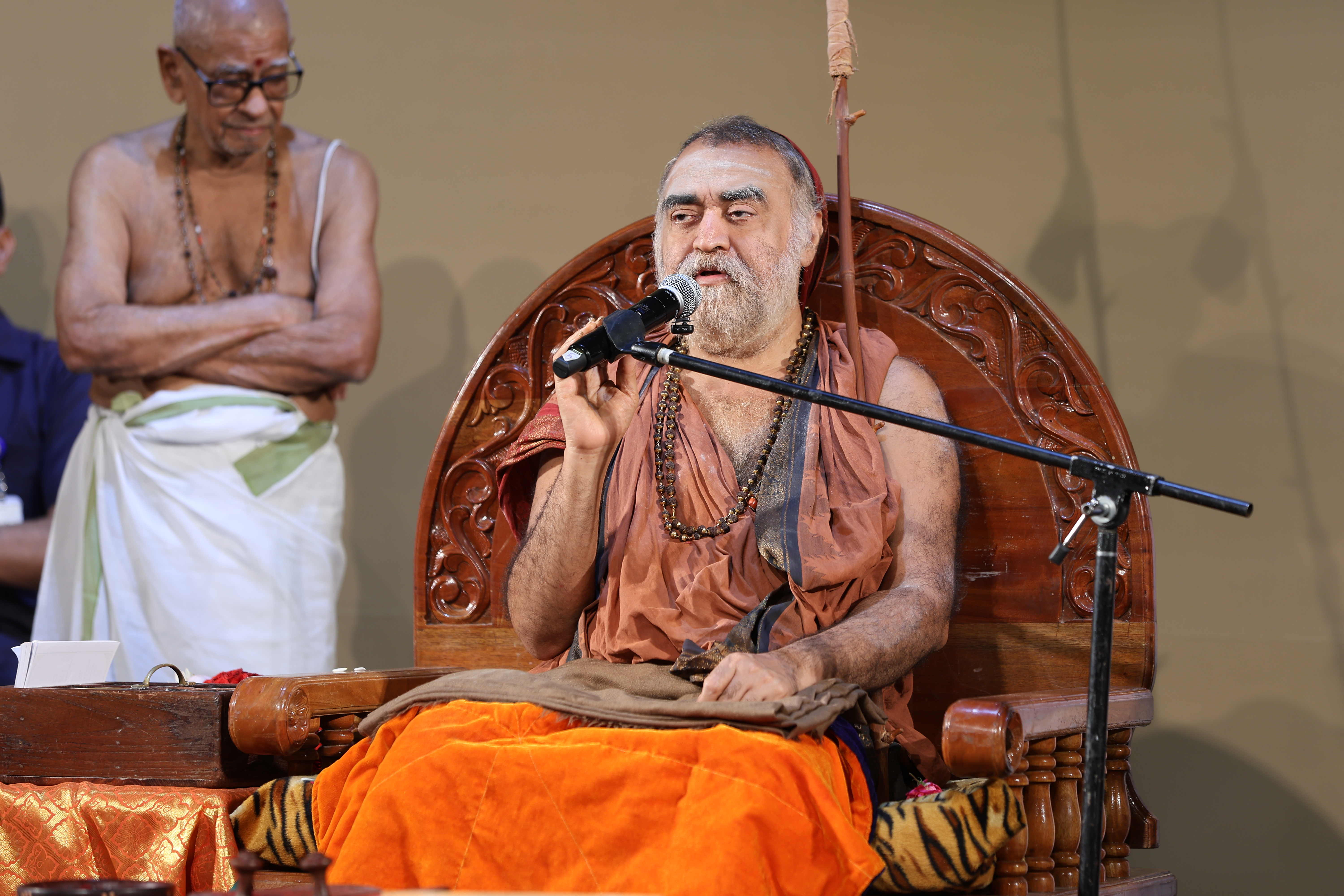
Jagadguru Pujyashri Shankara Vijayendra Saraswati Shankaracharya Swamiji delivered his highly anticipated benedictory address. He said that the main purpose of his visit to Delhi was to attend the Kumbhabhishekam of the Devi Kamakshi temple near Jawaharlal Nehru University and a religious function in the name of Lord Murugan. Swamiji went on to explain the great legacy of his Paramacharya, who lived for a hundred years and gave strong spiritual and moral support to India’s freedom struggle, and he also mentioned the historic meeting in Kerala in 1927, when the Paramacharya met Mahatma Gandhi and C. Rajagopalachari and blessed and encouraged the independence movement. He also highlighted the Paramacharya’s unwavering commitment to the Swadeshi spirit, and how in 1922, after a bath at Dhanushkodi, the Paramacharya renounced traditional silk clothes and chose to wear only saffron-dyed khadi for the rest of his life.
In his benedictory address, Shankaracharya Swamiji also referred to the Kanchi Peeth’s close relationship with the youth of the country and its governing institutions, and how the Peeth had played a very important role in the post-1947 era, particularly in the framing of the Constitution. He narrated the story how the clauses in Articles 25 and 26 in the constitution were drafted with the help of scholars from Kanchi Peeth after dialogue with constitutional stalwarts like Dr B R Ambedkar and Sardar Vallabhbhai Patel, so that India’s ancient cultural and religious institutions could continue to thrive with dignity and autonomy in the new democratic framework.
Underlining the importance of preserving India’s civilisational memory, the Shankaracharya Swamiji elaborated on the work the Kanchi Peeth had undertaken in the areas of traditional knowledge and epigraphy, and he recalled how the recitation of the Atharva Veda had once almost disappeared and was confined to the Pancholi family in Gujarat. The Peeth had deputed scholars to Gujarat for several years to study and preserve the oral tradition, and this work had resulted in over 200 Atharva Veda scholars today. The Swamiji also mentioned the establishment of the Uttankita Vidyaranya Trust to translate and publish ancient Sanskrit inscriptions from India and abroad. , and he mentioned a key publication on a 1,400-year-old inscription from ancient Gandhara (in present-day Afghanistan) which recorded the consecration of a Ganesha temple around 600 AD. Such evidence, he said, was proof of India’s deep and extensive cultural presence in Asia, therefore, it highlighted the significance of the Peeth’s efforts in preserving the country’s cultural heritage.
The Shankaracharya Swamiji also shed light on the Kanchi Peeth’s socio-economic programmes and initiatives, particularly those spearheaded by his immediate predecessor, Sri Jayendra Saraswati, and he said that in the 1980s, the institution was giving much thrust to inclusive growth through grassroots programmes like loan melas and support to small and micro-industries, similar to the present-day Vishwakarma Yojana, as well as large-scale temple renovation activities. Shankaracharya Swamiji said that democracy must not be viewed as a Western concept only because, citing the example of King Dasharatha, who sought the views and approval of his people before deciding to crown Lord Rama, he showed that democratic consultation and respect for public opinion have been an integral part of India’s civilisational tradition from ancient times.
Shankaracharya Swamiji painted a powerful vision of the future of the nation as he spoke of a Triveni of ‘Trade, Tradition and Technology’, in which India’s development model would focus on converting villages into specialist service and economic zones that were closely linked to urban resources, so that rural communities could flourish without being forced into migration. Shankaracharya Swamiji said he had no hesitation in accepting scientific and technological advancements from abroad, but he said India did not need foreign advice or guidance on matters of culture, human rights and civilisation, because these values were well-entrenched in India’s own ancient traditions. Shankaracharya Swamiji ended his benedictory address with a special emphasis on youth and women, and he announced the revival of the Yuva Tirth Yatri Sangh for the youth of Delhi, which would help to connect young graduates with ancient pilgrimage centres and strengthen their civilizational identity; therefore, he also called for the practice of “Laghu Nyas”, or micro-charity, among women, as a means of promoting cultural values at the grassroots level. Swamiji closed the function with prayers to Lord Chandramouleeshwara and Goddess Kamakshi, wishing the people of Delhi and the nation peace, prosperity and harmony.