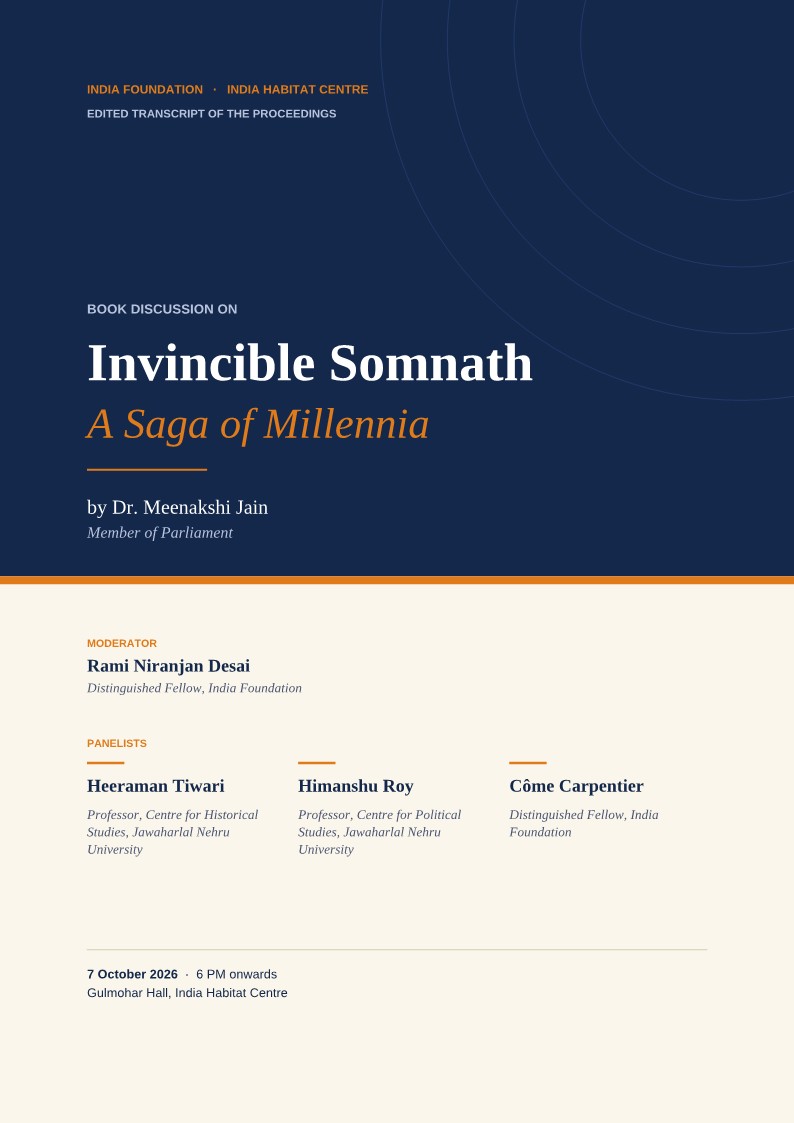
Contents
Opening Remarks — Rami Niranjan Desai . . . . . . . . . . . . . . . . . . . . . . . . . . . .
Address — Dr. Meenakshi Jain . . . . . . . . . . . . . . . . . . . . . . . . . . . .
Panelist — Heeraman Tiwari . . . . . . . . . . . . . . . . . . . . . . . . . . . .
Panelist — Himanshu Roy . . . . . . . . . . . . . . . . . . . . . . . . . . . .
Panelist — Côme Carpentier . . . . . . . . . . . . . . . . . . . . . . . . . . . .
Editor’s Notes . . . . . . . . . . . . . . . . . . . . . . . . . . . .
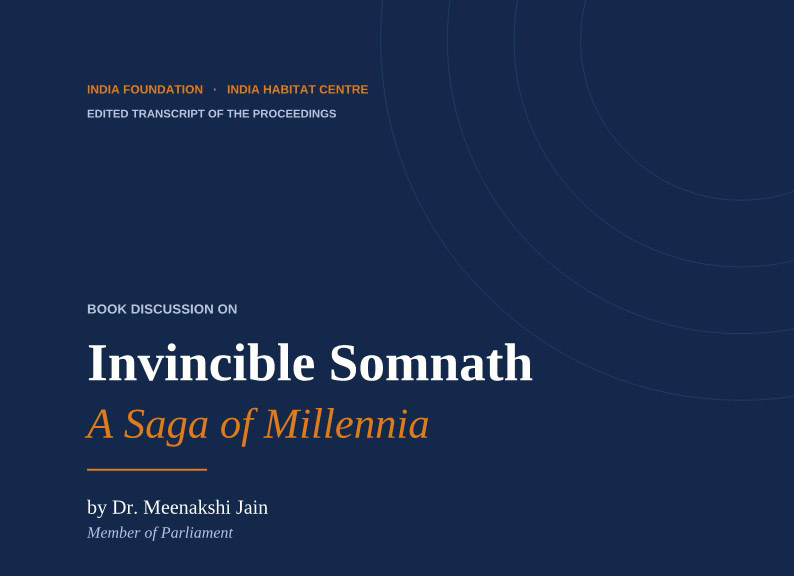
About this edition. This is a cleaned and structured version of the automatic transcript of the book discussion held at the India Habitat Centre on 7 October 2026. Speaker names have been restored from the event poster, obvious speech-recognition errors have been corrected, and passages that could not be reconstructed are shown in [italic square brackets]. See the Editor’s Notes at the end for details and for items that need verification.
MODERATOR · OPENING REMARKS
Rami Niranjan Desai
Distinguished Fellow, India Foundation
“History is important enough to be told the way she has told it.”
[The recording begins mid-sentence.] …Dr. Jain has really addressed this gap in her book. We learn so much more about the sacred geography of Saurashtra, keeping at the centre the civilizational memory — the resurrection of this temple over and over again through the many disruptions it has had to face. If you look at the book, at the resources, at the archives she has gone through, at the pages of appendices, the research that goes into a book like this is incredible. And I think history is important enough to be told the way she has told it.
Because, after all, Somnath is the first of the twelve Jyotirlingas [transcribed as “the first of the four golden rings”]. It is the abode of the Lord of the Moon, where Lord Shiva is worshipped as Somnath. [A further phrase here is unclear in the recording.]
I won’t speak much about the book, but I will tell you that Dr. Jain’s research draws on multiple sources: religious texts, inscriptions, archives, archaeology, foreign accounts and Persian accounts. The book moves from Somnath’s early history right down to the last chapter, very interestingly titled A Thousand Years Later, and it ends with Prime Minister Modi’s article and his visit to the temple on 11 May 2026 to commemorate the 75th anniversary of the post-independence construction.
Dr. Jain, I will now invite you to speak for about ten minutes. First, a word on the rules of the panel. For those of you who come here often, you already know that we maintain strict decorum. For those who are new: each panelist will get ten to fifteen minutes. At 7 o’clock we will break for question-and-answer. I will take the questions in a group; you may raise your hands and the team will bring the microphone to you. Please, no interjections, debates or arguments. We will take a question, and the panelists will answer; it is entirely the panelists’ right to choose which questions they wish to answer. There will be tea afterwards, and if you wish to continue the discussion, you may do so then.
AUTHOR · ADDRESS
Dr. Meenakshi Jain
Member of Parliament · Author, Invincible Somnath: A Saga of Millennia
“This civilization survived not because of kings or warriors. It survived because of the determination and contribution of ordinary people.”
I would like to begin by thanking the Foundation for organizing this, and all of you who have taken time out to be here this evening.
As historians, when we study any sacred site, the tendency is to find out when the temple was first built, when it was destroyed, and how many times it was destroyed. But for those who revere a site, it is not seen in those terms. [The remainder of this thought, and a passage comparing other sacred sites such as Kashi and the oldest temple in India, are too garbled in the recording to reconstruct.] The point is that, for us, a sacred site is bound up with the memory of our civilization.
Similarly, in Somnath, a civilizational memory connects the place with Soma, the Moon, who was cursed by Daksha Prajapati and cured of that curse by Shiva. Daksha had given his twenty-seven daughters in marriage to Soma. Soma had promised to treat each of them equally, but he favoured only one. The other daughters went to their father to complain, and Daksha cursed Soma [the wording of the curse is unclear; in the traditional account, that he would lose his lustre]. Soma went and worshipped Shiva at the place where three rivers meet. He performed great austerities and created a Shivling there. Shiva was pleased with his austerities but said, “I cannot undo the curse, but I can lessen it: for fifteen days you will wax, and for fifteen days you will wane.” And to protect Soma further, Shiva placed the crescent moon on his head. These are the civilizational memories we have of that time.
Of course, we also know that Lord Krishna met his end there, and there is a beautiful small temple at the spot. That is the place where Krishna is said to have taken his last breath. So any story that is there in our memory, in our religion, in our culture — we find that site revered even to this day.
Why are we a civilization in continuity? Not because of the patronage of kings or rulers, but because of the beliefs and devotion of ordinary people like you and me. People who went to Somnath were not receiving rewards from a king. They went there because they said: we cannot forsake our Gods, and the Gods have not forsaken us.
The seven temples of Somnath
Now, to come to Somnath, there is a curious question that confronts all historians: when was the first temple built? This does not interest the believers in the sanctity of Somnath. But to answer it — Somnath was built seven times. Let me quickly go through the seven temples.
The first temple is supposed to have been built by Somasharma, the founder of the Pashupata order [transcribed “Vashupata”]. No trace of that temple has survived. There is evidence of another temple dated 871. We have an inscription which speaks of a resident of Somnath, so it is possible that this temple existed even before 871. It was likely built by the Maitrakas [transcribed “the Maitreya caste of Varanasi”; probably the Maitrakas of Vallabhi].
Then the history becomes clearer, and we have the Solanki (Chalukya) king Mularaja, who built a temple. From that time we can trace the history of the temple. Mularaja’s temple is the one that was destroyed by Mahmud of Ghazni [the recording says “destroyed by Moolraj”, an evident slip].
Evidence of the destruction
There is a tendency among certain academics to deny the existence of the temple or to deny its destruction. But, unfortunately for them, we have eyewitness accounts from that period describing its destruction. We have all heard of Al-Biruni [transcribed “Alchemony”]. He speaks of the lingam being broken into four parts and taken to Ghazni.
Then we have other historians. One mentions how much difficulty Mahmud had in getting back home, because the resentment at what he had done was so great that people combined to block his passage, and some even led him down the wrong path. He suffered so much in reaching home, and half his troops died, because he was misled on the way by a man who claimed to be a priest of the Somnath temple. Nobody was telling the Somnath priest that he must take revenge; it came from within them.
The third, and more interesting, account is that of a poet who laments the death of Mahmud. What he says is surprising: alas, in him, the Brahmin … [the poet’s exact words are unclear in the recording]. So, people interested in history, in our civilization, must not ignore the role of iconoclasm — what role it played. [A remark about the eighteenth century, to be discussed later, is unclear.]
Rebuilding, and a mosque built with help
Mahmud destroyed the temple, and within a decade of that destruction, three kings of North India gathered together and rebuilt, or repaired, the temple. We are told that these temples meant nothing to us. If they meant nothing, how is it that within a decade three kings of North India came together to rebuild it? After that we have a series of rulers; I will not go through them all. Karna, Jayasimha and Siddharaja are the prominent ones to remember.
It is striking that about 200 years after Mahmud’s destruction of Somnath we have a very important inscription: the Veraval inscription [transcribed “Neeravani”]. It records that a trader from Arabia went to Somnath and asked the people there whether he could build a mosque. The people of Somnath, and the ruler, helped him to build the mosque, and he built it — 200 years after Mahmud’s attack. The inscription on that mosque has survived and has been translated by eminent scholars. It specifies how much money and how much land were to be assigned, and how the money was to be spent on the building; and finally it says that if any money is left over, it should be spent on the mosque. D. C. Sircar [transcribed “D. C. Sarkar”], who translated the inscription, remarks that it is really surprising that the donor never thought of giving anything to those who had helped him create the mosque.
Then we have Alauddin Khalji, the Sultan of Delhi, who attacked Somnath. [The recording is unclear about the chronicle written on this episode and about what happened as his forces returned to Delhi.] So it was not a one-way story, in which somebody came from Delhi or Ghazni, demolished the temple, and there was no response. There was a response. I told you that rulers had rebuilt the temple within a decade of Mahmud’s attack, and, according to one account, Alauddin Khalji’s army was also vanquished [the chronology of this sentence is unclear as transcribed].
The story goes on. So many kings contributed, and we have evidence of kings coming on pilgrimage to Somnath. How do we know? Because an inscription of theirs records that they went to Somnath on pilgrimage. It is a fascinating story, and it tells us that this civilization survived not because of kings or warriors. It survived because of the determination and contribution of ordinary people.
Independent India: Junagadh and the rebuilding
Since I have very little time, I want to come to the most perplexing part of the history of Somnath: what happens in independent India. There were two states [one name is unclear in the recording] and the Junagadh state. Junagadh was originally ruled by Rajputs, but in the eighteenth century a Muslim, Sher Khan Babi [transcribed “Sher Khan Gandhi”], established the dynasty of Junagadh, and that dynasty ruled until 1947. It is notable that Somnath fell within the territory of the Nawab of Junagadh.
In 1947 the most pressing issue was which way a state would go: to Pakistan or to India. Junagadh was a state with an 80 per cent Hindu population. Sardar Patel sent messages, but the ruler and his Diwan — Shah Nawaz Bhutto, a Muslim League politician who came to Junagadh in May 1947 and became Diwan — would not tell him which way they were going. They said the matter was under consideration. Finally, on 15 August, they declared that Junagadh had acceded to Pakistan [the recording says “India has ceded to Pakistan”, an evident slip]. The Government of India came to know about it two days later, and a month later the Pakistan government said that it had accepted, and that Junagadh was now part of Pakistan.
You see, when we talk about the history of countries and civilizations, there is no straight path. Imagine what we would be talking about today if Junagadh had gone to Pakistan. We have lost so much of our sacred heritage because of the division of the country. This was an attempt by the Diwan and the ruler to keep the Government of India in the dark.
And then, when they realized that it was not possible to maintain their independence — because everything they were getting, the electricity, the supplies, the food, came from India — the Nawab rushed to Pakistan with his family and his wealth, leaving some of his family behind. Shah Nawaz followed a little later. Sardar Patel — how much we owe him — had Indian forces on the borders of Junagadh, and when the moment was right they entered, and that is how Junagadh became a part of India.
I have not spoken about Ahilyabai Holkar’s temple at Somnath [the surrounding sentence is garbled]. But Sardar Patel, standing at Ahilyabai’s temple, took a pledge there: “I will rebuild the temple soon.” So the two important figures in the rebuilding of this temple were Sardar Patel — who, unfortunately, died very soon — and K. M. Munshi. We should remember what service they did to our civilization.
When the movement to rebuild the temple began, the Prime Minister in Delhi was appalled and shocked. He said, in effect: what is this? How backward can we get, how regressive? He wrote to K. M. Munshi; he first wrote to the President of India, saying he feared the President was going to Somnath to preside over the inauguration. The President wrote back — and all these letters are there in the published works of Jawaharlal Nehru; no imagination is required, no falsification of history is required. The President replied that he had been going to so many temples, so what was the problem if he went to this one? And he actually went to that temple and presided over the inauguration.
Then there is a series of letters from the Prime Minister to K. M. Munshi, saying: I cannot understand what you are writing to our ambassadors abroad, asking them to send twigs from this tree and drops of water from that river — how is it going to help? Do you realize what a negative impression it is creating? [A sentence about “a consecrated new temple of India” is unclear.] In any case, the Prime Minister in Delhi was totally appalled and shocked, and he expressed his displeasure in sixteen pages of letters, which are reproduced in the works of Jawaharlal Nehru.
So we recall that moment, and we recall 2026, when another Prime Minister led the celebration of the 75th anniversary of that temple.
A wounded civilization
Civilization has many paths, which go up and down. Sometimes they are not revived; there are many examples of civilizations that did not revive. But I think we are grateful and indebted to our ancestors and to the passage of our civilization. We overcame all obstacles. When we talk about our history, we have to pay due homage to our ancestors, to our humble people, to ordinary men and women, and to the resilience of our civilization.
And today we see the glorious revival of Somnath. Since independence we have only two such examples: one is Ayodhya and the other is Somnath. But so much was lost, and it has taken so much time for even a little revival to take place. It is a wounded civilization, a battered civilization — but it is taking time to recover. Thank you.
PANELIST
Heeraman Tiwari
Professor, Centre for Historical Studies, Jawaharlal Nehru University*
THE MODERATOR
[Moderator’s remarks following Dr. Jain’s address:] Like I said earlier, having travelled to the site, it is amazing that you still see the peepal tree at the temple — the place where, they say, Lord Krishna took his last breath. The temple is really small, yet it draws a huge pilgrimage. And I think, as Dr. Jain said, it is the common people who have helped this civilization continue and revive itself every time it has encountered some sort of destruction.
Dr. Jain, you spoke about the chapter on [a chapter title is unclear] and the resistance of the topmost brass in Delhi to seeing this temple resurrected — two very important chapters. Now I come to my panel discussion, and to my first panelist, [introduced as] a professor at a central university [the university’s name is garbled in the recording], who also serves as a dean. His scholarship spans Sanskrit language and literature, Indian philosophy and intellectual history. He holds a PhD from the University of Delhi and a DPhil from the University of Oxford.
Attribution note: this speaker is placed here as Heeraman Tiwari, by elimination from the event poster (the other two panelists are identified by name later in the recording). The introduction read out in the recording describes a Sanskrit and Indian-philosophy scholar, whereas the poster lists Prof. Tiwari at the Centre for Historical Studies, JNU. Please verify.
“We in India should delight in the magnificent story of the repeated resurrections of a sacred Somnath.”
Thank you very much for the very kind introduction. Rami, to you and to your Foundation, I am grateful for this honour of being part of this celebration. My friends Côme and Himanshu — and, of course, the heroine of this evening, Professor Meenakshi Jain — what an honour to be here, to be able to speak a few words about the book. [A remark about having prepared a written text rather than rambling is unclear.]
Rarely, very rarely, do you get a writer who has the courage and scholarly wisdom to swim against the current. I am speaking, of course, about Professor Meenakshi Jain, historian of India, who, well before scripting this beautiful volume on Somnath, had written several books which not only challenged the cozy, well-settled historiography of India’s story — our story, the vestiges of our past, our memory — but also caused much anguish to those known as the “eminent historians” of India.
These historians, without doubt, wrote in lyrical prose the fate of Indian history, the myriad facets of the India that was, and indeed of India as a civilization. The power of their historiography was so compelling, and the narration so convincing, that it would have been almost impossible not to be persuaded by their account of India’s [word unclear] past.
Then comes Professor Meenakshi Jain, a historian without any friends around her, who began to gaze at some gaping cracks in the well-plastered fort of Indian historiography and the narrative it had built for all of us for decades. Gradually and surely she began to chisel away the layers of clever coating, laying bare the sound archival, archaeological and inscriptional evidence that had been staring at us. [The following sentence is unclear in the recording.]
Professor Jain dismantled certain myths of Indian history, writing volume after volume — like the story of Ayodhya’s Ramlala, who is now fully seated in his place of birth. In his life, Lord Rama was exiled by his father for only fourteen years. But a thousand years later, he was again made homeless by a foreign invader. And somehow, as if we Indians too felt resigned to our fate, Lord Rama remained exiled for nearly five hundred years. Five hundred years is a long time for any expulsion, any punishment. Our history books did give us that impression.
The fight for our history, India’s history, appeared perilous given the arguments our historians had presented before us. There were two struggles: the court battle, and the battle over the history and the narrative about this wounding event. Those who never wanted to give up their faith in our invincible civilization and culture experienced a torment — a torment in silence. Professor Jain, on the other hand, like our poet [name unclear], converted that tormented history into historical truth, shloka after shloka.
I am quoting here from the Valmiki Ramayana. Valmiki announced to the world that whatever he was writing, in the silence of his torment, was nothing but the truth. Whatever you write in the silence of torment has to be true. And, not for nothing, did Sumitranandan Pant say [the couplet is garbled in the recording; restored here from the well-known verse]:
Viyogi hoga pehla kavi, aah se upja hoga gaan;
Umadkar aankhon se chupchaap, bahi hogi kavita anjaan.
It took five hundred years for someone like Professor Meenakshi Jain to tell us the truth. Just like the invincibility of her account of Ramlala, Professor Jain’s book on Somnath has proved to be as invincible as Lord Somnath himself [transcribed “as miserable”]. [A quotation attributed to an Acharya, on every pebble of Bharat reflecting Shankar, is garbled and its attribution unclear.] Our Somnath is undefeatable, as indeed has been the belief of those who kept on rebuilding the herald of Shiva, the invincible Somnath, as she has just explained. On that same hallowed ground, each time, the invaders who could not tolerate our faith in Shiva demolished it, and looted it.
• • • RECORDING SEGMENT BREAK • • •
…the thousand-year story of Somnath, which Professor Meenakshi poignantly calls a saga of millennia. I like the subtitle perhaps more than the main title. It is a concise history of India’s struggle for truth. [A Sanskrit phrase, transcribed “anyatha, na anyatha”, is unclear.]
The book is based on sound sources, secure in the geography of Prabhaskshetra, and it traces meticulously the saga of many destructions and an equal number of reconstructions. While the rest of the world marvels at the blissful story of a single resurrection — a sacred resurrection of two thousand years ago — we in India should delight in the magnificent story of the repeated resurrections of a sacred Somnath.
Through her book, Professor Meenakshi forces the reader to sit at an unlit window and watch the celebration of Somnath with a thousand-year-long fireworks of evidence. This book has successfully conquered the three kālas [transcribed “Gita Ratakrishna”] — as Lord Shiva himself is known to us in the sources and stories: the ancient, the medieval and the modern. So the book is not about modern India, and it is not about medieval India. It is about India, if you can date it — if you dare to date it, in my opinion. That is why I say that it conquers these three times.
[A sentence on how Mahmud of Ghazni was drawn to the antiquity of Shiva and the strength of the people of India is garbled.] People often argue, and have been arguing, that the temple was plundered because of greed for wealth. I don’t believe so. Somnath had become the superglue of the people of this land — she herself said so. And in the eleventh century, the pinnacle of the Somnath temple, like the Himalaya, was piercing the sky. The greed of Ghazni was not only for the wealth and prosperity of the Somnath temple. His jealousy of, and hatred for, the invincible faith in Shiva was crushing him. That is my belief.
This desecration and sacking of Somnath by Mahmud of Ghazni is the central theme of this book, around which Professor Jain weaves this moving story, with sound support from inscriptional and textual evidence.
And then, in the twentieth century, the passion of Sardar Vallabhbhai Patel [transcribed “Sardar Bhagavatpate”] — and here too I am using the term “passion” — for another resurrection. His vow to rebuild Somnath, a commitment to the cause [the surrounding phrase is unclear]. Sardar Patel took the vow with the waters of the sea in his palms — the sea whose waves had been, for a thousand years, throbbing at the base of the original Somnath temple, as if to ring in our ears that Shiva is invincible. Even the waters around India are saying that, in my opinion, as indeed is the faith of this devotee.
The invader had thought that by destroying the temple of Somnath he was going to crush the faith of the Indians. Perhaps he had not read the story of Arjuna in the Mahabharata, who went to the Himalayas to meet the Lord, only to discover that the Himalaya itself was looking at him, and at the rest of the world, the way Shiva does. And I am not merely making up a story. I am quoting a seventh-century Indian poet, Bharavi [transcribed “Dharmi”], who retold the story in the Kirātārjunīya.
Let me recite that beautiful verse; I will summarize it in two sentences. I say that Mahmud [transcribed “Ghazali”], or anybody who wanted to sack or destroy our Somnath, had not been told this story. The dazzling snow-capped peaks of the Himalaya appeared to Arjuna as the face of Shiva. [The Sanskrit verse is too garbled in the recording to reconstruct.] Shiva is laughing, destroying the darkness.
Nor had Mahmud heard of the devotion of Indians, who make of their own body, as Shiva did, a temple: their legs become the pillars, their body the garbhagriha, the sanctum sanctorum, and their heads the golden finial. How can Shiva not remain invincible in the ocean of such devotion? [Transcribed “ocean of such a cave”.] Thank you.
PANELIST
Himanshu Roy
Professor, Centre for Political Studies, Jawaharlal Nehru University
THE MODERATOR
[Moderator:] He said: we did not forsake our Gods, just as our Gods did not forsake us. And on that note I move to my next panelist, Professor Himanshu Roy [transcribed “Professor Imam Shukla”], a professor at the Centre for Political Studies at Jawaharlal Nehru University. His areas of specialization include political thought and political theory. He has been teaching since 1988.
“Gandhi advised that not a single penny should be spent from the Government of India; the contribution should come from the public.”
Professor, fellow panelists, [an unclear salutation] — thank you for this invitation. A couple of things. I find this book to be the best written on Somnath. [A passage comparing it with other books on Somnath, including, it seems, K. M. Munshi’s Somnath: The Shrine Eternal, is garbled.] I will pick up from the book, Chapter 10, on Nehru’s position. Let me read it out.
“The decision that was taken on the reconstruction of Somnath temple: the condition of the temple was such that it was not for renovation. They had thought so initially, but the old structure was pulled down and, at a certain distance, a new structure was erected. The decision was taken by Patel in consultation with N. V. Gadgil [transcribed “V. M. Garg”; probably N. V. Gadgil] and the local residents of the area.
“Patel then apprised Mahatma Gandhi of the decision, when he met him sixteen days later. Gandhi advised him that, for the trust, not a single penny should be spent from the Government of India; the contribution should come from the public, and it would be the trust that would look into the reconstruction of the Somnath temple.” This takes place around 1949 [as stated]. The details I can skip, for those who are interested; my focus will be different.
In the cabinet meetings, all kinds of decisions were taken following Mahatma Gandhi’s suggestions. Archaeology, town planning, the Central Public Works Department, the Director-General of Archaeology, the Chief Engineer of the Saurashtra Government, and two architects — masters, the Sompuras, who were experts in temple design — were brought into the trust. The cabinet meetings were presided over by [name unclear; transcribed “Pradeep Menon”]. This is around 1949 and subsequent years.
Because Gandhi had given his approval, and Patel, of course, was the leader, the work moved ahead. And then, within a short span of a few months, Gandhi died. Subsequently, Patel died on 15 December 1950 [transcribed “by 1951, 15 December, 1927”].
[A passage of stage chatter is omitted.] Nehru’s objection, again I am quoting him, was “wasteful [transcribed “restful”] expenditure at a time of crisis”, and he gives all kinds of reasons. For example, Rs. 24,92,000 was spent on the reconstruction of the temple, and the whole of it came from the public. Now, what was the idea at the outset? The idea was renovation. But when the different departments and experts went there, they felt that the existing structure needed to be pulled down, the location shifted, and a new temple constructed. This is what they felt. And so the existing ruins were pulled down on 8 May 1950 — Patel was alive at that time — and a new structure, slightly away from the old location, began to be constructed from 19 October 1950. [A sentence about the reconstruction period is unclear.] This is how we find that the construction began.
Why did he suddenly react like this after the death of Patel? That, to me, speaks to things — the double face of Nehru. As a political theorist, I feel it this way. Number two: appeasement. Despite Patel’s encouragement, he had not recognized [the object of “recognize” is unclear]. And Patel had told him — I am reading out what Patel wrote to Nehru in a letter — that India’s policies should not, in their formulation, be influenced by internal and external factors. The Gulf factor, the Israel factor and the local factor were influencing this policy of appeasement — despite the fact that [the next phrase, transcribed “the Ashraf”, is unclear] were instrumental in partitioning India.
Now let me read out something else. In 1958, Nehru gave an interview to the BBC’s Panorama, and the interviewer was a British BBC correspondent, Markham [surname unclear]. After the interview, he wrote — I am quoting him — of “a man of egos and mimicry” [reading uncertain], “the last viceroy rather than the first leader of liberated India.” Nehru, in response, on 6 May 1964, said that what Markham had said was not correct, and he replied to Galbraith [the details of this exchange are unclear]. And this is connected, because it speaks to the attitude and the reflection. That was secularism and the double face. And therefore all this historical casting continues until the Ram temple was constructed. And we have seen the political consequences of the dynasty. So I stop here. Thank you very much.
PANELIST
Côme Carpentier
Distinguished Fellow, India Foundation
THE MODERATOR
[Moderator:] Thank you, Professor Roy. It almost makes us feel that we are diving into his strong words. [The rest of the sentence is unclear.] But now, coming to our very own Côme Carpentier [transcribed “Dr. Rohan Patel”]. He is a Distinguished Fellow with our Foundation and has served, since 2003, as the convener of the International Editorial Board of World Affairs, a journal. He has commented on international history and other subjects, and he is really one in the great line of historians [names unclear in the recording]. He brings to light a lot of things that we may not have noticed sufficiently.
“You cannot say that India was literally sunk in an abyss of mythological darkness.”
One thing that strikes you is that, despite all the comments about Indian history being very imprecise and sometimes almost non-existent, you do find in this book a very coherent — sometimes, I would say, fragmentary, but factual — account of the succession of dynasties and kings. Even though, of course, we don’t know many of their actions, you cannot say that India was literally sunk in an abyss of mythological darkness, as some Western and even Indian analysts have sometimes alleged.
Because the fact is that there was a very strong sense not only of who had ruled where, but also of where those monarchs had been, what territories they had conquered and what they had lost at other times. Clearly, India in that particular age [the opening of the period named is unclear; transcribed “from the days of Mahatma Gandhi”] to, you might say, the British Raj — and even under the British Raj — retained a typically feudal structure. It was like Germany in Europe until 1870, pretty much, and even before: a mosaic of states, overlapping and contesting each other continuously over tax collection, over glory, in order to conquer another state and assert greatness. This went on for centuries. We find the same in all feudal polities, and it largely explains why India was conquered and confronted with so many foreign invaders.
Number one, some of the invaders did not consider themselves foreign; they considered themselves of another religion, which was a bit different. Otherwise, if you look at the way in which Indian kings fought each other, you understand why it was very difficult to form a unified response to an invasion: there were paramount considerations to do with the safety of the state, which was often relatively small and fragile, because the borders changed rather fast.
That is how you see the succession of dynasties in the area that concerns this book — Saurashtra. Right from the days of Shri Krishna, when the Vrishnis, part of the Yadavas, went there and set up a kingdom to escape the oppression and persecution they had suffered under Kamsa and [transcribed “Saraswata”; probably Jarasandha]. So you see how the expansion of what you might call the Vedic people was caused partly by the desire to create new kingdoms and expand to new lands, but also by the fact that they had to make room for themselves by leaving the places where they had been living, sometimes for centuries. You find that in the Mahabharata, and clearly throughout the Puranas. That explains why there is a seamless transition from ancient India — what you might even call heroic India — into the historic period. And the historic period is where we find the invasions of Mahmud of Ghazni.
Then you also understand the context in which Mahmud, being a Turk — already a great invader and plunderer — was raised, in that tradition of the princes of Central Asia, who were at once very cruel and deliberate in their destruction, but also very fond of poetry, music and civilization, and always kept a court of bards, historians and scientists around them. My distinguished colleague [name unclear in the recording] talked about Mahmud’s possible motivations. But, again, it is part of the culture of that particular civilization, of a people who go on raids throughout the Middle East [a clause about distributing spoils to soldiers and building a more opulent kingdom is partly unclear].
And, of course, there are rewards for it. One: if you destroy idols, you get the grace of the only God, who is of course formless and does not tolerate false gods. And then you also get a distinction from the Caliph, and Mahmud was, I believe, the first one in Afghanistan to be made a Sultan. So you can see the most complex combination — as always in human affairs — of what we now call religious fanaticism and sheer political and economic interest, because many kingdoms could not support themselves if they did not bring in enough wealth from outside. So you have a constant fight for tribute and for aggrandizing your possessions.
And that lasts right until the period evoked in great detail by Dr. Jain, when she talks about the respective positions of the various princes of Saurashtra and Gujarat, and in particular the Gaekwads of Baroda, who had first been part of the Maratha Confederacy and then ended up as, so to speak, the overlords of Gujarat. Within their province, and to a certain extent under their authority, you have the Muslim Nawabship of Junagadh. That explains the great confusion: these states were so parcelled out that every state had a piece of another state inside its territory. The administration must have been an absolute nightmare, and it is quite amazing that the British were able to play all these people against each other and somehow keep their rule for a good number of years.
An Arab deity and the origin of Somnath
There are of course many other interesting details. One I want to allude to — because I am most interested in the historical — is that some reports say the reason Mahmud was so attracted to, you might say obsessed with, that particular temple is that there was an Arab deity, Manat, who had been worshipped in Mecca until the Prophet Muhammad declared that these three goddesses, apparently icons carved out of black stones, had to be destroyed. Apparently Manat was the one of the three that was not destroyed and was taken to Somnath. That, of course, would be an easy justification: “I still have to get to that idol, because it was the Prophet’s decision and desire that this idol should not be worshipped.”
And that brings you back to the very origin of Somnath. Gujarat, and particularly Saurashtra, is geographically close to the empire of Iran. For a long time the kings in part of Gujarat were called Kshatrapas, because they carried the Persian title of governor — satrap. And yet there is a lot in common between the Avestan religion and the Vedic religion. You know that Soma is Haoma, and that it is still worshipped by the Parsis, the Mazdeans. It survived even under Muslim rule in Iran. For example, Yazata — Haoma, who is Soma — is an Avestan, and therefore Zoroastrian, deity, and it is with this Yazata Haoma that you perform the ritual called Yasna in Iran, which is the Yajna of the Vedas, although there are certain differences that have emerged over time.
But you still have that commonality, and Yasna has given rise to the name Yazd [reading uncertain], which is used throughout the Muslim world. Therefore they carry, even without knowing it, a Persian-Vedic name. And you see, for example, that if you look at Humayun, he was named after Homa — which means Soma — and he regarded himself primarily as an astrologer. So, essentially, his primary personal religion, you might say, was astrology. So you can see the continuity of the pre-Humayun… [The recording ends mid-sentence here; the transcription tool truncated the file.]
Editor’s Notes
Attribution
First panelist. Placed as Heeraman Tiwari by elimination from the poster. The introduction read out in the recording (Sanskrit language and literature, Indian philosophy, DPhil Oxford) does not obviously match the poster’s listing (Professor, Centre for Historical Studies, JNU). Please confirm.
Names restored from the poster. “Imam Shukla” → Himanshu Roy; “Dr. Rohan Patel” → Côme Carpentier; “Professor Sajjad”, “Aminatu Jain”, “Dr. Glenn”, “Rafiqa Jain” → Dr. Meenakshi Jain. The moderator is Rami Niranjan Desai.
Corrections and unclear passages
Evident transcription slips corrected (each is flagged in the text where it occurs): Mahmud of Ghazni (“Ghazali”, “Mehboob Basanti”); Al-Biruni (“Alchemony”); Bharavi and the Kirātārjunīya (“Dharmi”, “Kirata Huniya”); Sardar Vallabhbhai Patel (“Bhagavatpate”); K. M. Munshi (“K.M. Rishi”); Sher Khan Babi (“Sher Khan Gandhi”); D. C. Sircar (“D.C. Sarkar”); the Veraval inscription (“Neeravani”).
Facts corrected from context. Sardar Patel died on 15 December 1950 (the recording gives “1951 … 1927”). Junagadh’s declaration on 15 August 1947 was an accession to Pakistan (the recording says “India has ceded to Pakistan”). The temple destroyed by Mahmud was Mularaja’s (the recording says “destroyed by Moolraj”).
Passages that could not be reconstructed are marked in italics within square brackets and have not been guessed at. Where a probable reading is offered (for example, the Maitrakas of Vallabhi, N. V. Gadgil, Jarasandha), it is labelled as such.
Scope and approach
What this edition includes. The opening of the recording is cut off mid-sentence; there is one break between the two transcript files during the first panelist’s talk; and the recording ends mid-sentence during Côme Carpentier’s talk. The question-and-answer session scheduled for 7 pm is not included. A few lines of stage chatter have been omitted.
Editing approach. Filler words, repetitions and obvious speech-recognition errors have been cleaned for readability; the speakers’ arguments and claims are reproduced as spoken and have not been independently fact-checked. Statements, interpretations and political characterizations are the speakers’ own.