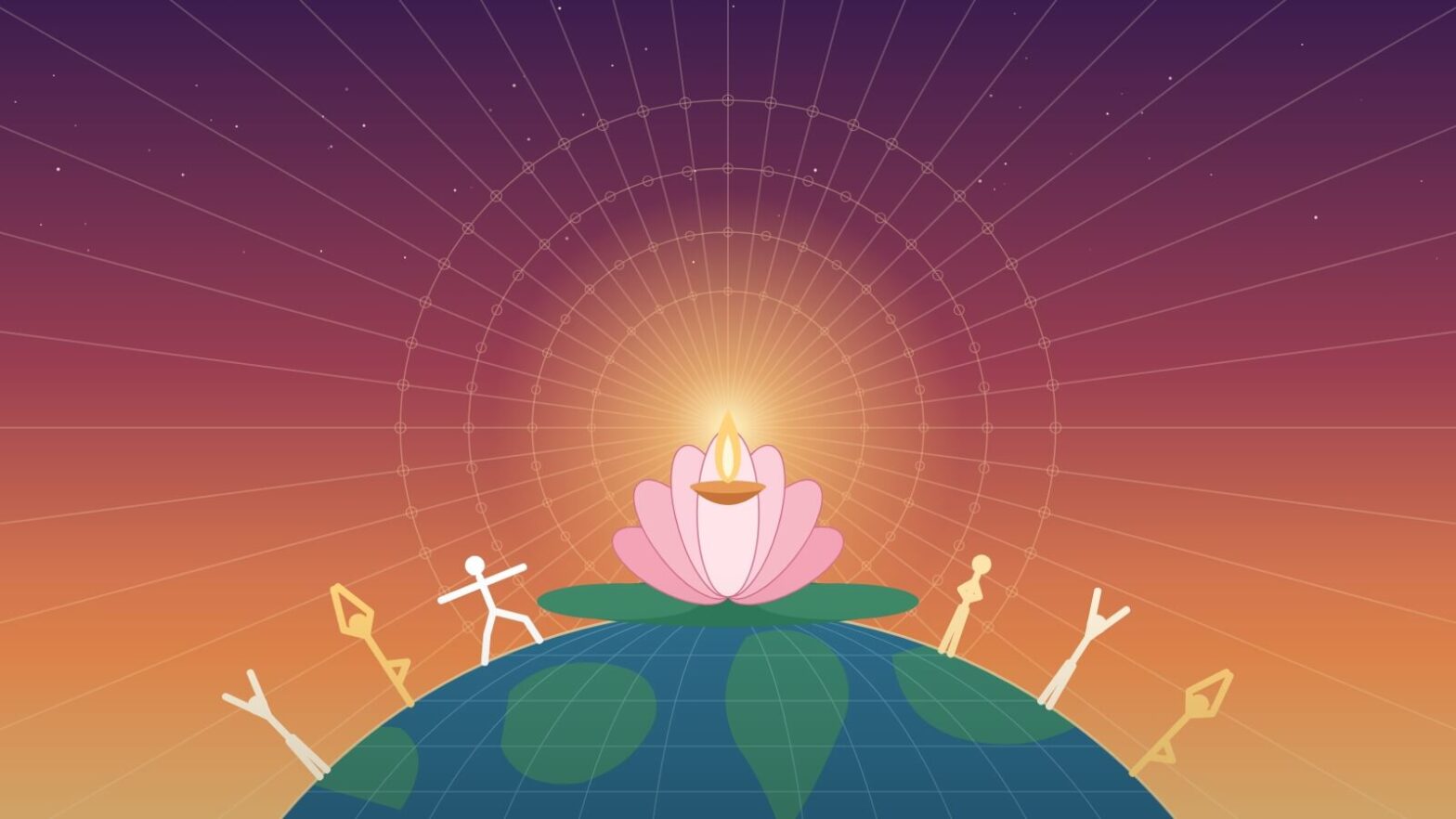
आ नो भद्राः क्रतवो यन्तु विश्वतः ॥
वसुधैव कुटुम्बकम् ॥
Two voices, separated by centuries, resonate with remarkable contemporary power. One invokes the wisdom that may come from every direction; the other embraces the world as one family. Together, they offer a glimpse into the civilisational imagination of Bharat: confident in its own inheritance, yet open to the world; rooted, yet not closed; secure in identity, yet willing to receive, engage and evolve.
Bharat is not merely an ancient civilisation with a rich past. Its civilisational memory endures, adapting and articulating itself in the present through its philosophies, knowledge systems, languages, literature, arts, traditions and ways of life. Its inheritance is not a museum piece trapped in time, but a living resource. Few civilisations have sustained, across millennia, such persistent inquiry into questions that remain fundamentally human: What constitutes a good life? What is the relationship between the individual and society? What is knowledge, and what is its purpose? Where does responsibility begin and end? What is Dharma? Is material attainment the ultimate purpose of life, or is there something beyond it? Most importantly, what does it mean to be human?
These questions did not arise in an age of artificial intelligence, globalisation, or climate uncertainty. They were central to Bharat’s civilisational inquiry long before the modern world developed its present vocabulary.
From Power to Influence
Power was not an unfamiliar concept in ancient Bharat. The political landscape encompassed kingdoms, alliances, competition, diplomacy, negotiation and warfare. The Ramayana and Mahabharata offer rich reflections on kingship, diplomacy, persuasion, alliances and political responsibility, while Kautilya’s Arthashastra presents a sophisticated framework for statecraft and interstate relations.
Yet a closer reading shows that force was not the sole instrument of influence. In the Ramayana, envoys and negotiations precede military action; in the Mahabharata, diplomacy precedes the great war, culminating in Krishna’s peace mission. Kautilya’s four upayas – sama (conciliation), dana (inducement), bheda (dissension) and danda (force) – similarly demonstrate that political influence could operate through multiple instruments rather than military strength alone.[1]
The modern vocabulary of soft power emerged much later. Joseph S. Nye introduced the concept in Bound to Lead (1990) and developed it further in Soft Power: The Means to Success in World Politics (2004), defining soft power as the ability to achieve preferred outcomes through attraction and persuasion rather than coercion or payment.[2]
This raises an intriguing question: did ancient Bharat possess dynamics that resemble what the modern world now calls soft power? The question is not whether ancient India consciously pursued a modern foreign-policy doctrine called “soft power.” It did not. The more useful question is whether forms of influence existed that travelled through ideas rather than conquest, through attraction rather than coercion, and through knowledge, culture, values and relationships rather than force. The historical record suggests that they did.
Ideas, philosophies, spiritual traditions, literature, artistic forms, languages, technologies, goods and systems of knowledge travelled across regions and, over centuries, across the seas. The movement was not always accompanied by armies. Sometimes it was carried by merchants, monks, scholars, pilgrims, teachers, artists and travellers. An idea needed only an interested audience.
This distinction matters. Hard power can compel behaviour; attraction can cultivate affinity. Yet culture by itself is not synonymous with soft power. Cultural resources become soft power when they generate attraction, credibility, relationships and influence. The more enduring form of influence arises when what is transmitted is perceived as possessing depth, meaning and continuing relevance.
Thus, soft power may be a modern term for a set of human dynamics that are much older. But global resonance suggests something further: the point at which civilizational resources cease merely to be projected and become meaningfully received, interpreted, adapted and lived by people beyond their original cultural setting. The more important question for contemporary Bharat is therefore not simply what civilizational assets does India possess? It is: how can a living civilisation translate its inheritance into contemporary relevance and, from there, into global resonance?
A Civilisation That Travelled
Ancient India was deeply connected to networks of trade, scholarship and religious exchange spanning Asia. Centres of learning such as Takshashila and Nalanda earned reputations that drew students and travellers from distant regions. Chinese pilgrims, including Xuanzang and Yijing, travelled to India to study Buddhist philosophy and texts, leaving detailed records of their experiences.[3] These encounters mattered because knowledge travelled with people. Manuscripts, philosophical ideas, medical knowledge, languages and artistic traditions moved through networks that were at once commercial, intellectual and spiritual.
The spread of Indian philosophical and religious traditions across Southeast and East Asia offers further evidence of this process. Sanskrit became an important language of elite and religious discourse in parts of Southeast Asia. The Ramayana and the Mahabharata were adapted into local literary and performance traditions. Indian cosmological and architectural ideas became part of the cultural landscape of regions far beyond the subcontinent. Angkor Wat in Cambodia and Prambanan in Indonesia stand as monumental expressions of this wider cultural encounter, while the Ramayana continues to live on in diverse local forms.[4]
The influence was never a simple one-way transfer. Local societies adopted, interpreted, adapted and transformed what they encountered. That is precisely what makes the phenomenon significant. Cultural influence becomes durable not when it is imposed, but when another society receives it and makes it meaningful. Bharat’s historical influence across Asia therefore offers an early illustration of attraction operating through culture, knowledge, spirituality and exchange. Its maritime and overland trade networks further strengthened these connections. Goods travelled with ideas; merchants travelled with stories; pilgrims travelled with philosophies. In several parts of Asia, cultural exchange was inseparable from commercial and intellectual interaction.[5]
The result was not a centralised programme of cultural diplomacy in the modern sense. For the most part, it was organic and decentralised. Its strength lay precisely in the intrinsic appeal of ideas, knowledge, artistic expression, spiritual traditions and material culture.
From Civilisational Capital to Contemporary Relevance
The richness of Bharat’s civilisational inheritance, however, does not automatically constitute contemporary soft power. Cultural resources become instruments of international influence only when they are transmitted, interpreted, supported institutionally and made relevant to contemporary audiences. This requires a conscious shift from triumphalism to responsibility.
A powerful legacy is not a weapon to brandish against others. It is an inheritance to be understood, researched, renewed and shared. Genuine civilisational confidence does not require a competitive hierarchy. It can acknowledge achievements without denying shortcomings and celebrate continuity without resisting reform. Bharat’s civilisational inheritance is strongest when treated not merely as evidence of past greatness but as a source of practical wisdom for present and future challenges. This also means resisting the temptation to museumify tradition. Authenticity does not perish when a tradition evolves; it dies when it stops breathing.
A civilisation that has endured for centuries has done so partly because it has continually renewed its forms while retaining deeper principles. Digital technology, contemporary art, film, music, education and new media can therefore serve as vehicles through which traditional knowledge remains vibrant rather than frozen. The objective should not be to preserve culture by preventing change. It should be to enable continuity through meaningful renewal.
From Wisdom to a Global Problem-Solving Resource
The deeper potential of Bharat’s civilizational inheritance lies in its ability to engage contemporary human concerns. The philosophical traditions of India repeatedly explore the relationship between consciousness, self, society and the larger universe. Concepts such as Dharma, Karma, Moksha, Bhakti, Jnana and Yoga offer different approaches to questions of ethical action, self-knowledge, responsibility, liberation and human flourishing.
The Purusharthas – Dharma, Artha, Kama and Moksha – offer an integrated framework in which material prosperity and legitimate human aspiration coexist with responsibility and the pursuit of deeper meaning. The enduring value of these ideas does not depend on presenting them as immutable doctrines. Their contemporary relevance lies in the questions they provoke and the possibilities they open.
This is particularly important at a time when the world faces interconnected crises of conflict, ecological degradation, mental distress, technological disruption and social fragmentation. The principle of Vasudhaiva Kutumbakam offers a vocabulary of interconnectedness rather than division. The relationship between Prakriti and Purusha invites reflection on nature and consciousness. The ethical dimensions of Dharma can inform conversations about responsibility in governance, technology and public life.
Such ideas cannot simply be exported as slogans. They must be authentically translated, tested in contemporary contexts, and, where appropriate, subjected to scientific and interdisciplinary inquiry. This is particularly relevant to artificial intelligence and biotechnology. Technological advancement is essential to development, but technological capability without an ethical framework can magnify human vulnerabilities. A Dharmic approach to technology would ask not only what can be built, but also what ought to be built, for whom, and with what consequences for human beings and the wider living world?
Similarly, an ecologically sensitive development model cannot treat nature merely as an unlimited resource. Bharat’s civilisational traditions offer multiple ways of understanding the relationship between human life and the natural world. These need not be romanticised; they can instead serve as starting points for contemporary ecological research and policy.
Keeping a Living Civilisation Alive
The greatest danger to civilisational continuity may not be change, but museumification—treating ancient texts, Sanskrit and traditions as objects to be admired from a distance, never questioned, interpreted or renewed. Bharatiya intellectual traditions themselves offer an antidote to this tendency. The Upanishads and the Bhagavad Gita are structured around questions, dialogues and encounters between teacher and student. The tradition of Shastrartha reflects an intellectual culture in which ideas could be examined, debated and challenged. This spirit is particularly important for younger generations.
A civilisation survives not merely when its heritage is preserved, but when each generation finds meaning in it and carries it forward in its own voice. Young people are unlikely to embrace an inheritance simply because they are told it is ancient. They are more likely to engage when invited to question, explore and test its relevance. When an ancient idea speaks meaningfully to contemporary psychology, leadership, sustainability, creativity or well-being, its relevance becomes experiential rather than ceremonial.
This ability to make profound knowledge accessible without diminishing its depth is also evident in the work of Gurudev Sri Sri Ravi Shankar, whose commentaries and discourses on the Upanishads, Bhagavad Gita, Ashtavakra Gita, Patanjali Yoga Sutras, and other streams of India’s philosophical and spiritual wisdom have brought these traditions into contemporary dialogue.
Rather than presenting them as remote philosophical texts, he explores their relevance to everyday human questions—relationships, stress, leadership, responsibility, happiness, consciousness and the search for meaning. His appeal across generations, including younger audiences, lies in his ability to retain the depth of the original wisdom while communicating it in a language and lived framework that contemporary minds can engage with. This offers an important model of civilisational transmission: knowledge remains authentic not by remaining untouched, but by remaining meaningful.
The same principle can guide the wider cultural sphere. Young filmmakers, writers, podcasters, and creators can retell Bharatiya stories. Architecture students can engage with traditional spatial principles alongside contemporary climate-responsive design. Management students can examine ethical leadership through the Arthashastra and Niti traditions. Students of environmental studies can explore historical Indian water-management systems alongside modern sustainability science. Music and the performing arts can be studied not merely as heritage, but also for their psychological, aesthetic, and social dimensions. The Bharatiya vocabulary therefore needs to be democratised – not diluted, but made accessible.
Gurudev Sri Sri Ravi Shankar: A Contemporary Case Study
The contemporary work of Gurudev Sri Sri Ravi Shankar offers an instructive case study of how civilisational knowledge can move from inheritance to lived global experience. The Art of Living, founded by Gurudev in 1981, has grown into a global humanitarian and educational movement whose programmes focus on stress reduction, meditation, human values and well-being. Its sister organisation, the International Association for Human Values, founded in 1997, has worked in areas including sustainable development, human values and conflict resolution.[6]
What is significant from the perspective of soft power is not merely the geographical reach of these organisations, but the way in which philosophical and yogic traditions have been translated into practices accessible to people across cultural and religious boundaries. Gurudev’s approach places concepts such as Dharma, Ahimsa, interconnectedness, meditation and self-awareness within contemporary conversations about mental well-being, leadership, social responsibility and peace.
His humanitarian work has also extended to communities affected by disaster, conflict and trauma. His engagement with Colombia’s FARC leadership in 2015, for example, was part of wider peace efforts during Colombia’s historic peace process.[7] Such initiatives illustrate a distinctive dimension of civilizational soft power: the ability to create spaces for dialogue where formal political instruments may be limited.
The Art of Living’s international volunteer network and large cultural gatherings likewise create opportunities for people from different countries, faiths, and cultural backgrounds to share experiences. In such contexts, Vasudhaiva Kutumbakam is not merely quoted; it is enacted through human interaction. Gurudev’s contribution can therefore be understood not simply as the revival of ancient practices, but as an experiment in translation: taking philosophical insights rooted in Indian traditions and presenting them as lived, accessible practices for contemporary global citizens.
This is an important lesson for Bharat’s broader soft-power strategy. Civilisational knowledge gains global resonance when people experience its relevance rather than merely hearing about its history.
Yoga: From Civilisational Practice to Global Language
Few examples demonstrate this transformation more clearly than Yoga. Yoga has travelled far beyond its original cultural context and now serves as a global language of physical and mental well-being. Its international acceptance also illustrates the role that state support, civil-society initiatives, and cultural diplomacy can play in transforming a civilisational practice into a globally recognised public good.
India’s proposal for an International Day of Yoga was adopted by the United Nations General Assembly in December 2014, and the first International Day of Yoga was observed on June 21, 2015. The initiative gave Yoga an unprecedented global platform and reflected the convergence of civilisational inheritance with contemporary international diplomacy.[8] The larger opportunity now is to move beyond Yoga as fitness or lifestyle branding and deepen its engagement with global conversations on mental well-being, stress, resilience and preventive health—while maintaining intellectual and scientific integrity. Here, too, the principle should be research, validation and accessibility without dilution.
Ayurveda and the New Architecture of Knowledge Diplomacy
Ayurveda offers another powerful illustration of how civilisational inheritance can translate into contemporary soft power. Its traditional knowledge systems encompass frameworks for health, diet, prevention, and the relationship between individual constitution and well-being. Yet its global credibility depends not merely on historical antiquity, but on evidence, quality standards, research, appropriate regulation, and responsible integration with contemporary healthcare. This is increasingly evident in India’s institutional approach.
The 2026 NITI Aayog Strategic Roadmap for Making Ayurveda Global explicitly links research, regulation, education, diplomacy, trade, technology and global health. Its objective is to identify systemic regulatory, institutional and perceptual barriers and to develop an evidence-based pathway for Ayurveda’s international expansion.[9] The WHO Global Traditional Medicine Centre in Jamnagar is another significant institutional platform. Established with support from the Government of India, the Centre focuses on research and evidence, data and analytics, sustainability and equity, and innovation and technology. WHO’s current strategy emphasises that traditional medicine must be evidence-based, safe, effective, equitable and sustainable.[10]
This is precisely the kind of transition that can turn cultural inheritance into contemporary soft power: not asking the world to accept a tradition merely because it is ancient, but creating the institutional conditions for its claims to be researched, tested, regulated and responsibly shared. Research is already exploring some of these intersections. A 2015 study published in Scientific Reports, for instance, examined correlations between Ayurvedic Prakriti classifications and genomic variation. Such work does not validate the whole Ayurvedic system, but it shows the possibility of bringing traditional conceptual frameworks into dialogue with contemporary scientific inquiry.[11]
The principle should therefore be neither uncritical glorification nor dismissive rejection. It should be rigorous inquiry. That approach is itself deeply compatible with Bharat’s intellectual heritage.
From Government Initiatives to a Soft-Power Ecosystem
India’s contemporary soft power is increasingly supported by an ecosystem of government initiatives spanning culture, education, knowledge, wellness, heritage and tourism. The Ministry of Culture’s international cultural engagement, heritage initiatives and manuscript-related programmes; the Gyan Bharatam Mission’s efforts to survey, conserve, digitise, translate and disseminate manuscript traditions; the Ministry of Education’s National Education Policy 2020 and the Indian Knowledge Systems initiative; the Ministry of AYUSH’s international cooperation and educational partnerships; the Ministry of External Affairs and the Indian Council for Cultural Relations’ cultural centres, scholarships and people-to-people exchanges; and tourism initiatives centred on heritage and pilgrimage all contribute to this wider ecosystem.[12]
The significance lies not in the number of programmes but in their convergence. Soft power increasingly operates not as a single instrument of foreign policy but as an ecosystem in which culture, knowledge, education, wellness, heritage, tourism, technology and human relationships reinforce one another. The challenge is to ensure that this ecosystem remains coherent, evidence-based and genuinely open to the world.
From Civilisational Roots to Global Resonance
The journey from heritage to soft power is therefore neither automatic nor linear. Civilisational inheritance provides the raw material. Contemporary institutions provide the platforms. Research lends credibility. Creative expression enhances accessibility. Young people provide renewal. And people-to-people relationships provide the human bridge through which attraction becomes trust.
This is where the distinction between soft power and global resonance becomes important. Soft power is the capacity for attraction and influence; resonance occurs when that influence is received, interpreted and made meaningful by others. Resonance cannot be manufactured by proclamation. It is earned through credibility, relevance, participation and trust. Bharat’s civilisational confidence can therefore be most persuasive when it does not seek to dictate to the world what it must become. Its greatest strength may lie in offering possibilities.
A world confronting mental distress can explore practices for inner well-being. A world confronting ecological crisis can examine traditions of interdependence with nature. A world navigating artificial intelligence can engage with questions of consciousness, responsibility and human purpose. A world fractured by conflict can revisit the language of Vasudhaiva Kutumbakam. A world seeking sustainable development can explore whether prosperity and inner well-being must necessarily be opposing aspirations.
This is not a call to romanticise the past, nor is it a claim that ancient knowledge offers ready-made answers to every modern problem. It is an invitation to engage in a more serious civilisational dialogue: to research the past rigorously, identify what remains relevant, test it in contemporary contexts, reform what needs reform, and communicate what is valuable without distortion.
Viksit Bharat@2047: Development with Depth
The vision of Viksit Bharat@2047 provides the broader context in which India’s evolving soft power can be understood. The Sapt Dhara framework places Soft Power and Global Influence among seven streams of India’s national endeavour, alongside manufacturing, agriculture and food processing, technology and innovation, Gati Shakti and infrastructure, Raksha Shakti, and the green and blue economy. The inclusion of soft power as a distinct stream is significant: it recognises that national development is not exhausted by material capacity. The ability to shape ideas, build relationships and contribute to global conversations is itself an element of national strength.
A developed Bharat need not be defined solely by economic size, technological capability or material prosperity. It can articulate a more comprehensive conception of development – one that combines prosperity with knowledge, innovation with values, modernity with civilisational continuity, and national strength with human and social well-being. In this context, civilisational inheritance is not merely the past to be preserved. It can become a living resource for the future.
Yoga and Ayurveda speak to well-being. India’s philosophical traditions offer profound reflections on consciousness, ethics and the self. Its knowledge traditions can stimulate fresh inquiry into mathematics, science, ecology, governance and education. Its pluralistic ethos offers a vocabulary of coexistence. Its languages, literature, arts, music, spiritual traditions and living cultural practices create avenues for human connection across borders. The task, therefore, is not merely to project these assets. It is to renew, research, validate, innovate and communicate them in forms meaningful to a contemporary, increasingly interconnected world.
This is where soft power becomes integral to Viksit Bharat@2047. A developed Bharat can aspire not only to be prosperous and powerful, but also to be consequential in shaping the ideas, values and possibilities that influence humanity’s future. The ultimate measure of civilisational soft power may therefore not be how loudly a nation speaks about its past, but how meaningfully its inheritance speaks to the future.
Bharat’s journey from civilisational roots to global resonance is not a journey from the past to the present. It is a journey from memory to meaning, from inheritance to relevance, and from relevance to responsible global influence. Perhaps the deepest expression of that influence remains contained in the two voices with which we began:
आ नो भद्राः क्रतवो यन्तु विश्वतः ॥
May noble thoughts come to us from all directions.
Author Brief Bio:
Dr Prema Seshadri is Senior Faculty, The Art Of Living Foundation, Bangalore, Karnataka, India
Dr Shobha Shrivastava is Faculty, The Art Of Living Foundation, Bangalore, Karnataka, India
References:
[1] Kautilya, The Arthashastra, trans. R. Shamasastry (Bangalore: Government Press, 1915); see also the discussions of diplomacy and political ethics in the Ramayana and the Mahabharata.
[2] Joseph S. Nye Jr., Bound to Lead: The Changing Nature of American Power (New York: Basic Books, 1990); Joseph S. Nye Jr., Soft Power: The Means to Success in World Politics (New York: PublicAffairs, 2004).
[3] Diana L. Eck, India: A Sacred Geography (New York: Harmony Books, 2012); see also accounts of Xuanzang and Yijing in scholarship on ancient Indian centres of learning.
[4] A. Singh and Amit Sarwal, “Paraspara, Encounters and Confluences: India’s Soft Power Objective in the Indo-Pacific Region,” Politics & Policy 45, no. 5 (2017): 733–61, https://doi.org/10.1111/polp.12222; see also scholarship on the transmission and localization of the Ramayana across Southeast Asia.
[5] K. M. Panikkar, India and the Indian Ocean: An Essay on the Influence of Sea Power on Indian History (London: George Allen & Unwin, 1951).
[6] Art of Living, “Gurudev Sri Sri Ravi Shankar”; International Association for Human Values, “Sri Sri Ravi Shankar: Founder,” accessed 21 October 2026, https://www.iahv.org/about-us/sri-sri-ravi-shankar/; Art of Living, “Key Addresses,” and related institutional materials.
[7] Art of Living, “From Meditation to Mediation: Address at the European Parliament,” Gurudev Sri Sri Ravi Shankar, 13 November 2019, https://gurudev.artofliving.org/work/leadership-ethics/from-meditation-to-mediation-address-at-the-european-parliament/; see also documentation concerning Sri Sri Ravi Shankar’s engagement with the Colombian peace process and FARC leadership.
[8] UN General Assembly, Resolution 69/131, International Day of Yoga, A/RES/69/131 (11 December 2014). The resolution proclaimed 21 June as the International Day of Yoga and was adopted with broad support from Member States.
[9] NITI Aayog, Strategic Roadmap for Making Ayurveda Global (New Delhi: Government of India, 2026).
[10] World Health Organization, WHO Global Traditional Medicine Centre: Annual Report 2025 (Geneva: World Health Organization, 2026), https://www.who.int/publications/i/item/9789240123656; see also WHO Global Traditional Medicine Centre, “About Us.”
[11] Periyasamy Govindaraj et al., “Genome-Wide Analysis Correlates Ayurveda Prakriti,” Scientific Reports 5 (2015): 15786, https://doi.org/10.1038/srep15786.
[12] Ministry of Culture, Government of India, “International Cultural Relations”; Ministry of Education, Government of India, “Indian Knowledge Systems”; Ministry of Ayush, Government of India, international cooperation materials; Indian Council for Cultural Relations, cultural and educational exchange programmes; Government of India, Gyan Bharatam Mission materials.
Bibliography
Art of Living. “From Meditation to Mediation: Address at the European Parliament.” Gurudev Sri Sri Ravi Shankar, 13 November 2019. https://gurudev.artofliving.org/work/leadership-ethics/from-meditation-to-mediation-address-at-the-european-parliament/.
Eck, Diana L. India: A Sacred Geography. New York: Harmony Books, 2012.
Govindaraj, Periyasamy, Sheikh Nizamuddin, Anugula Sharath, et al. “Genome-Wide Analysis Correlates Ayurveda Prakriti.” Scientific Reports 5 (2015): 15786. https://doi.org/10.1038/srep15786.
International Association for Human Values. “Sri Sri Ravi Shankar: Founder.” Accessed 21 October 2026. https://www.iahv.org/about-us/sri-sri-ravi-shankar/.
Kautilya. The Arthashastra. Translated by R. Shamasastry. Bangalore: Government Press, 1915.
NITI Aayog. Strategic Roadmap for Making Ayurveda Global. New Delhi: Government of India, 2026.
Nye, Joseph S., Jr. Bound to Lead: The Changing Nature of American Power. New York: Basic Books, 1990.
Nye, Joseph S., Jr. Soft Power: The Means to Success in World Politics. New York: PublicAffairs, 2004.
Panikkar, K. M. India and the Indian Ocean: An Essay on the Influence of Sea Power on Indian History. London: George Allen & Unwin, 1951.
Singh, A., and Amit Sarwal. “Paraspara, Encounters and Confluences: India’s Soft Power Objective in the Indo-Pacific Region.” Politics & Policy 45, no. 5 (2017): 733–61. https://doi.org/10.1111/polp.12222.
UN General Assembly. Resolution 69/131, International Day of Yoga. A/RES/69/131. 11 December 2014.
World Health Organization. WHO Global Traditional Medicine Centre: Annual Report 2025. Geneva: World Health Organization, 2026. https://www.who.int/publications/i/item/9789240123656.