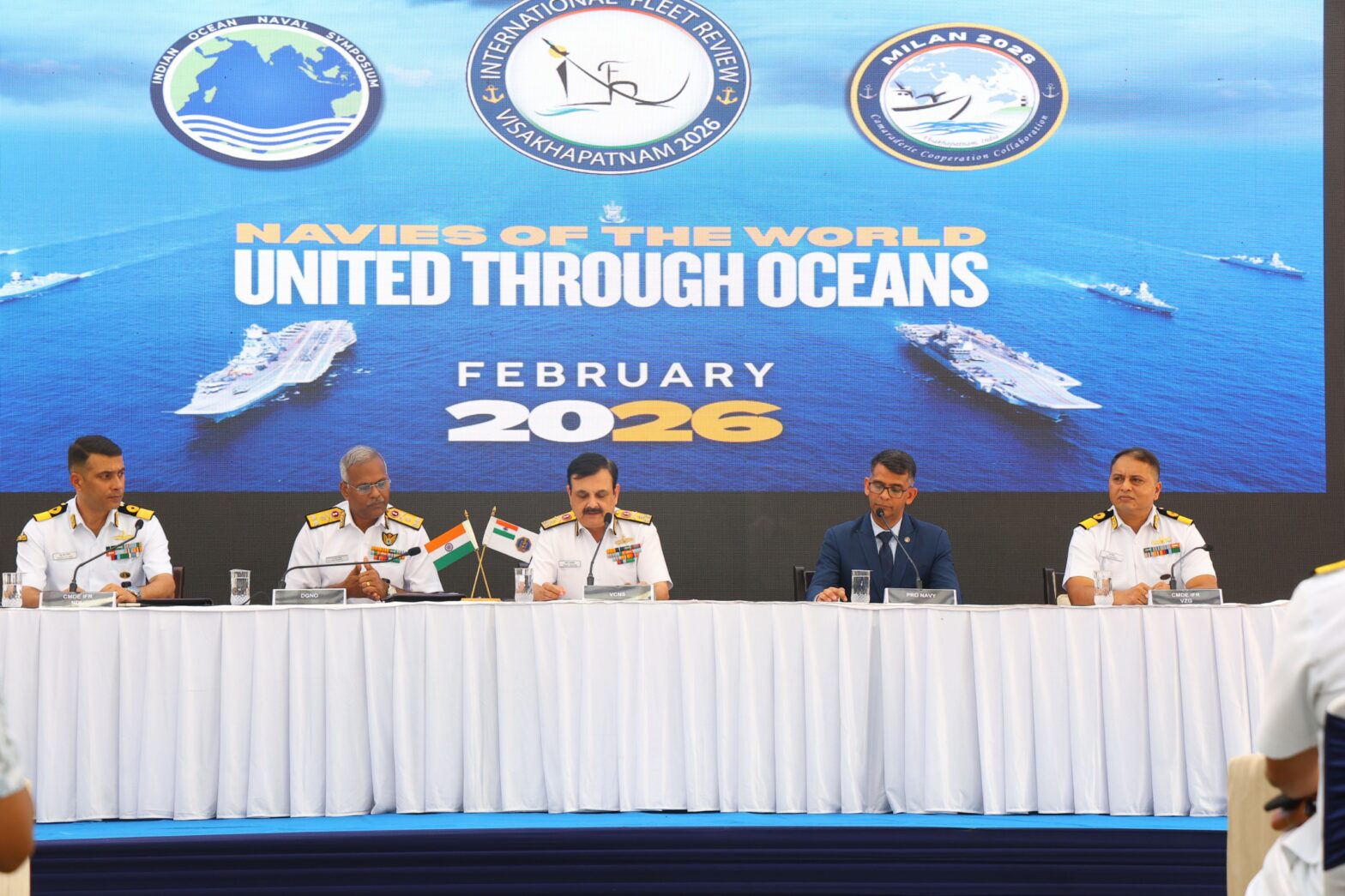
The Indian port city of Visakhapatnam served as the epicentre of global naval diplomacy for 10 days, from 15 to 25 February 2026. The Indian Navy held three major maritime events simultaneously in the city: the International Fleet Review (IFR) 2026[i], Exercise MILAN 2026 and the 9th Conclave of Chiefs of the Indian Ocean Naval Symposium (IONS) 2026. These events were attended by 74 countries, with 33 represented by their naval chiefs and heads of maritime security agencies[ii], creating a rare spectacle of international naval cooperation and professional camaraderie and demonstrating India’s growing maritime capabilities in the Indian Ocean Region (IOR).
The decision to hold all three events in Visakhapatnam was not based on logistics or convenience, but on a strategic choice to operationalise Prime Minister Narendra Modi’s vision of MAHASAGAR (Mutual and Holistic Advancement for Security and Growth Across Regions)[iii] and to demonstrate India’s intent to be a leading power in shaping the rules-based maritime order in the Indian Ocean.
The Strategic Context: China’s Expanding Indian Ocean Footprint
In the 21st century, China’s Indian Ocean strategy has evolved into a multi-layered approach to projecting power, and accordingly the People’s Liberation Army Navy (PLAN) has expanded its operational reach across the Indian Ocean. Although China officially has only one overseas military base, in Djibouti in 2017[iv], its actual strategic footprint in the region is far broader than this single facility. The growing number of dual-use ports, such as Gwadar (Pakistan), Hambantota (Sri Lanka) and Kyaukphyu (Myanmar), serve as potential logistical hubs that could support Chinese naval operations in the future. Chinese efforts to secure military access to ports in Tanzania and Mozambique on Africa’s east coast, if successful, would complement Djibouti and allow Beijing to influence events around the key maritime chokepoints in the northwestern Indian Ocean.[v]
The recent surge in Chinese research vessels in the IOR is equally concerning, with India tracking at least four dual-use Chinese research ships in the region by late 2025: Lan Hai 101, Lan Hai 201, Shi Yan 6 and Shen Hai Yi Hao.[vi] The Information Management and Analysis Centre (IMAC) and the Information Fusion Centre for the Indian Ocean Region (IFC-IOR)[vii] of India, based in Gurugram, have been tracking these developments closely, fully aware that a strong maritime domain awareness is the first line of strategic defence. In this context, China’s long-term Indian Ocean strategy, which combines political influence over littoral states, naval expansion, dual-use infrastructure and deep-sea data gathering, puts the Visakhapatnam naval trifecta in a stronger strategic position.[viii]
International Fleet Review (IFR) 2026: Projecting Capability
The International Fleet Review (IFR) 2026, which took place on 18 February 2026 with President Droupadi Murmu as the reviewing authority,[ix] was the ceremonial highlight of one of the largest maritime gatherings in the Indian Ocean Region. It was India’s third IFR, after Mumbai in 2001 and Visakhapatnam in 2016, but the scale and political messaging of the 2026 edition were qualitatively different. In 2001, the IFR was attended by 97 ships from 20 countries, whereas in 2016, it was attended by 95 ships from 50 countries. IFR 2026, in comparison, had 85 ships and participation from 74 countries, reflecting a major expansion in India’s diplomatic reach at sea.[x] The participation of so many countries signifies a major deepening of India’s international engagement in the maritime domain.
IFR 2026 was a clear demonstration of India’s convening power and the Indian Navy’s ability to assemble a large and diverse maritime coalition, not on the basis of hard alliances or coercion but on voluntary trust and shared interests. For smaller Indian Ocean littoral states such as Seychelles, Maldives and Sri Lanka, India’s ability to host such a massive and inclusive event stands in sharp contrast to China’s largely bilateral and often debt-heavy model of engagement. The turnout at IFR 2026 itself told a story, and the presence of navies from Australia, Japan, France, Russia, South Korea, along with some countries from ASEAN and the African continent, showed that India’s maritime partnerships are open and non-exclusionary, not locked into rigid ideological blocs. This demonstrates the diversity and flexibility of New Delhi’s naval relationships.
For Moscow, participation in IFR 2026, despite Western sanctions and relative diplomatic isolation, is proof of a strong India-Russia defence relationship. The presence of Russian and Western navies at IFR 2026 sent a clear message that India would not allow its multilateral maritime platforms to be held hostage to great-power rivalry or bloc politics. This is a clear signal that, under India’s leadership, the Indian Ocean will remain a common space governed by common rules rather than be carved up into rival spheres of influence. IFR 2026 is a concrete manifestation of India’s multi-alignment doctrine in the Indian Ocean, where India is engaging with multiple major powers without joining any single bloc while working to preserve a cooperative, rules-based maritime order in the IOR.
MILAN 2026: From Regional Exercise to Indo-Pacific Platform
MILAN is the Indian Navy’s flagship biennial multilateral exercise. Launched in 1995, it was initially a small, regional exercise under the Andaman and Nicobar Command, with just four participating navies from Indonesia, Singapore, Sri Lanka and Thailand. Thirty years later, in 2026, it has grown into one of the biggest multilateral naval exercises in the Indo-Pacific region. The 2026 edition, the 13th, was held in Visakhapatnam, with 74 participating countries, including Germany, the Philippines and the UAE as new entrants. This sheer scale and diversity of participants reflects what MILAN has come to represent. The exercise is also a clear physical manifestation of India’s strategic autonomy. New Delhi projects itself as a navy that can work with everyone and is adversarial to none, seeking to stitch together a collective, cooperative maritime security architecture across the Indo-Pacific, which is the exact opposite of China’s Indian Ocean strategy, because the Chinese PLAN approach relies on bilateral deals and strategic dependencies and tends to undermine such collective and cooperative frameworks.
The transition from SAGAR (Security and Growth for All in the Region), announced in 2015 by PM Modi, to MAHASAGAR (Mutual and Holistic Advancement for Security and Growth Across Regions), launched in 2025, is also evident at sea in MILAN’s ever-expanding agenda. While SAGAR was largely Indian Ocean-centric and security-focused, MAHASAGAR extends further outward from the Indian Ocean to the Indo-Pacific and brings in economic diplomacy, technological connectivity, environmental sustainability, and much deeper professional interoperability between partner navies.[xi] The participants in MILAN now cover the Indian Ocean Region, Southeast Asia, the Western Pacific, Africa, and Europe, which is a clear indication that MILAN has come a long way since its inception as a regional confidence-building exercise to become one of the major Indo-Pacific maritime platforms of our times.
Indian Ocean Naval Symposium (IONS) 2026: Institutional Leadership in the Indian Ocean
The 9th Conclave of Chiefs of the Indian Ocean Naval Symposium, held in Visakhapatnam on 20 February 2026, had special institutional significance because India took over the IONS chairmanship from the Royal Thai Navy for the 2026-28 term. India has returned to the chairmanship after 16 years, following its first term as chair from 2008-10. The IONS, established by the Indian Navy in 2008, now has 25 member navies and 9 observers. The 2026 conclave was attended by naval chiefs and heads of maritime security agencies from 33 countries, underscoring the importance IONS has acquired as a regional maritime forum. The Philippines was also inducted as a new observer, expanding and strengthening the IONS’ cooperative framework.
As part of IONS 2026, India has outlined an action-oriented agenda for its chairmanship, including conducting the IONS Maritime Exercise (IMEX), continuing the deployment of the Indian Ocean Ship (IOS) SAGAR to IONS member states with multinational crews,[xii] and holding a series of structured maritime information-sharing workshops and dialogues to deepen operational interaction, professional exchanges, and capacity building across member navies. As the chair of the IONS, India has a chance to steer the forum towards maritime domain awareness, information sharing, and interoperability, as these are the areas where China has been seeking to create a unilateral advantage through the deployment of research vessels and by negotiating bilateral port agreements across the Indian Ocean. India’s IONS chairmanship is not just symbolic but a deliberate attempt to strengthen a collective and transparent information ecosystem in the Indian Ocean Region to counter the information asymmetries that Beijing’s approach seeks to introduce in the IOR.
India’s Response Architecture – MAHASAGAR
The MAHASAGAR vision builds on the earlier SAGAR doctrine and projects India as a global maritime power. IFR 2026, Exercise MILAN 2026, and IONS 2026 are manifestations of India’s maritime statecraft, projecting a coherent strategic posture. The Indian Navy is not merely managing the IOR security environment but also asserting custodianship over the maritime order, grounded in UNCLOS and freedom of navigation. India’s bid for custodianship of the Indian Ocean is not without substance, as it counters China’s revisionist agenda and expanding footprint in the region. Each of the three events represents a different aspect of this approach. IFR 2026 highlights India’s indigenisation in naval modernisation and its gradual shift towards a technology-driven area-denial posture in the IOR. MILAN 2026 builds interoperability and translates goodwill into collective security. IONS 2026 enables India to shape rules of engagement as chair, focusing on maritime domain awareness, information sharing and interoperability. Overall, India’s IOR approach differs from China’s bilateral, transactional and infrastructure-oriented engagement, as India provides multilateral, inclusive platforms based on voluntary participation, common doctrine and rules-based norms.
Visakhapatnam’s trifecta underscores India’s forward-looking posture and a new regional security framework based on cooperation. The Indian Navy’s status as a “preferred security partner” and “first responder” in the IOR provides littoral states in the IOR with a free-from-debt, free-from-political-baggage option for security support and capacity-building.[xiii] The spirit of MAHASAGAR aligns with the Indian vision of a free, open, inclusive Indo-Pacific region, one that is open to all in a common pursuit of progress, because it is not directed against anyone, is not exclusive or competitive, and does not aim to undermine the centrality of ASEAN or the existing open, transparent and inclusive regional architecture.
The Road Ahead
The three events in Visakhapatnam hold greater strategic significance because India has shown it can bring together all three dimensions of power in the Indian Ocean at the same time: hard power through an impressive display of fleet capabilities, soft power through large, inclusive multilateral exercises, and institutional leadership by setting the agenda on maritime norms and cooperation. By holding IFR, MILAN and IONS together in the same place at the same time, India sent a deliberate signal that its Indian Ocean strategy had gone beyond simply responding to China’s growing presence, and that New Delhi is now proactively seeking to set the rules, networks and security architecture of the region. As the Indian Ocean is emerging as the primary arena for major power competition, the Visakhapatnam trifecta of 2026 will probably be remembered as the moment when India signalled that it would not merely take part in the maritime contest, but would seek to define the conditions in which it would occur.
Author Brief Bio: Mr Siddharth Singh is a Senior Research Fellow at the India Foundation. He is also the Assistant Editor of the India Foundation Journal
References:
[i] IFR & MILAN 2026. (n.d.). IFR & MILAN 2026. https://www.ifrmilan26.com/
[ii] Global fraternity must join hands to tackle evolving maritime challenges, says Raksha Mantri as he inaugurates Exercise MILAN in Vizag. (n.d.). https://www.pib.gov.in/PressReleasePage.aspx?PRID=2230212®=3&lang=1
[iii] Desk, I. (2025, August 18). MAHASAGAR Initiative: India’s Global Maritime Outreach And Strategic Vision. IMPRI Impact and Policy Research Institute. https://www.impriindia.com/insights/policy-update/mahasagar-initiative/
[iv] Jazeera, A. (2017, August 1). China opens first overseas base in Djibouti. Al Jazeera. https://www.aljazeera.com/news/2017/8/1/china-opens-first-overseas-base-in-djibouti
[v] Singh, A. K. (2025, August 6). Harbors of Power: How China’s African ports are shaping India’s ocean Strategy – Australian Institute of International Affairs. Australian Institute of International Affairs. https://www.internationalaffairs.org.au/australianoutlook/harbors-of-power-how-chinas-african-ports-are-shaping-indias-ocean-strategy/
[vi] WION Web Team. (2024, January 15). What are 4 Chinese ships doing in Indian Ocean and why their movements are being closely watched. WION News. https://www.wionews.com/photos/what-are-4-chinese-ships-doing-in-indian-ocean-and-why-their-movements-are-being-closely-watched-1764333408418/1764333408425
[vii] Information Fusion Centre – Indian Ocean Region. (n.d.). Home. https://ifcior.indiannavy.gov.in/home
[viii] Singh, Swaran. (2026, February 11). Milan 26: India’s maritime diplomacy comes of age. The Diplomat. https://thediplomat.com/2026/02/milan-26-indias-maritime-diplomacy-comes-of-age/
[ix] ADDRESS BY HON’BLE PRESIDENT OF INDIA SMT. DROUPADI MURMU ON INTERNATIONAL FLEET REVIEW – 2026 | President of India. (n.d.). https://www.presidentofindia.gov.in/speeches/address-honble-president-india-smt-droupadi-murmu-international-fleet-review-2026
[x] HON’BLE PRESIDENT OF INDIA REVIEWS THE INTERNATIONAL FLEET REVIEW 2026 OFF VISAKHAPATNAM. (n.d.). https://www.pib.gov.in/PressReleasePage.aspx?PRID=2229820®=3&lang=1
[xi] Bhatt, P. (2025, November 21). SAGAR to MAHASAGAR: India’s maritime security achievements and way forward. South Asian Voices. https://southasianvoices.org/sec-f-in-r-mahasagar-india-11-21-2025/
[xii] INDIA ASSUMES CHAIRMANSHIP OF THE INDIAN OCEAN NAVAL SYMPOSIUM. (n.d.). https://www.pib.gov.in/PressReleasePage.aspx?PRID=2231000®=3&lang=2
[xiii] NatStrat. (n.d.). The Indian Ocean and its littorals. https://www.natstrat.org/upload/specialedition/the-indian-ocean-and-its-littorals-natstrat.pdf