
When I first travelled to Guwahati in the early 2000s, the city seemed frozen in a gentler era. It lacked the speed and sensory overload of Delhi, the city I had left behind, and felt worlds apart from the analytical rigour of my postgraduate studies in London. Guwahati then was an urban space characterised by modest infrastructure, limited tourism, and a rhythm of life described locally as lahey lahey—slowly, patiently, without rush. The hills overlooking the mighty Brahmaputra gave the city an impression of serenity, reinforced by the cultural traces of old tea-plantation families with their Burma teak furniture and perennial pianos. It was easy, initially, to romanticise this slower-paced world.
But the idyll dissolved quickly. Beneath the gracious hospitality and the early closing of homes and shops lay an unmistakable atmosphere of fear. Social gatherings ended by nine in the evening. Guests returned home in small convoys. Business families spoke in hushed tones about kidnapping risks and extortion demands. Even displays of minor prosperity—such as an expensive car or a new house—were seen as calculated risks. The city was not understated by choice; it had been made so by violence. Around the year 2000, conflict-related deaths in Assam included more than 300 militants and nearly 400 civilians (Ministry of Home Affairs, 2001). The state’s name travelled across the country not for its tea or temples, but because of the United Liberation Front of Asom (ULFA), a separatist organisation formed in 1979 that sought an independent, sovereign Assamese state (Phukon, 2002). ULFA’s operations were not isolated: the group maintained ties with the National Socialist Council of Nagaland (NSCN) and Myanmar’s Kachin Independence Army, embedding Assam’s violence within a web of regional insurgency (Sinha & Goswami, 2011).
As I travelled further through the Northeast, I realised that the insurgent landscape extended well beyond Assam. Almost every state harboured its own militant outfit promoting an ethnic-nationalist vision of sovereignty. NSCN’s vision of “Nagalim” spanned Nagaland, Manipur, Assam, and Arunachal Pradesh, redefining territorial boundaries based on Naga identity rather than current state borders (Shimray, 2008). Tripura’s National Liberation Front of Tripura (NLFT) sought to establish a sovereign Tripuri homeland, while Meghalaya’s Garo National Liberation Army (GNLA) campaigned for a Garo homeland. Manipur, where insurgency had persisted since the 1960s, saw groups like the United National Liberation Front (UNLF) demanding an independent socialist state (Haokip, 2016). Throughout the region, these movements fostered a widespread us-versus-them mentality, with local populations often caught between state forces, militant organisations, and the pressures of survival (Misra, 2000).
It was in this environment that I began my own research on insurgency, travelling to remote districts where roads were unreliable and militant checkpoints operated with impunity. One of my early journeys took me to Dima Hasao, where an overnight bus ride included multiple stops by armed groups collecting “road tax”—a euphemistic term for illegal extortion. Exhausted, I checked into a school run by the Vanvasi Kalyan Ashram (VKA), an organisation inspired by the Rashtriya Swayamsevak Sangh (RSS). The school offered free boarding and education for tribal children who lacked access to basic schooling. Its headmistress—a retired State Bank of India employee from Pune—had chosen to spend her post-retirement years in this conflict-ridden area. Her quiet determination challenged every stereotype of RSS-affiliated workers as doctrinaire or rigid; here was a woman who could have lived comfortably in Maharashtra but instead taught in a district where insurgency was routine.
The children at the school quickly reshaped my understanding of how nationalism is experienced far from the nation’s metropolitan centres. They were most excited to tell me about their recent trip to Mumbai, their first time on a train and their first sight of the sea. For them, the school was not simply an educational institution; it was their gateway to an India they had only imagined. Their simple joy at singing the national anthem each morning stood in stark contrast to the separatist rhetoric dominating the region. In communities where separatist groups enforced identity boundaries violently, these children lived a form of innocent nationalism that undermined the ideological clarity of those who insisted they were citizens of future sovereign homelands rather than of India.
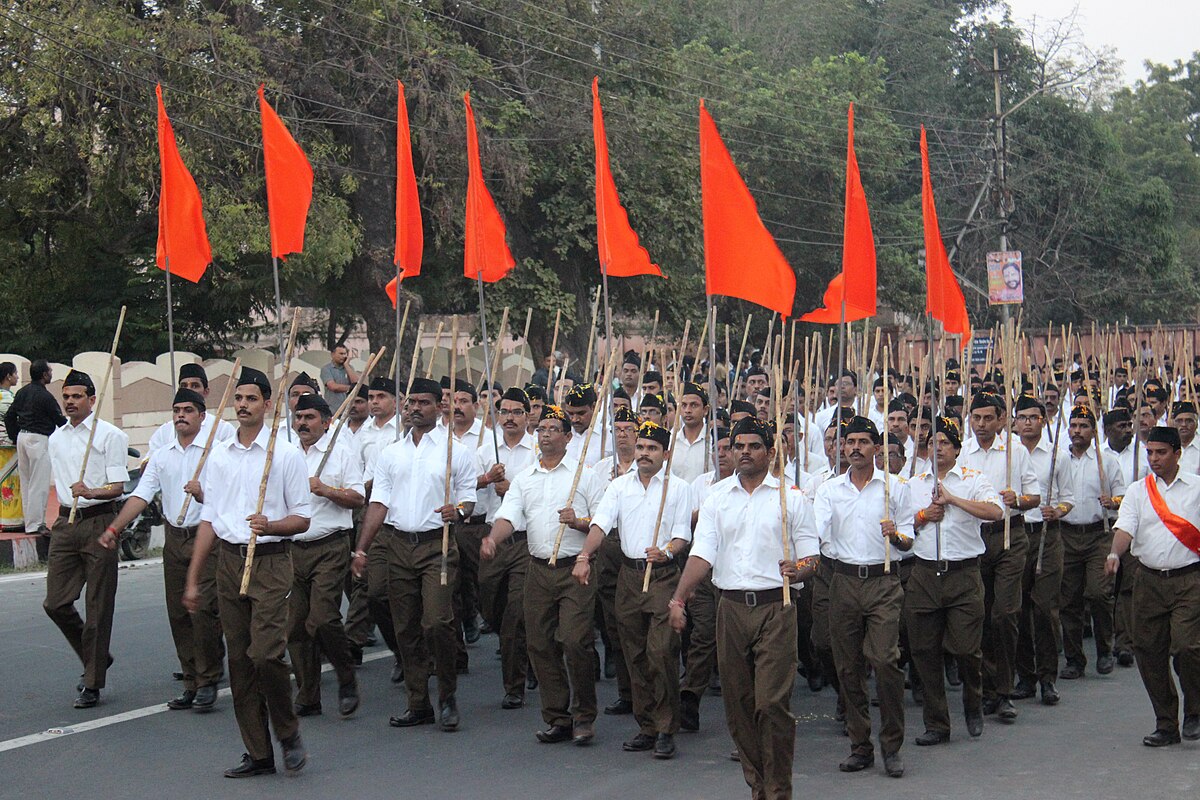
Across the Northeast, I observed this pattern repeated. For each separatist group, there was an RSS shakha or an affiliate organisation—collectively known as the Sangh Parivar. These included the Rashtriya Sevika Samiti, Seva Bharati, Vanvasi Kalyan Ashram, and the Akhil Bharatiya Vidyarthi Parishad (ABVP). Their work was quiet, decentralised, and persistent. Scholars often describe the RSS network as “cellular,” capable of adapting to different social environments through embedded volunteers, long-term cultural engagement, and welfare activities (Andersen & Damle, 2019). The Northeast was no exception.
The question that repeatedly struck me was how this network had penetrated so deeply into a region characterised by linguistic diversity, missionary influence, and violent separatism. To grasp this, one must look back to 1946, when the first RSS shakha was founded in Guwahati on 27 October by three pracharaks—Dadarao Parmarth, Vasant Rao Oak, and Krishna Paranjpe (Deshpande, 1993). Their mission aligned with the organisation’s broader aim: uniting people through a shared national-cultural narrative that transcended ethnic, linguistic, and religious identities.
Early expansion was driven more by social engagement than political mobilisation. Initiatives such as the Pahari Sewa Sangh, later incorporated into VKA, aimed to build relationships with tribal communities through active participation in daily life. This was not superficial cultural outreach typical of state-led programmes. Instead, it involved establishing mutual trust through prolonged immersion. Anthropologists studying the region observe that such trust-building is vital in overcoming the lingering suspicion of “mainland India” (Baruah, 2003). By the 1970s, every district in Assam had an RSS shakha.
The Assam Movement (1979–1985), which stemmed from concerns about migration from Bangladesh, marked a significant turning point. While the All Assam Students’ Union (AASU) called for the removal of all “foreigners” from electoral rolls, the RSS argued for keeping Hindu Bengalis, many of whom were religious refugees fleeing persecution (Weiner, 1983). The ABVP’s involvement in the movement helped prevent separatist groups from dominating its narrative. These actions gradually enhanced the legitimacy of the RSS among some sections of Assamese society, which had previously been cautious of external influence.
In the 1980s and 1990s, the RSS focused more of its energy on Christian-majority regions—Arunachal Pradesh, Nagaland, Meghalaya, and Mizoram. Instead of opposing Christianity directly, the organisation aimed to revive and institutionalise indigenous belief systems. One of the most frequently cited cases, documented in ethnographic research, involves Rajesh Deshkar, a pracharak who worked with tribes in Changlang district of Arunachal Pradesh to give visual form to the deity Rangfraa (Longkumer, 2018). Over several months, he sketched multiple versions of Rangfraa based on tribal descriptions. When a statue was finally commissioned and brought from Rajasthan, many villagers reportedly hid in awe and fear, having never visualised their deity in physical form. Today, more than a hundred Rangfraa temples are found in the region.
Similar patterns appeared as the Sangh supported the revival of Sanamahism in Manipur, the Heraka movement among the Zeliangrong tribes of Nagaland, and the Seng Khasi faith in Meghalaya. These initiatives resonated with local communities who felt culturally marginalised by aggressive missionary networks. Scholars argue that the Sangh’s success in these regions arises from its ability to localise nationalism by embedding it within indigenous worldviews rather than imposing an external ideology (Jaffrelot, 2011). In doing so, the RSS developed a language of belonging that was neither homogenising nor assimilationist but rooted in “civilisational commonality.”
However, this journey was not without a heavy cost. Advocating for national unity in the Northeast often involved confronting separatist groups that saw nationalists as barriers. ULFA carried out several killings of RSS workers over the years. Shashikant Chauthaiwala, a seasoned pracharak, recounts in his memoir the murders of Murli Manohar, Omprakash Chaturvedi, and Pramod Narayan Dikshit, along with Assamese pracharaks Sukleshwar Medhi and Madhumangal Sharma (Chauthaiwala, 2015). In Tripura, the combination of militant activities by the NLFT and the anti-Hindu stance of the then CPI-M state government fostered further hostility. In 1999, the NLFT abducted four pracharaks—Shyamal Sengupta, Dinen De, Sudhamay Datta, and Subhankar Chakraborty. Despite negotiations at the national level, all four were executed in the Chittagong Hill Tracts (Ministry of Home Affairs, 2000). Such incidents highlight the brutal reality of nationalist mobilisation in regions where sovereignty itself is disputed.
Yet the Sangh persisted. From a single shakha in 1946, its network expanded into hundreds of educational institutions, hostels, training centres, and daily shakhas across the region. Their work fostered a countervailing narrative to militant separatism: one that portrayed India not as an external power but as a shared civilisational space. For tribal children who travelled to distant Indian cities for the first time, nationalism was not an abstract idea but an experience of geographic and emotional connection. Through thousands of small interactions—singing the national anthem each morning, travelling beyond their districts, interacting with volunteers from across the country—students encountered a version of India difficult to reconcile with separatist visions.
This cumulative influence has transformed the sociopolitical mindset of the Northeast. While separatist groups exploited fault lines of language, ethnicity, and religion, the RSS aimed to dissolve them through cultural outreach, welfare initiatives, and ideological perseverance. Many scholars argue that the Sangh’s model in the Northeast exemplifies one of the most successful cases of grassroots nation-building in India’s postcolonial history (Andersen & Damle, 2019). The organisation’s capacity to withstand violence, adapt strategies, and embed itself in local contexts has allowed it to become a key player in shaping regional political awareness.
Today, the work continues—lahey lahey, slowly but steadily. The psychological distance between the Northeast and the rest of India has narrowed significantly, even as challenges persist. The figure of Bharat Mata, the symbolic representation of the nation, gains significance only when children from the most remote corners can encounter other parts of the country. Like the children of Haflong who saw the sea for the first time, a unified national imagination emerges not from state slogans but from lived experience.
The story of the RSS in the Northeast is thus not merely about organisational expansion but about transforming how belonging is understood in a region historically marked by fragmentation. It is the story of nationalism experienced quietly rather than loudly proclaimed, cultivated through relationships rather than coercion. And it remains, by its very nature, unfinished.
Author Brief Bio: Rami Desai is an author, anthropologist, and scholar specializing in the North Eastern region of India. She holds degrees in Anthropology of Religion and Theology from King’s College, London. Her research focuses on ethnic identity, tribal issues, and insurgency. She is a Distinguished Fellow at the India Foundation and regularly contributes to major newspapers and news channels.
Note: A version of this article has earlier been published in Open the Magazine.
References:
Andersen, W. K., & Damle, S. D. (2019). The RSS: A view to the inside. Penguin Random House.
Baruah, S. (2003). Confronting constructionism: Ending India’s Naga war. Journal of Peace Research, 40(3), 321–338.
Chauthaiwala, S. (2015). My journey as a pracharak. Suruchi Prakashan.
Deshpande, R. (1993). The RSS in the Northeast: The beginning. Suruchi Publications.
Haokip, T. (2016). Ethnic conflicts and their implications in the Northeast. Strategic Analysis, 40(1), 36–49.
Jaffrelot, C. (2011). Religion, caste, and politics in India. Columbia University Press.
Longkumer, A. (2018). Reform, identity and narratives of belonging: The Heraka movement in Northeast India. Routledge.
Ministry of Home Affairs. (2000). Annual report 1999–2000. Government of India.
Ministry of Home Affairs. (2001). Annual report 2000–2001. Government of India.
Misra, U. (2000). The Periphery strikes back: Challenges to the nation-state in Assam and Nagaland. Indian Institute of Advanced Study.
Phukon, G. (2002). ULFA and the rising of Assam. Vikas Publishing.
Shimray, U. A. (2008). Naga identity: End of ethnicity? Economic and Political Weekly, 43(23), 21–24.
Sinha, A. C., & Goswami, U. (2011). Indian Northeast affairs: Continuity and change. Concept Publishing.
Weiner, M. (1983). The political demography of Assam’s anti-foreigner agitation. Population and Development Review, 9(2), 279–292.