Date: 16/10/2025 (Thursday)
Time: 15:00–17:00
Speaker: Shri Amar Sinha, Former Ambassador of India to Afghanistan
Topic: India’s Approach Towards Afghanistan under Taliban Regime
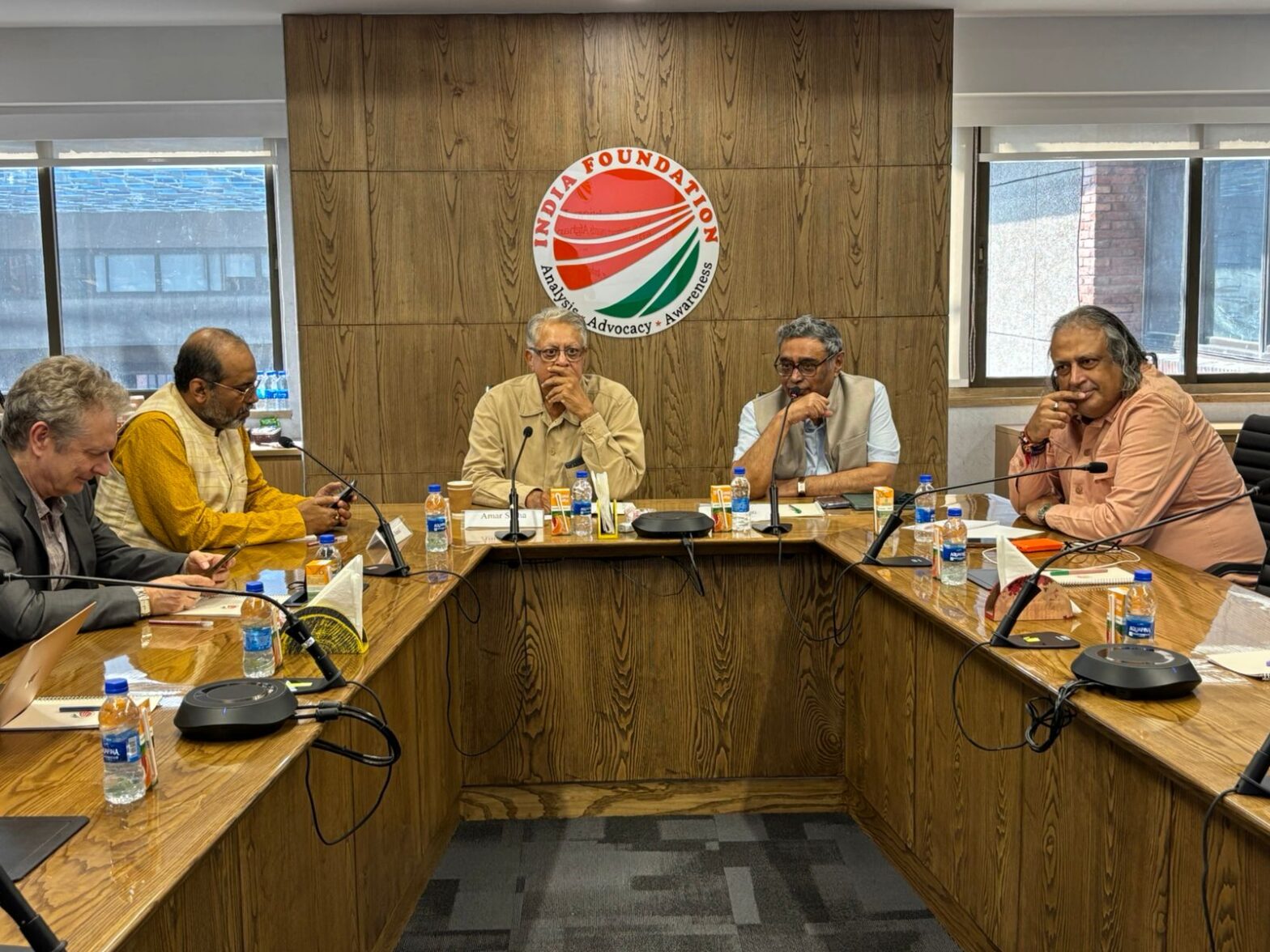
The 101st India Foundation Dialogue was held on 16 October 2025 from 3:00 PM to 5:00 PM (IST). The session featured Shri Amar Sinha, Former Ambassador of India to Afghanistan, who delivered an insightful address on “India’s Approach Towards Afghanistan under Taliban Regime.” The dialogue provided a pragmatic and historically grounded analysis of the evolving situation in Afghanistan and outlined the choices before India in dealing with the Taliban regime.
Shri Sinha began by tracing the Taliban’s evolution from its origins in the 1990s to its current form. He explained that the first Taliban was seen as a Pakistan-backed proxy created during the Afghan civil war, with no real legitimacy or control over the entire country. India, at the time, supported the Northern Alliance and viewed the Taliban as a destabilising force. However, after two decades of foreign military presence, the Taliban’s image within Afghanistan has transformed. The group has sought to portray itself as a nationalist movement that fought for independence from foreign occupation. This shift, he argued, was made possible by the corruption, inefficiency, and urban elitism of the previous Afghan governments, which alienated the rural and tribal base that forms the core of Afghan politics. “No nation—small, medium, or large, can be run by a diaspora sitting outside; it needs roots in the country,” he emphasised.
On Pakistan’s role, Shri Sinha observed that while Islamabad created and sheltered the Taliban, it has gradually lost control over them. The Taliban leadership in Kabul increasingly wants to assert its independence, even though Pakistan continues to exercise influence through certain factions. From the Afghan perspective, he said, India continues to be viewed positively, with centuries-old trade, cultural, and familial ties still shaping Afghan perceptions. Sinha warned, however, that India must avoid a Pakistan-centric lens in its Afghan policy. Reducing Afghanistan to a theatre of rivalry with Pakistan, he argued, weakens India’s credibility and makes its approach appear transactional rather than principled.
Discussing security issues, Shri Sinha maintained that while Pakistan-sponsored terrorism remains a challenge, it does not pose an existential threat to India. He cautioned against an overly security-driven view of Afghanistan and urged for pragmatic engagement based on ground realities. “We must deal with the situation as it is, not as we wish it to be,” he remarked. He noted that the Taliban’s internal structure is far from unified- there are visible rifts between the pragmatic, Kabul-based leadership and the hardline clerical faction. Although the Taliban government has managed to reduce corruption and improve customs revenue, its regressive social policies, particularly the restrictions on women, are eroding its internal legitimacy and drawing criticism even from conservative Afghans.
Shri Sinha also addressed the diplomatic complexities surrounding India’s engagement with the Taliban, highlighting recent incidents that exposed the sensitivities of such interaction. Despite these challenges, he emphasised that India must remain engaged to retain influence and prevent Afghanistan from drifting into deeper isolation. He lamented the sharp decline in trade, education, and medical exchanges between the two countries since 2021 and urged for their revival, noting that such people-to-people ties are crucial for both humanitarian and strategic reasons.
Concluding his address, Shri Sinha called for a calibrated policy that balances realism with principle. India, he said, should preserve its civilisational and cultural links with Afghanistan while safeguarding national interests through constructive engagement. Isolation, he cautioned, would strengthen hardline forces and reduce India’s leverage. The way forward, he suggested, lies in pragmatic diplomacy, developmental cooperation, and sustained humanitarian outreach, an approach that reflects both India’s strategic wisdom and its moral responsibility in the region.