
Trump’s Return: Trade Implications for India and the Global Economy
Introduction
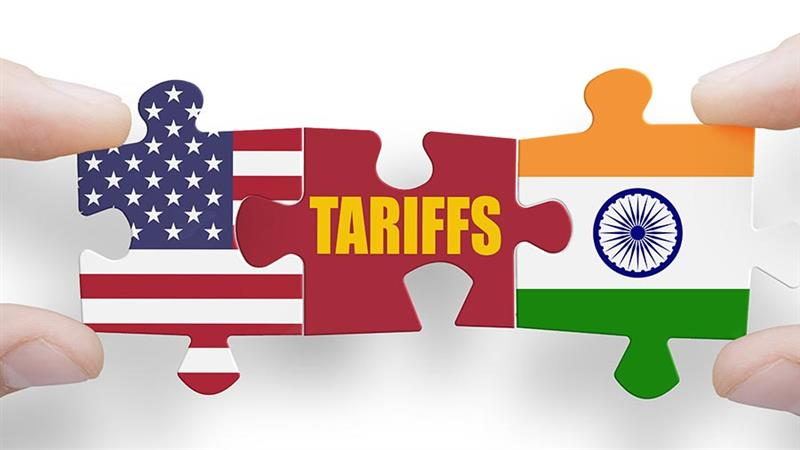
The return of President Trump to a second term ushered in a wave of sweeping tariff declarations, reigniting a global trade war that involved both allies and adversaries of the United States, ultimately plunging the world economy into a pronounced and far-reaching recession (Bouët, Sall & Zheng, 2024). These announcements, rolled out in successive stages, culminated in April with the imposition of reciprocal tariffs, prompting varied retaliatory responses from affected trading partners. The administration defended these unilateral tariff measures as necessary to address its persistent trade deficit with certain countries, blaming the imbalance on unfair trade practices. Central to its complaints were discriminatory tariffs, ongoing IPR infringements, and regulatory hurdles that hindered US exports and widened the trade deficit. Such tariffs may have briefly boosted customs revenues, but their broader implications cast doubt on the effectiveness of these measures. While some rationale supported the retaliatory approach adopted by the Trump 2.0 regime, the administration’s stance appeared unilateral. It contravened the spirit and rules of the multilateral trading system established in WTO agreements (Klingebiel & Baumann, 2024). The tariff increases were mainly a coercive tactic, aimed at pressuring trade partners into negotiations to rebalance trade relations and create a fairer playing field.
Through this, the US aimed to reduce its deficit by establishing bilateral or regional trade agreements. However, the core issue behind the imbalance was America’s unchecked domestic consumption. Without curbing domestic demand, its trade deficit was likely to continue. Instead of implementing structural reforms domestically, the Trump administration chose a populist strategy, shifting the burden of adjustment onto external trade policy. Additionally, the method used to set reciprocal tariffs was questionable, as these were often tied to the trade deficit levels rather than the extent of protectionism practised by partner countries. To strengthen its protectionist stance, the US employed or planned to use existing domestic laws, such as IEEPA, Sections 338, 301, 232, and 122, to restrict trade with specific partner countries, products, and regions. By June 2025, the heated rhetoric of the trade war began to ease, with negotiations resuming on various bilateral and multilateral platforms. How the international community responds to this changing tariff landscape remains an open question.
India, facing an average tariff of 26% on its exports, has not been immune to the consequences. To avoid a direct tariff clash, India has actively pursued economic agreements such as the ‘India–U.S. COMPACT’ and ‘Mission 500’ to strengthen bilateral trade relations. These initiatives cover both goods and services and seek to balance the trade relationship through mutual agreements. The US will benefit from market access in high-technology sectors, while India is given greater entry into labour-intensive segments. The long-term effects of these arrangements deserve careful examination, especially considering the unilateral imposition of a 26% reciprocal tariff by the US and India’s actions regarding US tariff policies.
Tariff Tremors: Global Response
The ‘America First Policy’ took centre stage during President Trump’s 2015 election campaign and has since remained a symbol of his political vision (Bukhari et al, 2025). It was the cornerstone of his first and second presidential terms, guiding the administration’s domestic and international stance. At its core, the policy aimed to revitalise domestic production—particularly in the manufacturing sector—to boost employment and to adopt a cautious approach towards regional integration. A key focus of the agenda was to pressure major trading partners into revising their trade frameworks to align with US efforts to narrow its growing global trade deficit. The policy’s operational focus involved strengthening the US influence over multilateral institutions such as the WTO and various UN bodies—including the WHO—alongside strategic use of tariff threats, withdrawal from the Paris Climate Accord, and a confrontational stance on immigration. However, this assertive nationalist approach has weakened the United States’ leadership in various areas of global collective action—ranging from climate change to multilateral trade—and has strained its economic relations with longstanding allies like the European Union, Canada, and Mexico, as well as strategic rivals such as China.
The initial course of action involved the sudden and comprehensive imposition of tariffs on several trading partners, aimed at reducing the growing bilateral and overall trade deficit of the United States. The US chose a unilateral approach in trade policy, trying to rebalance its bilateral trade gaps with key economic partners. These policy measures mainly aimed to protect the domestic manufacturing industry, prioritising aluminium, steel, and the automobile sectors. A significant factor contributing to the decline in US exports was widespread violations of intellectual property rights, often justified under the guise of ‘unfair trade’ practices. Other countries also saw similar practices, including forced technology transfers, non-transparent subsidies, and other structural distortions. These ongoing imbalances led President Trump to implement extraordinary policy measures designed to shift the trade balance in favour of the US and to address persistent bilateral deficits with certain nations.
Following the Executive Order issued on 20 January 2025, tariffs in various formats continued to be implemented until May of the same year. Due to their extensive scope and scale, only a few key tariff decisions are highlighted here for illustration. In January 2025, tariffs were significantly increased on imports from China, Mexico, and Canada—including steel—with Canada and Mexico facing 25% tariffs (10% on energy), and China facing 20%, justified by concerns over fentanyl trafficking and border security. In March, imports from Canada again faced a 25% tariff, with energy imports specifically taxed at 10%. A blanket tariff of 25% was also imposed on countries importing crude oil from Venezuela. Tariffs on steel and aluminium were designed to encourage the relocation of base metal manufacturing back to US territory. By April, the administration announced broad reciprocal tariffs affecting over 90 trading partners worldwide. Tariffs against China increased to 84% and 125%, before a 10% reduction was granted following the Geneva Accord. Steel and aluminium tariffs rose to 50% in May, establishing the US as the most tariff-protected economy in the industrialised world. The average tariff rate in the US rose from 2.5% in January to 27% in April, eventually decreasing to 15.6% in June after some reversals were announced.
Diverging Trade Deficit
The United States’ trade deficit with the rest of the world is a deeply rooted structural issue that cannot be solved simply by imposing trade restrictions. As a consumption-driven economy with a per capita income reaching $82,000 in 2023, the US shows a strong preference for imported goods, especially finished consumer products, which is a key reason for its growing trade deficit. The US dollar, the world’s reserve currency, remains in high demand worldwide, leading to a persistent appreciation that worsens the trade imbalance. This upward pressure on the currency makes imports more attractive while exports become less competitive, weakening the global position of American manufacturing. Recognising these structural inefficiencies, many U.S.-based companies have chosen to move their production overseas, unintentionally increasing pressure on the country’s external sector.
Additionally, global trade regimes have played a significant role in shaping the US’s external trade performance. During the second wave of the global recession, especially in 2017, the US economy saw a partial recovery, with exports and imports expanding compared to the previous global trade environment. However, this recovery was accompanied by an increase in the overall trade deficit, driven mainly by a resurgence in goods trade.
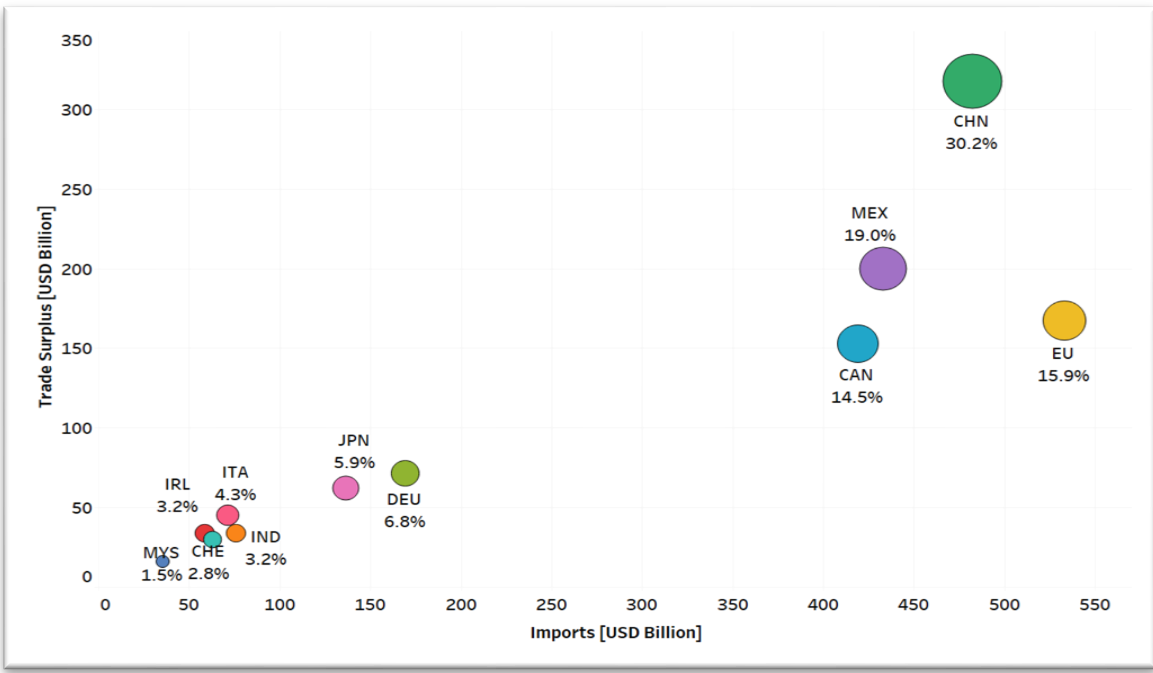
Figure 1: America’s Trade Gaps: Top Contributors by Country- Share in Overall U.S. Deficit, %
Source: RIS (2025)
The growing deficit in goods was partly offset by a favourable trade balance in the services sector, providing some relief. Nevertheless, the ongoing imbalance in goods trade negatively affected the current account and added to the gradual depletion of foreign exchange reserves. It is worth noting that the US external sector performed better in 2023 compared to 2022. In analysing the trade deficit, China emerged as the largest contributor, accounting for 30% of the total US trade gap, as shown in Figure 1, with a bilateral deficit of $317.7 billion in 2023. The US has also voiced concerns over its NAFTA partners, although bilateral trade flows—especially with Canada—have been more favourable than with other major trading partners. Bilateral trade tends to increase when the trade deficit ratio is low.
While the US showed lower bilateral trade deficit ratios as a proportion of total trade with Canada and Mexico (22.3% and 30.0%, respectively), countries such as China (49.1%), Italy (46.2%), and Ireland (40.7%) exhibited significantly higher proportions. Empirical analysis indicates that the US has struggled to sustain its global competitiveness in specific sectors, failing to maintain a consistent advantage across its major trading partners. Conversely, India recorded a relatively modest trade surplus of $33.8 billion with the US in 2023, representing 28.7% of bilateral trade. India recorded surpluses in agriculture and manufacturing while incurring deficits in minerals, along with signs of intra-industry trade in 2023 (RIS, 2025). The Indian trade surplus with the US appears to be structural, distributed across a broad range of sectors at the product level. Therefore, attempts to rectify this bilateral trade imbalance through tariff manipulation are unlikely to produce meaningful results.
Reciprocal Tariffs and Reconciliation
Reciprocal tariffs were implemented by the United States on 2 April 2025, with a comprehensive 10% tariff applied universally, alongside country-specific rates tailored to mirror the tariff structures of each trading partner. The Trump Administration targeted nearly 57 nations, notably exempting other NAFTA members from its scope. For several key partners—China, India, Japan, and others—tariff rates were determined based on various criteria, including existing tariff systems, bilateral trade imbalances, currency policies, etc. Unlike the uniform MFN tariffs approved by the WTO, these reciprocal tariffs varied significantly—China faced over 34%, Vietnam 46%, Thailand 36%, Japan 24%, and South Korea 25%. This policy also included India, with a 26% tariff levied on its exports. The impact was particularly felt in electronics, auto components, aluminium, and steel sectors, while industries like pharmaceuticals and energy exports were relatively exempt.
In response, some nations resorted to direct retaliation—China imposed 25–30% duties on soybeans, semiconductors, and automobiles, while the EU responded with tariffs of up to 25% on selected American goods such as whisky, motorcycles, jeans, and orange juice. India and others adopted more targeted strategies, penalising US exports like almonds, apples, walnuts, and pulses; Brazil notably reduced soybean shipments to China, undermining American trade interests. Others imposed non-tariff barriers—South Korea limited meat and poultry imports, while Japan introduced strict chemical compliance protocols for manufactured goods. Meanwhile, the US pursued a more conciliatory approach towards countries like Canada, Mexico, and Vietnam, opting for diplomatic negotiations and tailored bilateral agreements. By June, the Trump administration, aiming to de-escalate the growing trade conflict, stepped back from aggressive tariffs and pursued dialogue-based resolutions through bilateral deals. These agreements took various forms, involving strategic partners such as China, the EU, the UK, and South Korea. At the G7 Summit, the US and Canada committed to developing a new trade framework before July 2025—an approach India, notably, did not remain distant from.
Decoding Policy Impacts on India
Export advantage for India: A Structural Issue
India has consistently maintained a trade surplus with the United States — a crucial dynamic for a country that usually runs a persistent trade deficit with the rest of the world. With an ambitious export target of $2 trillion by 2030, India has aligned its ambitions with the Indo-US’ Mission 500′ initiative, which aims to increase bilateral trade to $500 billion by the decade’s end. This initiative fits well with India’s broader economic vision of becoming a $7 trillion economy by 2030. However, the path to this milestone is hindered by the current average tariff of 27% on Indian exports to the US. This barrier might impede India’s competitive ability to reach its export targets, especially with lower-cost exporters such as China.
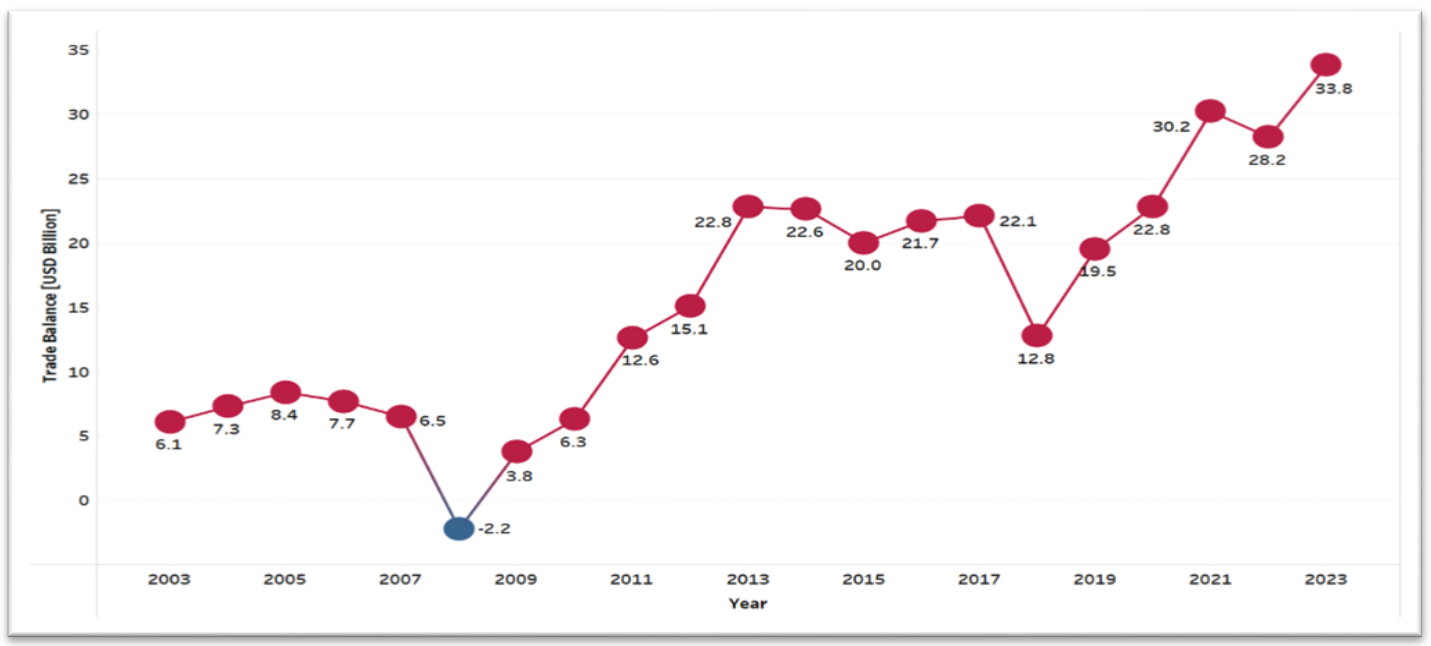
India has consistently been a competitive exporter to the United States across both primary and secondary sectors. Generally, India has maintained a trade surplus in agriculture and manufacturing, while the US has held an advantage in the mineral trade. Despite India’s significant and persistent trade deficit in hydrocarbons, its overall trade balance with the US remained favourable over the past twenty years, except for 2008, as shown in Figure 2.
Figure 2: Exporting Advantage: India’s Surplus Story with the US, $Bn
Source: RIS (2025)
This favourable balance remained steady during global economic growth, fluctuating modestly between $6.1 and $7.7 billion from 2003–07, before rising sharply from $3.8 billion in 2009 to $22.8 billion in 2013. Between 2014 and 2017, India’s trade surplus plateaued once again before experiencing a steep decline in 2018. The period from 2019 to 2023 marked another phase of rapid and consistent growth in India’s trade surplus, briefly interrupted by mild stagnation in 2022. Empirical evidence shows India’s strength in specific agricultural sub-sectors such as animal products, fruits and vegetables, and processed foods, while the US demonstrated competitiveness in oils and fats. In manufacturing, India recorded notable surpluses in chemicals (particularly pharmaceuticals), textiles and clothing, gems and jewellery, and machinery.
In 2023, India’s mineral imports amounted to $13.5 billion, yet a bilateral trade deficit of only $6.8 billion was recorded—an outcome attributed to intra-industry trade (IIT) within the same sector. Nonetheless, China remains a significant competitor for India in several product lines across the US market. Against President Trump’s 2.0 aggressive tariff regime, analysing at the product level across key target trade partners—Canada, China, Germany, Japan, South Korea, and Mexico—indicates that higher tariffs on China may spill over, indirectly impacting Indian exports. While these tariffs could restrict China’s access to the US market, India may not be able to fill the resulting gap across numerous product categories without initiating renewed negotiations under the umbrella of ‘Mission 500’.
Structural Trade Issue
The Trump administration remained convinced that India’s trade surplus in manufacturing and related sectors was a short-term anomaly, manageable through firm tariff-based strategies. The persistent bilateral trade deficit with India was not seen as a systemic economic issue and could be addressed using conventional tariffs or regulatory tools. As an emerging economy, India was often expected to export raw materials and import manufactured goods. However, this longstanding assumption does not hold in the case of Indo-US trade relations. Contrary to expectations, India does not export a significant volume of primary goods to the United States, while the US, in contrast, exports substantial amounts of such goods, especially minerals, to India. The U.S. has effectively become a net exporter of primary commodities to India. In 2023, India’s bilateral trade in intermediate goods with the US was valued at $52.6 billion, from a total bilateral trade volume of $117.8 billion. Within the intermediate goods sector, semi-processed products dominated, accounting for 68.8% of bilateral trade in this category. Although parts and components (P&C) comprised a relatively small part of this trade, India was expected to increase its dependence on the US for such imports. Nonetheless, India managed to sustain a trade surplus in semi-processed goods and the P&C sub-segments of intermediate trade.
As India progresses in its industrialisation, it is logical for its reliance to shift towards imports of final capital goods, ideally evident through increased bilateral trade volumes in this sector. However, that expected trend has not materialised. Furthermore, India’s most significant bilateral export segment remains final consumer goods, which has generated the highest trade surplus. This segment alone contributed a surplus of $23.7 billion out of the total $33.8 billion bilateral trade surplus recorded in 2023. The final consumer goods sector has thus become the primary source of India’s export earnings from the American market. It accounted for 66.7% of India’s final goods exports and 25% of the bilateral trade volume between the two nations.
Nevertheless, this heavy dependence on final consumer goods has become a strategic weakness for India. Within this category, Indian exports have shown a high concentration of a limited number of products. Specifically, just 44 products made up over 70% of India’s exportable items within the final consumer goods segment. These concentrated exports include processed foods, cotton & textiles, fish products, pharmaceuticals, footwear, carpets, and fresh produce. Such over-reliance could restrict diversification and resilience against policy shocks. Therefore, upcoming trade negotiations with the US should focus on securing stable and long-term market access for these key product lines.
Bilateral Arrangement: Mission 500
In February 2025, both nations launched ‘Mission 500’, a Multi-sector Bilateral Trade Agreement (BTA) to boost economic and technological cooperation. The BTA covers trade in goods and services, establishing a solid and future-oriented economic partnership. ‘Mission 500’ aims to double current bilateral trade flows in goods and services to reach a target of $500 billion by 2030. A core element of the agreement is a reciprocal framework, where the US seeks to improve access for its industrial products in India. At the same time, India aims for preferential terms for exporting labour-intensive goods to the U.S. India has long maintained trade surpluses in agro-based, low-technology, medium-technology, and even high-technology goods, reflecting its growing export capabilities across various sectors. Historically, the US has maintained high tariffs on low-technology goods; reducing these tariffs could help expand India’s access to the American market. The signing of ‘Mission 500’ and the India-U.S. COMPACT represents a significant development in bilateral relations. Under the BTA, India is expected to increase its imports of US goods and services, which will likely help balance the US’s persistent trade deficit with India. However, implementing high reciprocal tariffs could seriously challenge achieving the goals and cooperative spirit of ‘Mission 500’.
Conclusion
The second Trump administration’s tariff regime cast a long shadow, sowing pessimism among both allies and rivals of the United States. In its first five months, the administration unleashed a surge of bilateral and global tariffs as a bold assertion of its ‘America First’ doctrine. However, by June 2025, these tariffs were scaled back following negotiations with key trading partners. The cascade of tariff declarations from Washington prompted varied retaliation from affected nations. While major partners such as China and the European Union responded in kind with mirror tariffs as before, others employed more measured counterstrategies to navigate the pressure from the US’s unrelenting tariff offensive (Yu, 2020; Li, Balistreri, & Zhang, 2020). Adopting a more moderate stance, India chose to absorb the 27% reciprocal tariff while entering into negotiations that led to the India-U.S. COMPACT and the launch of ‘Mission 500’ in February 2025.
As such, India maintained a trade surplus of $33.8 billion with the US in 2023, supported by robust agricultural and manufacturing exports. Besides the primary sector, India has consistently recorded trade surpluses across multiple industries. Its strength particularly lies in exporting semi-processed goods and finished consumer products to the US market. Under the ‘Mission 500’ terms, both nations agreed to double their current trade volume in goods and services, aiming to reach a milestone of $500 billion by 2030. The agreement envisages reciprocal market access—India in labour-intensive goods, and the US in industrial sectors, especially high-tech products. India continues to post surpluses across low-, medium-, and high-technology sectors, even as the US imposes especially steep tariffs on low-tech imports. The American commitment under ‘Mission 500’ to reduce tariffs on labour-intensive goods could boost India’s future exports in this sector. However, the long-term success of ‘Mission 500’ depends on how effectively both sides manage future trade negotiations amid current high tariff tensions.
Author Brief Bio: Prof. S. K. Mohanty is a Professor at the Research and Information System for Developing Countries (RIS), New Delhi.
References
Bouët, A., Sall, L. M., & Zheng, Y. (2024). Trump 2.0 Tariffs: What Cost for the World Economy? Policy Brief, 49.
Bukhari, S. R. H., Jalal, S. U., Ali, M., Haq, I. U., & Irshad, A. U. R. B. (2025). America First 2.0: Assessing the Global Implications of Donald Trump’s Second Term. Qlantic Journal of Social Sciences and Humanities, 6(1), 51-63.
Klingebiel, S., & Baumann, M. O. (2024). Trump 2.0 in times of political upheaval. Implications of a possible second presidency for international politics and Europe.
Li, M., Balistreri, E. J., & Zhang, W. (2020). The US–China trade war: Tariff data and general equilibrium analysis. Journal of Asian Economics, 69, 101216.
RIS (2025), Trump’s Trade Policies Peril Global Economic Stability, Research and Information System for Developing Countries, New Delhi.
Yu, M. (2020). China-US trade war and trade talk. Berlin, Germany: Springer.
A New Case for Manufacturing and Supply Chains in India within the current geopolitical context
Introduction
The May 6, 2025, India-Pakistan conflict has raised questions about the future of South Asia’s regional economic integration. India has ceased all direct and indirect trade with Pakistan, halting a $10 billion annual exchange of goods. South Asia, as a region of aspiration, seems lost for some time. However, the geographical reality of proximity, common borders, and cultural affinity cannot be changed. India is a key destination for the shift of supply chains from China, and the region is the catchment area for these benefits. How, then, can the region play its role as the next big trade hub?
There are currently three imperatives for India to emerge as a manufacturing hub. The first is the Trump tariff effect, where India faces 26% reciprocal tariffs on exports to the US, the world’s largest high-income market. A second factor is Pakistan, whose tepid growth, low productivity, and lack of domestic reform are hindering the region, depriving it of the benefits of developing a supply chain ecosystem and ultimately prosperity. Thirdly, China and East Asia’s integration into global supply chains, which has generated jobs and unprecedented prosperity, provides valuable lessons for others, even amidst global trade policy uncertainty.
This indicates that South Asia is increasingly leaning towards trade in the new geopolitical context. Indeed, India is enhancing its trade engagement with the world, showcasing a series of free trade agreements (FTAs). Recently, Sri Lanka signed FTAS with Thailand and Singapore. Meanwhile, Bangladesh has been discussing FTAs with various Asian countries. This reflects a regional aspiration to establish the supply chain ecosystem necessary for an ambitious trade agenda.
It is none too soon. Starting in June, all of Apple’s iPhones for the U.S. market will be made in India, still cheaper despite the new U.S. tariffs. Samsung, Volvo, Siemens, and Amazon have announced they will expand their manufacturing footprint in the country. This is not a sudden shift following the imposition of U.S. tariffs. Multinational companies had already begun reducing their dependence on China before Covid-19, and its popularity as a manufacturing source was receding, particularly among Western firms.
This essay, therefore, examines the prospects for India and the rest of South Asia. It seeks to address the following questions:
- Is India rising as a global manufacturing hub?
- Is trade diplomacy in high gear at last?
- What lessons can we learn from China?
- How can India’s neighbours be lifted?
India’s Role in Global Manufacturing
The disruption of China-centric global supply chains is underway, with reports indicating that inward Foreign Direct Investment (FDI) has fallen to historic lows for both the U.S. and China (Baldwin, Freeman & Theodorakopoulos, 2023). The migration of labour-intensive supply chains from China to lower-cost locations can be attributed to rising wages, domestic supply chain bottlenecks, and investor concerns about stricter regulation of foreign companies, along with the escalating trade war between Washington and Beijing. Vietnam and Thailand have emerged as significant beneficiaries of these supply chain shifts. India is now being positioned to become a complementary Asian manufacturing hub to China (Wignaraja, 2023), regarded as a reliable alternative destination among the largest global FDI recipients, driven by its rapid economic growth, a large educated labour pool, and a vast domestic market (Economic and Social Commission for Asia and the Pacific, 2023).
An influential view, most prominently presented by Rajan and Lamba (2024), argues that India’s services sector is the primary driver of economic growth in an increasingly globalised world of services. They suggest that India should leverage its comparative advantages in labour to enhance its role in both the domestic economy and global services trade, particularly in digitally delivered services. They conclude that India ought to invest more in human capital and skills to capitalise on this strength in services. This view holds some merit, as India does possess favourable demographics with a youthful population, providing ample supplies of low-cost manpower. However, international development history indicates that relying solely on services development may be inadequate for a large economy like India to progress beyond lower middle status and create high-quality jobs.
The crucial role of manufacturing development in generating jobs and prosperity is emphasised by the East Asian miracle story. This narrative begins with the industrialisation of Japan during the inter-war period, followed by the emergence of the four East Asian dragon economies (Korea, Taiwan, Hong Kong, and Singapore) in the 1960s and 1970s, and China since the 2000s. Looking further back in history, the rise of the UK, Germany, and the US occurred alongside the industrial revolutions of the 18th and 19th centuries.
Furthermore, the evidence suggests that pessimism regarding manufacturing and supply chains in India appears to be shifting at last. One indication comes from within the Indian manufacturing sector itself. The Purchasing Managers Index (PMI) summarises whether market conditions for manufacturing are expanding, remaining the same, or contracting, as perceived by purchasing managers. India’s PMI is well above 50, relatively high compared to comparator economies including China and Indonesia (ADB, 2025). Furthermore, there have been significant micro-level investments by global MNCs in India. Prominent among these is Apple, which has been ramping up its manufacturing of iPhones in India since 2020; Toyota has increased its investment by establishing a new plant in Karnataka, and Hyundai’s 2024 investment in Maharashtra has enhanced its capacity and encouraged technological advancement. India’s manufacturing sectors in areas such as automotives, pharmaceuticals, and electronics assembly are already well-established and stand to benefit from a series of policy initiatives, which have resulted in a 69% increase in FDI equity inflow in the manufacturing sector over the past decade of 2014-24 compared to the previous decade of 2004-14.
Perhaps most important in uncertain global times has been the visible advancement in India’s defence manufacturing sector, largely due to the Make in India initiative (Ahuja, 2024). In 2023-24, it experienced an increase of 174% (CK) over the past decade, along with a boost in exports. India aims to become a defence manufacturing hub, targeting ₹3 lakh crore ($35 billion CK) in defence production by 2029. Start-ups, large domestic companies, and multinationals are actively developing a range of products. For instance, in 2024, Airbus, in partnership with Tata Advanced Systems, inaugurated a C295 final assembly line complex in Gujarat for producing military transport aircraft for the domestic market.
An impressive performance has been that of the BrahMos, a long-range supersonic cruise missile developed collaboratively by India’s Defence Research and Development Organisation (DRDO) and Russia’s NPO Mashinostroyeniya. India exported the BrahMos to the Philippines in 2024, and in 2025, it has been in talks with Vietnam and Indonesia for similar exports. In the conflict between India and Pakistan on 7-8 May 2025, the vastly superior performance of the BrahMos has resulted in increased inquiries for exports and enhanced discussions between India and Russia for advanced versions of the missile.
With this new confidence, India needs reforms that promote trade openness, reduce the red tape regulations strangling businesses, and facilitate investments in renewable green energy (Das, 2024; World Bank, 2024). Closer policy coordination between the central government and India’s semi-autonomous states is essential in areas such as attracting foreign direct investment and cross-provincial infrastructure development (including national highways and high-speed road networks).
Is there some merit in revisiting India’s landmark 1991 reforms? Influential commentators like Douglas Irwin (2025) suggest that the political economy of reforms matters. He argues that in 1991, reform-minded technocrats persuaded political leaders to reject what had been a standard response to balance of payments pressure (import repression to avoid a devaluation) and embrace a new approach (exchange rate adjustment and a reduction of import restrictions). Several other elements now need to coalesce. Supply chains rely on a multitude of service inputs. In this vein, India’s service sectors (including information and communications technology, financial and professional services, and transport and logistics) are also positioned for growth.
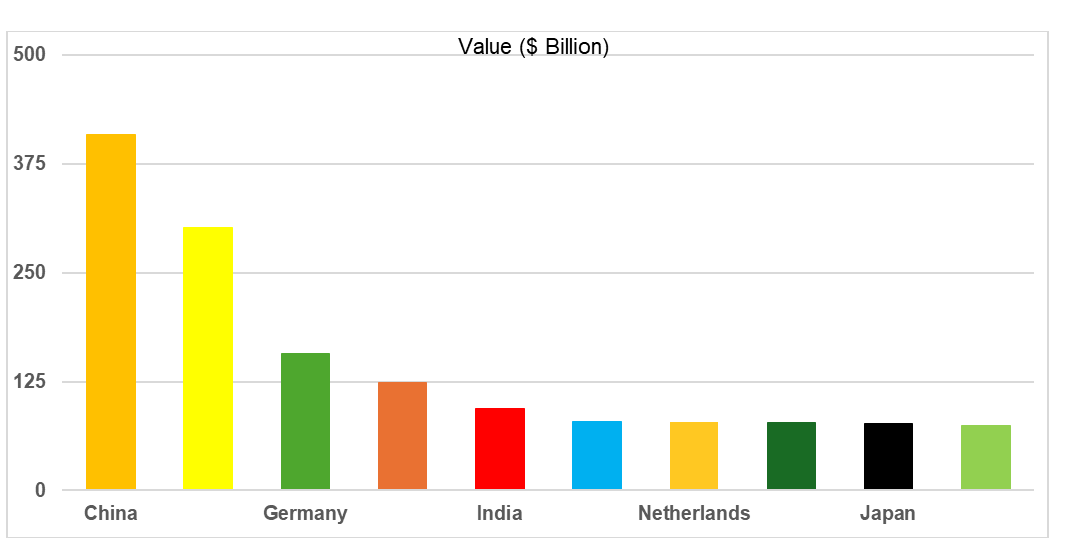
The final goods produced in these factories rely on sophisticated semi-finished goods from abroad, which have contributed to the growing Indian imports of intermediate goods. Thus, a second indication of India’s ascent in the global supply chain is its role as a major global importer of intermediate goods. In the fourth quarter of 2023, the WTO ranked India as the fifth-largest importer of intermediate goods (see Figure 1) – up from the 10th rank in the second quarter of 2021. In 2023, India was behind top global importers such as China, the U.S., Germany, and Hong Kong. The country is now positioned ahead of European developed country importers (the UK, Netherlands, and France) as well as Japan. Few foresaw India’s emergence as a leading global importer of intermediates a decade ago.
Figure 1: World’s Ten Largest Intermediate Goods Importers
Notes: Figures in $billion
Source: World Trade Organisation, 2023
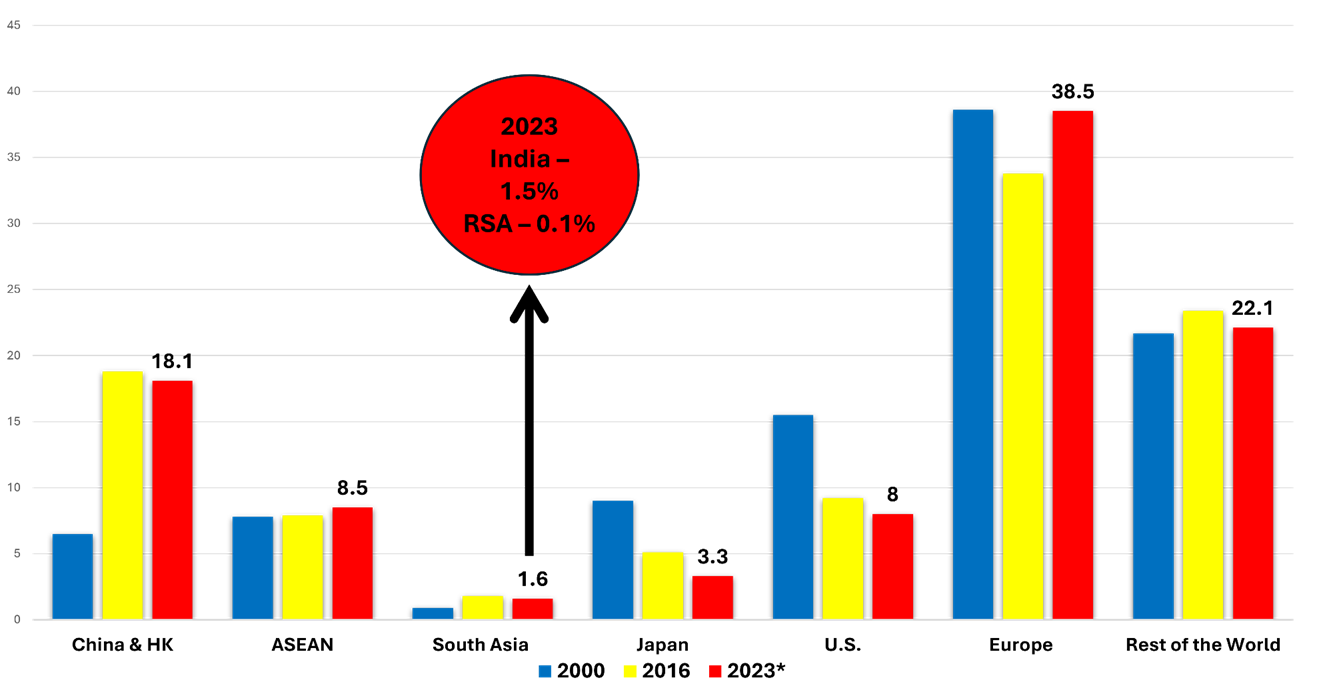
A third indication of India’s role in global supply chains is its position as an exporter of intermediate goods. Here, the data suggest that India and South Asia as a whole are relatively small players in supply chains compared to East Asian or developed economies. Between 2000 and 2023, India’s share of world intermediate goods exports doubled from a modest 0.8% to 1.5% (see Figure 2). Adding the rest of South Asia (an estimated 0.1% of world intermediate goods exports) to India’s share yields a tiny regional total of only 1.6% in 2023. Meanwhile, China and Hong Kong account for 18.1% of the world share, and ASEAN contributes another 8.5%. Although declining, Japan, the U.S., and the EU hold larger world shares than South Asia.
Furthermore, there are very limited regional spillovers from India’s supply chain activities to the rest of South Asia. Intra-regional trade in South Asia, at 5% in 2017, is among the lowest globally. This positions South Asia as one of the world’s most economically disconnected regions. Despite its increasing trade volume with the world, India’s trade with its neighbours constitutes between 1.7% and 3.8% of its global trade. India’s largest regional trading partner is Bangladesh, followed by Sri Lanka and Nepal.
Figure 2: South Asia in World Shares of Intermediate Goods Export (%)
Note: * represents estimates
Source: WTO (2023), Wignaraja (2023)
Trade Diplomacy in High Gear
Since 2022, the Modi government has renewed its emphasis on preferential openings with trading partners through a series of bilateral trade deals, such as the UAE-India Comprehensive Economic Partnership Agreement and the Australia-India Economic Cooperation and Trade Agreement (ECTA). Additionally, it has joined significant regional trade frameworks like the Indo-Pacific Economic Framework (IPEF) (Dhar 2022). A trade agreement signed with the UK in May 2025 offers notable gains in services and ambitious market access (Wignaraja, 2025). This will enhance ongoing negotiations with the EU to conclude an equally comprehensive, high-standard FTA and with the U.S. for a partial Bilateral Trade Agreement. India is a latecomer to Asia’s FTA bandwagon but is striving to catch up with East Asia (Kawai and Wignaraja, 2013; Wignaraja, 2022). According to the Asian Development Bank’s Asia Regional Integration Centre database, India has 17 concluded FTAs and another 19 under negotiation (see Table 1). In terms of concluded FTAs, India ranks alongside leading Southeast Asian countries like Indonesia (19), Malaysia (19), Thailand (16), and Viet Nam (18).
The geopolitical signalling regarding trade openness in 2025 is significant. India is progressing with free trade agreements with the Global North, which has positive implications across the board. Firstly, an India-EU FTA alongside an India-UK FTA could strengthen reformed global rule-making on international trade and potentially revitalise the WTO – a stated goal of India. Secondly, FTAs act as a stepping stone to India’s membership in the Comprehensive and Progressive Trans-Pacific Partnership (CPTPP). The CPTPP, a high-standard mega FTA that reduces trade barriers for its members and which India declined to join, represents a significant share of world trade. The 12 members, including Japan and the UK, collectively account for 15% of global trade and 15% of world GDP.
The CPTPP includes agendas for services, trade, investment rules, intellectual property rights, government procurement, etc., which support the spread of supply chains. Consultations with businesses during FTA negotiations and the provision of business development services for FTA implementation are essential, as trade and investment do not necessarily increase merely because an FTA is signed.
As Indian businesses gain experience and confidence in trading under the agreements with the Global North, facilitating closer economic integration, India can effectively study the economic benefits and costs of CPTPP accession. It provides access to multiple markets at once, will benefit India from the China+1 strategy, and boost business for MSMEs, which account for 40% of India’s exports. This will resonate throughout South Asia, where SMEs are the backbone of these economies but do not yet contribute significantly to exports.
Table 1: South Asia: Joining the bandwagon of FTAs
| Country | Negotiations launched | Concluded FTAs |
| Japan | 7 | 21 |
| China, People’s Republic of | 8 | 25 |
| Korea, Republic of | 12 | 28 |
| Hong Kong, China | 1 | 9 |
| Taipei,China | 2 | 6 |
| Brunei | 1 | 11 |
| Cambodia | 1 | 11 |
| Indonesia | 11 | 19 |
| Malaysia | 8 | 19 |
| Philippines | 3 | 11 |
| Singapore | 7 | 35 |
| Thailand | 10 | 16 |
| Vietnam | 2 | 18 |
| India | 19 | 17 |
| Sri Lanka | 5 | 7 |
| Bangladesh | 3 | 5 |
| Pakistan | 6 | 13 |
| Maldives | 1 | 4 |
| Bhutan | 2 | 3 |
Source: Asia Regional Integration Center, February 2025
At home, the FTAs will provide the country with a unique opportunity to implement necessary reforms and open up its economy, as it did in 1991. This, in turn, will increase foreign capital, enhance skills, foster R&D and innovation, and drive the country towards a more competitive and open economy.
Thus far, India has undertaken the following initiatives to enhance manufacturing:
- Make in India: Launched in September 2014, it aimed to transform India into a global design and manufacturing hub. The focus was on facilitating business by reforming policies to make them more investor-friendly and emphasising infrastructure development.
- Atmanirbhar Bharat: Launched in May 2020, the Self-Reliant India Campaign focused on reforming seven key sectors, particularly to facilitate business.
- Product Linked Incentive (PLI) Scheme: Launched as a continuation of Atmanirbhar Bharat, this initiative provides financial incentives for increased production and incremental sales across an additional 14 sectors. The objective is to support and enhance India’s manufacturing sector.
Lessons from China
Some aspects of China’s industrial policy may be relevant to India, such as better targeting of multinationals with which to partner for new industrial endeavours that could provide potential comparative advantages. It necessitates improved coordination between the central government and state administrations. Equally important is investment in higher education in science, technology, engineering, and mathematics.
However, industrial policy is a contentious area, and caution should be exercised before India attempts to emulate China’s state interventionist template. Significant risks include government failure and cronyism. It would be prudent to engage actively with think tanks to gain insights into what might work. Still, India can learn much from China’s experience.
- Lesson 1: Promoting export-oriented FDI. Trade liberalisation entails an open-door policy towards FDI in manufacturing and encourages high-level investment, offering competitive incentives and establishing modern SEZs as public-private partnerships.
- Lesson 2: Reducing business hurdles. The digitalisation of taxes, customs fees, and business administration is essential. Industrial policy aimed at facilitating the green transition and trade is increasingly being employed and can yield significant benefits.
- Lesson 3: Fostering regional supply chains. India should promote regional supply chains by scaling up the Make in India programme to a Make in South Asia initiative. India can offer fiscal incentives to its manufacturers to expand into Bangladesh and Sri Lanka. The food processing, textiles, apparel, and automotive sectors are suitable for regional expansion, considering the factories and expertise of these neighbours.
Lifting Up India’s Neighbours
At present, much of South Asia is not a significant part of India’s trade narrative, despite the economic potential of certain countries. Therefore, it is economically beneficial for India to disseminate the advantages from this trade regionally, fostering resilient and cost-effective regional supply chains in South Asia. This will stabilise the region, create jobs, and render its neighbours less vulnerable to the potential risks associated with Chinese infrastructure investments, including debt distress linked to high interest, low return port projects, as well as environmental challenges (e.g. deforestation, habitat destruction, water pollution, and increased carbon emissions).
In this spirit, India-Sri Lanka FTA talks could be resumed, with a view to concluding an investment deal, followed by a more comprehensive FTA. Cutting redundant business regulations and strengthening investor protections in Sri Lanka are crucial for attracting Indian foreign investors to the country’s ports, logistics, renewable energy, digital economy, and tourism ventures. Such ventures generate much-needed foreign exchange and provide Sri Lanka with a path away from indebtedness and towards transformative growth.
A sure way for South Asia to establish resilient and cost-effective regional supply chains is for Indian businesses to invest in the region and cultivate substantial local linkages and spillovers for their South Asian partners (Kathuria, Yatawara and Zhu, 2021). This is already occurring to a limited extent in Sri Lanka and Bangladesh. The Adani Group, for instance, has invested in a joint venture with John Keels Holdings to develop the West Container Terminal at Colombo Port. This project leverages Sri Lanka’s advantageous geographical position along the main East-West global sea route and transhipment trade to India.
Bangladesh was growing rapidly, boasting a larger domestic market and cheaper wages than Sri Lanka, until its internal crisis. It had become an attractive destination for Indian FDI in the manufacturing sector. Tata Motors, Hero MotoCorp, Sun Pharma, Godrej, VIP, CEAT Tyres, and Aditya Birla Cement all established factories in Bangladesh. A natural corollary would have been increased private investment in consumer-oriented sectors and start-ups focused on fintech, healthcare, and agritech, aimed at developing a local ecosystem with access to seed funding and technology transfer from India. However, these potential developments are now on hold due to political events.
India-Sri Lanka: A Model for South Asian Cooperation
The joint statement released following Prime Minister Narendra Modi’s visit to Colombo in April 2025, and Sri Lanka’s President Anura Kumara Dissanayake’s visit to New Delhi in December 2024, highlighted India’s commitment to assist Sri Lanka in becoming an energy hub, strengthening India-Sri Lanka defence cooperation, enhancing educational, health, and technological exchanges, and promoting Indian FDI in Sri Lanka.
It is evident that India recognises Sri Lanka as a premier partner in transforming South Asia into a progressive economic region amid an uncertain global economy. Sri Lanka has recorded the highest GDP per capita in South Asia, peaking at $4,388 in 2017, driven by a robust machine of medium and small enterprises. Its decline over five years to $3,3431 per capita has dealt a blow to a country used to a comfortable standard of living. This is what Dissanayake has pledged to reverse. He has affirmed that Sri Lanka will proceed with its 17th IMF programme while increasing social spending to alleviate high poverty levels. He is enhancing governance by implementing anti-corruption measures, digitising the government, and modernising agriculture.
The bilateral agreements with India assist the new government in continuing these efforts and shifting the focus of the relationship from aid to trade. India has committed to supporting Sri Lanka in the digitalisation of its public services, a model that India has pioneered, which will aid in fulfilling some of the promises made by the NPP for targeted social protection and anti-corruption. A Memorandum of Understanding (MoU) was signed during PM Modi’s visit to Colombo in April 2025 with Sri Lanka to establish a high-voltage direct current (HVDC) connection for importing and exporting power. A tri-partite agreement between India, the UAE, and Sri Lanka to develop Trincomalee into an energy hub is a model that can be replicated in other sectors.
It’s a promising start that can elevate the bilateral relationship to resemble the close cooperation evident among Thailand, Cambodia, and the Lao People’s Democratic Republic, for instance, in the Greater Mekong sub-region. New Delhi and Colombo can consider piloting a regional PLI scheme in Sri Lanka, similar to the Government of India’s efforts to build domestic capabilities in sophisticated manufacturing industries, including solar panels, electric vehicles, and electronic components. A limited extension of the domestic PLI scheme to Indian businesses for manufacturing solar panels in Sri Lanka will mitigate the risks of overseas investment and foster regional supply chains in the neighbourhood – a key goal for India’s China+1 strategy.
Such enhanced cooperation with Sri Lanka is almost a necessity. India is facing a hostile neighbourhood in 2025. Relations with Bangladesh are strained; the debt-distressed Maldives reluctantly accepted a short-term liquidity inflow from an RBI swap after China cooled towards its request for aid. Nepal’s Prime Minister K.P. Sharma Oli has just signed a framework agreement with China to implement infrastructure projects under the Belt & Road Initiative. Struggling economically under Taliban rule, Afghanistan risks becoming a regional centre for narcotics trade and illegal migration, as does Myanmar to India’s east. Relations with Pakistan remain in cold storage.
These issues concern both India and Sri Lanka. An effective economic partnership in South Asia can serve as a model for others, bolster India’s Neighbourhood First Policy, and enhance India’s position as a regional power.
Conclusion
The slowdown of the Chinese economy and the shift, particularly by MNCs, from China to other, more competitive locations, have opened up business opportunities for latecomers to supply chains in the developing world. The available evidence suggests that Southeast Asia and some South Asian countries, such as India, Sri Lanka, and Bangladesh, could benefit from the supply chain shift, particularly in labour-intensive segments. The shift is underpinned by geopolitics, as well as the availability of skilled and relatively low-cost labour and a large middle class. However, these factors carry constraints: Southeast Asia does not offer scale, and South Asia, which can, is a latecomer to trade-led regionalism, therefore constrained by policy barriers and infrastructure gaps.
Three policy implications arise from the analysis presented in this paper regarding the enhancement of India’s and the broader South Asia’s role in global supply chains. First, openness to trade and FDI inflows is fundamental for entering and deepening a country’s position in global and regional supply chains. The Trump reciprocal tariffs might be viewed as an opportunity for South Asia to implement comprehensive trade and FDI reforms, reduce red tape, and digitise business procedures to improve the ease of doing business and minimise corruption vulnerabilities. It may be prudent to reconsider the case for ‘big bang’ comprehensive reforms, as gradual, incremental reforms have yielded mixed results.
Secondly, countries should invest in trade-related infrastructure, such as transhipment ports, logistics services, and connectivity between ports and roads, to significantly reduce trade costs. In this context, enhancing the performance of Special Economic Zones (SEZs) to attract both foreign and domestic investors, along with the clustering of business activities, is advantageous as trade and investment reforms may require time.
Third, concluding comprehensive free trade agreements with India’s neighbours, such as Sri Lanka, would help to reduce regional trade barriers and establish rules-based trade in the region amidst global uncertainty. In this context, India should consider time-bound fiscal and financial incentives to encourage the regionalisation of supply chains in its neighbourhood, similar to its own PLI scheme.
Author Brief Bio: Dr. Ganeshan Wignaraja is Professorial Fellow in Economics and Trade at Gateway House and Visiting Senior Fellow at ODI Global in London. He holds visiting appointments at the National University of Singapore and RIS in New Delhi. He is a member of the Central Bank of Sri Lanka’s Stakeholder Engagement Committee on monetary policy and financial stability matters. Previously, he served on the WTO Director-General’s Task Force on Aid for Trade during the WTO Doha Round and the Sri Lankan Prime Minister’s Task Force on the Indian Ocean. In a career spanning over 30 years in the UK and Asia, he has held senior roles in international organizations (including the Director of Research at the Asian Development Bank Institute in Tokyo, Chief Programme Officer at the Commonwealth Secretariat in London and a Visiting Scholar at the IMF in Washington DC), government (including Executive Director of the Sri Lankan Foreign Ministry’s think tank), and the private sector (including Global Head of Trade and Competitiveness at Maxwell Stamp PLC in London). He also worked at the Institute of Economics and Statistics at Oxford University and the OECD in Paris. He has a DPhil in economics from Oxford University and a BSc in economics from the London School of Economics.
References
Ahuja, Anil, “Changes in India’s Defense Technology Development Policies Over the Decade”, Article, Vivekananda International Foundation, https://www.vifindia.org/article/2024/may/29/Changes-in-India-s-Defence-Technology-Development-Policies-Over-the-Decade
Asian Development Bank (ADB), Asia Regional Integration Center, “Free Trade Agreements” accessed April 01 2025. https://aric.adb.org/fta
Baldwin, Richard; Freeman, Rebecca and Theodorakopoulos, Angelos, “Hidden Exposure: Measuring U.S. Supply Chain Reliance”, Brookings Papers on Economic Activity, Fall 2023, September 28-29, 2023. https://www.brookings.edu/wp-content/uploads/2023/09/2_Baldwin-et-al_unembargoed.pdf
Das, Koustav, “India needs consistent reforms to remain fastest-growing economy: IMF’s Gita Gopinath”, India Today, January 16, 2024. https://www.indiatoday.in/business/story/imf-gita-gopinath-interview-world-economic-forum-davos-india-reforms-fastest-growing-economy-2489558-2024-01-16
Dhar, Biswajit, “India’s renewed embrace of free trade agreements”, East Asia Forum, February 21, 2022. https://eastasiaforum.org/2022/02/21/indias-renewed-embrace-of-free-trade-agreements/
Economic and Social Commission for Asia and the Pacific, “Foreign direct investment trends and outlook in Asia and the Pacific 2023/2024”, December 15, 2023. https://www.unescap.org/kp/2023/foreign-direct-investment-trends-and-outlook-asia-and-pacific-20232024#
Irwin, Douglas “Dismantling the license raj: The long road to India’s 1991 trade reforms” Peterson Institute for International Economics Working Paper 25-2, January 2025.
Kathuria, Sanjay; Yatawara, Ravindra A. and Zhu, Xiao’ou, Regional Investment Pioneers in South Asia: The Payoff of Knowing Your Neighbors (English). South Asia Development Forum Washington, D.C.: World Bank Group, November 18, 2021. http://documents.worldbank.org/curated/en/172151637224905060/Regional-Investment-Pioneers-in-South-Asia-The-Payoff-of-Knowing-Your-Neighbors
Kawai, Masahiro and Wignaraja, Ganeshan, “Patterns of Free Trade Areas in Asia”, East West Centre, Policy Studies, No 65, 2013 https://www.eastwestcenter.org/sites/default/files/private/ps065_0.pdf
Rajan, Raguram. and Lamba, Rohit, Breaking the Mold: India’s Untraveled Path to Prosperity, Princeton University Press, 2024.
Wignaraja, Ganeshan, “Fostering Regional Trade Integration between South Asia and East Asia for COVID-19 Recovery” in South Asia’s Path to Resilient Growth, eds. Salgado, Ranil; Anand, Rahul, International Monetary Fund, December 23, 2022. https://www.imf.org/en/Publications/Books/Issues/2022/12/23/South-Asia-s-Path-to-Resilient-Growth-527427
Wignaraja, Ganeshan, “The Great Supply Chain Shift from China to South Asia?”, Gateway House: Indian Council on Global Relations, Paper No.34, July 2023. https://www.gatewayhouse.in/wp-content/uploads/2023/07/Gateway-House-Paper_The-Great-Supply-Chain-Shift_2023.pdf
Wignaraja, Ganeshan. 2025 “India and UK Seal Historic Trade Deal After Brexit: Economic Gains for India” ODI Blog, 23 May 2025.
World Bank, “India: Becoming a High-Income Economy in a Generation”, Country Economic Memorandum, World Bank: Washington DC. https://thedocs.worldbank.org/en/doc/400139d320ead96a0ec624d3608d9b56-0310012025/original/India-Country-Economic-Memorandum-2024-0227c.pdf
World Trade Organization, Economic Research and Statistics Division, “Information Note on Trade in Intermediate Goods: Fourth Quarter 2023”, 2023. http://wto.org/english/res_e/statis_e/miwi_e/info_note_2023q4_e.pdf
India’s Trade Diplomacy in the Indo-Pacific: A Counter to China?

Introduction
The Indo-Pacific—spanning the Indian and Pacific Oceans—is a critical region for global trade, energy security, and geopolitical competition. Home to over half the world’s population and accounting for nearly 60% of global GDP, it serves as a central hub for maritime trade routes and economic activity. The emergence of China, characterised by its Belt and Road Initiative (BRI) and expanded military presence, has intensified great power competition in the region, particularly with the United States.
India’s trade diplomacy within the Indo-Pacific region is driven by two strategic imperatives: facilitating economic advancement and strategically containing China’s regional ascendancy. The statistics are revealing. In 2023, India’s trade-to-GDP ratio was recorded at 31%, a figure substantially below those of neighbouring nations such as Vietnam at 158% and Thailand at 112%. India faced a significant trade deficit of $83 billion with China in Fiscal Year 2023, which, alongside border tensions, necessitates stronger strategic alliances.
India’s Strategic Interest in the Indo-Pacific
India’s strategic and active engagement in the Indo-Pacific region is closely linked to its economic and security objectives. To achieve its aspiration of becoming a $10 trillion economy by 2030, it must forge strong trade partnerships and ensure a secure maritime environment. The Indo-Pacific, a crucial maritime region featuring major sea routes for communication and access to vital resources, is therefore of paramount importance.
In the evolving strategic landscape, the Association of Southeast Asian Nations (ASEAN) holds increasing significance. India shares a distinctive and multifaceted partnership with ASEAN—encompassing trade, investment, connectivity, tourism, digital innovation, and skill development. ASEAN centrality receives India’s strong and consistent support, a principle now also embedded within the Quad, where India contributes a unique perspective as its only non-U.S. ally. As both a direct neighbour and a security partner, India remains deeply engaged with ASEAN’s regional priorities.
ASEAN member states account for 11% of India’s global trade, reflecting significant economic interdependence. According to the 2024 Asia Power Index, India ranks tenth among 27 nations in economic interactions, highlighting both recent progress and the potential for deeper integration. The findings underscore the necessity for enhanced strategic engagement and economic diplomacy to fully capitalise on the dynamic markets of the Indo-Pacific—and indicate India’s growing ambition to expand its role in regional trade diplomacy.
At the same time, China’s decisive actions pose significant security challenges. The Belt and Road Initiative has expanded China’s influence in India’s immediate region, including Sri Lanka, Nepal, and Bangladesh. Border disputes, notably those of May 2020 and November 2022, along with China’s ongoing obstruction of India’s entry into the Nuclear Suppliers Group and its ambitions within the UN Security Council, have considerably heightened tensions in the bilateral relationship. India’s economic diplomacy seeks to strengthen resilience and build strategic alliances to counterbalance China’s regional ascendancy.
The Quadrilateral Security Dialogue (QUAD)
In 2007, former Japanese Prime Minister Shinzo Abe proposed the Quadrilateral Security Dialogue (Quad), bringing together the United States, India, Japan, and Australia. The objective was to facilitate a “free and open Indo-Pacific” through a series of discussions and deliberations focusing on maritime cooperation. Geopolitical tensions in the Indo-Pacific, heightened by China’s growing influence in the South China Sea and its Belt and Road Initiative (BRI), resulted in the formation of the Quad as a response. While initially effective in disaster relief, the Quad struggled with multiple issues. Facing Chinese pressure, Australia withdrew in 2008, and India’s policy of non-alignment added further complexities, leading to the Quad’s effective disbandment, demonstrating the challenges of establishing multilateral security alliances in the region.
Driven by escalating geopolitical tensions, particularly China’s military expansion in the South China Sea and border clashes like Doklam with India, the Quad was revitalised at the 2017 ASEAN Summit. This resurgence indicated shared concerns about China’s growing economic power and its challenge to established global norms. Over time, regular summits and discussions at the foreign minister level have become a characteristic feature, with the Quad’s focus broadening to include key technologies, climate change resilience, and diversifying supply chains.
The Quad seeks to strengthen India’s Act East Policy and the SAGAR initiative, thereby enhancing its strategic position within the Indo-Pacific and addressing the challenge posed by China’s increasing regional hegemony, particularly following the 2020 Galwan clash. It bolsters India’s maritime security, trade diplomacy, and access to advanced technologies, although it requires a careful balance between maintaining strategic autonomy and pursuing deeper alignment. The Quad’s promotion of a multipolar Indo-Pacific reinforces India’s stance against the expansion of Chinese influence while also contributing to regional stability. Furthermore, the cultivation of democratic alliances significantly elevates India’s international stature.
Efforts such as the QUAD Vaccine Partnership and collaborative endeavours in cybersecurity and telecommunications aim to counterbalance China’s technological advancements. The Production Linked Incentive (PLI) initiatives in India, encompassing sectors such as electronics and drones, align seamlessly with the QUAD’s emphasis on enhancing supply chain resilience. India can strengthen its defence through the QUAD’s joint military exercises, like the Malabar drills, and intelligence sharing. Projects such as the India-Myanmar-Thailand Trilateral Highway serve as a counter and an alternative to China’s BRI. By participating in the Quad as one of its crucial partners, India can maintain a competitive stance with China while preserving pragmatic diplomatic ties.
Indo-Pacific Economic Framework for Prosperity (IPEF)
On 23 May 2022, the ‘Indo-Pacific Economic Framework for Prosperity’ was inaugurated by the United States in Tokyo, with thirteen founding partners, including India. Its objective is to advance economic collaboration across four principal domains: trade, supply chains, clean energy and infrastructure, and tax and anti-corruption measures. The IPEF, which accounts for 40% of global GDP, distinguishes itself from conventional trade agreements by emphasising resilience, sustainability, and inclusivity over mere tariff reductions. This methodology embodies insights from the United States’ exit from the Trans-Pacific Partnership in 2017. The framework emerges as a development from the Biden administration’s strategic “Pivot to Asia,” while also reflecting Japan’s Indo-Pacific vision initially expressed by Shinzo Abe in 2007.
The IPEF serves as a strategic counterweight to China’s economic influence, particularly when contrasted with the Belt and Road Initiative and China’s role in RCEP, which India declined to join in 2019. By intentionally excluding China, the IPEF aligns with the QUAD goal of promoting a free and open Indo-Pacific. This strategic positioning directly addresses China’s actions in the South China Sea and its methods of economic coercion. India’s engagement significantly enhances its Act East Policy and strengthens relationships with ASEAN and Quad partners. Furthermore, the IPEF’s emphasis on augmenting supply chain resilience, particularly through the 2023 Supply Chain Resilience Agreement, aims to reduce India’s dependence on Chinese supply chains in critical industries such as pharmaceuticals and technology. Nevertheless, the current elevated tariffs and protectionist measures in India could impede the realisation of the full advantages offered by the IPEF unless these are harmonised with the framework’s inherent flexibility. The IPEF also reinforces India’s geopolitical stature by furthering economic integration and partnerships while maintaining its strategic independence in the context of the ongoing U.S.-China rivalry.
Free Trade Agreements with ASEAN and Australia
India’s endeavour to establish Free Trade Agreements (FTAs) with key strategic partners, such as ASEAN and Australia, signifies an important element of its foreign economic policy, designed to stimulate economic integration and enhance its geopolitical stature in the Indo-Pacific region and beyond. The ASEAN-India Free Trade Area (AIFTA), which has been in effect since 2009, serves as a notable illustration of this ambition. AIFTA has been instrumental in systematically reducing tariffs and various trade barriers between India and the ten ASEAN member states, covering the domains of goods, services, and investment. This approach has led to a significant enhancement in bilateral trade, achieving an impressive total of $122.67 billion in the fiscal year 2023-24. The burgeoning trade dynamics have unveiled marked disparities, particularly a persistent trade deficit nearing $44 billion for India. While some sectors like pharmaceuticals, automobile components, and agricultural products have shown growth in exports, numerous challenges persist. Non-tariff barriers, including sanitary and phytosanitary regulations, technical standards, and complex rules of origin, continue to impede the smooth flow of trade. The intricate customs regulations across different ASEAN nations also pose significant operational hurdles for Indian businesses.
In contrast, the India-Australia Economic Cooperation and Trade Agreement (ECTA), established in 2022, represents a significant step forward in enhancing bilateral economic collaboration. The extensive provisions of ECTA for eliminating tariffs on a substantial majority of goods traded between the two countries provide India with improved access to vital resources, including critical minerals, energy, and cutting-edge technologies. The arrangement offers Australia a considerable opportunity to engage with India’s vast and rapidly growing consumer market. In addition to the immediate economic benefits, both AIFTA and ECTA contribute to advancing strategic objectives for India.
The significance of these FTAs lies in their ability to expand India’s trade portfolio, reduce reliance on specific markets, and enhance the robustness of supply chain resilience. Furthermore, in an era characterised by geopolitical instability, these agreements serve as essential tools for countering the economic hegemony of other major powers and strengthening India’s position as a key player in the evolving global economic framework. They promote improved integration within regional and global value chains, facilitate the transfer of technology and innovation, and elevate India’s diplomatic presence in international arenas. The Free Trade Agreements that India has established with ASEAN and Australia go beyond mere trade liberalisation; they are integral to a comprehensive approach aimed at fostering economic development, enhancing geopolitical standing, and reinforcing its strategic independence on the global stage.
India’s Trade Diplomacy as a Countermeasure to China
India’s trade diplomacy in the Indo-Pacific, a region that constitutes 63% of global GDP and over 50% of international maritime trade, has become a fundamental aspect of its foreign policy, demonstrating its aspiration to be a significant economic force. Evolving from the Look East Policy established in the 1990s, India’s involvement with the region has intensified with the introduction of the Act East Policy in 2014. This initiative focuses on economic, strategic, and cultural aspects to strengthen connections with Southeast Asia and beyond. This development has established India as an engaged collaborator in efforts such as the Quad and the Indo-Pacific Economic Framework for Prosperity (IPEF), thereby enhancing its influence in advocating for a rules-based regional order.
Through the strategic utilisation of its dynamic IT and pharmaceutical industries, India has established a distinct position within global value chains, with trade agreements such as the India-ASEAN Free Trade Agreement enhancing export opportunities. The formation of strategic alliances with Japan and Australia, exemplified by the Asia-Africa Growth Corridor, spotlights India’s commitment to sustainable infrastructure development, providing viable alternatives to China’s Belt and Road Initiative (BRI).
Nonetheless, India’s aspirations in trade face significant hurdles. In terms of economic performance, it lags behind China, which recorded a trade volume with ASEAN of $975.3 billion in 2022, compared to India’s $131.5 billion. Additionally, China’s substantial foreign direct investment continues to worsen this disparity. India’s protective economic measures, marked by high import tariffs averaging 13.8%, along with its decision to withdraw from the RCEP due to concerns regarding Chinese imports, have limited market access and obstructed integration within regional trade frameworks.
The complexities of geopolitical tensions, particularly highlighted by the 2020 Galwan Valley clash, impede India’s ability to navigate the delicate interplay between economic collaboration and strategic competition with China. Furthermore, India’s limited capacity to finance large-scale infrastructure projects undermines its competitiveness against the extensive influence of the BRI. Addressing these challenges through innovative trade initiatives and regional integration is vital for India to strengthen its economic presence in the Indo-Pacific.
The Way Forward
India’s strategic and trade diplomacy in the Indo-Pacific is at a pivotal moment amid ongoing geo-economic shifts. India must adopt innovative strategies to reinforce its regional influence, narrowing the economic gap with China, navigating rising protectionism, managing geopolitical frictions, and overcoming infrastructure deficits. Key initiatives aligned with the Act East Policy and the SAGAR (Security and Growth for All in the Region) vision focus on deepening economic ties, promoting sustainable development, and countering China’s Belt and Road Initiative (BRI) through strategic partnerships and forward-looking frameworks.
Enhancing Infrastructure Collaboration
Collaborating with Quad partners—Japan, the United States, and Australia—India should seek to revitalise the Asia-Africa Growth Corridor (AAGC) as a strategic counter to China’s Maritime Silk Road. This could involve establishing a dedicated task force within the appropriate line ministry to streamline project execution, exploring joint funding initiatives with Japan in Southeast Asia and Indian Ocean coastal nations—particularly in ports, roadways, and renewable energy—and leveraging the Quad’s infrastructure coordination group to align investments with regional needs, including clean energy efforts in Indonesia and Vietnam.
To enhance its maritime connectivity and diversify port access, India could contemplate joining Japan’s Partnership for Quality Infrastructure (PQI). As a Japan-led initiative promoting transparent and sustainable infrastructure, PQI offers opportunities for co-financing strategic projects—such as a deep-sea port in Indonesia—as viable alternatives to China-funded ports.
Formulating a Comprehensive Digital Trade Framework
The rapidly expanding digital economy, projected to reach $2 trillion in e-commerce by 2030, presents yet another avenue for strategic engagement. India is poised to lead efforts towards establishing an Indo-Pacific Digital Trade Agreement (IPDTA) within the ASEAN-India framework, with a focus on enabling cross-border data flows, strengthening cybersecurity, and formulating shared digital standards. Collaborating with Singapore and South Korea to establish reliable digital infrastructure, such as 5G networks, while also empowering Indian SMEs through capacity-building programmes inspired by Canada’s trade initiatives, will significantly improve market access. A pioneering digital trade corridor with Singapore has the potential to enable effortless e-commerce and data exchange, thereby establishing India as a frontrunner in the realm of digital trade.
Promoting Sustainable Trade Practices
Advancing sustainable trade practices will set India apart from the widely debated Belt and Road Initiative of China. By initiating a Green Trade Initiative within the SAGAR framework, India has the potential to export cutting-edge clean energy solutions, including solar panels, to ASEAN nations. Collaborating with Australia to ensure the stability of critical mineral supply chains for batteries will reduce dependence on Chinese markets. Furthermore, a regional fund, supported by the Quad, aimed at fostering climate-resilient infrastructure, can provide vital assistance to Pacific Island Countries. Implementing solar-powered microgrids in the Maldives would significantly enhance energy security while simultaneously mitigating China’s regional influence.
Enhancing Regional Cohesion
To enhance regional integration while abstaining from participation in the Regional Comprehensive Economic Partnership (RCEP), India could engage in bilateral free trade agreements (FTAs) with Vietnam, Indonesia, and the Philippines, focusing on reducing tariffs on pharmaceuticals and IT services. Strengthening the India-ASEAN Comprehensive Strategic Partnership through trade facilitation initiatives, such as single-window customs clearance, and integrating the India-Middle East-Europe Economic Corridor (IMEC) with the India-Myanmar-Thailand Trilateral Highway will establish resilient trade pathways. A free trade agreement with Vietnam, for example, has the potential to boost India’s pharmaceutical exports by leveraging the opportunities within Vietnam’s healthcare market.
Utilising the Quad and Squad Frameworks
Ultimately, utilising the Quad and the emerging Squad frameworks, which include the United States, Australia, Japan, and the Philippines, will enhance India’s strategic influence. The establishment of a Quad Trade and Technology Council to harmonise policies regarding semiconductors and clean energy, the consideration of Squad inclusion to safeguard trade routes in the South China Sea, and the organisation of annual Indo-Pacific Trade Summits will significantly bolster supply chain resilience. A supply chain initiative supported by the Quad, drawing upon the Australia-Japan-India framework, has the potential to diversify essential technology networks, thereby mitigating the economic coercion exerted by China.
These collective efforts enhance India’s trade diplomacy, promoting a multipolar Indo-Pacific framework while simultaneously addressing the strategic rivalry with China. By aligning domestic reforms with regional aspirations, India has the potential to consolidate its status as a premier economic force within the region. These initiatives correspond with India’s vision for a liberated and accessible Indo-Pacific, highlighting the significance of a rules-based trading system and maritime security. By emphasising sustainable and refined alternatives to China’s Belt and Road Initiative, India could cultivate trust with regional partners cautious of Beijing’s debt-driven strategies. The enhancement of digital trade and collaborative infrastructure initiatives will position India as a leader in emerging sectors, thereby narrowing the economic gap with China. India must also tackle local challenges, such as refining regulatory frameworks and minimising tariffs, to fully realise this potential.
Author Brief Bio:
Ruchira Kamboj: Ambassador Ruchira Kamboj is a distinguished officer of the 1987 batch of the Indian Foreign Service. She served as India’s first female Permanent Representative to the United Nations in New York until May 2024, where she led key initiatives and made history in December 2022 by becoming the first Indian woman to preside over the UN Security Council. Her trailblazing path includes being India’s first female Ambassador to Bhutan, High Commissioner to South Africa, and Permanent Representative to UNESCO in Paris—each role marked by significant contributions to India’s strategic and cultural diplomacy. From 2011 to 2014, she served as India’s first woman Chief of Protocol, overseeing high-level diplomatic engagements that enhanced India’s global profile. Earlier in her career, she held key postings in Paris, Mauritius, New York, and Cape Town, and from 2009 to 2011, she was seconded to the Commonwealth Secretariat in London as a staff officer to the Secretary-General. She is a Member of the Governing Council of India Foundation.
Chitra Shekhawat: Ms. Chitra Shekhawat is currently working as a Research Fellow at India Foundation. She completed her Masters and B. A. Honours in Economics from St. Xavier’s College, Jaipur where she was elected as a Cultural Secretary of the Student Council. Her area of interest lies in the fields of development economics, good governance, public policy and advocacy.
References:
Saha, Premesha. “India’s growing strategic footprint in the Indo-Pacific” orfonline.org, 23 Aug. 2023, www.orfonline.org/expert-speak/indias-growing-strategic-footprint-in-the-indo-pacific
“The Indo-Pacific in Indian Foreign Policy.” Royal United Services Institute, www.rusi.org/explore-our-research/publications/policy-briefs/indo-pacific-indian-foreign-policy.
India Signs First-of-its-kind Agreements Focused on Clean Economy, Fair Economy, and the IPEF Overarching Arrangement Under Indo-Pacific Economic Framework for Prosperity. www.pib.gov.in/PressReleasePage.aspx?PRID=2057489.
Wikipedia contributors. “Indo-Pacific Economic Framework.” Wikipedia, 1 Feb. 2025, en.wikipedia.org/wiki/Indo-Pacific_Economic_Framework.
“Free Trade Agreements Between India and ASEAN Countries.” Invest India, www.investindia.gov.in/blogs/free-trade-agreements-between-india-and-asean-countries.
“Australia-India Economic Cooperation and Trade Agreement (ECTA).” Australian Government Department of Foreign Affairs and Trade, www.dfat.gov.au/trade/agreements/in-force/australia-india-ecta.
Rossow, Richard, and Richard Rossow. “India’S Diplomacy in the Indo-Pacific Has an Economic Hole. Fill It With Trade, Investment.” ThePrint, 3 Mar. 2025, theprint.in/opinion/india-economic-diplomacy-indo-pacific-trade-investment/2301558.
The Financial Express. “Blowing Hot and Cold.” Financial Express, 21 June 2023, www.financialexpress.com/opinion/blowing-hot-and-cold/3136415.
Monika Yadav, and Monika Yadav. “Goods Exports to China Fall 28% in FY23.” The New Indian Express, 14 Apr. 2023, www.newindianexpress.com/business/2023/Apr/14/goods-exports-to-china-fall-28-in-fy23-2565813.html.
India Today. “NSG: The Great Wall of Xi.” India Today, 1 July 2016, www.indiatoday.in/the-big-story/story/20160711-nsg-membership-india-china-829187-2016-06-30.
ET Bureau. “China Only P5 Nation Opposing India’s UNSC Entry: S Jaishankar.” The Economic Times, 5 Aug. 2023, m.economictimes.com/news/india/china-only-p5-nation-opposing-indias-unsc-entry-s-jaishankar/articleshow/102458250.cms.
Invest India, www.investindia.gov.in/production-linked-incentives-schemes-india
Team, Next Ias Current Affairs. “India and Indo-Pacific Economic Framework (IPEF) for Prosperity – Current Affairs.” Current Affairs – NEXT IAS, 5 Nov. 2024, www.nextias.com/ca/editorial-analysis/05-11-2024/india-and-indo-pacific-economic-framework-ipef-for-prosperity.
Press Trust of India and Business Standard. “India Signs IPEF Bloc’s Clean, Fair Economy Agreements to Boost Cooperation.” www.business-standard.com, 22 Sept. 2024, www.business-standard.com/economy/news/india-signs-ipef-bloc-s-clean-fair-economy-agreements-to-boost-cooperation-124092200218_1.html.
Desk, Explained. “India Accepts Three Out of Four Pillars of US-led IPEF, so Why Has It Stopped Short of a Total Agreement?” The Indian Express, 10 Sept. 2022, indianexpress.com/article/explained/explained-economics/us-ipef-india-accepts-three-pillars-stopped-short-total-agreement-8142554.
India’s evolving trade strategy with ASEAN: https://www.orf.org/expert-speak/india-s-evolving-trade-strategy-with-asean
“India Seeks Greater Market Access, Flexibilities in Rules of Origin in FTA Review With ASEAN.” BusinessLine, 7 Mar. 2024, www.thehindubusinessline.com/economy/india-seeks-greater-market-access-flexibilities-in-rules-of-origin-in-fta-review-with-asean/article67925058.ece.
Pandit, Rajat, and Times Of India. “India Hands Over Warship to Vietnam, With an Eye on China.” The Times of India, 23 July 2023, timesofindia.indiatimes.com/india/india-hands-over-warships-to-vietnam-with-an-eye-on-china/articleshow/102043200.cms.
Peri, Dinakar. “Philippines Inks Deal Worth $375 Million for BrahMos Missiles.” The Hindu, 28 Jan. 2022, www.thehindu.com/news/national/philippines-inks-deal-worth-375-million-for-brahmos-missiles/article38338340.ece.
SEA PHASE OF ASEAN-INDIA MARITIME EXERCISE – 2023. pib.gov.in/PressReleaseIframePage.aspx?PRID=1922815.
“Two Years of Indo-Pacific Strategic Results: Strengthening Indo-Pacific Commerce for a Prosperous Future.” U.S. Department of Commerce, 9 Feb. 2024, www.commerce.gov/news/fact-sheets/2024/02/two-years-indo-pacific-strategic-results-strengthening-indo-pacific.
“The Geopolitics of Indo-Pacific Trade.” Royal United Services Institute, www.rusi.org/explore-our-research/publications/conference-reports/geopolitics-indo-pacific-trade.
Deshpande, Prashant Prabhakar. “India’s Indo-Pacific Strategy to Counter China.” Times of India Voices, 14 Aug. 2023, timesofindia.indiatimes.com/blogs/truth-lies-and-politics/indias-indo-pacific-strategy-to-counter-china.
Bhowmick, Soumya. “The Indo-Pacific Economics: Inextricable Chinese Linkages and Indian Challenges.” orfonline.org, 8 Dec. 2021, www.orfonline.org/expert-speak/the-indo-pacific-economics-inextricable-chinese-linkages-and-indian-challenges.
Teekah, and Ethan. “Indo-Pacific | Geopolitics, Economics, History, Climate Change, and Outlook.” Encyclopedia Britannica, 23 June 2025, www.britannica.com/place/Indo-Pacific.
“The Indo-Pacific Economics: Inextricable Chinese Linkages and Indian Challenges.” orfonline.org, 8 Dec. 2021, www.orfonline.org/expert-speak/the-indo-pacific-economics-inextricable-chinese-linkages-and-indian-challenges.
India–China Trade Paradox: Dependency and Geopolitical Rivalry
The dominant paradigms for understanding international relations, particularly after the end of the Second World War, have been realism and neorealism. Given the numerous conflicts that have ravaged the world, the international relations community desperately sought to understand the root causes of these conflicts so that they could be avoided. Human nature was seen as one of the most important causes behind the conflict-seeking behaviour of countries in the international system. However, this alone was insufficient, leading to the emergence of neorealism. The dominant cause was now understood to be the anarchy within the international system, or the absence of a central authority capable of enforcing norms and rules. Given that states are acutely aware of their sovereign status, stemming from the signing of the Treaty of Westphalia, bartering away their sovereignty and the most supreme functions of governments was unacceptable.
As a result, despite the establishment of an organisation like the United Nations, the enforcement of norms and rules could never truly occur, leading to the prevalence of ‘anarchy’ and compelling states to prioritise their national interests above all else. In this context, liberalism emerged, focusing on finding mechanisms to avoid conflict. The priority areas envisaged by the liberal international relations theory included creating mutual dependencies through trade and investment, which would reduce the impetus for military disputes among states. As countries in the 1970s and early 1980s recognised that economic prowess could no longer be viewed solely as an aspect of soft power, the necessity for creating mutual dependencies through trade and investment also arose.
Trade and investment have contributed to improving development indicators in various countries. This has allowed nations, by leveraging their economic growth rates and central roles as trade hubs, to increase in significance and potentially usher in multipolarity, starting from the late 1990s. Countries like India, China, and South Korea, to name a few, found themselves sharing the high table of decision-making in international relations. However, as time progressed, it also became evident that trade created dependencies, because countries possess comparative advantages in production, which subsequently become leverage points over others. The case of India’s trade with China is pertinent in this context.
As the U.S. renegotiates its role as the dominant player in the existing world order and leverages tariffs and trade to secure gains for itself first, prioritising its interests above those of friends, partners, and foes alike across the spectrum of international relations, countries are now desperately seeking stable partners in economics and trade. Despite being the world’s second-largest economy, China does not have an excellent track record of fair trade or granting equal market access to its partners. Thus, understanding how India navigates the tricky challenge of its trade dynamics with China and the U.S., neither of which has served as a role model for fair trade, becomes essential for grasping the geo-economic challenges of the current epoch in history.
While trade has often been viewed as a mechanism for reducing the potential for military conflict, the fact remains that due to tariffs, trade has also become a domain leading to ever-increasing economic and, consequently, political conflicts. In the current epoch of history in which the world is living, the concept of tariffs as tools to further one’s economic growth and agendas, directly at the expense of others, is particularly associated with the U.S., especially under Trump 2.0. However, the other great power in the system, albeit not yet the leader of the international system—i.e. China—is no different. India’s case study becomes relevant to understand better the evolving dynamics of trade, tariffs, and geopolitical contestation.
As one of the leading actors of the existing international order, India stands as an economic heavyweight in its own right. India’s USD 4.19 trillion nominal GDP ranks it behind only the U.S., China, and Germany.[1] The World Economic Outlook from the International Monetary Fund (IMF) projects growth of 6.2% in 2025, reinforcing India’s position as a global economic driver and the world’s fastest-growing major economy.[2] India has active trade partnerships with both the U.S. and China. The U.S. has remained India’s largest trading partner for the fourth consecutive year in 2024-25, with bilateral trade valued at USD 131.84 billion, while the country’s trade deficit with China widened to USD 99.2 billion during the same period. Generally, India has maintained trade surpluses with the U.S., while it has consistently suffered trade deficits with China. The following graphs, which show India’s trade with the U.S. and China over the last 10 years, offer a clearer picture of the nature of trade ties India has with the two leading players in the current international order.
Graphs 1 and 2: Comparing India’s merchandise trade with the U.S. and China, respectively
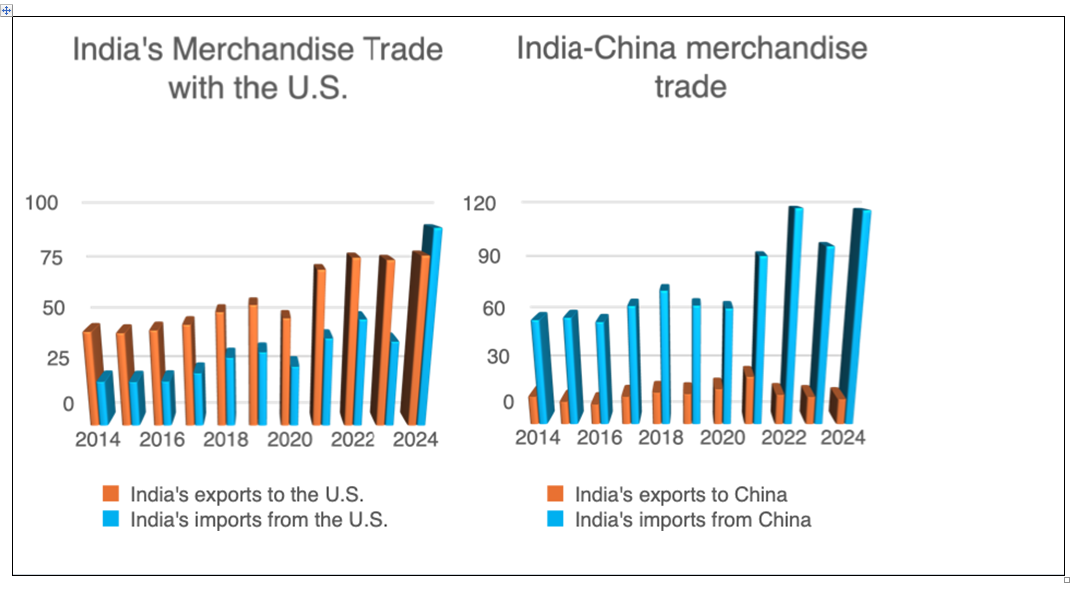 |
Source: United Nations COMTRADE database
As shown in graphs 1 and 2, India consistently maintained a trade surplus with the United States between 2014 and 2024, while running a persistent trade deficit with China. This contrasting trend warrants closer examination. India’s exports to China peaked at USD 28.14 billion in 2021 but declined sharply to USD 14.90 billion by 2024—a 14.5% drop from 2023 alone. Meanwhile, imports from China have risen steadily, from USD 55.31 billion in 2011 to USD 117.68 billion in 2024, reaching a high of USD 118.77 billion in 2022. India primarily exports iron ore, engineering goods, chemicals, and marine products to China, whereas its imports are dominated by electrical machinery, nuclear reactors, organic chemicals, plastics, and components.[3] Overall, bilateral trade between the two countries has expanded from USD 73.39 billion in 2011 to USD 132.58 billion in 2024.
Despite a dip in 2023, trade volumes between India and China remain robust[4]. Nevertheless, India has consistently experienced a trade deficit with China, which has widened drastically from USD 27.23 billion in 2011 to USD 102.78 billion in 2024. In the context of this trade deficit, it is pertinent to note that India has a limited export basket of iron ore, cotton, shrimps, and primarily agricultural products. However, market access barriers to Indian goods in China are severe. A crucial point here is that if India’s export basket is as small as assumed in its trade with China, why has expansion not occurred, especially when India exports these commodities and a much broader range to the U.S. and maintains a positive trade balance? The answer lies in analysing China’s tariff and non-tariff barriers against goods and services from India. China has imposed tariffs and non-tariff barriers on Indian goods and services, restricting market access for Indian exports, particularly in sectors like agriculture, pharmaceuticals, and IT services, where India has a comparative advantage.
China’s tariff barriers on key Indian exports
Tariff barriers are those barriers to trade that involve taxes or duties imposed on imported goods, thereby increasing their costs and reducing competitiveness. The following sections outline the key tariffs China imposes on Indian goods.
- Agricultural products: On Indian agricultural goods, such as sugar and rice, there are high Chinese tariffs. Tariffs on non-basmati rice and other agricultural commodities can range from 10% to 65%, reducing the competitiveness of Indian exports compared to domestic and other foreign suppliers.[5] Chinese tariffs on Indian sugar exports stand at around 50%, with additional safeguard duties applied inconsistently. This hampers India’s capacity to exploit China’s sugar demand, even though India is the world’s second-largest producer[6].
- Pharmaceuticals: India’s strengths in generic drugs are blocked by China’s tariffs, which average around 4-10% on pharmaceutical products. Active pharmaceutical ingredients encounter further barriers, diminishing cost advantages.[7] What should be highlighted for better context is that India exports pharmaceutical products to over 200 countries, including developed nations with strict regulatory standards. Currently, the U.S. is the largest destination for India’s pharmaceutical formulation products. Furthermore, India is a significant exporter of drugs (active pharmaceutical ingredients) and has 664 manufacturing plants approved by the U.S. Food and Drug Administration (USFDA)[8]. However, due to trade restrictions in China, Indian pharmaceuticals cannot access the market on equal terms.
- Textiles and Apparel: Indian textiles face tariffs ranging from 5% to 25%, with higher rates applied to value-added products such as garments. This hampers India’s ability to compete with countries like Vietnam or Bangladesh, which benefit from zero or lower tariffs in trade with China.[9]
- Pesticides: Starting from 7 May 2025, the Chinese government will impose anti-dumping duties on cypermethrin, a key pesticide ingredient from India. China’s Ministry of Commerce announced that the policy will be in effect for five years. The duties will range from 48.4% to 166.2%, depending on the Indian companies exporting[10].
The following table shows 5 out of 202 items from India traded with China and the tariff rates that China applies to them.
Table 1: Five representative products from India and China’s tariffs on them.
| Reporter | Year | Partner | Product | MFN Rate | Applied Tariff |
| China | 2022 | India | Fish; tuna, fresh or chilled, (excluding fillets, livers, roes and other fish meat) | 7 | 4.69999980926514 |
| China | 2022 | India | Swordfish (Xiphias gladius) | 7 | 3.5 |
| China | 2022 | India | Ducks | 5 | 5 |
| China | 2022 | India | Fatty livers, fresh or chilled | 20 | 20 |
| China | 2022 | India | Cuts and offal, fresh or chilled | 20 | 20 |
Source: World Integrated Trade Solution[11]. [12]
While tariff barriers restrict trade, they are easier to spot and understand than non-tariff barriers, which are opaque and applied arbitrarily. China’s non-tariff barriers (NTBs) significantly restrict Indian exports, particularly in pharmaceuticals, agriculture, and marine products.
China’s non-tariff barriers against Indian products
NTBs, viewed in a regulatory context, impose higher costs on trade than tariffs, and a significant challenge with NTBs is quantifying the affected trade. Indian officials from the Ministry of Commerce have repeatedly highlighted the issues India faces due to import surges from China, which harm the Indian domestic industry. Indian exporters encounter problems such as payment deductions and financial losses associated with the banking system in China, without sufficient clarification regarding the reasons for these deductions[13]. Indian trading companies have also accused Chinese steelmakers of backing out of orders for Indian iron ore, resulting in significant economic losses[14].
Issues encompass food and public health safety, as well as cooperation in science and technology. For instance, China refrains from purchasing rice from India, citing quality concerns[15], while importing from Pakistan and Myanmar without mentioning concerns regarding quality issues!
More than half of imports to China require import licences. Depending on the product, the initial licence is issued by various organisations, but the Chinese Ministry of Commerce grants the final licence. Consequently, it remains unclear which product or company will ultimately receive the licence, leaving Indian traders often at the mercy of these opaque processes in China[16].
The Institute of Chinese Studies created a table of Chinese non-tariff barriers against certain Indian products in 2017. The following table provides a clearer picture of the NTBs that China has against Indian products.
Table 4: Bilateral level NTBs imposed by China
| NTB Code | Description | Number | Percentage |
| P163 | Product quality, safety, or performance requirement | 1004 | 42.3 |
| A11 | Temporary geographic prohibitions for SPS reasons | 980 | 41.3 |
| A82 | Testing requirement | 281 | 11.8 |
| E32 | Prohibition for non-economic reasons | 35 | 1.5 |
| A86 | Quarantine requirement | 16 | 0.7 |
| A851 | Origin of materials and parts | 12 | 0.5 |
| C3 | Requirement to pass through specified port of customs | 8 | 0.3 |
| B83 | Certification requirement | 6 | 0.3 |
| B84 | Inspection requirement | 6 | 0.3 |
| A84 | Inspection requirement | 4 | 0.2 |
| E1 | Non-automatic import-licensing procedures other than authorizations for SPS or TBT reasons | 3 | 0.1 |
| E111 | Licensing procedure with no specific ex ante criteria | 3 | 0.1 |
| F61 | Custom-inspection, processing and servicing fees | 3 | 0.1 |
| P162 | Product quality, safety, or performance requirement before export | 3 | 0.1 |
| A14 | Special authorization requirement for SPS reasons | 2 | 0.1 |
| A51 | Cold/heat treatment | 2 | 0.1 |
| A69 | Other requirements on production or post-production processes | 2 | 0.1 |
| A83 | Certification requirement | 2 | 0.1 |
| B31 | Labelling requirements | 2 | 0.1 |
| F71 | Consumption taxes | 1 | 0 |
| Total | 2375 | 100 |
Source: Malini Tantri, C. Nalin Kumar and Varadurga Bhat, 2021[17].
Specific examples of China’s NTBs against Indian products
- Sanitary and phytosanitary measures and testing requirements: India’s agricultural exports, such as grapes, mangoes, chillies, tea, and basmati rice, face stringent SPS measures in China. These include complex testing and certification by Chinese customs, which increases costs and causes delays. High compliance costs deter small and medium enterprises from exporting to China, further reducing Indian exports. As far back as 2012, India had raised concerns that China did not provide sufficient scientific evidence for restricting exports of its agricultural commodities. Despite India having consistently raised the issue of market access for Indian agricultural products with China, there has been no inclination from China to resolve the matter, and the problem persists even in 2025[18].
- Pharmaceutical export rejections: Indian pharmaceutical exports to China often encounter rejections due to “non-compliance” with Chinese testing standards, which are, to say the least, unclear. Furthermore, no redress mechanism is in place, resulting in significant financial losses. In 2019, India requested that China open its pharmaceutical market, especially for affordable and high-quality generic drugs from Indian pharmaceutical companies. India also urged China to prioritise the resolution of various regulatory hurdles faced by Indian companies, including addressing the lengthy delays in product approval timelines, the lack of clarity in registration guidelines, drug procurement by local governments in China, suomotu approvals for those Indian pharma companies that have received approvals from stringent regulatory authorities like USFDA, EDQM, Japan, and ‘risk based’ batch testing with self-certification[19]. However, the situation in 2025 remains the same.
- Technical standards and quality control orders: China imposes stringent technical standards on Indian exports, particularly for food, meat, fish, dairy, and industrial products, where India holds a comparative advantage. These Chinese non-tariff barriers often diverge from international norms[20]. This highlights China’s strategy of denying exports while attempting to leverage the Indian market, all the while subtly refusing similar access to Indian products in China.
- Market access restrictions: Indian goods, particularly in the sectors of agriculture and pharmaceuticals, face barriers to entering the Chinese market due to opaque regulatory processes. Even 13 years ago, in 2012, China suspended the import of rapeseed meal from India because of alleged contamination with malachite green dye in shipments. Indian bovine meat and meat products were similarly refused entry into the Chinese market due to claims of foot and mouth disease. Access to certain vegetables and fruits from India was also restricted[21]. The situation remains the same even today.
China’s barriers to trade and its linkages with its geopolitical ambitions
In 2025, in the face of economic wrath from the U.S. in the form of tariffs, countries across the globe, including India and China, braced and continue to brace for economic catastrophes. While China has consistently used tariffs and non-tariff barriers against Indian products and denied equal market access, in 2025, when China was hit with the highest amount of tariffs by the U.S., it reached out to India, stating that India and China should stand together against the “abuse of tariffs” by the U.S.[22].
Yu Jing, the spokesperson for the Embassy of the People’s Republic of China in New Delhi, posted on X, “China-India economic and trade relationship is based on complementarity and mutual benefit.”[23] This marks the first time that China has made such a statement. What the PRC has conveniently forgotten is that it has imposed tariffs and non-tariff barriers against India for decades, without any redress, even when India has made specific requests for resolution.
China aspires to be the leading actor in the international system, displacing the U.S. However, its economic growth must continue for it to attempt to achieve some level of parity with the U.S. India is not regarded as valuable in this competition unless the Indian market needs to be leveraged by China to drive its own economic growth at India’s expense. Even within the framework of regional groupings such as the Shanghai Cooperation Organisation or BRICS Plus, China frequently highlights what it perceives as malicious trade practices of the U.S., often overlooking that it has engaged in the same practices, and even worse, against Indian products.
While India also suffers from the adverse effects of the weaponisation of tariffs by the U.S., the fact remains that India has maintained positive trade balances with the U.S. until now and has not experienced the same level of denial of equal market access as has been the case with China. As stated in previous sections, India has raised these issues with China, requesting equal market access. However, China has consistently chosen to turn a blind eye. In the current historical context, as the U.S. renegotiates its role as the provider of a stable international order, serious strains will be felt across the globe. While it is crucial to identify and highlight the malicious use of tariffs by the U.S., it is equally important to recognise that China has long engaged in such practices. Its reliance on NTBs, in particular, is noteworthy, as these barriers are difficult to counter. NTBs are often complex, less transparent, and rooted in national regulations and policies. Tariffs are explicit taxes on imports, whereas NTBs are subtle and challenging to identify, measure, and contest.
India has employed the mechanism of the World Trade Organisation to counter China’s dumping of products within its borders. Recently, India has also instituted anti-dumping duties on certain Chinese goods. China has called it “unfortunate.”[24], even though India has clearly stated why it is a move to protect its domestic industry. While China, under the guise of protecting its domestic industry, has been imposing tariffs and non-tariff barriers on Indian products for years, India’s similar actions do not sit well with China. This hypocrisy is further highlighted by China’s imposition of a 166% duty on cypermethrin from India, which the PRC claimed was a measure to safeguard its own industry. Conversely, when India takes the same steps, it faces criticism from China.
While trade could have been a great tool to keep political and military conflicts at bay, the fact is that trade itself has emerged as a realm for further conflicts, duplicity, and a selfish, one-sided pursuit of interests. China’s utilisation of trade to become one of the leading actors in the international system has been well documented. However, what remains to be demonstrated is how it has used trade for its own benefit, often at the expense of its trading partners, thereby ensuring that true globalisation can never fully take place. India needs to be cognisant of the fact that while the U.S. is resorting to weaponising tariffs, China has long abused the principles of fair trade.
Author Brief Bio: Prof. (Dr.) Sriparna Pathak is a Professor of China Studies at the Jindal School of International Affairs and a Senior Fellow at the Jindal India Institute of O.P. Jindal Global University. She can be reached at sriparnapathak@gmail.com.
References:
[1] Jain, Smriti. “Explained in Charts: India to Become 4th Largest World Economy Soon. What’s the Road Ahead to No.3 Spot?” The Times of India, 27 May 2025, timesofindia.indiatimes.com/business/india-business/explained-in-charts-india-to-become-4th-largest-world-economy-soon-whats-the-road-ahead-to-no-3-spot/articleshow/121418460.cms.
[2] India: Fastest-Growing Major Economy.
[3] Embassy of India, Beijing. www.eoibeijing.gov.in/eoibejing_pages/MjQ%2C.
[4] Embassy of India, Beijing. www.eoibeijing.gov.in/eoibejing_pages/MjQ%2C.
[5] Barik, Soumyarendra, and Ravi Dutta Mishra. “Govt Looks at Options as Business Mounts Pressure for China Dealings Again.” The Indian Express, 23 Oct. 2024, indianexpress.com/article/india/govt-looks-at-options-as-business-mounts-pressure-for-china-dealings-again-9633750.
[6] https://apps.fas.usda.gov/newgainapi/api/Report/DownloadReportByFileName?fileName=Sugar%20Annual_Guangzhou%20ATO_China%20-%20People%27s%20Republic%20of_CH2025-0086.pdf
[7] Singh, Sandeep, and Anil Sasi. “US Tariffs Looming, India Looks at Easing Non-trade Barriers, Relaxing Chinese FDI.” The Indian Express, 24 Mar. 2025, indianexpress.com/article/business/economy/us-tariffs-looming-india-looks-at-easing-non-trade-barriers-relaxing-chinese-fdi-9902293.
[8] Chaudhuri, Sudip. “India’s Import Dependence on China in Pharmaceuticals: Status, Issues and Policy Options.” RIS Discussion Paper Series, 268, July 2021.
[9] Suneja, Yogima Seth Sharma and Kirtika. “India Sees Export Opportunity in 10 Products Amid US-China Tariff War.” The Economic Times, 15 Apr. 2025, economictimes.indiatimes.com/news/economy/foreign-trade/india-sees-export-opportunity-in-10-products-amid-us-china-tariff-war/articleshow/120289496.cms?from=mdr.
[10] https://www.idnfinancials.com/news/54376/china-hits-back-at-india-through-166-anti-dumping-duty-on-pesticide#:~:text=BEIJING%20%E2%80%93%20The%20Chinese%20government%20has,pesticide%20ingredient%20originating%20from%20India.
[11] China Tariffs on India | WITS Data. wits.worldbank.org/tariff/trains/en/country/CHN/partner/IND/product/all#.
[12] Please see the complete list at https://wits.worldbank.org/tariff/trains/en/country/CHN/partner/IND/product/all#
[13] Ace Global Private Limited. “Trade Facilitation Problems of Indian Exporters.” Final Report, by Govt. of India, Ministry of Commerce & Industry et al., June 2005, wtocentre.iift.ac.in/UNCTAD/UNCTAD%20TFAC%20%20Final%20Report%2013%20June%202005.pdf.
[14] Peter Wonacott “Downturn Heightens China-India Tension on Trade”, Wall Street Journal, 20 march 2009, https://www.wsj.com/articles/SB123749113639187441
[15] Gupta, Yashi. “Explained: Why Is China Importing Rice From India for the First Time in Decades?” CNBCTV18, 17 Dec. 2020, www.cnbctv18.com/world/explained-why-is-china-importing-rice-from-india-for-the-first-time-in-decades-7757601.htm.
[16] Tantri, Malini L., et al. “Trade Irritants and Non-Tariff Measures Between China and India.” Institute of Chinese Studies, 2021, www.icsin.org/uploads/2021/06/07/9e51ae3fb07b4f54a7d5900d21ec9319.pdf.
[17] Tantri, Malini L., et al. “Trade Irritants and Non-Tariff Measures Between China and India.” Institute of Chinese Studies, 2021, www.icsin.org/uploads/2021/06/07/9e51ae3fb07b4f54a7d5900d21ec9319.pdf.
[18] Pti. “India Raises Concerns Over Agricultural Exports to China.” The Economic Times, 21 Mar. 2012, www.economictimes.indiatimes.com/news/economy/agriculture/india-raises-concerns-over-agricultural-exports-to-china/articleshow/12355807.cms?utm_source=contentofinterest&utm_medium=text&utm_campaign=cppst.
[19] Meeting of Drug Regulators of India and China. www.pib.gov.in/PressReleasePage.aspx?PRID=1578521#:~:text=Both%20sides%20also%20decided%20to%20work%20towards,CFDA%20to%20enable%20higher%20exports%20to%20China.
[20] Ananth, Venkat. “Seven Flashpoints Between India and China.” Mint, 24 Sept. 2014, www.livemint.com/Politics/PsdTIEaclnM6EkEMUrMGDP/Seven-flashpoints-between-India-and-China.html.
[21] Trade Between India and China. www.pib.gov.in/newsite/PrintRelease.aspx?relid=108614#:~:text=China%20has%20suspended%20import%20of%20rapeseed%20meal,of%20alleged%20’Foot%2Dand%2DMouth%20Disease’%20(FMD)%20in%20India.
[22] Anirban Bhaumik, and Anirban Bhaumik. “China Calls on India to Jointly Oppose US ‘abuse of Tariffs.’” Deccan Herald, 8 Apr. 2025, www.deccanherald.com/india/china-reaches-out-to-india-after-us-tariffs-abuse-proposes-to-stand-together-3484834.
[23] Sharan, Sunil. “China Is on Our Side. Really?” The Statesman, 12 Apr. 2025, www.thestatesman.com/opinion/china-is-on-our-side-really-1503419665.html.
[24] TOI Business Desk. “India Imposes Anti-dumping Duties on Five Chinese Products to Protect Local Industries.” The Times of India, 23 Mar. 2025, timesofindia.indiatimes.com/india/india-imposes-anti-dumping-duties-on-five-chinese-products-to-protect-local-industries/articleshow/119378432.cms#:~:text=India%20has%20imposed%20anti%2Ddumping%20duties%20on%20five,protect%20local%20industries%20from%20unfairly%20low%2Dpriced%20imports.&text=As%20both%20India%20and%20China%20are%20WTO,which%20reached%20USD%2085%20billion%20in%202023%2D24.
Decoding India’s Tariff Strategy: Protectionism or Pragmatic Policy?
Introduction
India’s trade policy has undergone significant changes in the past five years, raising the crucial question of whether its tariff regime is driven by protectionist instincts or a pragmatic economic strategy. As a senior industry professional with three decades of experience, and responsible for strategic decisions in a USD 15 billion manufacturing company, I have observed how tariff policies can shape competitive landscapes.
India’s policymakers are striving to balance the protection of domestic industries with the benefits of trade liberalisation. On one hand, the government has raised import duties on various goods and invoked trade defence measures (such as anti-dumping investigations) to safeguard local producers. On the other hand, it has pursued export targets, established new trade agreements, and offered production incentives to integrate with global markets. This brief report examines India’s tariff strategy through a macroeconomic lens to assess whether recent policies represent protectionism or a pragmatic recalibration. Key indicators—from comparative advantage metrics to export composition, tariff structures, and industry challenges—are evaluated. Lastly, strategic recommendations are provided for businesses to establish competitive advantage amid India’s evolving tariff and non-tariff trade policies.
India’s Comparative Advantage and Trade Specialisation
India’s trade profile reveals areas of both strong comparative advantage and unrealised potential. Comparative advantage indicators show that India excels in certain skilled industries and services. For example, India has world-leading competitiveness in IT and business process services, capturing a major share of global IT exports. In manufacturing, India performs well in pharmaceuticals and transport vehicles, sectors that leverage the country’s skilled labour and large-scale industry. These areas demonstrate India’s revealed comparative advantage (RCA) indices, which are high and reflect global export shares exceeding its world export share. In contrast, labour-intensive manufactures, such as textiles and apparel, have lagged despite India’s inherent advantages in these sectors. For instance, India’s share of world exports in apparel has stalled, even though low-cost labour and traditional know-how suggest it could be higher. This divergence indicates that while India has specialised successfully in certain medium- and high-tech goods, it has not fully capitalised on its potential in all areas.
Trade specialisation metrics present a mixed picture. India’s share of global merchandise exports remains modest at approximately 1.8% as of 2023, having only slightly increased from 1.7% in 2014. (By comparison, China accounts for over 14% of world exports.) India’s ranking among merchandise exporters improved from 19th to 17th globally during this period. The country’s export basket is fairly diversified, with a moderate concentration in its top products. India’s export complexity (a measure of the range and sophistication of exports) has improved over time, reflecting a shift towards higher-value goods. However, the overall scale of India’s exports remains low relative to the economy’s size – merchandise exports amount to only around 13% of GDP (2021-22), down from roughly 17% a decade earlier. This indicates that India’s trade specialisation is still limited, and the economy is less export-driven than its East Asian counterparts. In summary, India demonstrates clear comparative advantages in specific sectors (pharma, refined petroleum, IT services, etc.) but has yet to fully translate these into a dominant global trade position. Addressing internal bottlenecks – such as infrastructure gaps, technology adoption, and skills – could enhance India’s trade specialisation in both traditional and emerging industries.
India’s Tariff Strategy: Protectionist or Pragmatic?
India’s recent tariff actions have sparked debate about whether they represent a protectionist shift or a pragmatic policy response to global and domestic challenges. Factually, India did increase many import tariffs in the late 2010s, reversing a lengthy period of post-1991 liberalisation. The simple average of India’s tariffs rose by approximately 25% over the last decade, reaching 11.1% in 2020-21. This increase marked a departure from the steady tariff reductions of prior decades and has been described as a “creeping rise in protectionist tariffs.” In budgets from 2018 onwards, the government raised customs duties on products like electronics, toys, furniture, auto parts, and textiles, explicitly encouraging domestic manufacturing under the “Make in India” and Atmanirbhar Bharat (self-reliant India) initiatives. Such measures—alongside frequent anti-dumping actions (India initiated 233 anti-dumping investigations in 2015–2019 alone)—have led many observers to label India’s trade approach increasingly protectionist. Even the World Bank noted in 2024 that India’s import tariffs on key inputs (from China and others) raise costs and undermine its participation in global value chains.
However, the government defends its approach as pragmatic and strategic rather than protectionist. Officials argue that selective tariff hikes are intended to nurture nascent industries, correct trade imbalances, and reduce import dependence in sensitive sectors, not to isolate India from trade. In practice, India’s trade policy in recent years appears to blend protectionism with pragmatism. On one side, tariffs on items such as electronics, toys, and furniture have been raised to bolster domestic producers, and import bans or restrictive origin rules have been imposed (for instance, stricter rules of origin were implemented to prevent Chinese goods from routing via FTA partners). These measures indeed protect local industry but risk inviting retaliation or higher costs.
On the other hand, India has offered tariff concessions on inputs (e.g. reducing duties on raw materials for textiles and steel in budgets). It has utilised production-linked incentive (PLI) schemes instead of blanket tariffs to encourage domestic manufacturing in electronics, pharma, and solar panels. Such calibrated steps can be considered pragmatic industrial policy consistent with WTO rules (since PLI subsidies are targeted) rather than blunt protectionism.
Composition of India’s Exports: Landscape of Manufactured Goods
The landscape of India’s exports has evolved significantly in recent years, with manufactured goods now dominating the export basket. In the fiscal year 2021–22, India’s merchandise exports surged to a record $418 billion, rebounding strongly after the pandemic. Manufactured products (industrial goods) constitute the bulk of these exports, alongside notable contributions from agriculture and minerals. Within manufacturing, a few categories stand out as pillars of India’s export profile:
Engineering goods, petroleum products, gems and jewellery, chemicals, and pharmaceuticals consistently rank as the top earners. Engineering goods—a broad category that includes industrial machinery, automobiles and auto parts, iron and steel products, among others—constitute the largest segment, reflecting India’s strength in heavy industries and automobile manufacturing. In 2021-22, India’s engineering exports surpassed $100 billion for the first time, accounting for approximately one-quarter of total merchandise exports.
Due to India’s large oil refining capacity, petroleum products are the second principal component. India imports crude oil but exports substantial volumes of refined fuels (diesel, petrol) and petrochemicals. Elevated global oil prices and increased refining output caused petroleum product exports to surge over 140% in 2021-22, reaching an estimated ~$60 billion. Gems and jewellery, particularly cut and polished diamonds and gold jewellery, represent another traditional export forte (around $40 billion annually), leveraging India’s skilled artisan workforce in the diamond polishing hubs. Chemicals and related products (including speciality chemicals, plastics, etc.) and pharmaceuticals have expanded rapidly, contributing approximately $50+ billion. Notably, India is a top global supplier of generic medicines (pharma exports ~$24–25 billion) and an emerging player in organic chemicals.
Meanwhile, textiles and apparel – once a leading export sector – have shown modest performance (estimated at over $30 billion), yielding ground to countries like Bangladesh and Vietnam in recent years. India’s agricultural exports (rice, sugar, spices, etc.) and software services exports are also significant, but the focus here is on merchandise. The chart in Figure 1 illustrates the scale of key merchandise export categories (values for FY2021- 22), highlighting the dominance of engineering goods and refined petroleum among exported products.
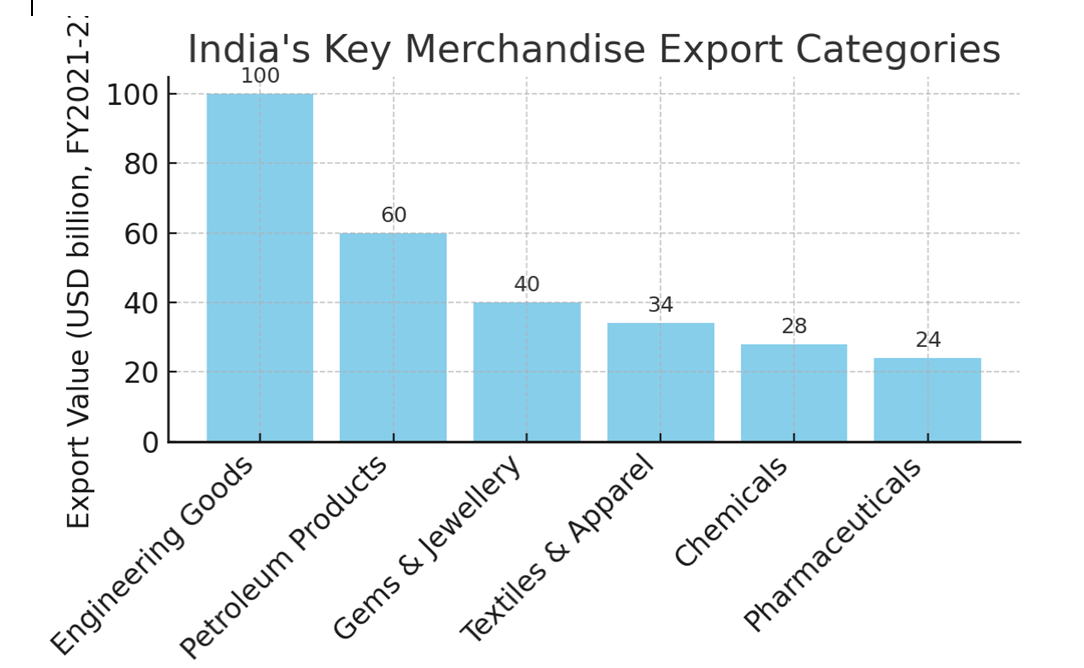
Figure 1: India’s top merchandise export categories by value (FY2021- 22).
Engineering goods and other manufactured products constitute the majority of India’s exports. Petroleum refinery products are a significant export because of India’s refining industry. Traditional sectors such as gems and jewellery, alongside textiles, continue to hold importance, while chemicals and pharmaceuticals are rapidly growing segments.
This export composition underscores that manufactured goods drive India’s trade, contrary to the outdated image of India as primarily an exporter of primary goods or services. Over 75% of India’s merchandise exports are in manufacturing categories (including refined petroleum). This diversification into manufacturing has been a gradual structural change: policy reforms since 1991 enabled industries such as autos, pharma, and steel to become internationally competitive. By the mid-2010s, India had established a foothold in medium- and high-tech exports; for instance, it is among the top five exporters of generic pharmaceuticals, and its auto industry exports millions of vehicles and components annually. India’s performance in these sectors demonstrates improved technological depth, though challenges remain (e.g., low R&D spending at 0.9% of GDP hampers the move up the value chain).
Another encouraging sign is the broadening of India’s export destinations. Indian goods are now exported to over 115 countries, covering 46% of all world economies. Traditional markets like the U.S. and EU still dominate (the EU alone accounts for ~12% of India’s goods trade), but India has expanded exports to emerging markets in Asia, Africa, and Latin America. This diversification helps reduce dependence on a few markets and indicates a maturing export sector. Still, India’s export intensity (exports/GDP) lags behind its peers – a concern for long-term growth.
The government’s $400 billion export target (achieved in 2021-22) was driven by rises in global commodity prices and a post-COVID demand recovery; however, maintaining high growth will require improvements in competitiveness. Notably, India’s share of world exports in certain labour-intensive goods (such as apparel and leather) has stagnated or declined, indicating that domestic bottlenecks (infrastructure, logistics, compliance costs) undermine those sectors’ advantages. Conversely, India’s success in skill-intensive goods (pharma, engineering) demonstrates what can be accomplished with the right mix of entrepreneurship and supportive policy.
In summary, India’s export landscape is characterised by a diverse, manufacturing-led basket, with several star sectors compensating for weaker areas. This composition also reflects India’s natural endowments and policy choices – abundant labour and jewellery craftsmanship support the gems and textiles industries; large refineries and pharmaceutical firms have developed from earlier policy initiatives. The key for India will be to deepen its comparative advantages (e.g., ascending the value chain in electronics, machinery, chemicals) while revitalising its competitiveness in job-rich sectors like apparel. The tariff strategy will play a crucial role here: high tariffs on inputs or capital goods could undermine export competitiveness, whereas supportive trade policies could assist.
Indian manufacturers integrate into global supply chains and maintain their export momentum.
Challenges Encountered by Indian Industries under Current Tariff Policies
India’s present combination of tariff and trade policies presents several challenges for domestic industries, impacting their cost structures, market access, and integration into supply chains.
Higher Input Costs and Inverted Duty Structures: A recurrent complaint of Indian manufacturers is that import duties on raw materials and components often raise their input costs, making final products less competitive. The existence of inverted duty structures (IDS) – where import tax on inputs exceeds that on finished goods – is particularly harmful. As noted, about one-third of products in sectors like electronics, chemicals, textiles, and metals in India face IDS. This means a textile producer might pay a 10% duty on imported fabric, but the finished garment faces, say, a 5% duty when imported – a recipe for undermining domestic manufacturing. Such tariff anomalies “leak” cost competitiveness, encouraging imports of finished goods and discouraging local value addition. While the government has started reviewing and correcting these (a comprehensive tariff review is underway), many industries still struggle with high duties on essential inputs like electronic components, speciality chemicals, or machine tools. Until resolved, this challenge limits Indian firms’ ability to scale up and become export-competitive.
Export Competitiveness and Global Value Chains (GVCs):
The integration of Indian industry into global value chains remains limited, mainly due to tariff policy. Higher tariffs not only increase domestic costs but can also provoke retaliatory barriers abroad. Moreover, a protectionist stance may result in India being excluded from trade arrangements that facilitate GVC integration. For instance, rising tariffs since 2014 have been cited as a factor that could exclude India from emerging supply chains (such as the Quad’s semiconductor initiative) unless reversed.
Many multinational firms still regard India primarily as a local market rather than an export base, partly because India’s tariff and regulatory regime makes importing inputs and exporting outputs less seamless than, for instance, Vietnam. A Deloitte survey of global business leaders indicated that countries like Vietnam and Indonesia score higher than India as preferred investment destinations, specifically due to more open trade regimes and easier business climates. Thus, Indian industries face the challenge that if trade policies remain relatively protectionist and cumbersome, they could miss out on foreign investment and partnership opportunities that GVC participation offers. This represents a strategic concern – modern manufacturing often entails components crossing borders multiple times, and tariffs can act as a tax on this process.
Policy Uncertainty and Frequent Changes: Industries value a stable policy environment for long-term planning.
In recent years, India’s trade policy has undergone frequent tweaks, including sudden tariff hikes in certain budgets, abrupt import bans (for example, on certain electronics or auto parts, citing quality concerns), and changes in export incentive schemes. The government’s amendment of the Customs Act in 2021 to enable bans on any goods “to prevent injury to the economy” is one such move that, while WTO-consistent in principle, adds regulatory uncertainty.
Businesses fear that unpredictable policies can heighten the risks of investing in export-oriented capacity. What if critical inputs are subjected to high duties or an export is banned to control inflation? A case in point was India’s ban on wheat exports in 2022 to ensure food security. While this decision benefited domestic consumers, traders and farmers were caught off guard. Similarly, incremental alterations in import tariffs, often announced with little notice, complicate efforts for industries to establish stable supply chains. The challenge for firms is to remain agile and compliant amid a multitude of changes to tariff lines, new quality control orders (non-tariff barriers), and evolving export incentive regimes, such as the recent shift from the MEIS to the RoDTEP scheme. Such uncertainty can deter investment, as companies may prefer more predictable jurisdictions for establishing manufacturing intended for export.
In summary, Indian industries today are in a transitional phase: they benefit from a large protected home market due to tariffs. However, many are striving to become world-class exporters, which requires reducing costs and integrating with global supply chains. The challenges highlighted—costly inputs (IDS), limited FTA benefits, policy uncertainty, and competitive disadvantages abroad—suggest that India’s tariff strategy, while providing short-term protection, might hinder firms in the long run if not calibrated correctly.
Industries such as chemicals, electronics, and textiles have explicitly pointed out that tariff protection alone cannot ensure global success and that complementary measures (infrastructure, skill development, innovation) are required. Encouragingly, the government recognises some of these pain points: the ongoing tariff review to rectify inverted duties and the pursuit of new FTAs are positive steps. However, until these measures materialise, Indian firms must navigate a challenging environment where domestic policy shields them at home but potentially handicaps them abroad.
Strategic Recommendations for Gaining Competitive Advantage
In light of the challenges mentioned above and the current tariff regime, Indian businesses—particularly large manufacturers and those engaged in global trade—should adopt strategies to create a competitive advantage while alleviating tariff-related disadvantages. Below are strategic recommendations for companies to prosper under India’s tariff and non-tariff trade policies:
- Focus on Operational Efficiency and Product Differentiation: When tariffs raise input costs or shelter a firm from competition, there exists a risk of complacency. Savvy businesses should utilise the protected period to enhance efficiency, quality, and R&D to better withstand competition in the long term. This involves investing in modern production technology, workforce training, and lean manufacturing to counteract cost disadvantages. By boosting productivity, Indian firms can narrow the cost gap that tariffs temporarily disguise. Furthermore, product differentiation is crucial – rather than competing solely on cost (where Chinese or other competitors might undercut), Indian companies can innovate and specialise in higher-value niches. For instance, in the textiles sector, instead of mass-producing basic apparel (where Bangladesh has an advantage), Indian firms could concentrate on technical textiles or fashion segments where they can command a premium. In chemicals, businesses are shifting towards specialty chemicals and formulations customised for client requirements, which face less direct competition and often inspire loyalty. These strategies enhance businesses’ resilience against both domestic import competition (if tariffs are lowered) and aggressive pricing abroad. Essentially, competitive advantage must stem from inherent strengths – quality, innovation, branding – rather than reliance on tariffs. Firms that accomplish this will discover that even if tariffs are reduced (as OECD and others recommend for India), they can maintain their position in the market.
- Advocacy for Tariff Rationalisation and Trade Facilitation: Industry leaders could actively engage with the government (through industry associations such as CII, FICCI, etc.) to advocate for a simpler, more rational tariff structure that benefits the broader economy. The ongoing anomalies, such as inverted duties, harm not only individual companies but entire value chains. By providing data and case studies to policymakers, businesses can push for the timely removal of such anomalies. Advocacy can also extend to urging the government to fast-track critical FTAs; for instance, an India-EU FTA would greatly assist sectors such as automobiles, textiles, and pharmaceuticals by reducing tariffs in that vast market. Additionally, firms should lobby for improved trade facilitation, including smoother customs processes, digital clearance, and infrastructure development at ports. Reducing non-tariff barriers and transaction costs can often be as significant as cutting tariffs. Some issues highlighted include alignment with international standards (to reduce rejections abroad) and increased transparency in trade policy changes. A collaborative approach, where industry voices its needs and works with policymakers, can create a win-win: policies that both protect and empower domestic industry in a sustainable way.
- Capitalising on Government Support Programmes: While tariffs are one tool, the government has introduced numerous programmes to boost industry that firms could capitalise on. The Production-Linked Incentive (PLI) schemes in sectors like electronics, autos, pharma, and chemicals effectively provide financial rewards for scaling up domestic production and exports. By participating in PLI, companies can offset some disadvantages (such as higher input costs) through subsidy gains, which enhances overall competitiveness. Similarly, programmes for MSMEs, export promotion capital goods (EPCG duty exemptions), and refund of duties & taxes on exports (RoDTEP) help reduce the tax burden on exporters. Savvy firms will ensure they claim all eligible incentives and remain compliant with requirements to maximise these benefits. Over time, such support can help firms achieve global scale and competitiveness, after which they can thrive without protection. The recent success of mobile phone manufacturing in India – which went from near-zero to over $5 billion in exports in a few years, aided by tariffs on imports and PLI incentives – is a model that could be replicated in other sectors. Businesses should align their strategies with these national initiatives (for example, the push for green hydrogen or electric vehicle components) where they identify long-term potential, as they often come with tariff adjustments (low duties on inputs, high on finished imports) that favour early movers.
Conclusion
India’s tariff strategy over the past five years reflects a delicate balancing act. The nation has employed tariffs and trade measures to protect domestic industries and promote self-reliance, a stance that leans towards protectionism in the short term. Simultaneously, India’s long-term economic aspirations – to increase manufacturing’s share of GDP, integrate into global value chains, and become a $5 trillion economy in the near future – create a pragmatic need for openness and competitiveness. As this report has analysed, India’s comparative advantages are genuine but require nurturing through efficient policy, not permanent protection. The composition of exports demonstrates that India can succeed in diverse manufacturing sectors; however, challenges such as inverted duties and limited free trade access hinder industries from reaching their full potential.
India’s tariff strategy is not merely a binary of protectionism versus pragmatism; it rather exists on a spectrum where policy must continuously calibrate between the two. The next few years will likely witness further tariff rationalisation, more trade deals, and efforts to align with global standards – steps towards pragmatism that are already underway. Indian industry, for its part, should be prepared to capitalise on a more open yet competitive environment. With the right strategic responses, businesses can transform India’s tariff and trade policies into a foundation for securing competitive advantage, both domestically and on the global stage. This balanced approach – protecting where necessary and liberalising where possible – could effectively decode a tariff strategy that propels India towards high-quality growth and greater prominence in global trade, achieving the best of both protectionist caution and pragmatic engagement.
Author Brief Bio: Sundeep Kohli is SVP Finance at Indo Rama Ventures Ltd based in Thailand working closely with the founding family. Prior to that he worked with Reckitt Benckiser for almost 15 years in global finance roles across Japan, UK, China, Singapore amongst others and started his career with ITC Ltd. He is a Chartered Accountant by profession and an executive MBA from ISB, Hyderabad and has also done advanced business strategy courses from Harvard Business School.
India’s Trade Strategy for the 21st Century: Tariffs, Supply-Chains, Investment and Technology
Introduction: Trade Policy in the Context of the Vision for Viksit Bharat
India has set itself an ambitious target. The country hopes to transform into a developed economy with commensurate per capita income and quality of life by 2047. This vision of Viksit Bharat envisages a robust economy that is globally competitive and integrated into global value chains, generating economic opportunities for Indian workers and businesses to assist in fulfilling this transformation into a developed economy. Integral to this vision is a diversified and technologically advanced industrial sector that serves as an engine of growth and employment creation and a means to meet India’s security needs, reinforcing India’s emergence as a global power.
Achieving this goal would require sustained economic growth of at least 8% for well over a decade. However, such growth would also need to produce relatively well-paying jobs capable of absorbing the millions of working-age Indians. With around 990 million people in its working-age population, India currently boasts the world’s largest cohort of potential workers. This presents both a challenge and an opportunity. If this population is productively employed, it will create a virtuous cycle of production leading to income and demand that will aid India in achieving its target of Viksit Bharat. Generating such productive employment would necessitate a rapid expansion of the manufacturing and services sectors, allowing India to leverage demand drivers in both the domestic and global economies. Consequently, India’s trade and investment strategies are central to its path towards Viksit Bharat.
However, this growth path is complicated by the increasingly rapid adoption of automation and robotics in manufacturing, along with AI-led solutions in services. East Asian economies, including China, relied on relatively low labour costs, supported by decent infrastructure and political stability, to attract the labour-intensive segments of the manufacturing value chain to their countries during their industrial transformation from the 1980s to the early 2000s. Indian workers will now have to compete not only with workers from other countries in terms of productivity and cost, but also with robots and AI-led automation in skilled jobs.
Autor (2019) presents evidence of a highly polarised labour market due to such technological shocks, with high returns for the highly skilled and increasingly lower returns and opportunities for less skilled workers. This indicates a shrinking number of ‘middle-class’ jobs precisely when India would want millions of its low-wage workers to transition towards better-paying middle-class jobs to drive its economic development. Giuntella et al. (2022) show that China is already facing a challenge from the adoption of robotics despite the scale and depth of its manufacturing sector. The increasing use of robots to enhance productivity and reduce costs diminishes economic opportunities for less-skilled workers in China. Acemoglu and Restrepo (2020) have shown that the growing use of robots reduces wages and employment, while Christiansen and Winkler (2019), using the trade flows between the US and Mexico as an example, provide evidence that increasing automation in developed country industries has reduced export opportunities for developing countries.
India would have to contend with this challenging technology transition and what many economists have termed the ‘China Shock’. China’s economy and manufacturing exports have grown at an unprecedented rate over the past three decades since the 1990s. As Table 1 below shows, China’s share of global manufacturing output increased 11.5 times from just 2.5% in 1990 to 28.7% in 2020. Currently, China accounts for close to one-third of global manufacturing output. No other single economy has dominated global manufacturing as China’s does today. China’s global share of manufacturing exports increased marginally from 1.5% to 1.8% between 1990 and 2000. However, it increased exponentially post-2000 after China became a member of the World Trade Organisation (WTO), reaching 14% by 2023.
Table 1: Share of Global Manufacturing Output
| Countries/Region | 1980 | 1990 | 2000 | 2010 | 2020 |
| China | 3.70% | 2.50% | 6.40% | 18.20% | 28.70% |
| Germany | 9.00% | 9.50% | 6.70% | 6.30% | 5.40% |
| India | 1.10% | 1.20% | 1.20% | 2.70% | 2.80% |
| Japan | 11.00% | 17.90% | 18.60% | 11.30% | 7.50% |
| Korea, Republic of | 0.50% | 1.50% | 2.50% | 3.00% | 3.00% |
| South-eastern Asia | 1.30% | 1.80% | 2.70% | 4.40% | 4.90% |
Source: Author’s calculation based on UNCTAD Data
China has not only come to dominate labour-intensive manufacturing exports (global share rising from 11% to 32% between 2000 and 2022), but also high-tech manufacturing exports (global share rising from just 4.5% to 25.6% between 2000 and 2022), as illustrated in Figure 1 below.
Figure 1: Global Share of Manufacturing Exports
High-tech Products
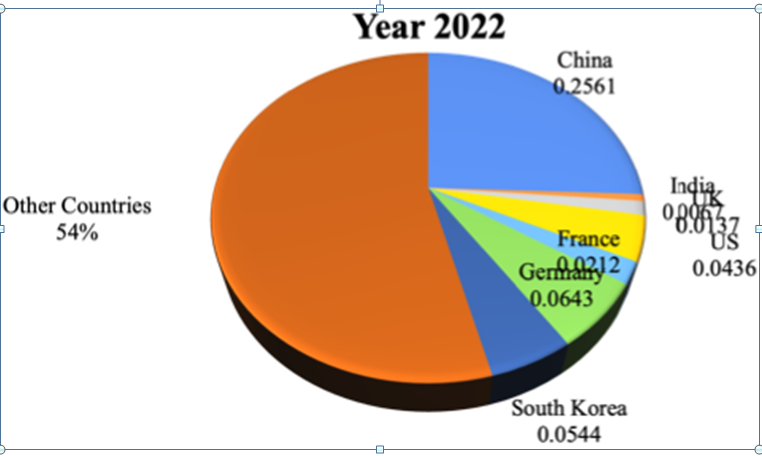 |
Labour Intensive Products
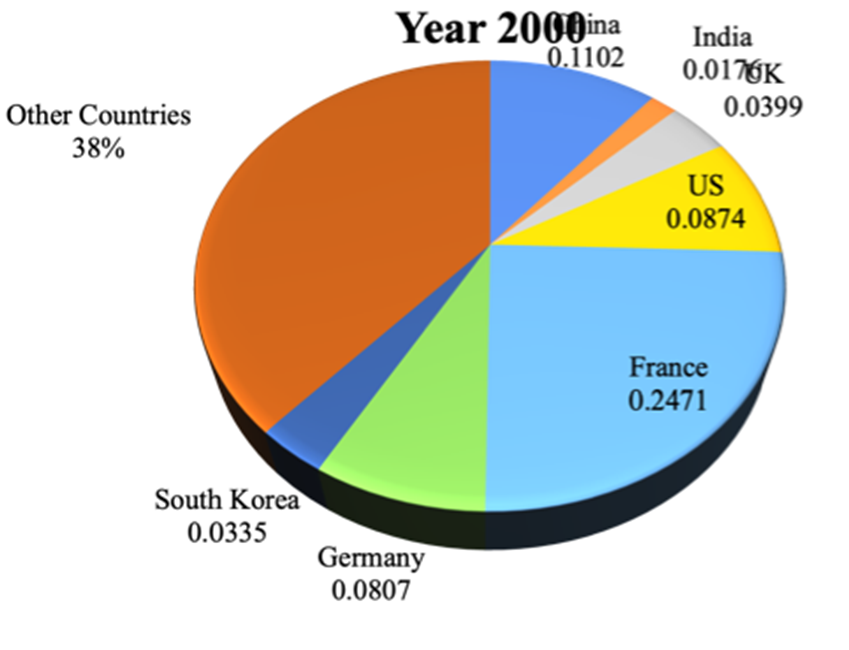 | 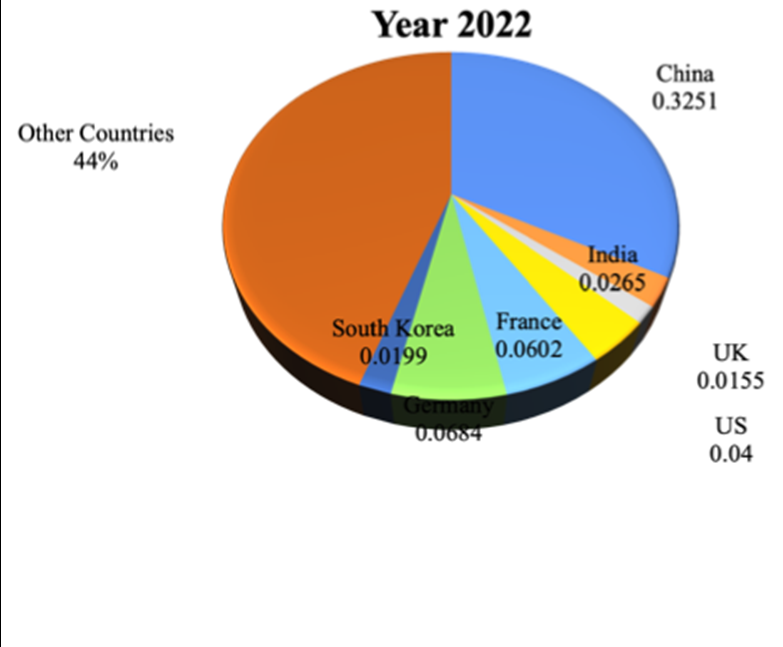 |
Source: Authors’ calculations based on World Integrated Trade Solutions (WITS) UN COMTRADE
The impact of this rapid and unprecedented rise has been further exacerbated by the fact that China has largely followed a mercantilist approach, encouraging exports and production while limiting consumption and imports. This gap between China’s exports and imports has been widening since the early 2000s (see figure 2 below). It is important to note that China’s share of global exports has not increased since 2016 and has remained stable at around 13% to 14%. This stagnation is partially attributable to tariff protections targeting Chinese imports implemented during the first Trump administration and protectionist measures in the EU and several other Asian countries. Nevertheless, China’s share of global manufacturing output has continued to grow, supported by state assistance, thereby increasing the risk of creating global overcapacity across various sectors[1].
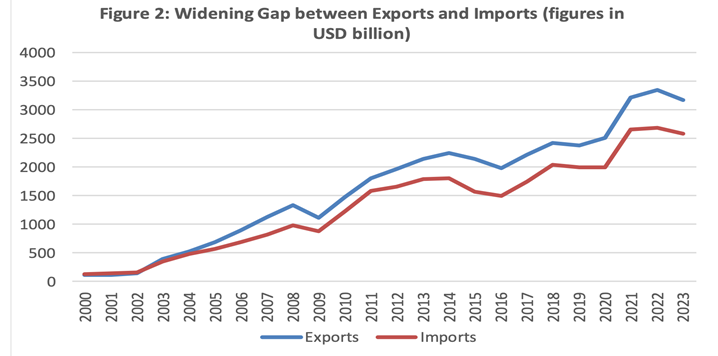
Source: Authors’ calculations-based World Development Indicators Database, World Bank
This unprecedented and unbalanced growth of China’s manufacturing sector and its domination of manufacturing exports have resulted in severe economic distress and job losses. Caliendo et al. (2019) and Autor et al. (2013) provide evidence of such significant job reductions due to this so-called ‘China Shock’. A Rhodium Group report from 2024 emphasises that developing countries have been particularly adversely affected by China’s mercantilist policies[2].
The western world, particularly the United States, facilitated the entry of China, a non-democratic polity and a non-market economy, into the rules-based trading architecture of the global economy as represented by the WTO in 2000, with the hope that increasing integration with the global economy and rising incomes would lead to a democratic transition. It is clear that developments in China are actually moving in the opposite direction. As long as China’s unfair trade practices predominantly affected labour-intensive industries, with the adverse effects primarily felt by developing countries like India, the Western nations (and Japan) showed little concern (Banerjee et al. 2025a). In fact, many Western economists argued that Chinese subsidies helped manage inflation in their countries and that cheaper Chinese industrial parts and components enhanced the competitiveness of Western industries[3].
However, as China began to challenge the dominance of Western economies in their core tech-intensive sectors, Western countries started to push back with more protectionist policies and state support for their own industries, often in contravention of the global rules they themselves championed a few decades ago. The tariff policies under the Trump administration and industrial policies such as the Inflation Reduction Act (IRA) and the CHIPS Act under the Biden administration are examples of such trade-distorting policies. The EU has been actively using environmental policies, such as the Carbon Border Adjustment Measures or CBAM, as a guise for protectionism. This Western reaction to the global imbalance caused by China is also shrinking the global opportunities available to large developing countries like India, precisely at a time when it needs to leverage such opportunities the most.
Another major concern arising from China’s domination of global manufacturing and exports is the vulnerabilities created for global supply chains due to over-reliance on China (or any single country). China has a 65% or greater share of imports in 407 products that are critically important, as they are associated with national security, healthcare, agriculture (fertilisers), renewable energy, or represent key intermediate inputs to industry[4]. Such dependence can be easily weaponised by China, as demonstrated by the recent instance of China withholding the export of key capital machinery to slow down the shift of smartphone manufacturing to India[5], or export controls of industrial magnets[6] that have widespread industrial application including in the automobile industry, are perfect examples of such weaponisation of supply-chains.
China has also employed predatory pricing to eliminate any domestic capacity a country has, thereby increasing dependence on Chinese imports. In India, this was evident in the case of several chemicals that are Active Pharmaceutical Ingredients (APIs) critical to India’s pharmaceutical industry. Consequently, reducing dependence, particularly on unreliable trade partners whose geopolitical interests do not align with India, assumes significant importance.
Indian trade and investment policy must account for and address these fundamental challenges. India needs to establish trade deals that ensure assured access to key markets and eliminate both tariff and non-tariff barriers to its exports. Such assured market access would attract FDI and enable India to leverage global opportunities to drive its economic growth. However, making such deals requires reducing its own tariff barriers. India must negotiate optimal pathways for tariff liberalisation that allow it to provide strategic short- to medium-term protection to key industrial sectors, enabling them to grow while also safeguarding vulnerable sectors of its economy. Furthermore, India must ensure that it is perceived as a trusted partner and is not denied essential technologies.
Another priority would be to address unfair trade practices, particularly those originating from non-market economies. Simultaneously, India would need to advocate for flexibilities in global rules on industrial policy, allowing it to implement strategies that foster manufacturing growth and lift the majority of its population out of poverty and into the middle class. This would require persuading its main economic partners of the necessity for such flexibilities to pursue industrial policies that are intelligent, targeted, and effective, while not being entirely consistent with WTO rules on subsidies and state support for industries.
Another key policy objective would be to further enhance India’s competitive advantage in high-skilled services. Increasing digitalisation is amplifying the scale and scope of services trade. As Indian skilled workers bring an increasing level of competition to workers in developed countries across various occupations, there will be mounting pressure on the governments of those countries to protect their workers from such Indian competition. India will need to pre-empt this protectionism and ensure that the economic benefits of services trade, which could generate millions of well-paid jobs and help create an urban middle-class revolution several times the scale of that generated by IT-led development in the 2000s, are not hampered by such protectionist pressures (Banerjee et al. 2025b). As figure 3 below shows, India boasts the world’s largest cohort of college-educated individuals. Effectively leveraging this talent will be a critical aspect of India’s successful transformation into a developed economy.
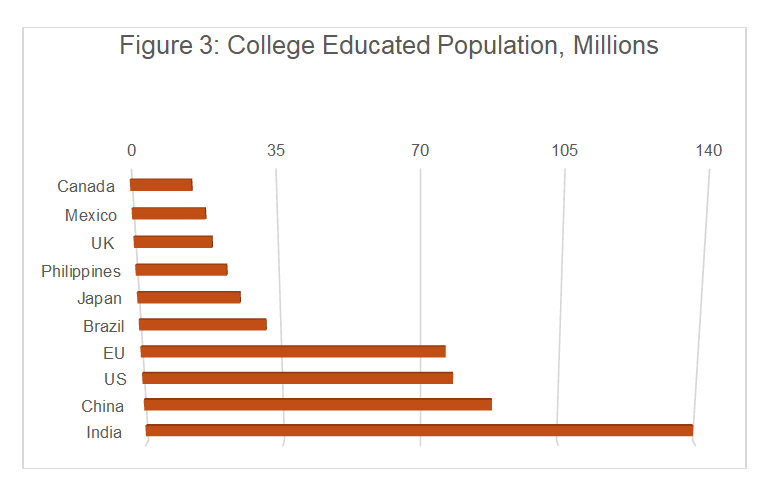
Source: Global Tech Talent Guidebook 2025, CBRE Research
The following sections will discuss trade policy in relation to specific goals such as ensuring market access for Indian exports, attracting investment, and enhancing technology accessibility for Indian firms. We will also examine the role of bilateral agreements in fostering more resilient supply chains.
Trade Agreements and Market Access
Sustained growth of Indian manufacturing and services will require leveraging both domestic and global opportunities. Ensuring assured market access to the world’s major economies and growth regions is, therefore, a critical priority for Indian policymakers. India already has FTAs in place with Japan, Korea, ASEAN, the European Free Trade Area (EFTA), and the UK[7]. It is currently pursuing FTAs with nearly all the other major industrial economies, including Australia[8], the European Union (EU), and the USA[9].
Having negotiated an FTA with the UAE. India is actively considering initiating agreements with the other Gulf Co-operation Council (GCC) member states, including Saudi Arabia[10]. India is engaged in discussions with Russia and other member states of the Eurasian Economic Union (EaEU) for an FTA. Additionally, India is actively pursuing negotiations with major economies in Africa and Latin America for FTAs. The overarching objective is to establish FTAS with all G20 economies, excluding China, by 2030, as well as with the key emerging regions in Africa and Latin America.
According to WTO rules, India’s so-called MFN tariffs are available to all WTO member states, including non-market trade distorters like China. Therefore, India cannot discriminate and impose higher tariffs on non-market economies while applying lower tariffs on others. However, India can offer reduced tariffs without violating WTO rules to all countries or regions with which it has negotiated an FTA. India should aim to negotiate and finalise such FTAs with all major economies and trade partners by 2030. These FTA partners would account for a significant portion of global trade covered by FTAs[11]. As Figures 4a and 4b below demonstrate, India’s FTA strategy would integrate the country with economies representing two-thirds of global GDP and more than two-thirds of global import demand. Consequently, India’s MFN tariffs would effectively apply only to China and other non-market economies with which India has not negotiated FTAs.
| Figure 4a |
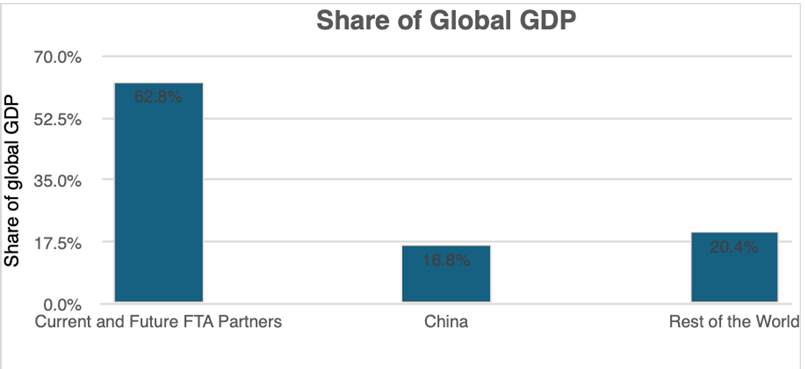 |
| Figure 5a |
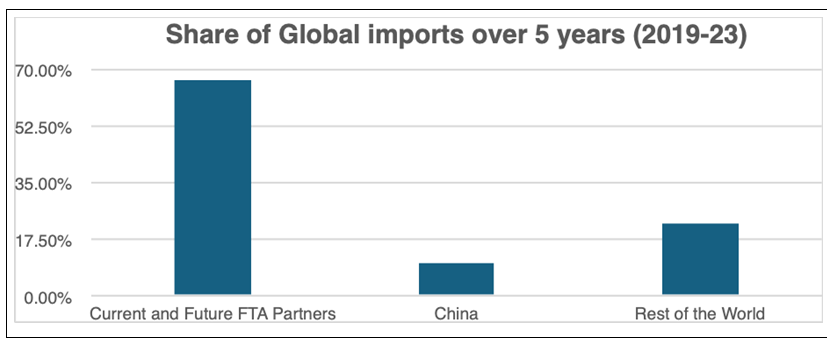 |
Source: Calculations based on World Integrated Trade Solution (WITS)
Strategically, this would provide India with the policy space to achieve two important objectives. First, increase such MFN tariffs as high as possible to counter non-market trade-distorting actions by non-market economies while ensuring they do not impact trade with other major market economies, which will be covered by much lower FTA tariffs. Second, use such high MFN tariffs strategically to reduce import dependence and supply-chain vulnerability, and ‘friendshore[12]’ supplies from preferred FTA partners.
India’s FTA strategy aligns completely with the vision of Atmanirbhar Bharat. Thus far, India has largely succeeded in excluding certain sectors from market liberalisation or securing considerably long transition periods before opening its markets to key strategic sectors that are integral to its long-term industrial policy strategy[13] (which we discuss subsequently). This will provide some breathing space before such sectors are exposed to foreign competition as tariffs decrease. India will need to leverage its domestic market size and enhance scale and competence in these crucial sectors that are set to dominate the global economy in the future.
Non-tariff barriers related to product standards, national security, consumer safety, health, and the environment are becoming greater obstacles to trade than tariffs. India must, therefore, ensure that these non-tariff barriers do not hinder its export opportunities. To achieve this, it needs to identify innovative provisions within its FTAs that focus on minimising the costs of complying with these standards and regulations for India’s exporters. India has been relatively less successful in this regard, making it a crucial area for further development and application as the country advances its FTA strategy.
Digitally delivered services are set to increasingly dominate the global value chain. India is the hub for Global Capability Centres (GCCs) mediating these emerging value chains. The growth of GCCs is central to fostering the next ‘middle-class’ revolution in India, creating millions of high-paying jobs in the country. India’s FTAs with key economies must include measures that pre-empt any protectionism in market access for Indian services exports. Many of these protectionist measures are currently absent, not discussed, or not applied, so there is still time for pre-emption. While India has secured some binding commitments for the cross-border digital delivery of services, this remains a work in progress, and there is a need for a more comprehensive strategy on this front[14].
Ensuring gainful employment opportunities for India’s large working-age population will require leveraging global demand for workers, particularly in countries with ageing populations where such demand is likely to emerge. Services chapters in FTAs present opportunities for India to secure binding commitments on labour mobility for skilled service workers. Moreover, India must proactively seek stand-alone bilateral mobility agreements outside of FTAs that would enable Indian industrial workers and less-skilled service workers to find employment globally.
Investment and Technology
FTAs play a crucial role in attracting investments into the country. As mentioned earlier, FTAs provide predictability concerning tariffs through binding commitments on reduced tariffs and on regulatory aspects of trade. Businesses are therefore more inclined to invest due to the reduced risk of policy-induced shocks once an FTA is established. There is robust empirical evidence linking binding tariff liberalisation and regulatory predictability in FTAs to significant increases in FDI. The impact of FTAs on boosting FDI is particularly evident in agreements between developed and developing countries (Laget et al. 2021).
India’s FTA policy has been strategised based on the FTA-FDI linkage, which is why India has prioritised its FTAs with major industrialised economies. While the FTA-FDI linkage has traditionally been implicit, India has introduced innovations in FTA disciplines to create an explicit connection. It is important to note that the India-EFTA TEPA is the world’s first FTA explicitly establishing a discipline linking market access outcomes to FDI.
The agreement acknowledges that one fundamental trade-off in FTAs with advanced countries is opening up India’s vast and growing market in exchange for access to global value chains dominated by MNCs based in these advanced economies. FDI from these global MNCs and their affiliated suppliers in India will be crucial to India’s capacity to expand manufacturing and exports. It will also be central to technology and skills transfer. The India-EFTA TEPA includes a commitment from EFTA member states led by Switzerland to invest USD 100 billion and create 1 million jobs in India within 15 years of the agreement’s entry into force. This Indian innovation is being closely examined by other large developing economies seeking to emulate it in their FTAs.
FDI relies on the ease of doing business (EoDB). India has prioritised EoDB under Prime Minister Modi’s leadership since 2014 and has made significant progress. Over 39,000 compliance requirements have been streamlined, and over 3,400 legal provisions have been decriminalised. A comprehensive programme led by the Department for Promotion of Industry and Internal Trade (DPIIT), involving both central and state governments, has been established to implement reforms. This is crucial since the vast majority of clearances and procedures investors face fall under state governments’ jurisdiction. These ongoing efforts have elevated India’s rank in the World Bank’s EoDB Report from 142nd in 2014 to 63rd in 2019[15].
India is also exploring innovations within FTAs to incorporate disciplines on investment facilitation that offer greater assurance to investors. India’s newer FTAs aim to include disciplines on good regulatory practices (GRP) that will help catalyse faster reforms within India, provide opportunities to learn from the best practices of its trade partners, and foster collaborations and capacity building in this area.
However, one area where India needs to bring greater policy focus and reform is Bilateral Investment Treaties (BITs). BITs protect foreign investors from adverse policy changes or conditions. The current model of BITs that India insists on is generally considered ineffective as it does not include disciplines that would assure foreign investors. For example, it excludes taxation policies from BITs, exposing foreign investors to sudden tax policy changes without any recourse in the investment treaty. They also require investors to exhaust all domestic legal remedies for a set period (e.g., five years) before resorting to international arbitration. This can lead to significant delays and discourage investors who prefer a quicker resolution process.
As India becomes an outward foreign investor, seeking access to essential raw materials, critical technology, and infrastructure assets to support its ambition of becoming a significant player in planned global trading corridors like IMEC, its firms will also require investment protection. Therefore, India’s BITs must reflect this dual reality: Indian investment may also need safeguarding in a world characterised by policy uncertainty and shifting geopolitical concerns, where countries may be inclined to alter policies that affect investments.
Technology
Despite rapid advancements in key areas of technology and engineering and some remarkable achievements in space, defence, biotechnology, and other fields, India has yet to catch up with its peers. In a global economy where competitiveness is defined by the ability to access, adopt, and develop cutting-edge technology, India must implement strategies that minimise impediments to the accessibility and adoptability of technology. Access to technology is critical for India’s successful integration and eventual leadership in two major transformations in the global economy: the green transition to more sustainable energy sources and the digital transition. Figure 5 illustrates India’s relative position among global tech leaders in critical technologies. India is ranked 9th overall and significantly lags in areas such as semiconductors and quantum computing.
Figure 5: India’s relative performance in key technologies among technology leaders
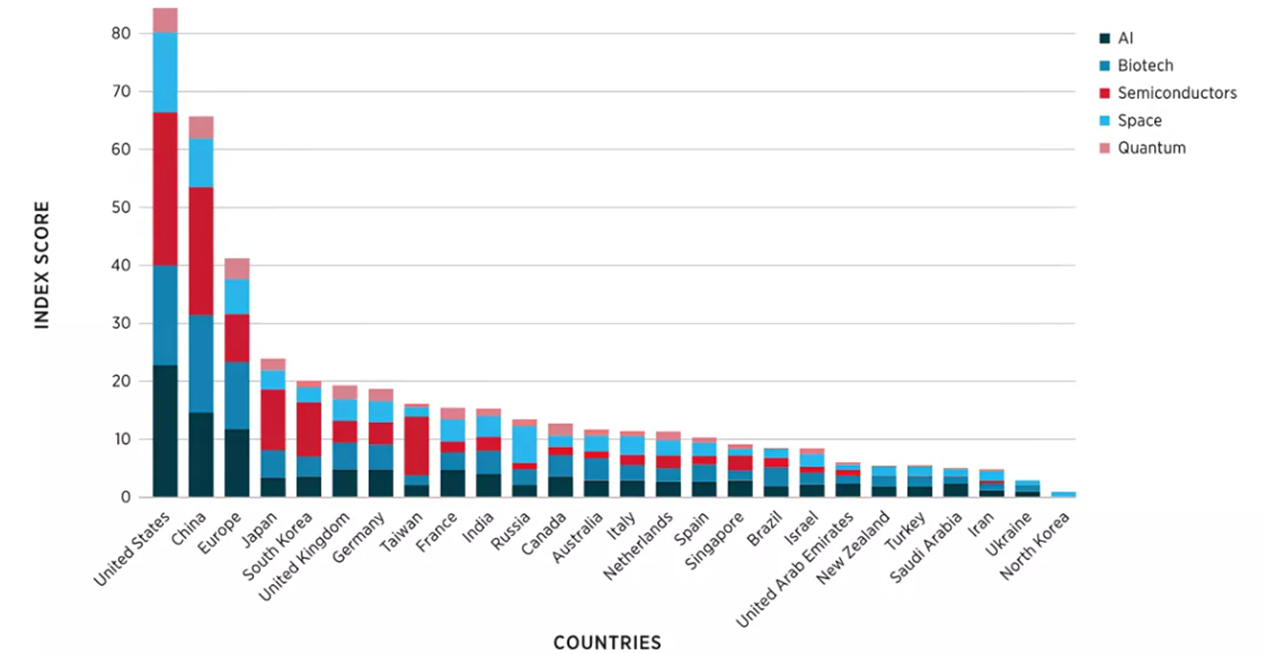
Source: Taken from the Emerging and Critical Technologies Index, published by the Harvard Kennedy School, Belfer Centre for Science and International Affairs, June 2025
Technology denial is an inherent aspect of geopolitical tension. Technology leaders like the EU, the US, and Japan increasingly attempt to withhold technological know-how and hardware from less-trusted players. The US policy of restricting the export of high-performance AI chips to only a few trusted countries is but one example of such emerging challenges.
India’s independent courts and rule of law, which prevent technology theft and hold violators accountable, provide the foundation on which India could be regarded as a trusted partner for technology transfer by Western firms and countries. As FTAs enhance trade and investment linkages between India and industrialised economies, Western multinational technology leaders would have a significant incentive to engage in technology transfer and cooperation with India. As Table 2 illustrates, India ranks third among large developing and newly industrialised economies as a technology market and is the fastest-growing one.
Table 2: India as a market for technology: Relative importance among developing countries and NIE peers
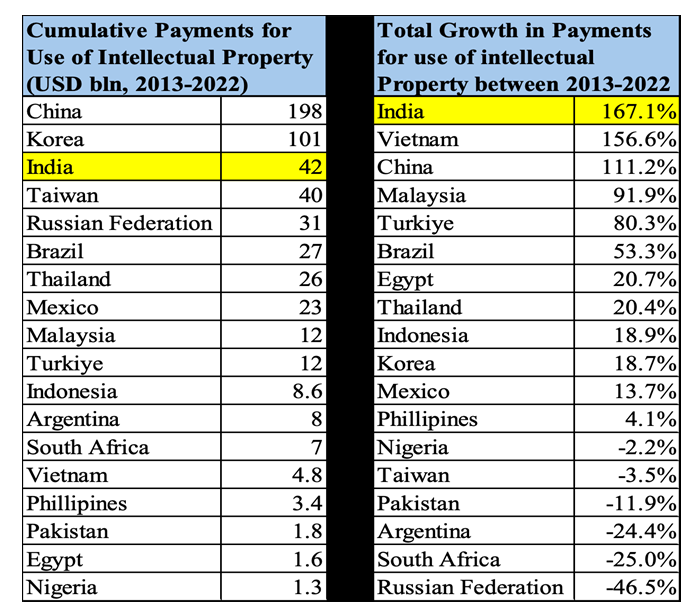
Source: Calculations using the Trade in Services by Mode of Supply (TISMOS) database, WTO
India’s vast pool of highly skilled labour (see Figure 2) offers another key advantage in joint technology development and innovation. India has emerged as one of the largest defence procurers in the world. It has successfully leveraged its purchasing power to advocate for licensed production, joint product development, and technology partnerships. The recent successes in indigenous production and development are attributed to reforms in the procurement process and strategy involving the Indian private sector.
Military technologies have significant spillovers for non-military commercial applications. The US military-industrial complex is a prime example of cutting-edge commercial product development. From Ray-Ban sunglasses to the internet, the defence sector has been the source of some of the most successful commercial products. A strategic approach to India’s defence procurement, as it expands in scale and scope to facilitate technology transfer, is critical to India’s long-term trade and industrialisation policies. As Figure 3 illustrates, India is the world’s fourth-largest defence spender, and its spending growth is second only to China among the leading countries.
Table 3: India as a defence spender: Relative importance among leading economies
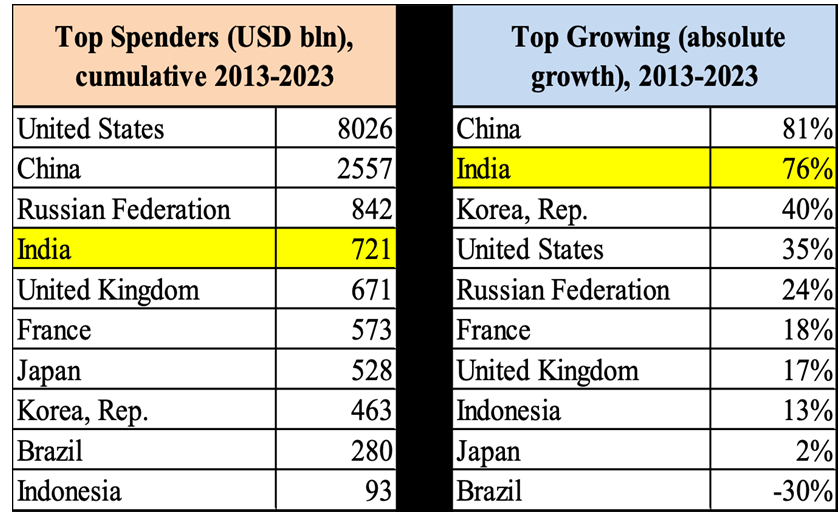
Source: Calculations using World Bank Development Indicators Database
However, defence is not the only area where India’s influence in government procurement is rapidly increasing. Indian government investment and procurement in renewables, telecommunications, transport, agriculture, and medicine should be effectively leveraged along the same lines as defence. Unlike in the case of defence, procurement in these other sectors is distributed across numerous departments and state governments. This dilutes the advantage of scale. A thought-out planning process is needed where procurement remains independent, yet is conducted in a coordinated manner to capitalise on scale advantages as an incentive for technology transfer and joint development in partnership with the Indian private sector.
Finally, as will be discussed later under industrial policy, India would need to engage actively in its multilateral trade strategy within the WTO to seek flexibilities in current WTO rules[16] to use performance requirements related to investment that is trying to cash in on India’s large and growing market size. Such performance requirements may encompass technology transfer, training, or local sourcing (which facilitates tech transfer to local firms). For instance, a foreign firm keen on obtaining a share of India’s USD 10 billion per year industrial wastewater treatment market could be subjected to technology transfer and local content requirements to enhance India’s domestic capabilities in this vital area.
Developing Resilient Supply Chains
India depends significantly on foreign suppliers for critical goods and raw materials, including reliance on a single import source. In many instances, this singular source of imports is China, making India vulnerable to the potential weaponisation of supply chains. Figure 6 illustrates key areas of vulnerability for India.
Figure 6: Key Sectors and Associated Products of Supply-Chain Vulnerability for India
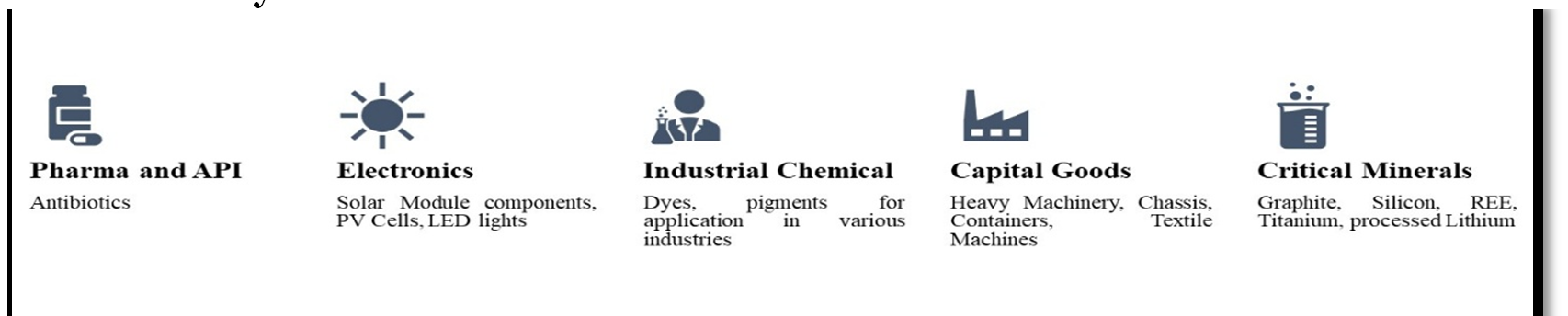
Source: Internal, unpublished analysis by the author
FTAs include disciplines that impose binding restrictions on partners, preventing export controls; that is, they reduce the risk of weaponisation of import dependencies. However, India has been reluctant to pursue deep commitments related to export controls due to its need to restrict exports of predominantly agricultural products to ensure food security and domestic price stability. Furthermore, India’s FTA strategy excludes China as a partner, even though dependencies on China define the majority of India’s supply-chain vulnerabilities. Nevertheless, India would benefit from reconsidering its soft commitments strategy to export controls with other trade partners, as such provisions are an essential mechanism for de-risking the supply chain. It should also be noted that WTO rules broadly prohibit export bans and restrictions, allowing members to apply them temporarily to prevent or alleviate critical shortages of foodstuffs or other essential products. However, WTO rules have been largely ineffective in preventing member states from restricting exports of various products.
India has also entered into agreements specific to supply chain security. These include the Indo-Pacific Economic Framework (IPEF) Supply Chain Agreement, which focuses on cooperation, information sharing, and joint crisis response mechanisms to minimise the impact of disruptions and enhance supply chain efficiency. India is also a signatory to the Mineral Security Partnership (MSP). The objective of the MSP is to coordinate policies among members to ensure effective access to critical minerals and collaborate to reduce dependencies on China overall.
India is also seeking to establish disciplines in its FTAs with countries that possess significant reserves of key natural resources, such as critical minerals, which will assist India in securing access to these resources. Examples of this strategy include discussions with Australia and Chile.
Indian policymakers are cognisant of the impact of disruptions at logistical chokepoints such as the Suez Canal and the Gulf of Aden. India has been focusing on creating alternative multi-modal linkages to supplement the routes where such chokepoints are situated. These initiatives include the International North-South Corridor (INSTC), linking India with Central Asia, Russia, and Europe, as well as the India-Middle-East-Europe Corridor (IMEC), which provides an alternative connection between the Indian Ocean and the Mediterranean Sea, bypassing the Suez Canal and the Gulf of Aden. Additionally, the trilateral highway offers overland connectivity between India, Southeast Asia, and the South China Sea. Unfortunately, these initiatives are progressing slowly due to geopolitical tensions and other operational challenges. Nonetheless, they remain essential objectives for India’s long-term supply chain resilience.
Last but not least, India must expand its domestic capabilities in key industries that are essential for national security, food security, and economic security. Industrial policy aimed at developing and enhancing indigenous capacity is crucial to this goal, and the next section discusses some pertinent issues regarding that topic.
Industrial Policy
India is increasingly caught between the aggressive use of state-led non-market unfair practices of the world’s largest industrial economy—China—and the well-funded industrial policies of advanced industrialised economies. Between them, these actors are attempting to squeeze out the competition in key sectors that will define the future of the global economy. India’s overall share in global manufacturing is a mere 2.9%, and in global manufacturing exports, it stands at 2.2%. Its share in high-tech sectors is just 2.7%. India must implement policies to support industrial development and competitiveness in these crucial sectors to catch up with dominant players. Since many of these policies could potentially conflict with WTO rules, for example, the performance requirements on foreign investment to aid technology transfer mentioned earlier, or subsidising inputs or credit for private industry, India would need to seek temporary flexibilities from such rules, arguing its developmental needs.
India must also find ways to discipline and limit unfair industrial policy actions that increase global developmental inequities and create global imbalances. This would entail countering China’s non-market unfair practices and finding ways to curtail aggressive and excessive industrial policies in the advanced industrial economies.
Achieving the above would necessitate independently pursuing each of the three objectives across different platforms with various sets of allies:
- Pursuing flexibilities in global rules to create policy space for India’s industrial policy: India must ally with major developing countries in Asia, Africa, and Latin America, whose interests align. The group of African nations has already submitted proposals seeking similar solutions at the WTO. With the forthcoming WTO 14th Ministerial Conference, India would benefit from articulating a position that distinguishes the legitimate developmental aims of industrial policy in most developing countries from the predatory and mercantilist industrial policies found in non-market economies like China.
- Pursue reforms in WTO rules that check unfair trade and industrial policies in non-market economies and hold them accountable: India’s interests broadly align with those of the US, EU, and Japan in this objective. India would benefit from making common cause with these developed economies and seeking to include as many developing countries as possible, which are also suffering from such unfair practices, in an alliance. In fact, the US, EU, and Japan might be willing to agree to allow market-oriented developing countries to pursue legitimate development goals with much greater freedom in using subsidies and state support in exchange for assistance in developing international disciplines to hold non-market economies accountable for their policies.
- Ensure that developed economies are held accountable for their trade-distorting policies: India must define parameters of development (per capita income, absolute number of poor people), along with the extent of global economic capabilities that prevent already prosperous countries, which have dominant industrial sectors, from using subsidies and state support that undermine competition and lead to the domination of industrial sectors by global oligopolies.
Conclusion
India’s goal of Viksit Bharat will need to be achieved under far more challenging circumstances than those faced by countries like Japan, Korea, or China during their respective transitions. The world is experiencing a backlash against globalisation and open markets, geopolitical tensions are disrupting supply chains, and access to key technologies is becoming increasingly restricted for geostrategic reasons. The relatively open markets and globalising trends that had progressed from the twentieth century into the first decade of the 21st century are now being reversed.
Furthermore, technological shocks stemming from advancements such as automation and AI have significantly diminished the creation of new jobs linked to economic growth, making it increasingly easier and cheaper to replace human workers with machines. This reduction in space for ‘labour-intensive’ economic activities poses a considerable challenge for India, which must ensure productive engagement for the world’s largest working-age population.
Adding to all this complexity is the challenge of imbalance in the global economy due to a huge non-market economy that has not played by the international rules governing trade and has weaponised both access to its market and its sheer dominance of supply chains against its competitors.
Finding comprehensive solutions that help India meet its developmental objectives by using access to global markets for goods, services, and human resources will require a focused approach involving deeper bilateral integration with major economies and regions through FTAs. Such FTAs must be complemented by matching initiatives that attract foreign investment and ensure accessibility to key technologies. India must form effective alliances to tackle the challenge of supply-chain vulnerability and the weaponisation of over-dependence on a single trade partner.
All of this would require agility. India would often find itself allied with countries in opposing geopolitical camps as it pursues its priorities in the areas mentioned above. Balancing such complexities would demand finesse and a relentless pursuit of Indian interests. More importantly, it would necessitate consistency and continuity in Indian policies over this extended period.
Author Brief Bio: Dr. Pritam Banerjee is Professor & Head, Centre for WTO Studies, Indian Institute of Foreign Trade, New Delhi.
References
Autor, David (2019) Work of the Past, Work of the Future, Working Paper No. 25588, National Bureau of Economic Research (NBER)
Autor, David H., David Dorn, and Gordon H. Hanson. 2013. “The China Syndrome: Local Labor Market Effects of Import Competition in the United States.” American Economic Review 103 (6): 2121–68.
Acemoglu, D., Restrepo, P., 2020. Robots and jobs: Evidence from US labour markets. Journal of Political Economy 128, 2188-2244.
Artuc, E, Christiaensen, L, Winkler, H. (2019) Does automation in rich countries hurt developing ones? Evidence from the us and Mexico. Evidence from the US And Mexico (February 14, 2019). World Bank Policy Research Working Paper No. 8741
Bai, Liang and Sebastian Stumpner. 2019, “Estimating US Consumer Gains from Chinese Imports.” American Economic Review: Insights, 1 (2): 209–24
Banerjee, P, Hussain, Z, and Karwal, K. (2025a) Navigating the Development Divide: The Case for Policy Space in India’s Industrial Policy Strategy Amid Rising Global Protectionism, Centre for Research in International Trade (CRIT) Working Paper No. 85
Banerjee, P, Vartul, Mandal, S, and Dua, D. (2025b) Negotiating for Digitally Delivered Services- Framework for a Comprehensive Approach, Centre for Research in International Trade (CRIT) Working Paper No. 82
Boullenois, C, and Jordan, J.A. (2024) How China’s Overcapacity Holds Back Emerging Economies’, Rhodium Group, June
Caliendo et al. (2019) ‘Trade and Labor Market Dynamics: General Equilibrium Analysis of the China Trade Shock’, Econometrica, 87(3),
Guintella, O, Yi, L, and Wang, T (2022) How Do Workers and Households Adjust to Robots? Evidence from China, Working Paper No. 30707, National Bureau of Economic Research (NBER)
Jaravel, X and E Sager (2019), ‘What are the Price Effects of Trade? Evidence from the U.S. and Implications for Quantitative Trade Models’, CEPR Discussion Paper No. 13902 and
Laget, E, Rocha, N, and Varela, G. (2021) Deep Trade Agreement and Foreign Direct Investments, World Bank Policy Research Paper No. 9829
Endnotes
[1] Chinese state control of Banking and other investment agencies de-links investment decisions from market risks, and thereby expansion of capacities are not based on market based, risk informed decisions which would have otherwise prevented such investments
[2] How China’s Overcapacity Holds Back Emerging Economies’, Rhodium Group, June 2024
[3] Examples include Jaravel, X and E Sager (2019), ‘What are the Price Effects of Trade? Evidence from the U.S. and Implications for Quantitative Trade Models’, CEPR Discussion Paper No. 13902 and Bai, Liang and Sebastian Stumpner. 2019, “Estimating US Consumer Gains from Chinese Imports.” American Economic Review: Insights, 1 (2): 209–24.
[4] Based on unpublished empirical research carried out by the author
[5] See China’s export ban on engineers and equipment disrupts manufacturing overseas, Strait Times, Published Jan 20, 2025, Singapore
[6] See China’s rare-earth curbs hit Indian auto industry, India Today, June 16th, 2025
[7] India-UK FTA was finalised in May 2025 and is expected to come into force in early 2026
[8] India has completed an early-harvest agreement with Australia and is currently negotiating to complete the comprehensive deal
[9] India is currently pursuing a Bilateral Trade Agreement with the US
[10] India has on-going negotiations with Oman
[11] India’s neighbours are already covered by South Asia Free Trade Agreement or SAFTA
[12] Friendshoring refers to the practice of developing more resilient supply-chains by sourcing imports from countries that are more dependable, politically aligned and generally considered to be market oriented and rules based.
[13] These sectors typically have the maximum potential for future growth includes electronics, advanced engineering, chemicals, pharmaceuticals, precision engineering included robotics, renewable energy etc
[14] For a more detailed discussion, see Banerjee et al 2025b
[15] The Make in India Ease of Doing Business page provides a complete list (refer to: https://www.makeinindia.com/eodb#:~:text=India%20jumps%2079%20positions%20from,of%20Doing%20Business%20Ranking%202020′.&text=To%20further%20enhance%20the%20ease,legal%20provisions%20have%20been%20decriminalized)
[16] Under the WTO agreement on Trade Related Investment Measures or TRIMS
Operation Sindoor: Redefining National Response to Terrorism
The brutal massacre of innocent tourists in Pahalgam on 22 April by five heavily armed terrorists of The Resistance Front (TRF), a proxy of the Pakistan-based Islamist terrorist group Lashkar-e-Taiba (LeT), marked a watershed moment in India’s war against terrorism. The attack, timed to coincide with the visit of U.S. Vice President JD Vance to India, was no coincidence. It was a calculated move intended to internationalise the Kashmir issue and sow communal discord within India. The terrorists and their sponsors failed on both counts. An outraged India rallied together, united in grief, anger, and resolve, and demanded justice for the victims. That justice was delivered on the night of 6-7 May through Operation Sindoor.
A press briefing on 23 April by India’s Foreign Secretary, Shri Vikram Misri, set the stage for what was to follow. He informed the media that the Cabinet Committee on Security (CCS), chaired by the Prime Minister, had convened to assess the evolving security situation. The CCS resolved to bring the perpetrators of the attack to justice and hold their sponsors accountable. As an immediate response, the Indus Waters Treaty of 1960 was suspended, and the Integrated Check Post at Attari was closed. Visas issued under the SAARC Visa Exemption Scheme (SVES) were also cancelled. Additionally, the military, naval, and air advisors at the Pakistani High Commission in New Delhi were declared persona non grata and instructed to leave the country.
Prime Minister Narendra Modi, in a public rally just 48 hours after the deadly Pahalgam attack, assured the nation that justice would be delivered. Switching to English, in his address, he declared, “Today, from the soil of Bihar, I say this to the whole world, India will identify, track and punish every terrorist and their backers.”[1] This was an unambiguous statement of intent. The promised retribution came fifteen days later, through Operation Sindoor. In multiple attacks carried out by the Indian Armed Forces in the early hours of 7 May, nine headquarters, training establishments and other infrastructure of three terrorist groups—Lashkar-e-Taiba, Jaish-e-Mohammad, and Hizbul Mujahideen were destroyed. Five of these targets were in POJK (Pakistan Occupied Jammu & Kashmir) and four in Pakistan’s Punjab province. About 140 terrorists were eliminated in this attack, and the headquarters of the LeT and JeM were destroyed.
Operation Sindoor marked an inflexion point in India’s response to cross-border terrorism. The hesitations of the past in confronting a neighbour that had long employed terrorism as a tool of state policy were gone. The assumption that nuclear weapons would shield such actions from a robust Indian response no longer held true. The doctrine of ‘strategic restraint’ had been decisively set aside, signalling a new assertiveness in India’s national security policy.
Strategic Restraint: the Background
‘Strategic Restraint’ characterised India’s approach to terrorism since the early 1990s. It was a defensive strategy aimed at preventing acts of terrorism. To that end, in the hinterland, a specialised counter-insurgency force, the Rashtriya Rifles, was formed from within the Indian Army to address the escalating insurgency in Jammu and Kashmir. The Rashtriya Rifles quickly established dominance, eliminating a significant number of terrorists and containing violence levels. However, as the losses suffered by terrorist groups were rapidly compensated through infiltration from across the LoC, the number of terrorists operating in J&K did not decline.
In the early 2000s, a fence was constructed along the International Border (IB) and the Line of Control (LoC) to check infiltration. The BSF was tasked with actively guarding the fence along the IB, while the Army was responsible for securing the LoC. These measures contributed to a reduction in Pakistan-sponsored cross-border infiltration. However, as Pakistan continued to support the terrorists, such infiltration could not be entirely eliminated.
The policy of strategic restraint did not envisage the use of force to deter the Pakistani military. The nuclear tests conducted by both India and Pakistan in 1998 provided Pakistan with the leverage to continue supporting cross-border terrorism under a nuclear overhang. Within India’s security establishment, there was genuine concern that military action against a nuclear-armed Pakistan could provoke a potential nuclear response. Ambiguous yet ominous statements from Pakistan’s political and military leadership, suggesting the possibility of using nuclear weapons to counter an Indian offensive, further reinforced this belief. Consequently, when Pakistani forces infiltrated the Kargil heights in early 1999, India intentionally restricted its military operations to its side of the LoC, signalling a cautious yet calculated employment of military power under the shadow of nuclear deterrence.
For the Pakistani establishment, cross-border terrorism represented a low-cost option to continue to bleed India by a thousand cuts—a policy first articulated by Pakistan’s Prime Minister ZA Bhutto after the country’s defeat in the 1971 war. For India, maintaining a significant security presence in Jammu and Kashmir to control levels of violence in the state imposed substantial costs in human and material resources. Despite the increased security presence, acts of violence continued, albeit at manageable levels.
The Pakistani state and its military were not impacted by the Indian response, which was directed at preventing infiltration and operating against terrorists in the hinterland. This allowed the Pakistani state to operate with impunity and claim deniability over the actions of the terrorist groups. Consequently, a significant number of high-profile terrorist attacks occurred in India during the first decade of the new millennium. These included an attack on India’s Parliament in 2001 by five Jaish-e-Mohammed terrorists, the 2002 Akshardham Temple attack by Lashkar-e-Taiba (LeT), the 2005 and 2008 Delhi bombings, and the 2008 Mumbai attacks, which were also carried out by the LeT. Predictably, Pakistan denied having a role in these attacks, claiming them to be the handiwork of “freedom fighters”. India’s ‘Strategic Restraint’ policy thus failed to deter Pakistan from sponsoring such attacks. A policy shift was necessary.
When the NDA government came to power with a substantial majority in 2014, it initially aimed to improve relations with Pakistan. Prime Minister Modi invited the Pakistani premier to his swearing-in ceremony on 26 May 2014. As the year drew to a close, in a move that surprised most observers, Prime Minister Modi, while returning from Afghanistan, made an unscheduled stop in Lahore to attend the wedding of Nawaz Sharif’s granddaughter on 25 December.[2] This was intended as an ice-breaker, but the bonhomie lasted only a few days. Just a week later, on New Year’s Day 2016, during the night of 1-2 January 2016, Pakistan-backed terrorists attacked the Indian Air Force (IAF) base at Pathankot. The terrorists were neutralised and prevented from causing damage to the IAF’s strategic assets, but seven defence personnel lost their lives and 25 were injured.[3] The brief period of bonhomie was over.
The Shift to Deterrence
Despite this grave provocation, India continued with its strategic restraint policy. The first glimmer of a policy change in the offing came about following the ambush of an Indian Army convoy in Manipur on 9 June 2015, in which 18 soldiers were killed. The terrorist group NSCN-K claimed responsibility for this outrage. A few days later, in a covert operation code-named “Operation Hot Pursuit”, India’s Special Forces targeted the training facilities and camps linked to NSCN-K a few kilometres inside Myanmar.[4] The success of this operation drew wide applause, but the Pakistani reaction was dismissive. Responding to the then Minister of State for Information and Broadcasting Rajyavardhan Singh Rathore’s remarks that military action in Myanmar to retaliate against rebels who killed 18 soldiers in Manipur was a message to other countries, Pakistan’s interior minister Nisar Ali Khan stated, “Pakistan is not like Myanmar” and warned that the threats from across the border would not intimidate Pakistan.[5] He and other leaders in Pakistan also obliquely threatened India with nuclear retaliation should India attempt a similar operation against Pakistan.
A terrorist attack on an army post in Uri on 18 September 2016 marked a pivotal moment in India’s response to incidents of terrorism emanating from Pakistan. In this attack, claimed by Jaish-e-Mohammed, a Pakistan-based terrorist group, 19 Indian soldiers lost their lives. Responding to the incident, Prime Minister Modi stated, “We strongly condemn the cowardly terror attack in Uri. I assure the nation that those behind this despicable attack will not go unpunished.” Ten days later, on the night of 28-29 October, the Indian Army launched a surgical strike on seven launch pads located a few kilometres across the LoC, in which a significant number of terrorists were eliminated.[6] During a briefing for the media the following afternoon, the Indian Army’s Director General of Military Operations, Lt Gen Ranbir Singh, provided details of the strikes. “Significant casualties have been caused to the terrorists and those who are trying to support them”, he stated. “We do not have any plans for the continuation of further operations. However, the Indian armed forces are fully prepared for any contingency,”[7] he added.
The surgical strikes represented a significant shift in India’s approach to cross-border terrorism, suggesting that the ‘strategic restraint’ policy was being replaced by deterrence. For the first time, India had demonstrated an intent to strike overtly at terrorist targets across the LoC and, in the process, had also called out the Pakistani nuclear bluff.
While Pakistan opted not to respond to the surgical strikes, it continued to support terrorist groups operating within J&K. Consequently, there was no significant change in the number of terrorist acts of violence, which remained relatively consistent over the subsequent three years.[8] However, there were no targeted acts of violence involving casualties significant enough to impact a large number of people. Also, no terrorist acts took place outside of Jammu and Kashmir.
That changed in 2019, when, on 14 February, in Pulwama, a bustling town about 25 kilometres south of Srinagar, a suicide bomber drove his vehicle into a bus that was part of a CRPF convoy, resulting in the deaths of 40 CRPF personnel. The suicide bomber was identified as Jaish-e-Mohammad’s Adil Ahmed Dar.[9] Two weeks later, India retaliated by attacking the Jaish-e-Mohammad headquarters in Balakot on 26 February.
The Balakot air strike was again a departure from the strategic restraint policy. IAF jets flew across Pakistani airspace and hit a JeM facility in Balakote, Khyber Pakhtunkhwa, approximately 80 km deep inside Pakistan. The facility, located atop a forest hilltop about 20 km from Balakot, was run by Muhammad Yusuf Azhar, the brother-in-law of Masoor Azhar, a wanted terrorist. It was reportedly a training camp, with a capacity of about 600, training terrorists in the use of weapons and explosives. Indian sources claimed that the attack killed between 200 and 350 terrorists who were in the buildings at that time. Pakistan, predictably, denied any loss of life, but retaliated thereafter with an air strike on an Indian forward post. In the process, an Indian MiG-21 fighter jet piloted by Wing Commander Abhinandan shot down a returning Pakistani F-16 in aerial combat. However, as his jet was also hit, he ejected over Pakistan-Occupied Kashmir and was captured by the Pakistani military. Two days later, he was released, ending the brief conflagration.
The Balakot air strike was significant for two reasons. First, it marked India’s first air strike on Pakistani territory since the 1971 war—and notably, in an undisputed area—signalling once again a shift away from its traditional posture of “strategic restraint”. Second, Pakistan’s swift release of the captured Indian Air Force pilot indicated a reluctance to escalate into full-scale conflict, deviating from its usual strategy of leveraging the threat of nuclear confrontation to prompt Indian caution and international intervention, particularly from the United States. India called Pakistan’s bluff, and Pakistan blinked. As Christine Fair put it, “Pakistan has nuclear weapons it cannot use because, while India will suffer tragic losses from Pakistani launches, Pakistan will cease to exist as a geopolitical entity after India responds in kind.”[10]
The Balakot air strike established a new normal in India’s approach to addressing cross-border terrorism. The use of air power, previously seen as a significant escalation, was no longer taboo. Through this strike, India affirmed its right to defend itself by targeting terrorist objectives wherever they may be.
The Jammu and Kashmir Reorganisation Act of August 2019, which followed a few months later, was also a significant step taken to restore normalcy in Jammu and Kashmir and break the linkages Pakistan had cultivated with various groups in the state. The Act revoked the state’s special status and divided it into two Union Territories: Jammu and Kashmir and Ladakh, with both coming under the President’s rule. During the following five years, until elections were held in September 2024, the Union Territory of Jammu and Kashmir witnessed a dramatic decline in casualty figures.[11] In the Kashmir Valley, the significant improvement in the security situation resulted in zero incidents of hartals, shutdowns, or stone-pelting demonstrations, which had been common earlier. Terrorist attacks in the Kashmir Division fell to 126 in 2021, then to 103 and 29 in the following two years, eventually reducing to single digits in 2024.[12] The number of tourists visiting the valley rose to record levels, with over three million visiting in 2024.[13]
Pakistan’s declining ability to incite separatism in Jammu and Kashmir was likely the underlying cause of the terrorist attack in Pahalgam on 22 April. The cold-blooded murder of 26 tourists, after identifying their religious identity, appeared to be a desperate attempt by Pakistan to maintain its relevance in the Union Territory. Within minutes of the Pahalgam attack, the TRF claimed responsibility.
The Doctrine of Compellance
In his address to a rally in Bihar, Prime Minister Modi made it clear that terrorists and their sponsors would face the wrath of the Indian state. Fearing a severe backlash from India and the international community, TRF, likely under Pakistani prodding, swiftly backtracked on its claim, but the evidence against it was overwhelming. As Prime Minister Modi had made it clear that India would respond strongly, Pakistan heightened its security nationwide. Nevertheless, the scale and ferocity of the Indian response took the Pakistan army and political establishment by surprise.
‘Operation Sindoor’ was conceived to punish the perpetrators and planners of terror and to destroy the terror infrastructure across the border. Accordingly, on the night of 6-7 May, the Indian Armed Forces launched coordinated and accurate missile strikes on nine terrorist bases—four located in Pakistan (including the headquarters of LeT and Jaish-e-Mohammed (JeM) in Muridke and Bahawalpur, respectively), and five in Pakistan-occupied Jammu and Kashmir (including Muzaffarabad and Kotli). All the terrorist bases struck were key command centres of the LeT and JeM.
What was significant about “Operation Sindoor” was Pakistan’s failure to protect its airspace, despite deploying the much-vaunted Chinese-made equipment: the long-range HQ-9 and the medium-range HQ-16 series of SAMs (Surface to Air Missiles). India successfully destroyed the terrorist camps in under 30 minutes, with none of its missiles being intercepted by the Pakistani air defence system. As India did not wish to escalate the conflict, the Indian Army’s DGMO immediately informed his Pakistani counterpart of India’s strike, stating that India had not attacked any Pakistani military target and that any response by Pakistan to Indian military targets would provoke a suitable response.
Pakistan, however, chose to escalate the conflict, and over the next 72 hours, attacked Indian cities and military bases using drones and missiles. India’s air defence system successfully intercepted all incoming threats, resulting in minimal loss of life or property. In retaliation for Pakistani aggression, India deployed kamikaze drones to neutralise Pakistan’s air defence capabilities, and Lahore’s air defence system was disabled. On the night of 9-10 May, India intensified its counter-offensive. Within three hours, 11 military installations, including Noor Khan, Rafiqui, Murid, Sukkur, Sialkot, Pasrue, Chunian, Sargodha, Skardu, Bholari, and Jacocabad, were struck, causing extensive damage. Pakistan’s air capability thereafter stood seriously degraded, forcing it to seek a ceasefire. This was a significant demonstration of India’s military and strategic power.[14]
Through a combination of kinetic and non-kinetic measures, remarkable political leadership, and skilled diplomatic manoeuvres, a new security doctrine has emerged, which I call the doctrine of compellence. The strategic restraint observed from the 1980s was replaced by deterrence in 2016, as exemplified by the surgical and Balakot air strikes. Now, Operation Sindoor has set the stage for a comprehensive strategy to compel Pakistan to desist from supporting terrorist attacks originating from its soil. In the future, the policy’s kinetic impact will focus on the Pakistan military. This was made clear by the Prime Minister in his address to the nation on 12 May, where he stated that Operation Sindoor has established a new benchmark in India’s fight against terrorism and has introduced a new parameter and a new normal. Three significant points emerged from the Prime Minister’s address. One, India will strike at every location from which the roots of terrorism emerge. Two, India will not tolerate any nuclear blackmail, and three, India will not differentiate between the government sponsoring terrorism and the masterminds of terrorism.[15]
The compellence doctrine establishes new paradigms for deterrence and response. Henceforth, all acts of terror against India will trigger a clear, forceful, and coordinated whole-of-government response, encompassing both kinetic and non-kinetic measures. India will no longer distinguish between terrorists and those who sponsor them—both will be held equally accountable and targeted in its responses. All of Pakistan’s territory is now within the scope of potential Indian action, which will be carried out through coordinated tri-service operations. Nuclear threats from Pakistan will not deter India from taking firm and resolute measures to safeguard its national security and respond decisively to cross-border terrorism. As part of reframing its response strategy, India has decoupled the Kashmir issue from its strike narrative and will act solely through the lens of counter-terrorism. In doing so, India will operate unilaterally and will not seek global approval for its actions. Through this doctrine, India has redefined the rules of engagement and established new red lines.[16]
The non-kinetic measures designed to compel Pakistan to abjure terrorism target the Pakistani state. Among these, linking cooperation on sharing the waters of the Indus River and its tributaries to Pakistan abjuring terrorism will have the most significant impact, as it instils uncertainty in Pakistan’s agricultural sector. “Blood and water cannot flow together” is not merely a slogan but a reality Pakistan must now confront. This will severely affect Pakistan’s Punjab province, which holds considerable influence over the country’s polity. This province relies heavily on the waters of the Jhelum and Chenab Rivers and is, consequently, the most severely impacted by Indian actions upstream of these rivers.
The other significant aspect of the non-kinetic response is that India’s engagement with Pakistan on any issue will be conditional, requiring Pakistan to dismantle its terror apparatus. There is no change to the Indian stance that talks and terrorism cannot go together. Discussions on the Kashmir issue will be restricted to the return of the territory illegally occupied by Pakistan, which includes Gilgit-Baltistan and the region of Mirpur-Muzaffarabad.
The Challenges Ahead
While a new doctrine has been enunciated, future challenges revolve around its execution. For instance, what will be the Indian response if Pakistan-based terrorists attack a military convoy, resulting in the loss of a couple of soldiers’ lives? Will the response match the scale of Operation Sindoor? If not, what will be India’s level of tolerance towards Pakistani-sponsored terrorist attacks?
How will India respond to instances of cross-border infiltration and violations of Indian airspace by drones operated from Pakistan? There would be a need for greater clarity on these issues. If the policy is to be zero tolerance, then India must be prepared to respond firmly to every act of terror, even if such terrorist acts are thwarted and cause no damage. In any case, each act of Pakistan-sponsored terrorism must be responded to in a manner that imposes heavy costs on the sponsors.
There is a view, especially among some former Indian diplomats, that India’s stated policy of no talks with Pakistan till it forsakes terrorism is counter-productive. The view expressed is that any meaningful progress can occur only through talks. However, talks have yielded little so far, and there is nothing to suggest that Pakistan will be more amenable to forgoing terrorism if negotiations are resumed. A more positive outcome could be obtained by making Pakistan bear the brunt of its policies. Hence, combining non-kinetic and kinetic measures to deter Pakistan may serve India’s interests better. The challenge is to keep the pressure on Pakistan, without getting derailed by internal voices seeking peace at any cost. If sufficiently high costs can be imposed on Pakistan, that could elicit a behaviour change.
For the policy to be impactful, India must have a decisive military edge over Pakistan. This edge must be maintained at all times.
Conclusion
India-Pakistan relations remain at a historic low, with little prospect of improvement in the foreseeable future. India is focused on its long-term developmental trajectory, aiming to become a USD 30 trillion economy by 2047. It cannot afford to be distracted by a belligerent neighbour that continues to pursue a policy of bleeding India through a thousand cuts.
Decades of experience have demonstrated that Pakistan is unlikely to alter its hostility unless compelled to do so through the imposition of meaningful costs. In this context, the new strategic framework initiated through Operation Sindoor represents a pivotal shift. It offers India a credible opportunity to reshape Pakistan’s calculus and compel a reconsideration of its priorities.
The doctrine of compellence—a mix of kinetic and non-kinetic instruments—provides the most viable path towards enforcing a peace that Pakistan cannot ignore. In the current environment, a forced peace—rather than an imagined reconciliation—is the most achievable outcome.
Author Brief Bio: Maj. Gen. Dhruv C. Katoch is Editor, India Foundation Journal and Director, India Foundation
References:
[1] India Will Identify, Trace, Punish Every Terrorist and Their Backers: PM Modi –. 24 Apr. 2025, www.newsonair.gov.in/india-will-identify-trace-punish-every-terrorist-their-backers-pm-modi.
[2] Rishi, Shubir. “Modi Makes Surprise Visit to Pakistan, Attends Nawaz’s Grand-daughter’s Wedding.” Rediff, 25 Dec. 2015, www.rediff.com/news/report/surprise-modi-to-drop-in-for-nawazs-birthday-in-lahore/20151225.htm.
[3] Terrorist Attack at Air Force Station Pathankot. www.pib.gov.in/newsite/PrintRelease.aspx?relid=136914.
[4] Dhingra, Ashok K. “Operation Hot Pursuit: The Indian Army’s Surgical Strikes Into Myanmar.” Fair Observer, 16 May 2025,
[5] IndiaToday.In. “Pakistan Is Not Myanmar: Pakistan Minister to India.” India Today, 10 June 2015, www.indiatoday.in/india/story/pakistan-is-not-myanmar-nisar-ali-khan-manipur-ambush-256792-2015-06-10.
[6] Correspondent, Ht. “India’s Surgical Strikes Across LoC: Full Statement by DGMO Lt Gen Ranbir Singh | Latest News India – Hindustan Times.” Hindustan Times, 29 Sept. 2016, www.hindustantimes.com/india-news/india-s-surgical-strikes-across-loc-full-statement-by-dgmo-lt-gen-ranbir-singh/story-Q5yrp0gjvxKPGazDzAnVsM.html.
[7] “Transcript of Joint Briefing by MEA and MoD (September 29, 2016).” Ministry of External Affairs, Government of India,
[8] List of Terrorist Killed in India | South Asian Terrorism Portal. www.satp.org/datasheet-terrorist-attack/major-incidents/india.
[9] Haidar, Suhasini. “Latest Pulwama Attack 2019 News, Photos, Latest News Headlines About Pulwama Attack 2019-The Hindu.” The Hindu, www.thehindu.com/topic/pulwama-attack-2019.
[10] Fair, C. Christine. “Pakistan’s Pulwama Game Plan: It Is Obsessed With Changing Maps in Kashmir and Retarding India’s Global Ri.” Times of India Voices, 25 Feb. 2019, timesofindia.indiatimes.com/blogs/toi-edit-page/pakistans-pulwama-game-plan-it-is-obsessed-with-changing-maps-in-kashmir-and-retarding-indias-global-rise.
[11] “Transcript of Joint Briefing by MEA and MoD (September 29, 2016).” Ministry of External Affairs, Government of India,
[12] Ramachandran, Sudha. “Jammu and Kashmir: Five Years After the Abrogation of Its Autonomy”
https://thediplomat.com/2024/08/jammu-and-kashmir-five-years-after-the-abrogation-of-its-autonomy/
[13] KL News Network. “Kashmir Sees 9.2 Million Tourists in 6 Years, 1.4 Lakh From Abroad.” Kashmir Life, 20 May 2025, kashmirlife.net/kashmir-sees-9-2-million-tourists-in-6-years-1-4-lakh-from-abroad-391550.
[14] Operation SINDOOR: India’s Strategic Clarity and Calculated Force. www.pib.gov.in/PressReleasePage.aspx?PRID=2128748#:~:text=The%20results%20of%20Operation%20SINDOOR,Mohammed%2C%20and%20Hizbul%20Mujahideen%20facilities.
[15] English Rendering of PM’s Address to the Nation. www.pib.gov.in/PressReleasePage.aspx?PRID=2128268#:~:text=Our%20brave%20soldiers%20displayed%20immense,every%20daughter%20of%20the%20country.
[16] Operation SINDOOR: India’s Strategic Clarity and Calculated Force. www.pib.gov.in/PressReleasePage.aspx?PRID=2128748#:~:text=The%20results%20of%20Operation%20SINDOOR,Mohammed%2C%20and%20Hizbul%20Mujahideen%20facilities.
Katha Session 3 with Mr. Nitin Kushalappa & Mr. Orson Passi
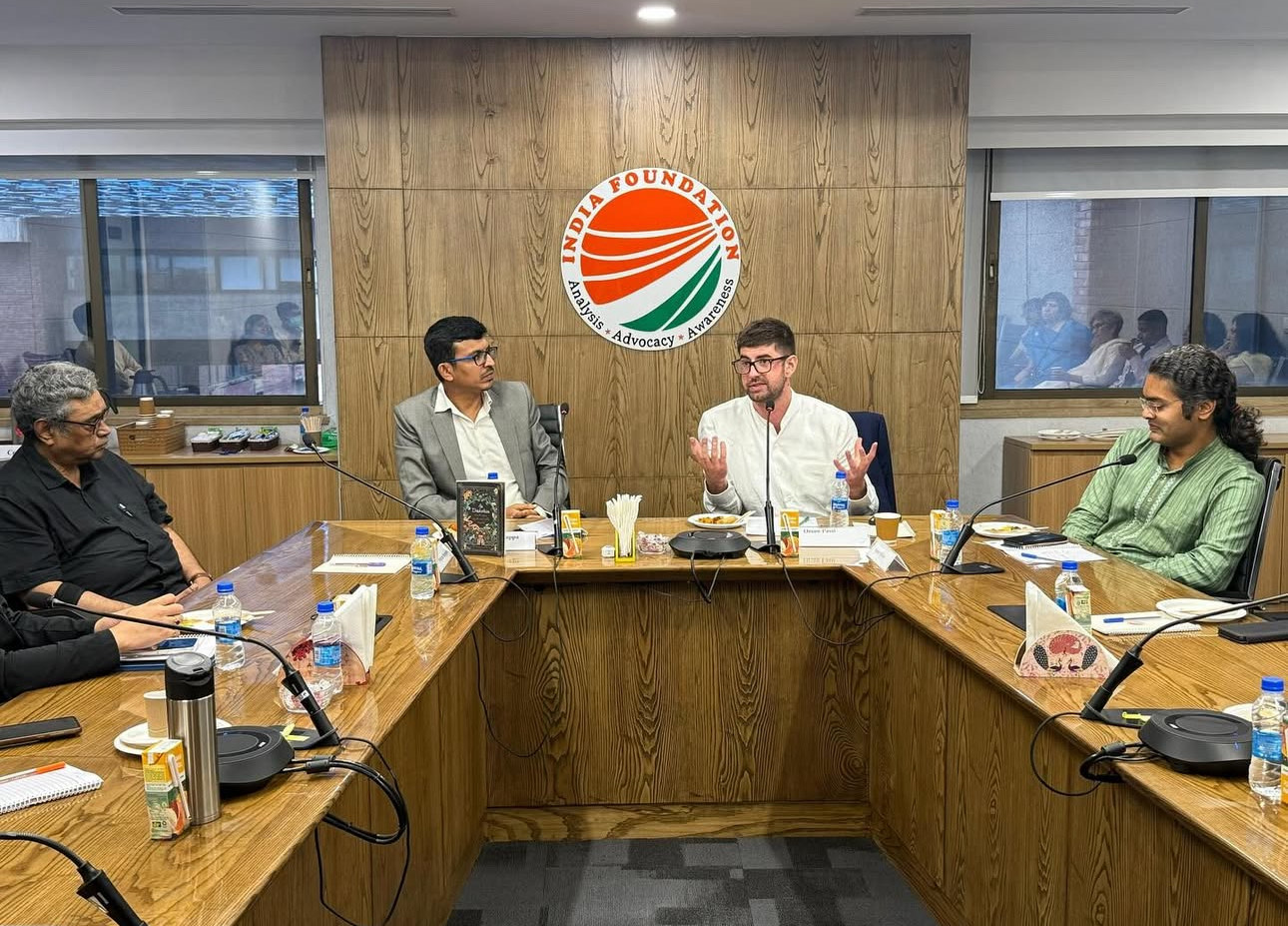
Date: 30th June 2025
Time: 5:00 PM to 6:30 PM
The third session of “Katha: The Folklore Circle” took place on 30th June 2025, bringing together enthusiasts of storytelling for an evening rich in South Indian folklore and cross-cultural narratives. The session was titled “South Indian Folklore: From Coorg & In Popular Media”, and it highlighted the enduring charm of regional tales as well as their resonance in modern literature.
The evening’s master storyteller was Mr. Nitin Kushalappa, an award-winning Coorg-based author whose book Dakshin won the 2025 Sahitya Akademi Bal Sahitya Puraskar. Mr. Kushalappa skillfully transported the audience to the verdant hills of Coorg, narrating timeless tales that had once been orally shared across generations. His storytelling weaved together elements of local culture, folklore, and moral wisdom, making each narrative immersive and memorable. Through his expressive voice, vivid imagery, and occasional humorous interludes, Mr. Kushalappa brought the landscapes, characters and traditions of Coorg to life, captivating audiences both young and old.
A special highlight of the evening was “Australian Dreamtime Stories & Other Myths” presented by Mr. Orson Passi, Second Secretary (Political) at the Australian High Commission, New Delhi. Mr. Passi shared the rich oral traditions of Indigenous Australia, emphasizing the spiritual and moral lessons embedded in these stories. His narration, complemented by reflections on the cultural context, offered a fascinating cross-cultural perspective and invited the audience to appreciate the universality of myths and storytelling.
Throughout the session, attendees were encouraged to reflect on the stories’ underlying themes of courage, morality, tradition, and the power of imagination. The interactive format, combined with the storytellers’ expertise, ensured that every listener could connect with the narratives on both an emotional and intellectual level. The audience also shared stories of their own, including a captivating account from a Coorgi attendee who spoke about the history behind the unique saree draping style of Coorgi women.
By the end of the evening, participants left with a renewed appreciation for folklore as a bridge between generations, cultures and continents. The session also provided opportunities for engaging discussions with the storytellers, making the experience personal, inspiring and memorable.
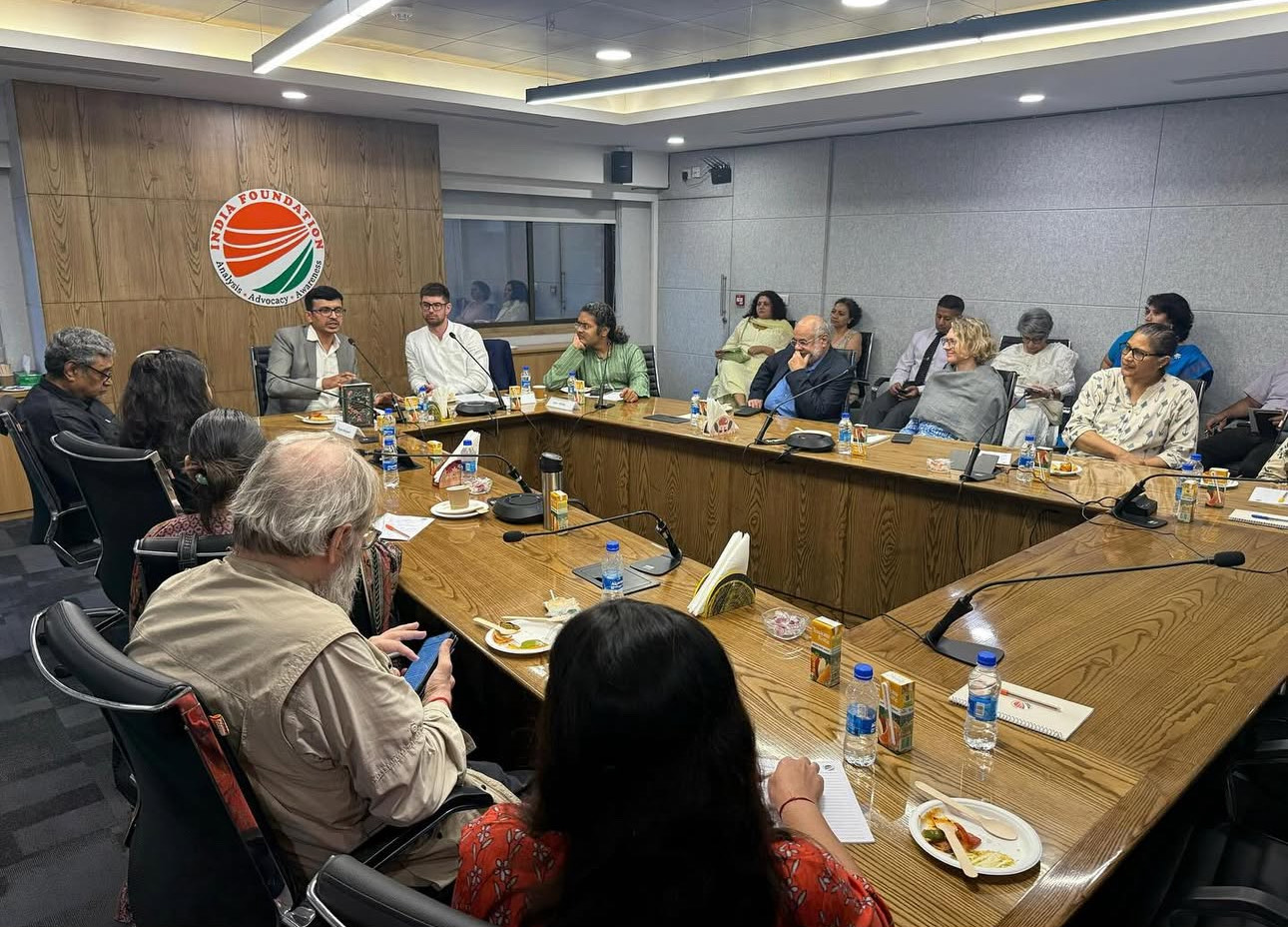
IF-IHC Book Discussion on ‘Alone in the Ring: Decision Making in Critical Times’ by General NC Vij

India Foundation, in collaboration with the India Habitat Centre, organised a book discussion on the book ‘Alone in the Ring: Decision-Making in Critical Times’, authored by General N.C. Vij, Former Chief of Army Staff on 24 June 2025 at India Habitat Centre.
Amb Yash Sinha, Former High Commissioner of India to the United Kingdom, Vice Admiral Anil Chopra (Retd.), PVSM, AVSM & Lt Gen Raj Shukla (Retd.), Member, Union Public Service Commission discussed the book with the author. The session was moderated by Capt. Alok Bansal, Director, India Foundation.
The panelists mentioned that the book is an engaging narrative that provides an insider’s viewpoint on significant events in India’s military history. General Vij, as the former Chief of Army Staff (2003–2005), reflects on pivotal decisions, such as the establishment of the 740-km Line of Control fence, which altered the security dynamics of Jammu and Kashmir, and the formulation of the Cold Start doctrine, which addressed strategic deficiencies exposed during Operation Parakram. His detailed narrative of Operation Khukri, which involved the rescue of 222 Indian forces in Sierra Leone, exemplifies tactical brilliance.
It was argued that General Vij’s account adeptly integrates personal thoughts with strategic analysis, providing insights into the Kargil War, during which he served as DGMO, and the political-military disjunction of Operation Parakram. He challenges the lack of a National Security Strategy and emphasises changes such as the Ex-Servicemen Contributory Health Scheme, demonstrating his administrative expertise. The book, composed in an approachable manner, attracts both military historians and general readers, although it sometimes falls short in its examination of bureaucratic resistance. Panelists highlighted that the memoir’s strength resides in its forthright analysis of leadership in high-pressure situations, highlighting collaboration and theaterization—relevant subjects in contemporary conflict. Some readers may seek additional personal anecdotes to enhance the strategic emphasis. It was concluded that Alone in the Ring is an essential addition to India’s military literature, providing insights for policymakers and academics and that the book contain a wealth of historical and strategic insights.

Military Application of Artificial Intelligence: A Case Study of Ecosystem in United States, China, and India
100th India Foundation Dialogue on “Recent Naxal Operations and Recent Successes”

Topic- Mission Naxal Free India ( Target- March 2026), Briefing delivered by G. P. Singh, Director General, CRPF
At the 100th Dialogue, IPS G.P. Singh provided a concise overview of recent developments under Mission Naxal-Free India (target: March 2026). Citing a major operation in a remote and strategically significant region, he emphasized the challenges of terrain and access, along with the tactical outcomes that followed.
G P Singh outlined a broader framework combining intelligence-led action, targeted development initiatives, and legal-financial tracking. He highlighted a sharp decline in affected districts and increased surrenders, indicating a shift in the operational landscape. Notable progress was also seen in the establishment of field infrastructure and service delivery in previously ungoverned zones. He touched upon evolving community engagement strategies and institutional responses to long-standing structural issues. The session underscored a larger transition in internal security dynamics—pointing toward a more stable and integrated future in historically troubled regions.

IF-IHC Panel Discussion on “India Pakistan Relations in light of Operation Sindoor”

On 3 June 2025, India Foundation, in collaboration with the India Habitat Centre, organized a panel discussion on “India-Pakistan Relations in Light of Operation Sindoor.” The panel featured Shri Raj Chengappa, Group Editorial Director (Publishing); Ambassador Ruchi Ghanashyam, former Indian High Commissioner to the United Kingdom; and Ambassador T.C.A. Raghavan, former Director General of the Indian Council of World Affairs (ICWA). The session was moderated by Captain Alok Bansal, Director, India Foundation.
The opening remarks were made by Shri Chengappa, who noted that Pakistan’s narrative gained some traction internationally, partly due to its effective information warfare, which occasionally overshadowed India’s tactical successes. He further analyzed the escalatory dynamics that unfolded during Operation Sindoor, detailing how the operation triggered a cycle of retaliation, with Pakistan responding through airstrikes and heightened border conflicts.
Ambassador Ruchi Ghanashyam focused on the limitations of a soft diplomatic approach in dealing with Pakistan. Drawing on her extensive experience in diplomatic engagements with Pakistan, she argued that soft treatment has its boundaries, particularly when engaging a nation whose military establishment thrives on a conflict-driven narrative. She expressed support for Operation Sindoor, viewing it as a necessary shift toward a more assertive stance, and underscored that diplomacy alone is insufficient to address the challenges posed by Pakistan’s military posture and its support for terrorism.
Ambassador Raghavan emphasized that following Operation Sindoor, India carries a significant responsibility to ensure effective deterrence against future provocations from Pakistan. He acknowledged the gravity of the decision to launch the operation, describing it as a weighted but necessary and justified step in response to Pakistan’s actions, particularly in the context of the Pahalgam terrorist attack. His remarks underscored the importance of India maintaining a strong and credible posture to prevent similar incidents moving forward, highlighting the strategic imperative of deterrence in the evolving India-Pakistan dynamic.

IF-IHC Panel Discussion on ‘From Look East to Act East Policy: What has Changed in Ten Years’
India Foundation, in collaboration with India Habitat Centre, organised a panel discussion on the topic ‘From Look East to Act East Policy: What has Changed in Ten Years’ at Gulmohar Hall, India Habitat Centre, on 26 May 2025. The panelists for the discussion were Amb Preeti Saran, Former Secretary (East), Ministry of External Affairs; Dr Prabir De, Professor at RIS, New Delhi and Dr Shristi Pukhrem, Deputy Director (Research), India Foundation. The session was moderated by Capt Alok Bansal, Director- India Foundation.
Amb Saran opened the session by providing a foundational overview of India’s transition from the Look East Policy (LEP) to the Act East Policy (AEP). She emphasized that LEP, initiated in the early 1990s, primarily focused on economic integration and symbolic diplomacy with Southeast Asia. However, AEP, launched in 2014, marks a more action-oriented, comprehensive approach involving strategic, defence, cultural, and connectivity-based dimensions. She highlighted the three core pillars of AEP: Culture, Commerce, and Connectivity, underlining how these have guided India’s diplomatic and infrastructural outreach in the region.
Dr De focused on evaluating the achievements and challenges during the first decade of the Act East Policy. He acknowledged that despite multiple global shocks, India achieved significant progress in logistics, payment systems, and cargo movement. As the policy enters its second decade, he emphasized the need for proactive cultural engagement, revival of agreements like AITIGA, and deeper FDI facilitation to strengthen value chains. He also called attention to enhanced partnerships with countries such as Japan, Korea, Indonesia, Singapore, and highlighted Vietnam as a strategic country of focus.
Dr Pukhrem offered a comprehensive review of India’s transformation from LEP to AEP, focusing on strategic, economic, and diplomatic dimensions. She noted that while LEP was passive and symbolic, AEP is multi-dimensional—encompassing defence, maritime security, digital partnerships, and people-to-people connections. India’s growing involvement in ADMM+, QUAD, and defence ties with Vietnam and the Philippines were highlighted as proof of this strategic upgrade. Regular high-level visits and institutional dialogues have improved India’s regional diplomacy. Northeast India was emphasized as a strategic bridge, especially through projects like Kaladan, IMT, and summits like the Rising Northeast Investor Summit. Tangible gains of AEP include deeper strategic ties, expanded trade with ASEAN ($120 billion in 2023–24), and India’s rise as a net security provider. Cultural diplomacy initiatives such as Nalanda University revival, ASEAN-India Youth Summit, and Champa-Kalinga project were cited as important milestones.
However, the panelist also pointed out certain shortfalls related to India’s Act East Policy: India’s lack of visibility in Southeast Asian public perception (as seen in the 2025 ISEAS survey), a growing trade deficit, and the need for more assertive engagement. In conclusion, they emphasized that India must expedite connectivity projects, invest in cultural diplomacy, and most importantly, leverage the Northeast as a strategic asset. They also argued that the External Affairs Minister’s clarion call: “Not just Act East, but Act Fast—and attract the East” must be taken both in letter and spirit.
IF Technology Roundtable – India Foundation Technology Ecosystem Roundtable

Date- 24th May 2025
Venue- T-Hub, Hyderabad, Telangana
India Foundation organised its 3rd IF-Technology Ecosystem Roundtable, focused on Quantum Technology, in Hyderabad, Telangana. It was chaired by Dr. Ram Madhav, President of India Foundation, and Dr. Satheesh Reddy, Former DRDO Chairman, along with key stakeholders from academia, industry, government, and startups engaged in quantum technology and related domains.