
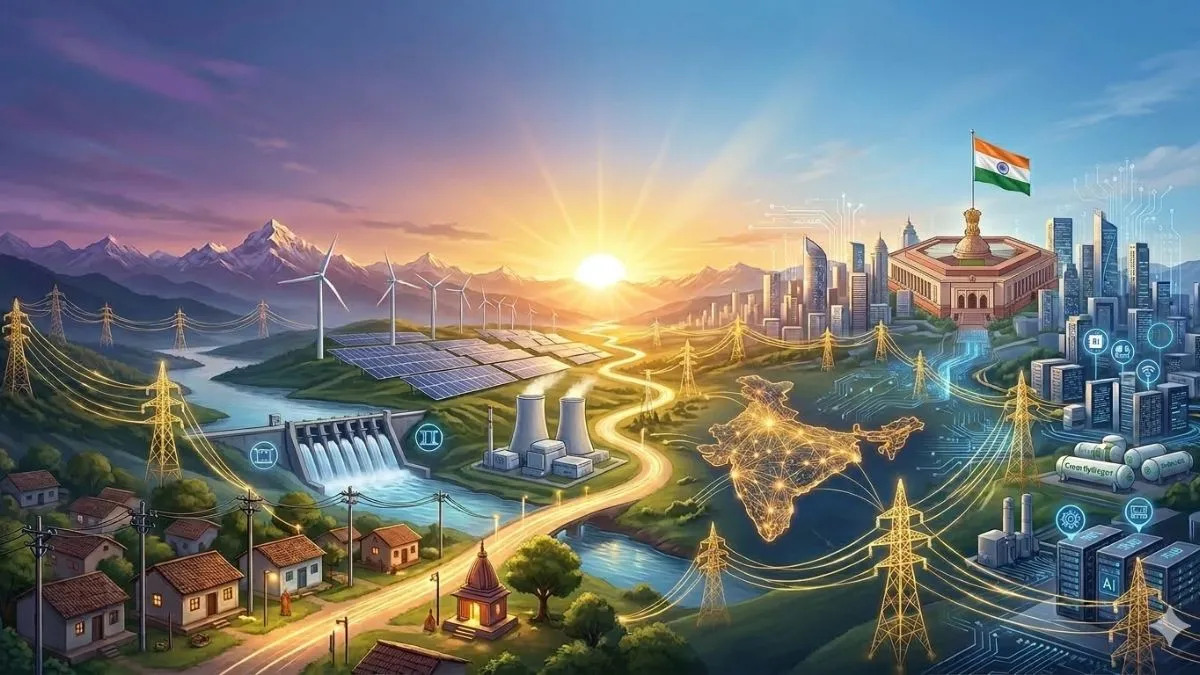
In 1950, just three years after independence, India had a modest electricity-generating capacity of 1.7 GW. At the time, India’s population was about 36 crore, and most people were outside the reach of the electricity grid. By the turn of the century, the installed generating capacity had increased to 112 GW, covering a majority of India’s population, which had now grown to about 100 crore. A quarter of a century later, in 2025, India’s installed generating capacity, at 557 GW, covered the length and breadth of the country, including all villages and hamlets. By 2018, all inhabited villages had been provided with distribution lines, and although power supply in some areas was erratic, it still represented a significant improvement over the situation that existed even a decade earlier.
Over the 75-year period 1950-2025, India’s electricity production increased by more than 320-fold, while its population grew fourfold. The first two decades, 1950-1970, were a period of growth driven by hydropower. The next three decades, 1970-2000, saw coal-driven expansion, with rapid growth in thermal power. Since then, power generation has more than tripled, largely driven by renewable energy, including solar, wind, and nuclear power.
In terms of generating capacity, solar power, at 154.2 GW, now accounts for 28.7% of the country’s capacity, while wind, at 56.4 GW, accounts for 10.5%. When we add 56.9 GW of hydropower, 11.8 GW of bio power, and 8.8 GW of nuclear power, non-fossil fuels make up over 52% of the national total generating capacity. This is a stupendous achievement, driven largely by green energy technologies, substantial funding, and government initiatives.[1]
A significant milestone is the near-100% electrification of India’s broad-gauge railway network, covering 70,271 route kilometres (RKM), of which 70,002 RKM have been electrified. At independence, India had just 388 RKM of its broad-gauge network electrified. This number grew to 21,800 RKM by 2014. The last decade has seen a tremendous push for broad-gauge electrification, with over 48,000 RKM electrified—indeed a tremendous achievement.[2] With just 269 RKM remaining to be electrified, Indian Railways stands on the threshold of complete electrification, marking a transformative achievement in sustainable, efficient, and future-ready rail transport and positioning itself among the world’s leading rail networks. Solar energy is a significant component of Indian Railways’ energy basket, rising from 3.68 MW in 2014 to 898 MW by the end of 2025, reflecting transformational growth in renewable energy adoption.[3]
While India has made a notable leap into renewable energy, its dependence on coal is unlikely to diminish. 55% of India’s primary commercial energy needs are still met by coal. Coal is used in thermal power plants for electricity generation, as well as in iron and steel production, cement manufacturing, coal gasification, and chemical manufacturing. It remains the backbone of India’s energy and industrial sectors. Although coal’s installed capacity accounts for 42% of electricity generation capacity, actual generation is much higher, at about 70-72%. This is because coal plants run continuously, day and night, whereas solar plants depend on daylight hours and hydropower is affected by seasonal flows.
India possesses one of the largest coal endowments in the world, estimated at about 400 billion tonnes by the Geological Survey of India. Despite India’s thrust towards renewables, it would be unrealistic to forgo exploiting its available resources at this stage of development. That said, India’s long-term energy security goal aligns with its net-zero target, and the commitment it made in November 2021 at COP26 to achieve net-zero by 2070 will be met.
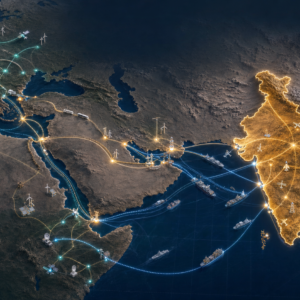
The global energy transition, however, is becoming a new industrial revolution. While global warming and climate change set the agenda for decarbonisation targets, the tremors following the closure of the Strait of Hormuz, which led to market volatility, have underscored the need for resilience and diversification. The defining issue, however, has shifted from generating clean power to building the electrical, digital, and industrial systems required to support an increasingly electrified world. The demand for electrical power is no longer about an annual incremental increase. Artificial intelligence (AI), hyperscale data centres, semiconductor manufacturing, industrial electrification, and battery production are transforming power consumption patterns across advanced and emerging economies alike.[4]
The countries that adapt fastest will shape the next phase of global economic leadership. That is the challenge India will face in its quest to compete for global leadership.
Author Brief Bio: Maj. Gen. Dhruv C. Katoch is Editor, India Foundation Journal and Director, India Foundation.
Endnotes:
[1] NITI Aayog, “Generation”, India Climate and Energy Dashboard, accessed June 23, 2026, https://iced.niti.gov.in/energy/electricity/generation
[2] Ministry of Railways, Government of India, “Status of Railway Electrification (as on 31 May 2026),” accessed June 23, 2026, https://indianrailways.gov.in/railwayboard/uploads/directorate/ele_engg/2026/Status%20of%20Railway%20Electrification%20(as%20on%2031_05_2026).pdf
[3] Press Information Bureau, “Mission 100% Electrification: Powering the Future of Indian Railways,” Government of India, January 6, 2026, https://www.pib.gov.in/PressNoteDetails.aspx?NoteId=156834&ModuleId=3®=3&lang=2
[4] Manmohan Parkash, “Energy Transition Is Becoming a New Industrial Revolution,” Financial Express (Dhaka), June 8, 2026, https://thefinancialexpress.com.bd/views-opinion/energy-transition-is-becoming-a-new-industrial-revolution-1780843478.