1. Introduction
South Asia is a region with the world’s fastest-growing economy and vast human capital, both of which underpin notable economic progress. However, economic growth remains dependent on fossil fuels such as coal, oil and natural gas, which continue to dominate power generation. According to an Economic and Social Commission for Asia and the Pacific (ESCAP) blog post[i], in 2023, South Asian countries relied heavily on fossil fuels, with coal accounting for about 67 per cent of total energy sources.
Energy demand is highly uncertain, driven by rapid income growth, urbanisation, industrialisation, access to energy, climate change, and technological change. Moreover, international events such as the Pandemic, the Russia-Ukraine War, and the Iran-Israel War have at times highlighted the developing world’s vulnerability to energy security risks. However, South Asia also has significant untapped potential in renewable energy sources, including hydropower, biomass, solar, and wind. These renewable sources are crucial for enabling economic development, meeting growing energy demand, and extending modern energy services even in remote mountainous regions.
Since the Paris Agreement, the urgency of the environmental crisis has prompted South Asian countries to commit to decarbonising their economies by setting their nationally determined contributions (NDCs). The transition to clean energy is critical to limiting emissions and strengthening regional energy security. In this context, India’s NDC for 2031-35 marks a major milestone in the journey towards a low-carbon and climate-resilient future. Since achieving certain first goals in 2015, India updated its NDC in 2022, setting a target to reduce emissions intensity from 33-35 per cent of GDP to 45 per cent by 2030 (from 2005 levels). On 25 March 2026, India further announced that it would reduce its GDP emissions intensity by 47 per cent below 2005 levels by 2035. As of 28 February 2026, India’s non-fossil-fuel-based electricity power installed capacity was 52.57 per cent of the total installed capacity, demonstrating achievement of one of the goals ahead of the five-year committed timeline.[ii]
This paper is broadly divided into two parts. Part I illustrates the dynamics of energy dilemmas, and Part II discusses India’s goal of transitioning from non-renewable to renewable sources.
2. The Dynamics of Energy Dilemmas
Energy is the foundation of our daily lives, and ensuring its security, production, and distribution under government regulation is one of the most significant challenges today. The International Energy Agency (IEA) defines renewable energy as derived from natural processes that are constantly replenished, such as solar, wind, biomass, geothermal, hydropower, ocean resources, tide and wave energy, and biofuels, as well as electricity and hydrogen derived from those renewable resources.[iii]
In a society where energy consumption is crucial for economic development, urban expansion, and technological advancement, energy is the backbone of state development and government capability. It is a daily requirement for social welfare in industrial development. This energy, sometimes linked to geopolitics, has become complex, polycentric, and volatile, with strategic location, source, and control becoming crucial. India’s approach to climate change is also based on energy security and sustainable development. Thus, the energy dilemma posed by geopolitics and climate change balances the urgent need to phase out fossil fuels against the new geopolitical vulnerabilities of the green transition.
2.1 Energy Linked to Geopolitics
Energy is directly or indirectly linked to geopolitics. According to Qin and Gao[iv], geopolitical and energy security risks are closely related, as political conditions, military conflicts, and diplomacy create market instability that disrupts energy supply networks. Great power competition over access to strategic locations and natural resources is a well-known phenomenon. Geopolitical literature provides ample evidence of the role of spatial geography, such as chokepoints, resource-based regions, and connectivity, all of which are crucial in determining who holds power and who dictates.
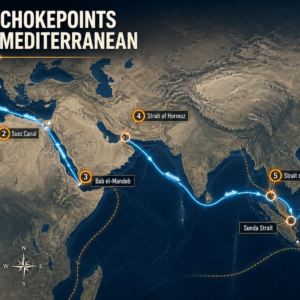
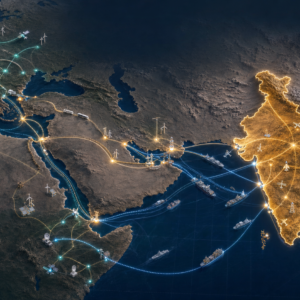
In the past, the British Raj was known for employing access denial against its adversaries, such as the Russians and the French. In the present context, examples include the Russia-Ukraine war since 2022, which has spiked energy prices across Europe and doubled fertiliser prices. In 2026, the closure of the Strait of Hormuz has driven oil prices above USD 100 and gas prices above USD 4.60 in America. Moreover, disruptions at the world’s critical chokepoints have led to geopolitical instability. This all underscores the urgency of ‘self-reliance’ (in the Indian context, Aatmanirbhar Bharat) in energy development and sustainability.
2.2 Energy Linked to Climate Change
In the second context, we can’t ignore the growing debate over energy consumption and climate change in academic and policy forums. This is because the production and consumption of energy is responsible for “75 per cent of greenhouse gas emissions, making it the primary driver of climate change”.[v] Saini et al.[vi] further demonstrate that climate change is primarily driven by carbon emissions and deforestation, which, in turn, lead to the environmental problems we face today. In this scenario, the South Asian region is seen as vulnerable to climate change impacts, with severe floods, droughts, cyclones, and extreme heatwaves posing risks to its growth trajectory, infrastructure development, and people’s livelihoods. According to the World Bank[vii], in its “South Asia Climate Roadmap” report, the region faces acute climate risks, and its population heavily depends on monsoon-fed agriculture and rapid urbanisation.
The India Meteorological Department (IMD) report shows that in recent years, weather conditions have been characterised by heavy rainfall and strong winds. Major Indian cities such as Delhi, Mumbai, Bengaluru, and Chennai are facing an increasing risk of urban flooding due to changing climate patterns, unplanned urbanisation, and inadequate drainage systems.[viii] One of the IAEA reports on “Nuclear Data” highlights that melting glaciers in the Himalayas are affecting water, food, and energy security.[ix]
Recurring heatwaves are another concern, with India, Pakistan, and Bangladesh experiencing temperatures of 40-50 degrees Celsius.[x] Recently, the IMD has issued orange alerts for heatwave conditions in Delhi.[xi] The International Energy Agency’s (IEA) Net Zero Roadmap sets out a mid-century net-zero emissions pathway for the global energy sector to fulfil the Paris Agreement’s goal of limiting global warming to 1.5°C. As a signatory to the agreement, India has advanced its decarbonisation efforts through its nationally determined contributions (NDCs), climate finance, and green bond frameworks, and has scaled up non-fossil fuel power generation to reduce its carbon-emission intensity.
India’s Energy Transition Goals
India’s energy transition began in the 1970s in response to the global oil crisis and culminated in the creation of the “Department of Non-Conventional Energy Sources” (DNES) in 1982.[xii] In 1992, DNES was renamed the “Ministry of Non-conventional Energy Sources” .[xiii] In October 2006, it was renamed again as the “Ministry of New and Renewable Energy” .[xiv] The primary focus was on ‘energy security,’ with increased emphasis on the share of clean power, its availability and accessibility, affordability, and equity.
In response to India’s proactive engagement on ‘climate change,’ policies such as the National Action Plan on Climate Change (NAPCC) were established in 2008. NAPCC identified eight core missions, including the National Solar Mission, which supports India’s push towards an energy transition. In 2015, India became a founding member and host nation of the International Solar Alliance (ISA) to promote solar energy as a sustainable solution for ‘energy access’ and ‘climate change’ mitigation. This was when India intended to sign the Paris Agreement, demonstrating a proactive approach to climate governance.
India’s energy needs are expected to grow by 2 to 2.5 times by 2047 to meet rising developmental priorities. India’s energy demand was 1074 Mtoe in 2023 and is expected to rise to 1921 Mtoe by 2040.[xv] Achieving Net Zero by 2070 requires an orderly transition with a greater share of non-fossil fuels and increased energy efficiency.[xvi] India’s advancing energy transition is reflected in solar capacity reaching 90.76 GW, while wind energy capacity stood at 47.36 GW. Table 1 shows that India crossed the 250 GW milestone in non-fossil power installed capacity in August 2025, the highest-ever renewable energy capacity added in a single year. This indicates that India’s low-carbon future, strong policies, innovation, and immediate action will be key to South Asia’s energy transition.
Table 1. Cumulative non-fossil installed (in GW) (as on 30 November 2025)
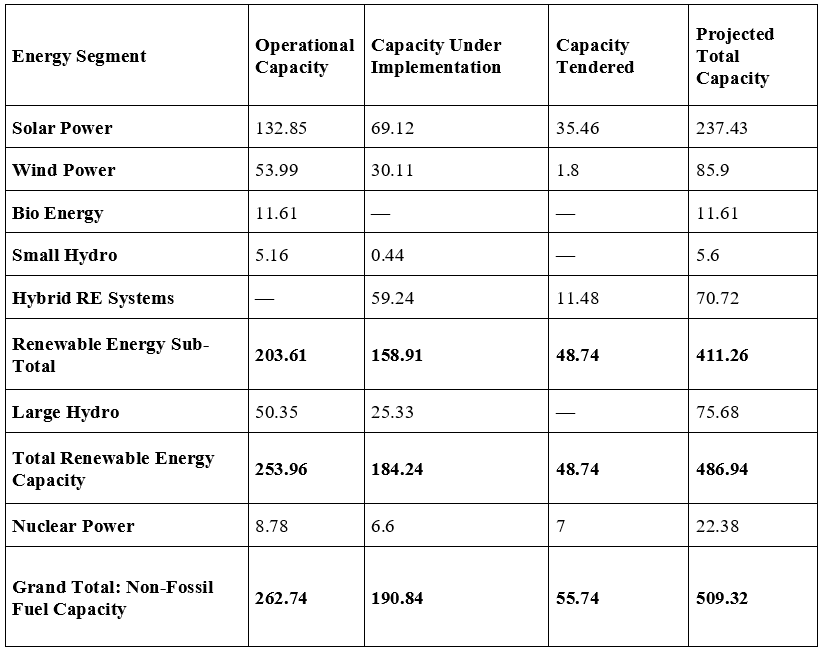
Source: PIB (Dec. 29, 2025). “Marks Highest-Ever Renewable Energy Expansion in India’s Energy Transition Journey,” Ministry of New and Renewable Energy, Government of India.
3.1 Net Zero 2070
India’s long-term energy security goal aligns with its net-zero target. At COP26 in November 2021, India announced its target to achieve net-zero by 2070. In line with Paragraph 19 of Article 4 of the Paris Agreement, India’s long-term low-carbon development strategy has been submitted to the UNFCCC, reaffirming its goal of achieving net-zero by 2070.[xvii] India’s long-term low-carbon development strategy is based on the principles of equity and climate justice, as well as the principle of Common but Differentiated Responsibilities and Respective Capabilities.
Several initiatives have been taken to reach this goal. “The Ministry of Environment, Forest and Climate Change launched the National Clean Air Programme (NCAP) in January 2019 to improve air quality in 131 cities across 24 States/UTs by engaging all stakeholders” .[xviii] By 2025-26, the programme had successfully reduced Particulate Matter 10 (PM 10) concentrations by up to 40 per cent or achieved the National Ambient Air Quality Standards for PM 10. Several monitoring portals are in place, and measures have been taken to improve data quality. For example, PRANA is used to monitor the implementation of NCAP, and under Swach Vayu Survekshan 2022, the self-assessment reports of NCAP cities are evaluated. “Sustainable Alternative Towards Affordable Transportation” (SATAT) is another notable initiative to set up a Compressed Bio-Gas production plant and make it available in the market for use as automotive fuel.
3.2 Clean Energy Pathways
India intends to strengthen its energy system through policy reforms, infrastructure expansion, and a range of cleaner energy pathways. This includes clean policies such as the National Green Hydrogen Mission, the PM Surya Ghar, Muft Bijli Yojana rooftop solar scheme, and the Carbon Credit Certificate Regulations, which aim to attract investment, shorten project timelines, and ensure a reliable energy supply. The clean energy transition and low-carbon pathways are therefore central to balancing energy security, economic growth, and climate objectives.[xix] Coal remains a primary energy source worldwide, and India is the second-largest consumer.
Chaturvedi[xx] adds that coal-based power generation must peak by 2040 and then decline by 99 per cent between 2040 and 2060. The “India’s Energy Transition” report shows that the higher cost of coal power makes renewable energy more competitive.[xxi] Since people’s livelihoods and revenue depend on coal mining in states like Jharkhand, Chhattisgarh, and Odisha, the government should support workers’ retraining for alternative industries to ensure a fair transition.
3.3 Hydropower Trade
Hydropower in South Asia plays a crucial role in meeting the region’s growing energy demand. This region is characterised by a diverse river landscape, and harnessing hydropower development potential can help meet its increasing energy needs and reduce reliance on fossil fuels. Earlier energy trade in South Asia was limited to India and Bhutan, India and Nepal, or India and Bangladesh. In the early 1960s or 1970s, hydropower accounted for a relatively high share of total electricity demand in South Asia.[xxii] In 1980, India’s share was 30 per cent, falling to 13 per cent by 1990. In Nepal, hydropower has been a primary source of electricity generation since 1990.[xxiii] Timilsina[xxiv] asserts that hydropower has an absolute advantage, with a comparative advantage arising from countries’ monthly or seasonal load profiles. For example, electricity demand is higher during June-October in Bangladesh and August-October in India. From April to July, India’s load curve shows declining electricity demand, while Bangladesh’s demand is increasing, suggesting India could supply electricity to Bangladesh during this period.
Recently, the first trilateral power transition from Nepal to Bangladesh via the Indian Grid was inaugurated on 15 November 2024, demonstrating the potential for regional electricity sharing.[xxv] Since 15 June 2025, Nepal has begun exporting 40 megawatts (MW) of electricity to Bangladesh via India’s transmission network, marking a shift beyond bilateral electricity trade. This cross-border electricity trade has been a historic development that not only positions India as an epicentre but also as a medium or transit for regional development.
3.4 Green Bonds
Climate finance is equally important for a smooth transition to energy security. Green bonds are debt securities issued for climate-compatible projects and are regulated by the Green Bond Principles (GBP). The GBP was established in 2014 under the guidance of the International Capital Market Association.[xxvi] The Paris Agreement recognised the role of private capital in the transition towards sustainability and supported the development of green bond markets. According to World Bank data from Bloomberg, “USD 21 billion in green bonds were issued in India, of which the private sector accounted for 84 per cent” .[xxvii]
In 2022, “Greenko, one of the largest private sector issuers of green bonds in India, raised USD 750 million through international green bond issuance” .[xxviii] These bonds were deployed in public sector projects that help reduce the economy’s carbon intensity through renewable energy, energy efficiency, and clean transport. Since April 2024, India has permitted eligible foreign investors in the International Financial Services Centre to invest in the Sovereign Green Bonds. To do so, foreign investors must be registered with the Securities and Exchange Board of India, thereby further enhancing international participation in India’s climate finance.
3.5 EVs Facilitator
In South Asia, India is often seen as the region’s epicentre. This is due to its geographic position and cultural connections with larger nations, linking both land and sea states. However, India is also a transit point, a destination, and a source for many in the South Asian market, including for jobs and education. India’s connectivity with South Asian nations will enable the region to serve as a facilitator. For example, owing to net-zero targets, the transportation industry is gradually entering a new era of electric vehicle (EV) manufacturing. According to the World Economic Forum[xxix], EVs are set to change everything about how energy is consumed and supplied. By 2040, more than half of the new cars sold worldwide will be EVs.
The National Electric Mobility Mission Plan (NEMMP) 2020 was introduced by the Government of India to promote and produce EVs for a cleaner, greener transport future. Previously, the FAME India Scheme (Faster Adoption and Manufacturing of Hybrid and Electric Vehicles) was implemented from 2015 to 2019, encouraging the adoption of electric and hybrid vehicles.[xxx] Now, the PM Electric Drive Revolution in Innovative Vehicle Enhancement (PM-E DRIVE), approved in September 2024 and implemented until March 2028, focuses on curbing emissions and tackling urban air quality. Apart from two- and three-wheelers, e-trucks, and e-ambulances, the schemes have supported 14,028 electric buses as of July 2025.[xxxi]
A scenario in which India becomes a global hub for EV manufacturing could meet the entire demand of the South Asian market.[xxxii] Bhutan’s move towards green transport, together with Nepal’s connectivity to India, and the inclusion of Bangladesh, could rejuvenate the aspirations of the sub-regional The BBIN (Bangladesh, Bhutan, India and Nepal) group now has only three partners (Bangladesh, India and Nepal). This market extends further into Southeast Asia through BIMSTEC (Bay of Bengal Initiative for Multi-Sectoral Technical and Economic Cooperation), where India’s energy transition in the product-based market can serve as a model for the region. India’s connectivity projects, such as the Trilateral Highways, need environmental guarantees to ensure the use of sustainable energy and environmentally friendly infrastructure and transport, thereby supporting the SDGs. The World Economic Forum[xxxiii] asserts that a sustainable transport system offers greater diversity in the fuel portfolio, reduces dependence on fossil-based sources, lowers the cost of ownership, and increases price stability, thereby fostering national security, energy independence, and a healthier environment.
3.6 International Solar Alliance
Technically, Indian foreign policy is set in a more partnership-based framework, but the International Solar Alliance (ISA) is the only platform where India calls for joining an ‘alliance.’ ISA’s founding vision, “One World, One Sun, One Grid,” was advanced by PM Modi and announced at COP21 in Paris. ISA has launched several platforms to work with beyond the South Asian region. It was first designed to serve 121 countries lying in the sun between the Tropics of Cancer and Capricorn. The ISA flagship goal is to attract USD 1 trillion in investment and add 1000 GW of additional solar capacity across member states by 2030.[xxxiv]
The SUNRISE (Solar Upcycling Network for Recycling, Innovation & Stakeholder Engagement) connects government, industry and innovators to work in the fields of solar waste, green employment and sustainable resource management.[xxxv] Other initiatives, such as the “One Sun One World Grid programme,” seek regional solar interconnections along vertical lines linking East Asia-South Asia, South Asia-Middle East, Middle East-Europe and Europe-Africa.[xxxvi] Notably, ministers and heads of delegation from Small Island Developing States (SIDS) signed a Memorandum of Understanding (MoU) for procurement under the SIDS platform. This was jointly developed by the ISA and the World Bank Group to advance energy deployment through coordinated procurement, digital integration and capacity building to enhance energy resilience.[xxxvii]
Conclusion
India continues to play a leadership role in the energy transition by improving energy security while aligning with its climate governance and development agendas. Energy is inherently linked to geopolitics and climate change, as it aligns with geopolitical agendas and development goals. India is a major player in both, linking its geography to proactive governance.
India’s neighbourhood-first agenda, the Act East connectivity policy, its Sagarmala ports, etc., all play a crucial role in geopolitics, defining partnerships, corridors, and connectivity for energy sharing and governance. India sets its clean energy targets by focusing on non-fossil-fuel electricity generation capacity. The major focus is on reducing emissions intensity and achieving net-zero by 2070.
The major push is a transition involving the expansion of solar and wind power, EV adoption in transport, and improvements in energy efficiency across geographies. At the same time, India’s energy transition seeks to balance climate goals with development needs. Here, coal remains pivotal in meeting the country’s growing electricity demand, especially amid urbanisation, but it is expected to be gradually phased out in the long run. Lastly, India’s policy implementation, supported by continued international partnerships, climate finance, and technological innovation, becomes essential to its futuristic energy transition goals.
Author Brief Bio: Dr Anmol Mukhia is an Assistant Professor at the Department of International Relations, South Asian University, New Delhi.
[i] ESCAP, “Powering South Asia’s Clean Energy Transition,” United Nations, 4 February 2026, https://www.unescap.org/blog/powering-south-asias-clean-energy-transition.
[ii] Government of India, India’s Nationally Determined Contribution (2031–2035) (UNFCCC, April 2026), 3.
[iii] International Energy Agency, World Energy Outlook 2004 (Paris: OECD/IEA, 2004).
[iv] L. Qin and R. Gao, “Impact of Geopolitical and Energy Security Risks on Energy Consumption Patterns,” Energy & Environment (2025): 3, https://doi.org/10.1177/0958305X251349478.
[v] International Energy Agency, “Energy and Climate Are Inextricably Linked,” IEA, https://www.iea.org/topics/climate-change.
[vi] Saini et al., 2024.
[vii] World Bank Group, “South Asia Climate Roadmap,” World Bank, 28 October 2026, https://www.worldbank.org/en/region/sar/publication/south-asia-climate-roadmap.
[viii] U. Singh, “Rains, Floods and Rising Heat: South Asia’s Growing Climate Crisis,” DD News, 2025, https://ddnews.gov.in/en/rains-floods-and-rising-heat-south-asias-growing-climate-crisis/.
[ix] E. Midgley, “From the Andes to the Himalayas,” in Nuclear Data: Modelling the Future (IAEA, April 2024), 5, https://www.iaea.org/sites/default/files/2025-09/nucleardata_0.pdf.
[x] U. Siddiqui, “‘A Calamity’: Why Is a Record Heatwave Sweeping South Asia?,” Al Jazeera, 8 May 2026, https://www.aljazeera.com/news/2026/5/8/a-calamity-why-is-a-record-heatwave-sweeping-south-asia.
[xi] “Delhi Temperature Today,” The Economic Times, 20 May 2026, https://economictimes.indiatimes.com/news/new-updates/delhi-temperature-today-capital-crosses-46c-inches-closer-to-record-high-imd-predicts-more-scorching-days-ahead-check-latest-forecast/articleshow/131215545.cms.
[xii] Ministry of New and Renewable Energy, Government of India, 2 July 2018, https://mnre.gov.in/en/about-department/introduction/.
[xiii] Ministry of New and Renewable Energy, Government of India, 2 July 2018, https://mnre.gov.in/en/about-department/introduction/.
[xiv] Ministry of New and Renewable Energy, Government of India, 2 July 2018, https://mnre.gov.in/en/about-department/introduction/.
[xv] P. Prajapati et al., “Navigating the Energy Transition in India: Challenges and Opportunities towards Sustainable Energy Goal,” Water-Energy Nexus 9 (2025): 1, https://doi.org/10.1016/j.wen.2025.07.004.
[xvi] P. Prajapati et al., “Navigating the Energy Transition in India: Challenges and Opportunities towards Sustainable Energy Goal,” Water-Energy Nexus 9 (2025): 1, https://doi.org/10.1016/j.wen.2025.07.004.
[xvii] Press Information Bureau, “Net Zero Emissions Target,” Ministry of Environment, Forest and Climate Change, 3 August 2023, https://www.pib.gov.in/PressReleaseIframePage.aspx?PRID=1945472.
[xviii] Press Information Bureau, “Net Zero Emissions Target,” Ministry of Environment, Forest and Climate Change, 3 August 2023, https://www.pib.gov.in/PressReleaseIframePage.aspx?PRID=1945472.
[xix] Press Information Bureau, “India’s Expanding Role in the Global Energy Transition,” 27 January 2026, https://www.pib.gov.in/PressReleasePage.aspx?PRID=2219208.
[xx] V. Chaturvedi, India’s Energy Transition under a Net-Zero Future (Council on Energy, Environment and Water, 2022), https://coal.gov.in/sites/default/files/2021-01/day5-net-zero-future.pdf.
[xxi] V. Garg et al., India’s Energy Transition: The Cost of Meeting Air Pollution Standards in the Coal-Fired Electricity Sector (Manitoba: International Institute for Sustainable Development, 2019), 18.
[xxii] G. Timilsina, “Regional Electricity Trade for Hydropower Development in South Asia,” International Journal of Water Resources Development 37, no. 3 (2018): 391.
[xxiii] G. Timilsina, “Regional Electricity Trade for Hydropower Development in South Asia,” International Journal of Water Resources Development 37, no. 3 (2018).
[xxiv] G. Timilsina, “Regional Electricity Trade for Hydropower Development in South Asia,” International Journal of Water Resources Development 37, no. 3 (2018).
[xxv] Ministry of External Affairs, “Inauguration of First Trilateral Power Transaction – From Nepal to Bangladesh through the Indian Grid,” Government of India, 15 November 2024, https://www.mea.gov.in/press-releases.htm?dtl/38523/.
[xxvi] F. K. Sudan, “Leveraging Green Bonds to Address Debt Sustainability and Economic Recovery in South Asia: Lessons from EU and ASEAN Countries,” Regional Economic Development Research 4, no. 2 (2023): 102, https://doi.org/10.37256/redr.4220233543.
[xxvii] Institute and Faculty of Actuaries, “India: The Road to Net Zero by 2070,” 1 January 2025, https://blog.actuaries.org.uk/india-the-road-to-net-zero-by-2070/.
[xxviii] Institute and Faculty of Actuaries, “India: The Road to Net Zero by 2070,” 1 January 2025, https://blog.actuaries.org.uk/india-the-road-to-net-zero-by-2070/.
[xxix] World Economic Forum, “The Electrification of Transport Could Transform Our Future – If We Are Prepared for It,” 16 April 2018, https://www.weforum.org/stories/2018/08/we-must-get-it-right-with-electric-vehicles-for-the-sake-of-our-planet/.
[xxx] Press Information Bureau, “Wheels of Change: India’s Electric Leap for Green Mobility,” Government of India, 26 August 2025, https://www.pib.gov.in/PressNoteDetails.aspx?NoteId=155094&ModuleId=3.
[xxxi] Press Information Bureau, “Wheels of Change: India’s Electric Leap for Green Mobility,” Government of India, 26 August 2025, https://www.pib.gov.in/PressNoteDetails.aspx?NoteId=155094&ModuleId=3.
[xxxii] P. De, Strengthening Regional Integration in South Asia: A Strategy Paper on Regional Connectivity and Trade Facilitation, Discussion Paper 288 (New Delhi: RIS, 2023), 12.
[xxxiii] World Economic Forum, “The Electrification of Transport Could Transform Our Future – If We Are Prepared for It,” 16 April 2018, https://www.weforum.org/stories/2018/08/we-must-get-it-right-with-electric-vehicles-for-the-sake-of-our-planet/.
[xxxiv] S. Shidore and J. W. Busby, “One More Try: The International Solar Alliance and India’s Search for Geopolitical Influence,” Energy Strategy Reviews (2019): 4, https://doi.org/10.1016/j.esr.2019.100385.
[xxxv] Press Information Bureau, “President Murmu Addresses Eighth Session of the ISA Assembly; Calls on the Global South to Lead Inclusive Solar Development before Representatives from 137 Countries,” Ministry of New and Renewable Energy, 28 October 2025, https://www.pib.gov.in/PressReleasePage.aspx?PRID=2183434.
[xxxvi] Press Information Bureau, “President Murmu Addresses Eighth Session of the ISA Assembly; Calls on the Global South to Lead Inclusive Solar Development before Representatives from 137 Countries,” Ministry of New and Renewable Energy, 28 October 2025, https://www.pib.gov.in/PressReleasePage.aspx?PRID=2183434.
[xxxvii] Press Information Bureau, “President Murmu Addresses Eighth Session of the ISA Assembly; Calls on the Global South to Lead Inclusive Solar Development before Representatives from 137 Countries,” Ministry of New and Renewable Energy, 28 October 2025, https://www.pib.gov.in/PressReleasePage.aspx?PRID=2183434.