
The Indian Ocean Region (IOR) remains of immense importance to India, as it carries 40% of global commercial trade traffic and almost 70% of the world’s energy trade. India has a significant presence in the region, given its peninsular geography, which extends deep into the Indian Ocean, with the Arabian Sea and Bay of Bengal on its western and eastern sides, respectively. India, with its fast-growing economy and efforts to become a global manufacturing hub, will need to secure the maritime routes available to it for commercial trade.
Consequently, securing maritime security in the area is urgent, as these Sea Lines of Communication (SLOCs) are the main arteries for sustaining and advancing its national growth plans, securing National Security, and maintaining its influence in the region. The target of becoming a developed nation by 2047 under the ‘Viksit Bharat’ can only be achieved by adopting a multipronged strategy that ensures the continued availability of maritime routes and a credible naval presence along them, thereby mitigating any potential threat to our national interests. It is important to recognise that 95% of India’s trade and more than 90% of India’s energy imports depend on this maritime connectivity.
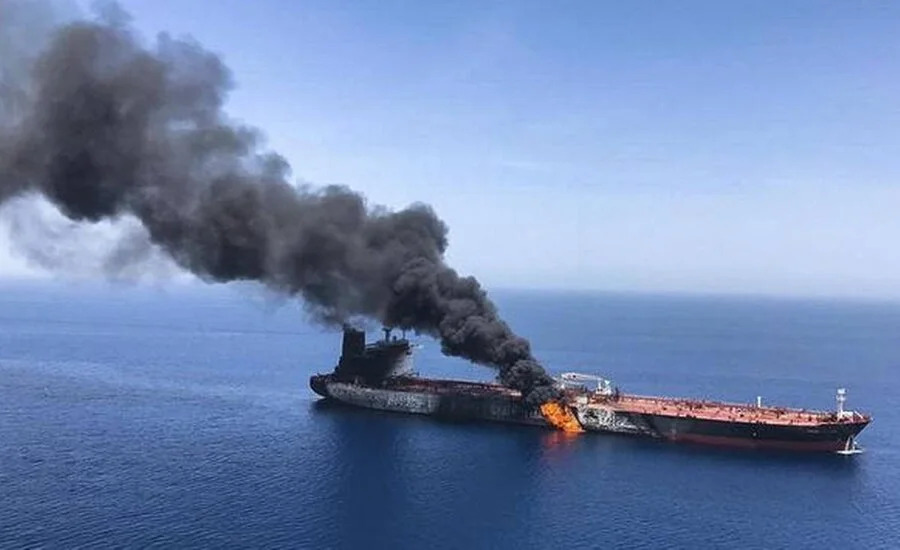
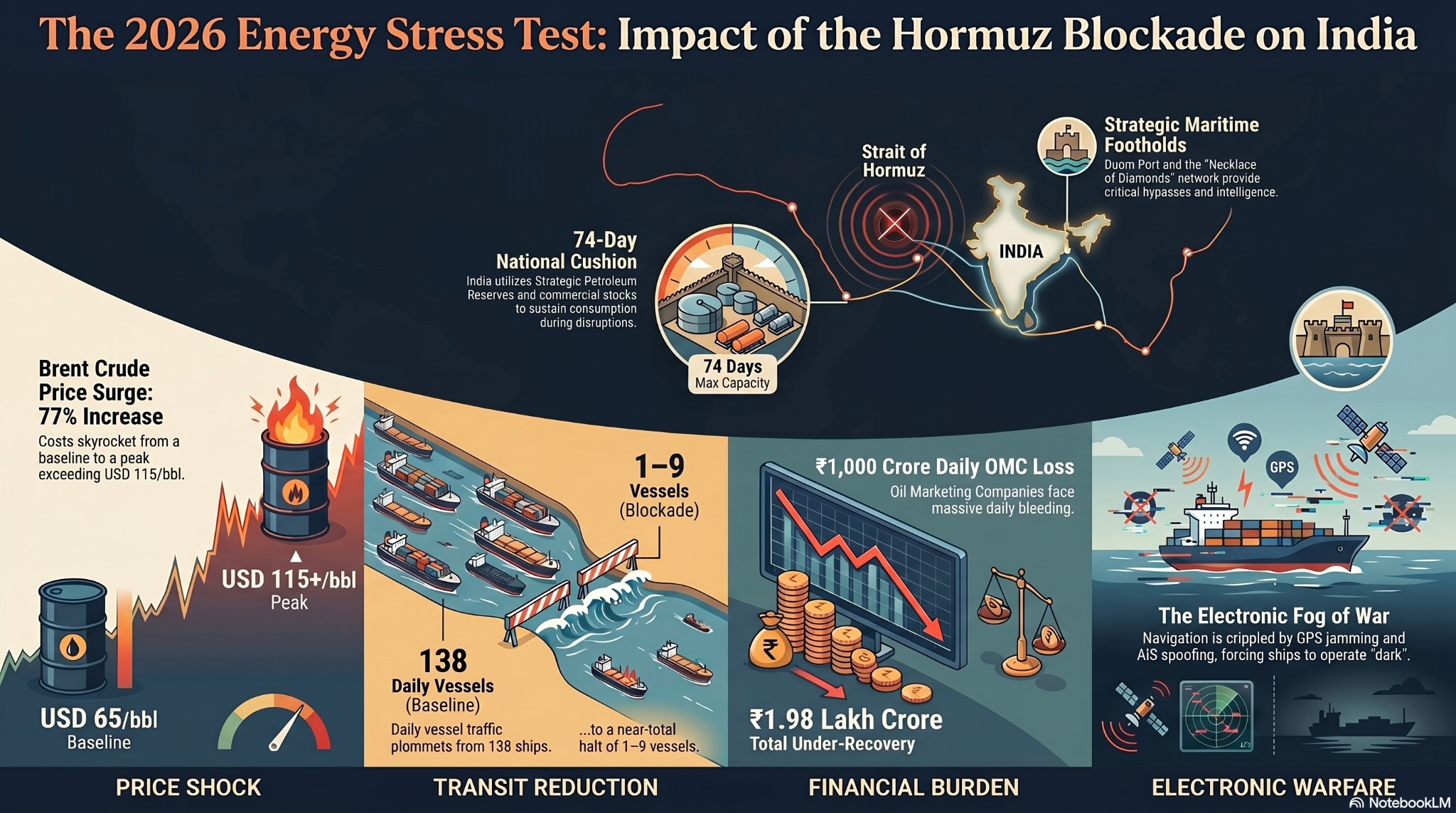
For decades, a global consensus held that vital maritime trade routes would not be disrupted given the catastrophic economic shocks such an action would trigger. That assumption was shattered in February 2026. The outbreak of the Israel-US conflict with Iran led to the complete closure of the Strait of Hormuz to international shipping, sending shockwaves through global energy security—with India particularly vulnerable. Consequently, global crude prices surged from a pre-war benchmark of USD 65 per barrel to a staggering USD 115 per barrel.
This has had a far-reaching impact on India and driven home a harsh lesson: India’s energy security can no longer be managed through long-term contracts. Instead, India needs a multi-pronged strategy to mitigate risks by immediately expanding strategic reserves, addressing critical chokepoint vulnerabilities through an effective countermeasure policy, and mitigating navigational challenges, including GPS disruptions and AIS spoofing for shipping vessels. India must have its own infrastructure to capture maritime awareness, strategic bilateral and multilateral partnerships with friendly energy-sourcing countries, and formidable naval influence covering this most important sea line of communications.
The Operational Layer: Anatomy of Chokepoints and SLOCs
There are four maritime routes or corridors that affect India’s energy security. Each presents both common and distinct physical, geopolitical and operational challenges. Of these, the Strait of Hormuz is the most critical chokepoint for India’s energy imports, as historically nearly 80% of Indian crude oil imports and nearly 60% of LPG needs have used this route. It is an exceptionally narrow sea route, only about 3 km wide, that is navigable by crude oil tankers and LPG vessels. The route is said to have a capacity to handle 20 million barrels per day. About 130-140 ships used to cross this narrow sea lane in the pre-war period, which has reduced to a single-digit figure post 28 Feb 2026 war. This has severely affected the movement of India-bound tankers and vessels. The effect has led India to seek alternative sources of crude oil beyond the Middle East, resulting in critical delays, increased freight rates, and higher insurance premiums. All this has resulted in a substantial increase in Indian bucket prices, which reached a peak of USD 140 per barrel, according to some reliable sources. Any prolonged escalation of these geopolitical situations will put immense pressure on India, seriously affecting its GDP growth. India has now increased the number of countries it sources crude oil from from 27 to 47 and has also raised domestic LPG production by more than 40%.
The Strait of Malacca is India’s eastern vulnerability. It handles 16 million barrels of crude oil per day and is the only maritime route connecting to energy sources in the Pacific Ocean. Nearly 60% of India’s commercial trade uses this route, and 100% of non-Gulf LNG trade passes through this vital chokepoint. Any disruption of this route will severely jeopardise India’s interests; if there is any simultaneous blockage of the western Hormuz route and the Strait of Malacca, it will be catastrophic for India. Effective maritime security is an urgent requirement for India to maintain continuity of trade via the Pacific Ocean LNG route and other commercial trade with East Asian countries.
The Bab el-Mandeb Strait and the Suez Canal collectively serve as the gateway to Europe and North Africa. Any disruption on this route, whether through drone attacks, missile batteries, or high-speed armed boats originating from coastal belt areas in this region, will seriously disrupt vessel traffic. If such asymmetrical warfare methods are used, they will force traffic to be rerouted around the African continent via the Cape of Good Hope. This will add 3,500 nautical miles, cause a 10-14-day delay, and incur exorbitant freight and insurance premiums, which will be highly detrimental to trade and the broader economic context of our country.
Tactical disruptions via GPS denial and electronic warfare severely impair the efficient navigation of ships along routes in this area. There have been reports of heavy GPS jamming and AIS spoofing in the Arabian Sea, the Gulf of Oman, and the high seas adjoining Fujairah. These tactical disruptions have led to errors in the navigation system and corrupted navigation. This is a serious issue that increases the risk of collisions and accidents involving shipping vessels. Another threat is the potential exposure of exact positions to asymmetric warfare by terrorists and rogue sea elements, which has often forced civilian ships to switch off their AIS transponders to avoid potential attacks. Therefore, for India, it has become an unavoidable requirement to preserve navigational integrity and maritime awareness by deploying its own infrastructure, including the ISRO-developed NavIC satellite navigation system, and by equipping its naval and commercial ships with these technologies. The absence of these measures will surely render our military and commercial assets in navigational darkness.
The February 2026 crisis emerging from the Israel-America-Iran war has further exposed vulnerabilities stemming from digital platforms’ weaknesses against cyberattacks, space-based weapons, and unmanned platforms powered by Artificial Intelligence (AI). This war has demonstrated how these technologies were extensively employed by America and Israel to completely destroy or deny Iranian naval resources the ability to even respond to their first attack. All the air defence infrastructure, be it on the ground or on board Iranian naval platforms, was rendered useless or completely destroyed by combining conventional airpower and naval platforms with these third-dimensional force multipliers.
These vulnerabilities are strategically significant because nearly 95% of global digital communications traffic is transmitted through submarine cable networks, many of which traverse the Indian Ocean Region. Simultaneously, the proliferation of autonomous drones, loitering munitions and low-cost precision-strike systems has reduced the barriers to asymmetric maritime disruption, enabling even non-state actors to threaten offshore energy infrastructure and commercial shipping lanes. This evolving operational environment requires us to move beyond conventional naval preparedness toward integrated maritime-electromagnetic resilience. Energy security in the coming decades will depend not only upon naval presence but also upon digital survivability, cyber resilience and uninterrupted access to secure maritime data networks. Accordingly, India’s future maritime-security architecture must incorporate anti-jamming navigation capability, indigenous satellite redundancy, AI-enabled maritime-domain awareness, cyber-secure port infrastructure and integrated civil-military digital coordination mechanisms.
Note: The above Infographic is original work generated using Google NotebookLM AI.
The Economic Buffer: India’s Strategic Reserves
In response to the severe operational and economic disruptions triggered by the 2026 crisis, India was forced to adopt major changes to its energy-security strategy. The shift reflected a broader strategic realisation that energy security depends not on procurement contracts but on effective control over logistics infrastructure, storage capacity, maritime access to routes, and supply-chain continuity. This change led to the event that during the Prime Minister’s May 2026 visit to Abu Dhabi, a series of strategic agreements were envisioned between India and the UAE.
The Strategic Petroleum Reserve was conceptualised on 16 Jun 2004. It has remained the backbone since then, with implementation carried out in phases. A further development, the adoption of out-of-the-box solutions, has emerged recently, including bilateral and multilateral agreements with friendly sourcing countries. The following are the main implementation frameworks that have emerged so far:
Phase-I Status
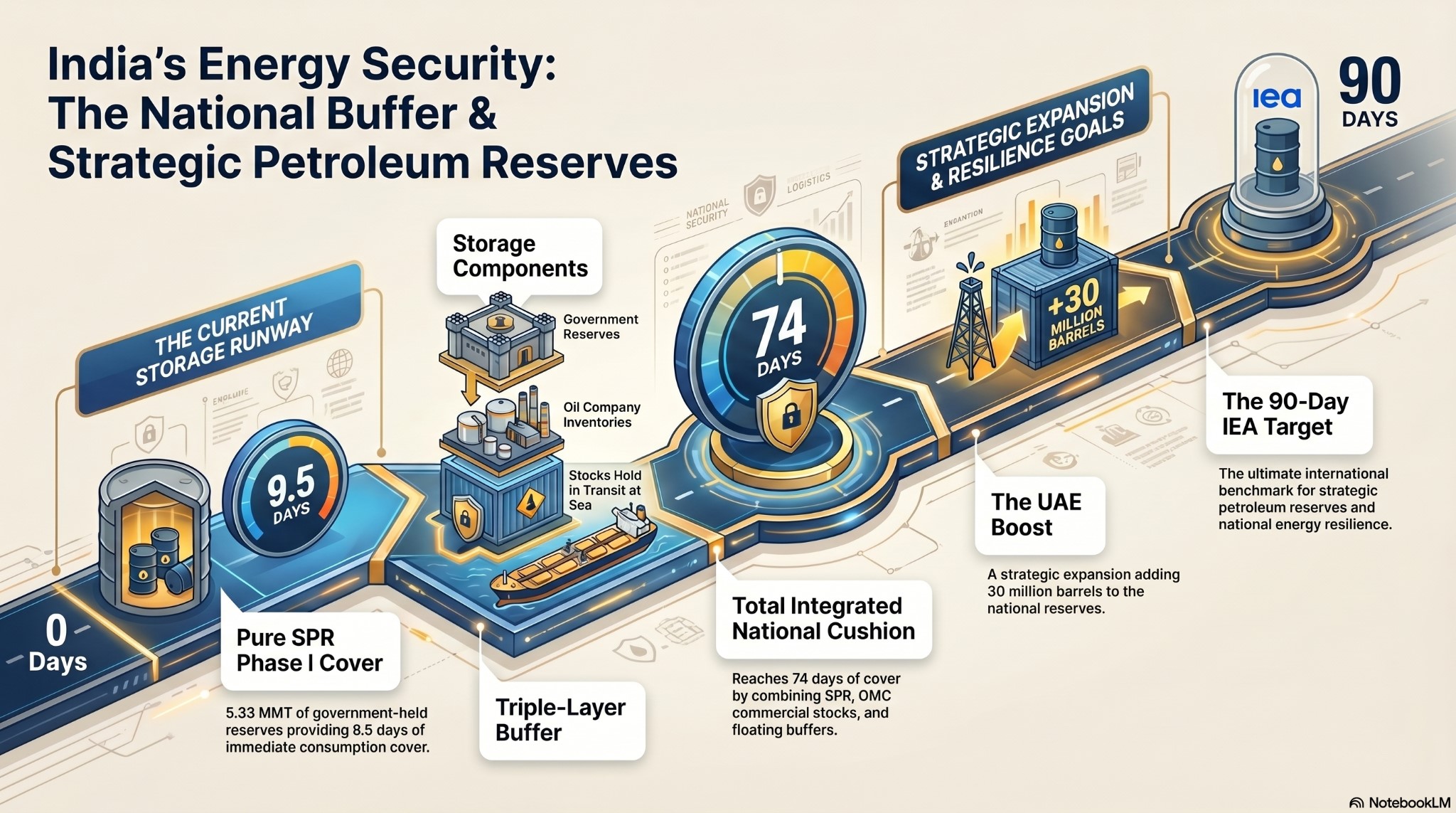
SPR Phase-I provides a storage capacity of 5.33 Million Metric Tonnes (MMT) which is equivalent to approximately 9.5 days of national consumption. The reserve infrastructure is distributed across three underground unlined rock cavern sites:
- Visakhapatnam (AP): 1.33 MMT
- Mangaluru (Karnataka): 1.50 MMT
- Padur (Karnataka): 2.50 MMT
In addition, India depends on the rolling inventories of the Oil Marketing Companies (OMCs) such as IOCL, BPCL, and HPCL, which include their own static storage and mobile transportation assets, amounting to 64.5 days’ worth of consumption stock. Of this total, refineries hold half in crude oil and the other half in finished products such as petrol and diesel. The total aggregated storage in these wats amounts to 74 days’ reserves. For LPG, India is completely dependent on OMC rolling inventory, amounting to 45 days of consumption and 60 days’ worth of LNG.
Phase II Expansion
Phase II received ‘in-principle’ Cabinet approval in June 2018 and financial approval under the PPP model in July 2021. However, progress was delayed due to a scarcity of funds and issues with land acquisition for the project. It is reliably learnt that, in the aftermath of the ongoing geopolitical disruptions in the Middle East, the Government has now fast-tracked the project. The SPR Phase II expansion remains critical for long-term resilience. Once fully operational, India’s standalone strategic cover could expand to approximately 22 days. The approved expansion includes:
- Chandikhol (Orissa) : 4.0 MMT
- Padur Expansion (Karnataka): 2.5 MMT
- India-UAE Strategic Reserve Framework.
In a new development, a series of strategic agreements were envisioned between India and the UAE. This arrangement could significantly increase India’s capacity for autonomous energy security insulation. Under the proposed India-UAE strategic partnership framework, ADNOC could commit approximately USD 5 billion towards infrastructure, technology and strategic storage investments. India could secure the ability to store up to 30 million barrels of crude oil within Indian reserve facilities. India could retain sovereign first-use rights during emergency conditions.
Note: The above Infographic is original work generated using NotebookLM AI.
SPR Phase I Cover: 5.33 MMT (9.5 Days).
Total Integrated Cushion: 74 Days (SPR + OMC commercial stocks).
The UAE Boost: 30-million-barrel addition to meet the 90-day IEA international goal.
The Strategic Layer: “The String of Pearls” Vs “Necklace of Diamonds”
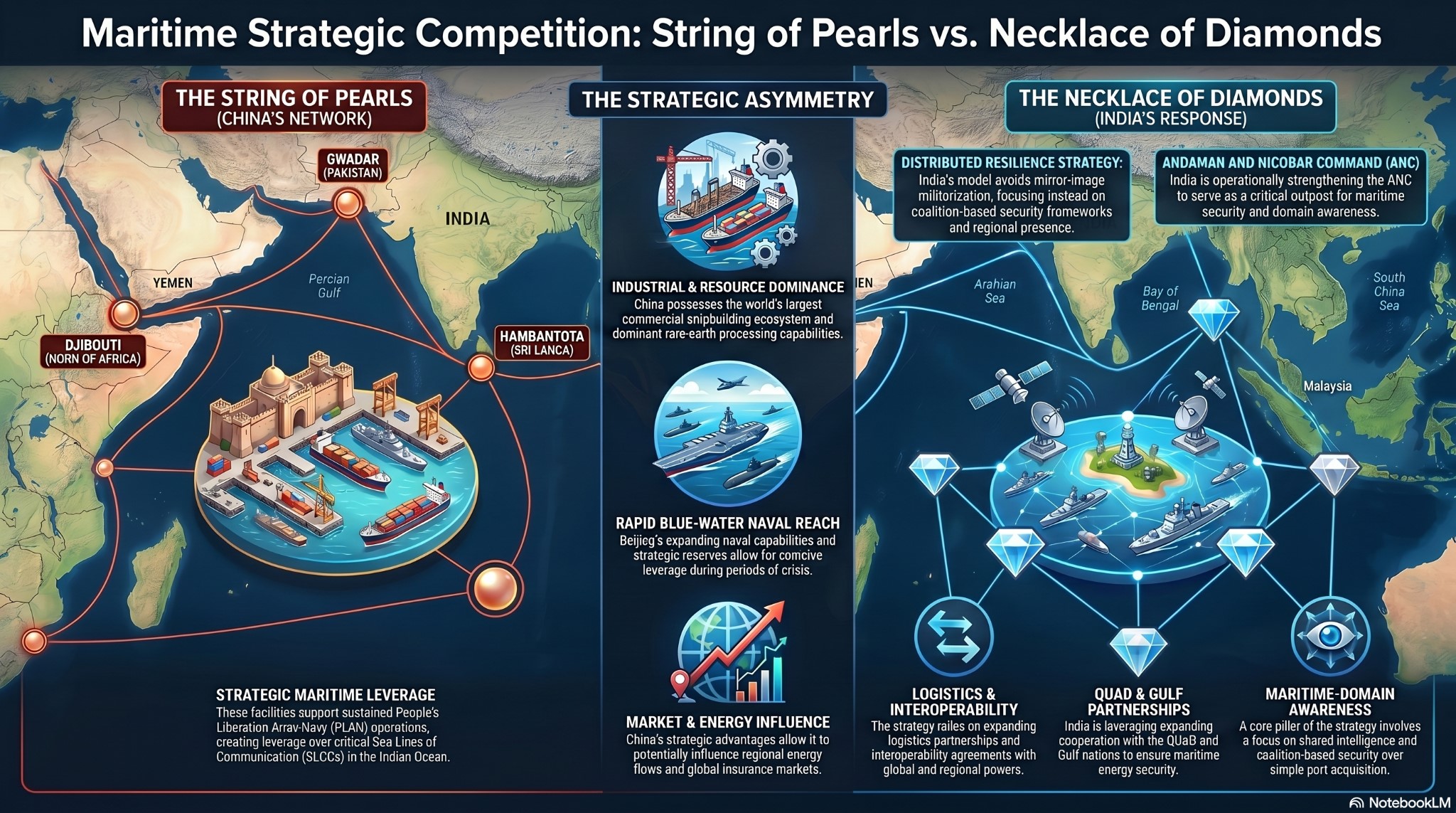
India’s maritime energy strategy cannot be understood in isolation from China’s expanding strategic footprint across the Indian Ocean Region (IOR). Over the past decades, China, with some seemingly not-so-good intentions, has developed a network of dual-use ports, logistics nodes and infrastructure partnerships popularly known as the ‘String of Pearls’. While officially presented as commercial infrastructure under the Belt and Road Initiative (BRI), several of these facilities possess military capabilities for supporting People’s Liberation Army Navy (PLAN) operations across the Indian Ocean.
Chinese increased presence at Gwadar (Pakistan), Djibouti (Horn of Africa), Hambantota (Sri Lanka) and growing access in the Gulf region collectively create the possibility of maritime influence over the Sea Lines of Communication (SLOCs). This becomes particularly significant because India’s energy security architecture remains heavily dependent upon uninterrupted access to the Gulf.
Note: The above Infographic is original work generated using NotebookLM AI.
The challenge for India is not only a conventional Naval competition but the risk of an asymmetry. China possesses the world’s largest commercial shipbuilding ecosystem, extensive rare-earth processing capabilities, large strategic reserves, and a rapidly expanding naval reach. During periods of crisis, these advantages may translate into substantial maritime advantages, leading to influence over regional energy trade.
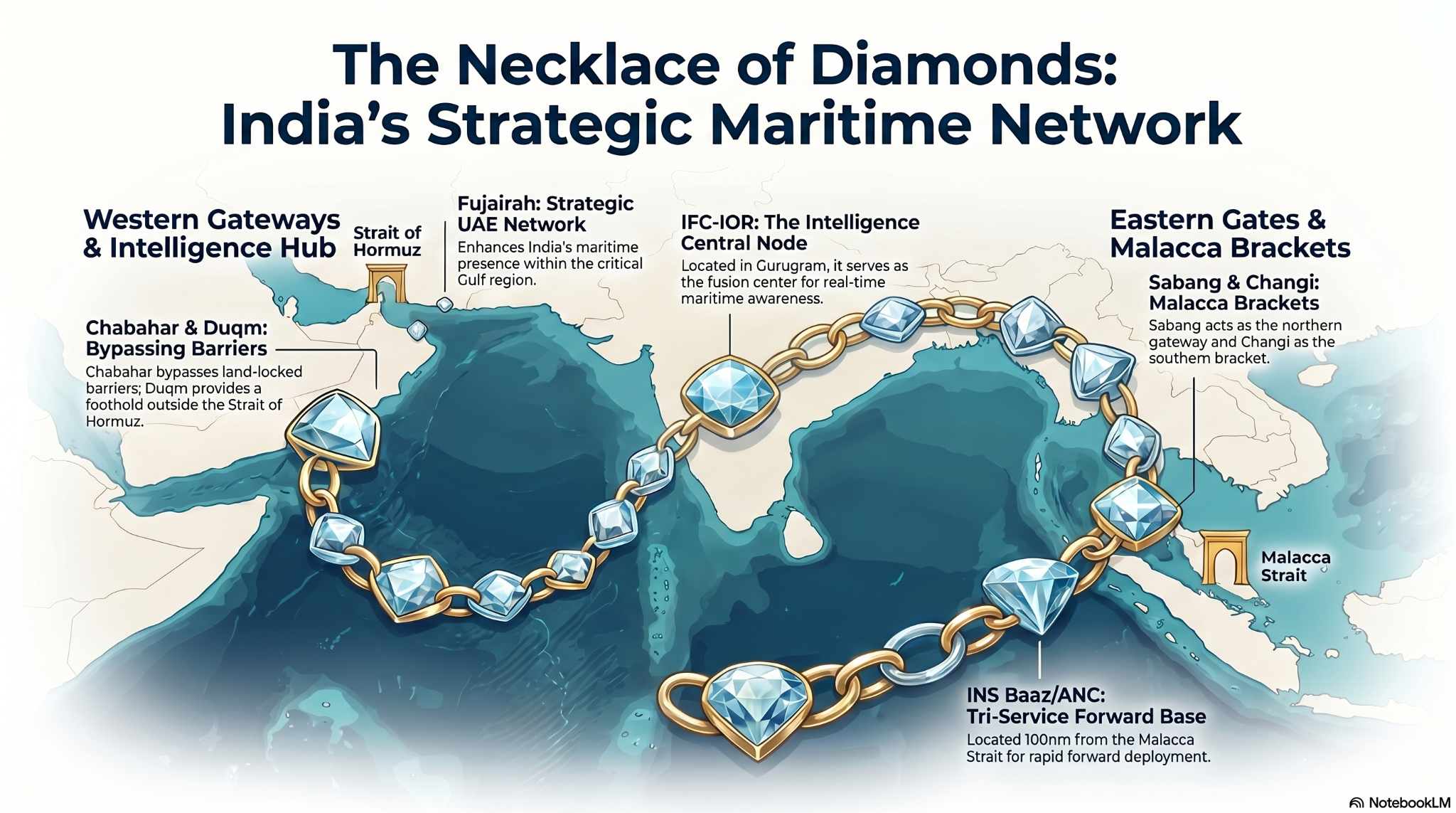
India’s response, through its ‘Necklace of Diamonds’ strategy, aims to establish a distributed presence rather than pure militarisation. Unlike China’s port acquisition model, India’s approach emphasises logistics partnerships, bilateral and multilateral agreements, maritime awareness, and coalition-based security arrangements. The operational strengthening of the Andaman and Nicobar Command, together with the expansion of QUAD cooperation and Gulf partnerships, reflects India’s recognition that maritime energy security will increasingly depend on regional presence, distributed logistics capabilities, and partnerships. The Andaman and Nicobar Command, located approximately 100 nautical miles from the western entrance to the Strait of Malacca, serves as a forward operating platform for maritime awareness, surveillance, logistics support, and sea-lane monitoring. INS Baaz and related infrastructure projects will significantly strengthen India’s eastern maritime presence.
To counter China’s strategic encirclement by securing access to countries surrounding India under the guise of economic and commercial partnerships, India is working to establish a counter-presence in friendly neighbouring countries to create ship repair facilities, logistics centres, and maritime awareness coalitions within a legitimate security framework. India has been developing maritime repair facilities at Vadinar in Gujarat. The facility is being developed in collaboration with Drydocks World, a DP World company, and Cochin Shipyard Limited, and in partnership with the Deen Dayal Port Authority, to create a large ship repair cluster that will also cater for repairs to naval vessels. This is in line with the Indian Government’s Maritime India Vision 2030 and Maritime Amrit Kaal Vision 2047.
Apart from this, India is focused on getting access to the following strategic nodes outside the mainland:
- Fujairah, UAE. It is one of the most strategically located nodes in the Indo-Gulf region, which provides a bypass of the Strait of Hormuz. It also provides an alternative overseas strategic storage capacity, largely immune to disruptions at the mouth of the Strait of Hormuz or in the Persian Sea.
- Duqm Port, Oman. Duqm, due to its location away from Hormuz, can again serve as a Naval refuelling hub and provide ship repair facilities.
- Chabahar Port, Iran. Despite Iran’s instability, Chabahar remains a strategically critical Indian maritime asset, to which India has invested USD 120 million, fully paid in August 2025. The investment has been made to develop the Shahid Beheshti terminal. The port provides access to Central Asia, bypass capability around land barriers, geopolitical presence within Iran, and connectivity to INSTC corridors. The investment remains linked to the International North–South Transport Corridor (INSTC), with a 750 km Chabahar–Zahedan railway line linking the port directly to Central Asia and Russia, preserving the long-term commercial intent of India’s trade bypass around Pakistan.
- Sabang Port, Indonesia. Sabang provides India with a forward eastern maritime presence near the Malacca Strait. The location strengthens bilateral patrol coordination, anti-piracy operations, and regional surveillance capability.
- Changi Naval Base, Singapore. India has inked logistics agreements with Singapore to facilitate the sustained operational presence of Indian naval assets near the southern end of the Strait of Malacca. This effectively extends India’s operational reach into the Pacific.
Physical assets and maritime deployments alone cannot secure the interests of stakeholders in the Indian Ocean. India’s maritime doctrine has therefore evolved from SAGAR (Security and Growth for All in the Region), launched in 2015, to MAHASAGAR (Mutual and Holistic Advancement for Security Across the Region), launched in March 2025. Through this endeavour, India seeks to have the world recognise that it is now willing to contribute as a global maritime stakeholder, transitioning from a regional security provider to its friendly nations.
Note: The above Infographic is original work generated using NotebookLM AI.
Conclusion and Strategic Recommendations
The 2026 maritime crucible (Middle East War) marks a major turning point for India and the broader Indo-Pacific stakeholders. The crisis that erupted has shown that maritime chokepoints can severely disrupt both large and small nations without mercy. Weaker economies, or those that have not developed resilience in their energy security, can be severely damaged or even destroyed. Therefore, it is important to build and maintain strategic reserves of crude oil and LNG/LPG, ensure credible naval access to secure maritime routes, and deploy technological measures to counter cyber-attacks, GPS jamming, EW, and digital security threats. This is an urgent requirement to safeguard national interests, absorb such shocks, and protect the country’s economic growth. It is equally important to pursue international collaborations to mitigate the risks of any misadventures along or in the maritime trade routes. There is an immediate requirement for India to redefine its maritime security to ensure energy security and protect its broader macroeconomic interests.
Strategic Energy Resilience. India must accelerate the expansion of Strategic Petroleum Reserve (SPR) infrastructure by rapidly operationalising the Chandikhol site, the Padur expansion, and the Rajasthan salt-cavern ecosystems. Rapid-access storage architecture is most important during future maritime disruptions and energy shocks. Simultaneously, India requires dedicated underground LNG and LPG reserve systems capable of providing at least 30 days of independent strategic insulation. Gas security is now closely linked to fertilizer production and to energy availability for rural and urban consumption. It is also linked to transport networks and power generation.
Maritime and Digital Security Architecture. The crisis also demonstrated that navigational independence and maritime awareness are core national security requirements. India must therefore accelerate the deployment of NavIC-based maritime navigation systems, anti-jamming capabilities, AIS redundancy frameworks, and resilient maritime electromagnetic infrastructure. India’s future maritime security must also prioritise indigenous Intelligence, Surveillance and Reconnaissance (ISR) capabilities, integrated with space-based systems. Undersea communication cables must likewise be recognised as critical infrastructure because of their role in global financial systems, digital commerce, and military communications.
Indo-Pacific Strategic Coordination. India’s maritime security strategy must increasingly operate through regional partnerships and distributed resilience frameworks. Institutions such as IORA, BIMSTEC and the QUAD provide the foundation for a coordinated Indo-Pacific maritime security architecture focused on SLOC continuity, crisis coordination, dark-target identification and chokepoint resilience. Strategic infrastructure partnerships with the UAE, Oman, Singapore, Indonesia and Iran should evolve into long-term maritime resilience ecosystems that support logistics continuity, operational persistence and emergency energy access during periods of regional instability. Simultaneously, the QUAD framework offers substantial potential for coordinated maritime domain awareness, logistics interoperability and Indo-Pacific energy security cooperation.
Towards a National Maritime Energy Security Doctrine. A formal National Maritime Energy Security Doctrine would help institutionalise inter-ministerial coordination and align long-term strategic planning across operational, economic and technological domains. Such a doctrine would provide the foundation for India to transition from a vulnerable maritime energy consumer to a resilient Indo-Pacific maritime power. The 2026 crisis demonstrated that India’s future energy security can no longer be managed through fragmented institutional mechanisms operating independently across the defence, shipping, petroleum and digital infrastructure sectors. India presently lacks a unified doctrinal framework that integrates naval operations, strategic reserves, maritime infrastructure, cyber resilience, energy logistics and economic continuity planning.
For India, the future of energy security increasingly depends on ownership of energy resources and the ability to secure maritime access to them across contested oceanic trade routes. India’s energy security architecture needs to be shaped not only by procurement contracts but also by logistics resilience, chokepoint-bypass capability, maritime awareness, technological sovereignty, and strategic partnerships. The 2026 crisis demonstrated that maritime geography remains the ultimate determinant of energy continuity in an interconnected global economy. Future conflicts are likely to span physical, digital, electromagnetic and economic domains. This necessitates India developing integrated, dependable frameworks rather than conventional models. India’s evolving response is being shaped by strategic reserves, distributed maritime partnerships, digital platform maturity, naval modernisation and regional diplomacy. This marks a major transition from reactive dependence to a proactive approach. If India can sustain this through long-term institutional coordination and investment, this transformation could position India not merely as a major energy consumer but as a stabilising Indo-Pacific power. In the present and the future, energy security is no longer defined by possession of fuel reserves alone but by uninterrupted control over the maritime, digital and logistical systems that enable continuous energy availability.
Author Brief Bio: Wg Cdr Sanjay Kamra (Veteran) is an Electrical and Aeronautical Engineer, PMP-certified strategic advisor and former Indian Air Force officer with 30+ years of experience in defence communications, telecom infrastructure, RF systems, UAV ISR and strategic technology programmes. He advises defence, aerospace, telecom and emerging technology organizations on secure communications, critical infrastructure and government engagement.
Endnotes:
- Ministry of External Affairs, Government of India, “Prime Minister’s Visit to the United Arab Emirates (May 15, 2026),” May 15, 2026, https://www.mea.gov.in/press-releases.htm?dtl/41146/Prime+Ministers+visit+to+the+United+Arab+Emirates+May+15+2026.
- Press Information Bureau, Government of India, “Prime Minister’s Visit to the UAE,” May 15, 2026, https://www.pib.gov.in/PressReleasePage.aspx?PRID=2261611&lang=1®=3.
- Prime Minister’s Office, Government of India, “List of Outcomes: PM’s Visit to the UAE,” May 15, 2026, https://www.pmindia.gov.in/en/news_updates/list-of-outcomes-pms-visit-to-the-uae/.
- Prime Minister’s Office, Government of India, “List of Outcomes: Visit of His Highness Sheikh Mohamed bin Zayed Al Nahyan, President of UAE to India,” January 19, 2026, https://www.pmindia.gov.in/en/news_updates/list-of-outcomes-visit-of-his-highness-sheikh-mohamed-bin-zayed-al-nahyan-president-of-uae-to-india/.
- Petroleum Planning and Analysis Cell (PPAC), Ministry of Petroleum and Natural Gas, Government of India, Ready Reckoner: Oil and Gas Industry Information at a Glance, FY 2025–26 (New Delhi: PPAC, 2026).
- Indian Strategic Petroleum Reserves Limited (ISPRL), Strategic Petroleum Reserve Facilities: Technical and Operational Status Reports for Visakhapatnam, Mangaluru, Padur, and Chandikhol (New Delhi: ISPRL, 2026).
- “Strategic Reconfiguration of Indo-Gulf Energy and Security Relations: A Geopolitical Analysis of the May 2026 India-UAE Agreements,” research paper, 2026.
- Discovery Alert, “PM Modi UAE Visit: India-UAE Energy Partnership 2026,” 2026.
- Discovery IQ, “ADNOC India Energy Storage and LNG Agreements Explained 2026,” 2026.
- Abu Dhabi National Oil Company (ADNOC), “Strategic Collaboration Agreement between ADNOC and Indian Strategic Petroleum Reserves Limited,” May 2026.
- Abu Dhabi National Oil Company (ADNOC), “Strategic Collaboration Agreement between ADNOC and Indian Oil Corporation Limited on Crude Oil and LPG Supply,” May 2026.
- “India’s Strategic Petroleum Reserves to Get Boost from ADNOC,” S&P Global Commodity Insights, May 15, 2026.
- “UAE-India Energy Security Partnership Strengthened by New ADNOC Agreements,” Energy Connects, May 2026.
- “UAE, India Agree to Expand Energy Supply Partnership,” Rigzone, May 2026.
- “Energy to Defence, India, UAE Deepen Ties as PM Modi Calls for Open Hormuz,” The Indian Express, May 2026.
- “India-UAE Energy Agreement: This Emirati Strategy Has Power,” The Economic Times, May 2026.
- “India-UAE Oil Reserve Pact Raises Hopes for Chandikhol SPR Project,” The New Indian Express, May 2026.
- “India-UAE Trade Relations and the Strategic Value of Recent Agreements,” India Narrative, 2026.
- “India-UAE Energy Deal 2026: Strategic Crude Shield Explained,” Defencera, 2026.
- Ministry of External Affairs, Government of India, “List of Outcomes: Prime Minister’s Visit to the UAE (May 15, 2026),” May 15, 2026, https://www.mea.gov.in/bilateral-documents.htm?dtl/41145/List_of_Outcomes_Prime_Ministers_Visit_to_the_UAE_May_15_2026.
- Reuters, “India Deepens Defence, Energy Ties with UAE during PM Modi Visit,” May 15, 2026, https://www.reuters.com/world/india/india-signs-pacts-with-uae-defence-petroleum-during-modis-visit-2026-05-15/.
- “PM Modi in UAE: India Signs Defence, Gas Supply and Strategic Oil Reserves Pacts with Abu Dhabi,” The Economic Times, May 15, 2026.
- “Short Trip, Big Results: Seven Crucial Deals Inked by PM Modi in UAE,” The Times of India, May 15, 2026.