
Introduction: Chokepoint Paradox and multiplex Geopolitics
Strategic debates in India view national sovereignty in terms of territorial boundaries and continental security concerns. Yet, recent crisis around the Strait of Hormuz demonstrates that ‘India’s economic stability is equally dependent upon secure maritime trade corridors and resilient diplomatic partnerships requiring continuous regional cooperation.[1]’
As the world’s third-largest energy consumer, India’s economic growth remains heavily dependent on vulnerable maritime trade routes, creating what may be termed the “Chokepoint Paradox.” Historically, as Angus Maddison (2006) observed, India and China dominated global wealth through expansive trade networks[2].
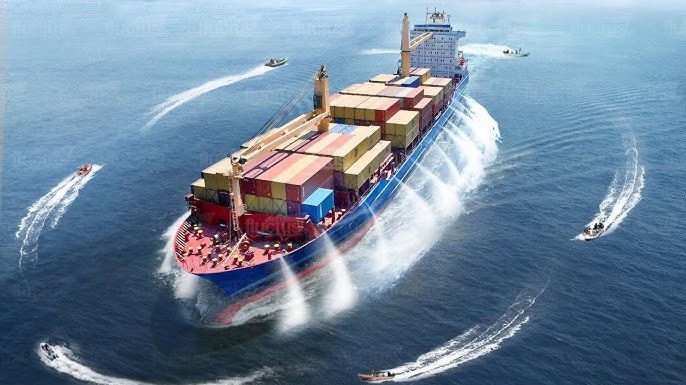
Modern supply chains operate through dispersed production hubs and maritime transit networks. Under the present ‘Multiplex World Order[3]’, sea lane stability is no longer guaranteed by a single naval power. As Kishore Mahbubani’s “Great Convergence[4] suggest maritime stability increasingly depends upon cooperative management of shared space.
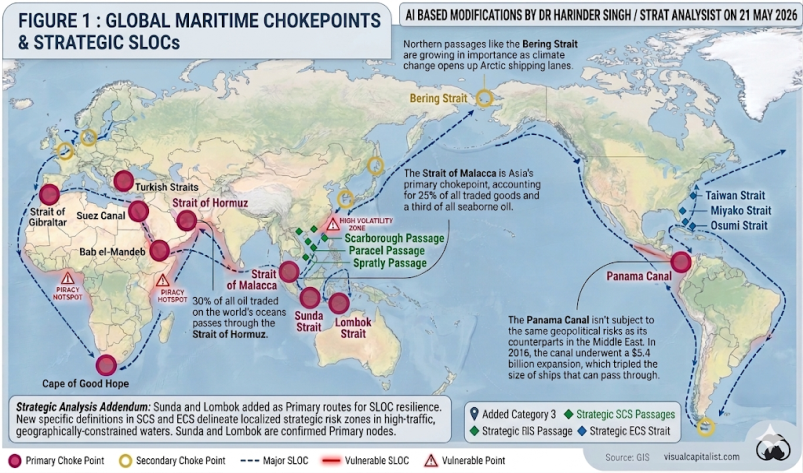
Yet contemporary policy remains hindered by ‘sea blindness’, prioritising land borders while underestimating the maritime foundations of national security.[5] Major chokepoints such as the Strait of Hormuz, the Strait of Malacca, and the Bab el-Mandeb remain vital corridors of global energy trade. They remain vulnerable to weaponised interdependence[6] of global economic and supply networks. Any constriction here rapidly affects freight costs, energy prices, industrial supply chains and the uninterrupted flow of hydrocarbons.
For too long, India’s ‘Maritime Strategy’ has emphasised naval force projection and the use of naval capability to secure uninterrupted energy flows. This approach is insufficient under present maritime conditions. India must move beyond a purely military understanding of sea control[7] to a broader maritime security, energy-resilient, and regional cooperation framework – namely “Multidimensional Energy Sovereignty (MES) framework”. By combining strategic planning with diplomacy, the framework operationalises India’s Maritime Goodwill Curve (IMGC)[8] and will help our nation transition from a ‘reactive security provider’ to a ‘proactive role’ in shaping regional maritime stability.
Strategic Fragility: Limitations of Conventional Maritime Security
The present-day ‘maritime threat environment’ extends beyond the reach of traditional naval responses. It has evolved significantly from the period dominated by Somali piracy, a comparatively limited maritime threat, to a more complex phase of ‘Hybrid Maritime Conflict’. Current threats increasingly include low-cost loitering munitions, Unmanned Underwater Vehicles (UUVs), and autonomous drone swarms. ‘Grey-zone tactics exploit the ambiguous space between peacetime commerce and open conflict.’[9]
Vulnerabilities of Hub-and-Spoke Supply Model.
Modern maritime logistics primarily relies on the Hub-and-Spoke (H&S) model, in which multiple regional sourcing locations (spokes) feed into centralised transit hubs before passing through critical maritime passages.[10] Although efficient under stable commercial conditions, it creates major concentration risks when these primary hubs or chokepoints are contested. During periods of asymmetric conflict, the high volume in these corridors makes them a high-value strategic target.
Carrier Battle Group (CBG) vs. 300% Insurance Premium
A Carrier Battle Group (CBG) alone cannot resolve prolonged maritime instability. Although it provides substantial deterrent capability, it also heightens concerns about regional escalation.[11] Transit premiums for vessels navigating contested chokepoints rise significantly during periods of instability, thereby substantially increasing commercial shipping costs. Analysis indicates that insurance premiums increased from the standard 0.07% of hull value to over 1.0%, resulting in a 300% to 500% increase in insurance costs.[12] Figure 3, ‘War Risk Surcharge Volatility’ diagram, placed here for the period 2023-2026, highlights the massive cost liabilities.
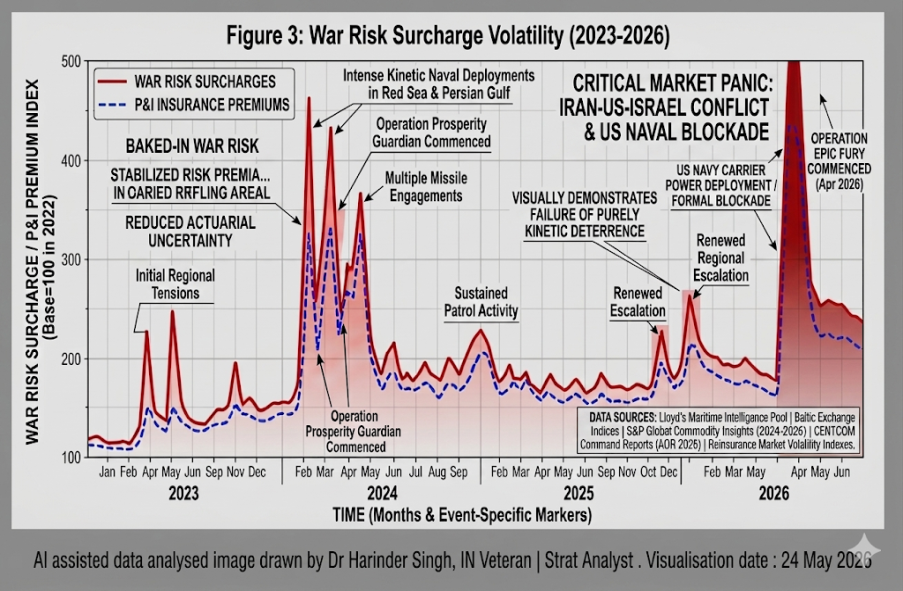
CBG or Naval deployments alone cannot fully resolve this insurance crisis due to three structural asymmetries:
- Cost-Exchange Asymmetry. We all understand that intercepting a ‘$20,000 Shahed-type drone with a $2.1 million SM-2 or $4.3 million SM-6 missile’[13] is operationally effective but financially unsustainable. Similarly, the insurance markets recognise the financial limits of such defensive responses during a prolonged crisis.
- Defensive Bubble vs. Dispersed Fleet. A CBG requires a substantial internal defensive screen to protect itself. It cannot provide point defence for individual merchant tankers scattered across a 500-mile transit corridor. Mandating convoys introduces ‘time-on-risk’ delays, increasing the actuarial probability of a mass-casualty event.
- Signal of Conflict. The arrival of a heavy naval task force acts as a force multiplier for market panic. It signals imminent kinetic escalation to reinsurance markets, permanently embedding “War Risk” clauses in maritime contracts.
Achilles’ Heel of Air-Sea Integration: Tanker Vulnerability & Incomplete AAR
The tactical limitations of carrier air elements are compounded by an operational bottleneck: India’s incomplete Air-to-Air Refuelling (AAR) capability and the fragility of support tankers in contested airspace.[14] Without persistent, long-range combat air patrols (CAP) over distant SLOCs, merchant vessels remain vulnerable to ballistic missiles and loitering munitions. Extending these air arcs requires a continuous AAR pipeline. However, the recent asymmetric downing of two large, non-stealthy refuellers highlights the catastrophic vulnerability of force-multiplier fleets.[15]
These lumbering, high-signature targets face immediate neutralisation. Their loss causes immediate fuel starvation for the forward-deployed fighter fleet, collapsing defensive air cover and leaving the naval task force and shipping exposed to saturation strikes. India’s current inventory of heavy refuellers (Il-78 MKI) is structurally limited in both volume and availability.[16] Attempting to patrol the Western Indian Ocean or the Bab-el-Mandeb with an incomplete, vulnerable AAR capability would invite operational paralysis. A Navy cannot command the surface if its aerial logistical spine can be severed by a single, low-cost munition. To secure sea lanes, India requires deep strategic goodwill in the littorals rather than mere naval firepower.
Maritime Goodwill Curve: Four-Dimensional Doctrine of Influence
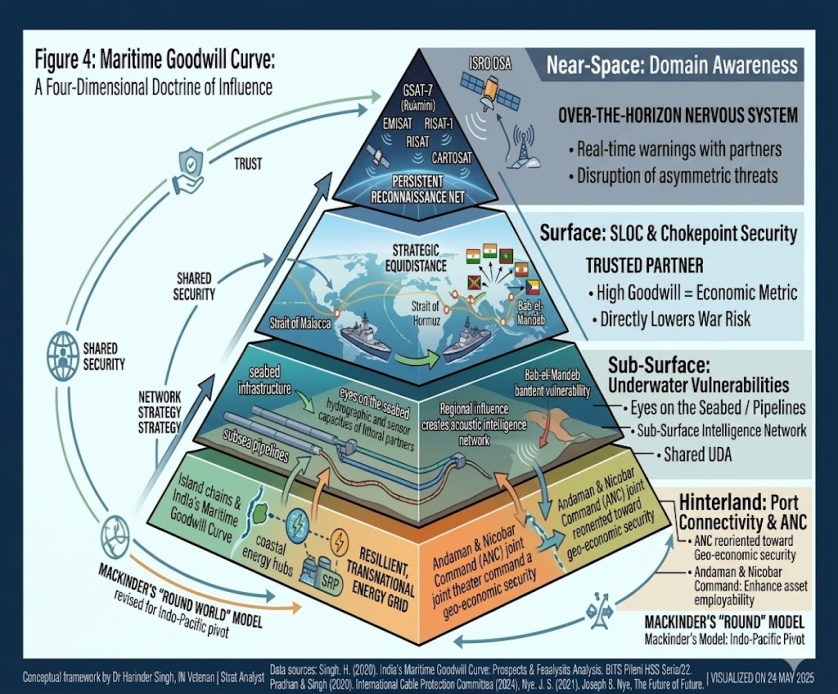
To move beyond purely military responses, India needs to address the persistent trust deficit in key littoral regions bordering critical chokepoints. Classical geopolitical thinking, particularly Mackinder’s Heartland framework, “The Round World model”, revisited for the Indo-Pacific, reveals that controlling global sea lanes and island chains is an important geopolitical factor in the Indo-Pacific.[17]
To win and preserve regional peace, India’s Maritime Goodwill Curve (IMGC) framework offers a practical and more cooperative strategic approach.[18] It posits that energy transit security increasingly depends on the level of strategic trust with the littoral state.[19] Goodwill here is not merely symbolic diplomacy. It’s a measurable strategic asset. As Joseph Nye states, it’s a highly ‘Quantifiable Smart Power Asset’ with layered strategic advantage. Let us expand this doctrine within a four-dimensional operational framework to establish broader maritime resilience.
Near-Space: Space-Based Domain Awareness.
Modern maritime security is increasingly linked to space-based infrastructure. To deter asymmetric threats before they reach maritime chokepoints, we need to improve coordination between space and maritime surveillance systems. By integrating the capabilities of the Defence Space Agency (DSA) and ISRO, India can maintain continuous satellite-based maritime monitoring. This can be achieved by leveraging the CARTO, RISAT, and GSAT-7 (Rukmini) satellite series, along with the EMISAT electronic intelligence constellation. This space-to-sea linkage shall form an integrated early-warning network to support IMGC operations. By sharing satellite-derived, real-time early warnings with friendly regional partners, India can identify drone activity and piracy threats before they directly affect shipping lanes.
Sub-Surface: Underwater Vulnerabilities.
Subsea pipelines and communication cables form a critical part of global infrastructure. They are among the most vulnerable components of energy sovereignty. The surface fleet has limited ability to monitor sub-surface sabotage. This vulnerability of undersea communications cables was evident in Bab-el-Mandeb.[20] Rather than relying on continuous physical monitoring of the seabed, IMGC must operationalise shared Underwater Domain Awareness (UDA). By investing in the hydrographic and sensor capabilities of littoral partners, India can improve underwater monitoring capabilities while building a collaborative, regional, real-time underwater surveillance network.
Surface: SLOC & Chokepoint Security
This domain yields the most immediate ‘Goodwill Dividend’. At the surface tier, maritime sovereignty is maintained through Strategic Equidistance – using diplomatic agility to navigate a heavily sanctioned world as a trusted partner rather than a hegemonic threat. Regionally, high goodwill serves as an economic metric that directly lowers war-risk surcharges. When littoral states perceive India as a collaborative, non-threatening partner, operational friction and security premiums for Indian-flagged energy hulls decrease sharply.
Hinterland Tier: Port-to-Pillar Connectivity and ANC.
The maritime security continuum must extend inland to include critical infrastructure that receives, stores, and distributes imported energy. In the context of the Andaman & Nicobar Command (ANC), India’s island chains remain a paramount national asset.
As late as early 2015, the Cabinet Committee on Infrastructure Enhancement & Security in GoI was considering ways to enhance the employability of infrastructure and strategic assets in the A&N islands.[21] With the 2019 institutionalisation of the Chief of Defence Staff and our joint theatre command still in fieri, it’s time to reorient the latter towards India’s geo-economic security. This can be achieved by tethering our coastal energy hubs and Strategic Petroleum Reserves (SPR) to regional littoral networks. We can transform these domestic stockpiles into vital nodes within a resilient, transnational energy grid.
Operationalising Goodwill Dividend: Five Pillars of Statecraft
Maritime goodwill curve acts as a catalyst for five substantive pillars of national resilience, bridging the vital gap between naval strategy and geo-economics:-
Pillar 1: The Economic Dividend (Stabilising the Landed Cost). In the context of modern chokepoint volatility, the primary threat to India’s sovereignty is inflationary contagion from imported energy. When the Strait of Hormuz became contested, economic friction was evident in dramatically higher P&I insurance premiums. Unlike kinetic defence, which invites reciprocal aggression, the Goodwill Curve signals regional stability. By maintaining high-trust partnerships (through HADR, joint patrols, and capacity building), India actively reduces underwriters’ perceived risk, thereby protecting India’s GDP from external geopolitical shocks. This synergy between international diplomacy and maritime operations is critical to stabilising the maritime supply chain.[22]
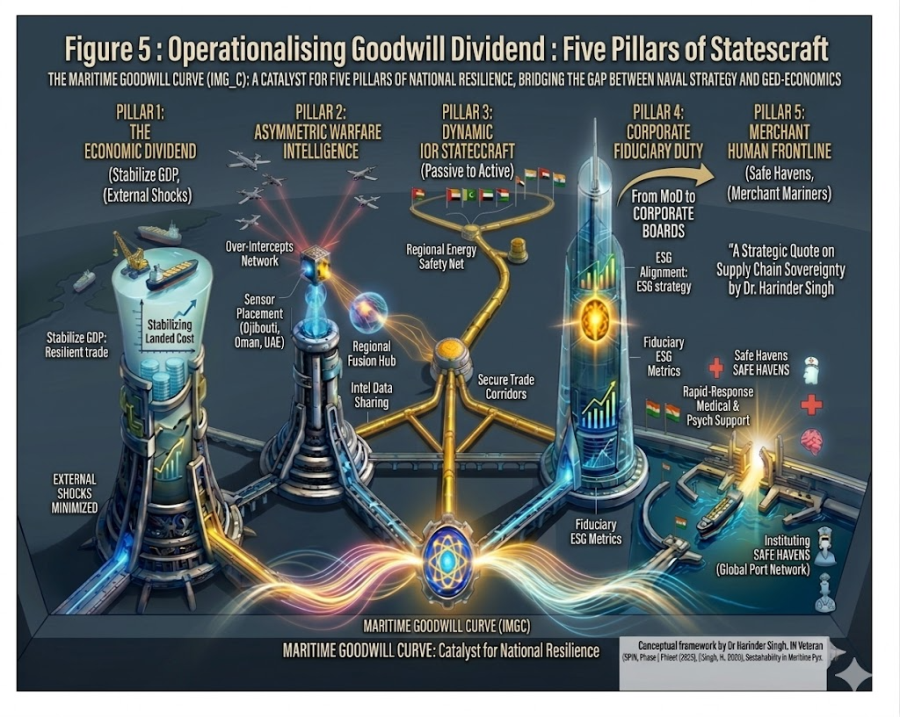
Pillar 2: Asymmetric Counter-Warfare (Intelligence over Intercepts). Rather than attempting to ‘out-missile drone swarms’, the Goodwill Curve operationalises Regional Intelligence Fusion. High levels of strategic trust enable the forward placement of sensors and the seamless sharing of real-time intelligence with littoral partners (e.g., Oman, UAE, Djibouti). An early-warning data point shared by a friendly littoral neighbour is infinitely more valuable than a multi-million-dollar interceptor launched in isolation.
Pillar 3: Dynamic SPR Leadership (Regional Energy Safety Net). While India’s Phase II SPR expansion (adding a planned 4.0 Million Metric Tons (MMT) at Chandikhol and 2.5 MMT at Padur II under a commercial-cum-strategic Public-Private Partnership (PPP) model) is a critical domestic imperative,[23] the Goodwill Curve enables the Strategic Petroleum Reserves (SPR) to serve as a regional diplomatic asset. By positioning India as a regional energy guarantor, domestic stockpiles act as a stabilising force across the entire IOR. This transforms the SPR from a passive stockpile into an active tool of energy statecraft, ensuring our littoral partners are deeply invested in the safety of the sea lanes that supply our tanks.[24]
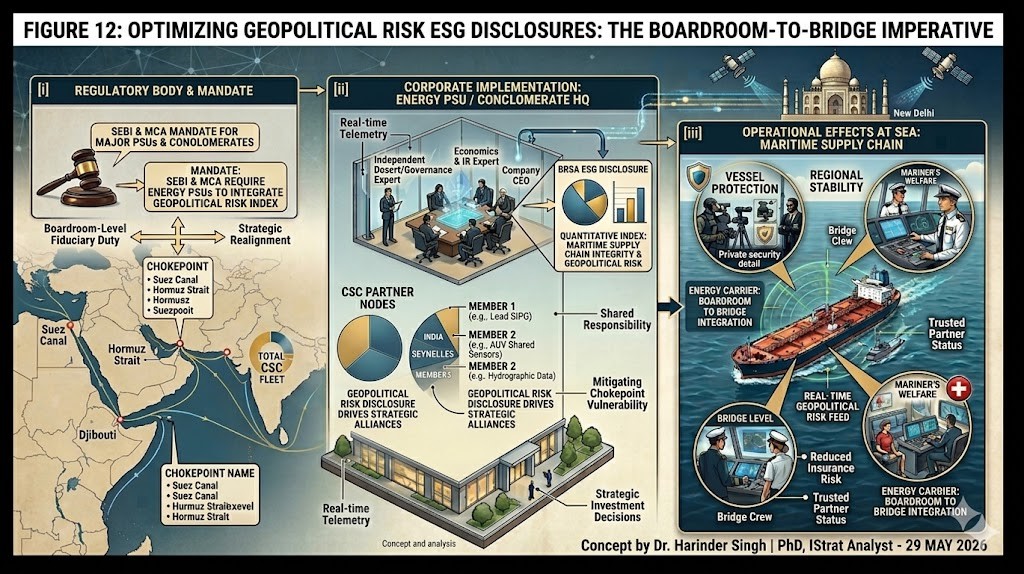
Pillar 4: Boardroom ESG Governance (Fiduciary Sovereignty). The mandate for national security must move swiftly from the Ministry of Defence (MoD) to the corporate boardrooms of India’s energy giants. We must reclassify maritime security as a core tenet of Environmental, Social, and Governance (ESG) strategy.[25]
“When the security of national supply chains is treated merely as an external logistics cost rather than an internal fiduciary duty, we surrender our industrial sovereignty to market volatility.” – Dr Harinder Singh.
For India’s energy PSUs, supply chain integrity is a primary fiduciary duty to the nation. Integrating environmental sustainability and developmental economics into maritime operations ensures that both private and public corporate capital support strategic national objectives.[26]
Pillar 5: The Human Frontline (The Merchant Mariner’s Resilience). The disruptions in the Strait of Hormuz and Bab el-Mandeb have taken an agonising psychological toll on merchant mariners, the unheralded frontline workers of global energy transit. True sovereignty is maintained by those who man the hull. The Goodwill Curve mandates establishing regional “Safe Havens” and rapid-response medical infrastructure for mariners in trusted littoral states.
Policy Recommendations
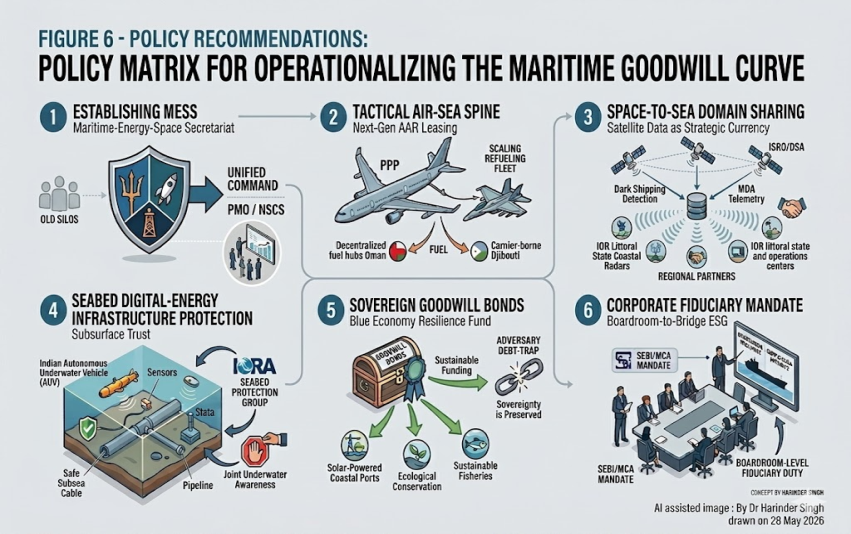
To institutionalise the ‘Goodwill Dividend’ and secure ‘Multidimensional Energy Sovereignty’ across all tiers of the strategic continuum, India’s strategic establishment must move aggressively beyond silos. Here, a six-tier policy matrix is proposed to operationalise the Maritime Goodwill Curve as India’s primary grand strategic instrument, as follows:
- Establishing a Maritime-Energy-Space Secretariat (MESS)
The foremost structural bottleneck in India’s current strategic architecture is the siloed operations of key departments. It is proposed to establish a unified Maritime-Energy-Space Secretariat (MESS) directly under the Prime Minister’s Office (PMO) and the National Security Council Secretariat (NSCS). MESS will structurally integrate tri-service military imperatives with the geo-economic mandates of MoPNG, the orbital vigilance of ISRO and the Defence Space Agency (DSA). By unifying the strategic triad of space tracking, naval positioning, and energy procurement into a single, real-time command loop, India can preemptively
neutralise chokepoint vulnerabilities before they trigger global market panics.
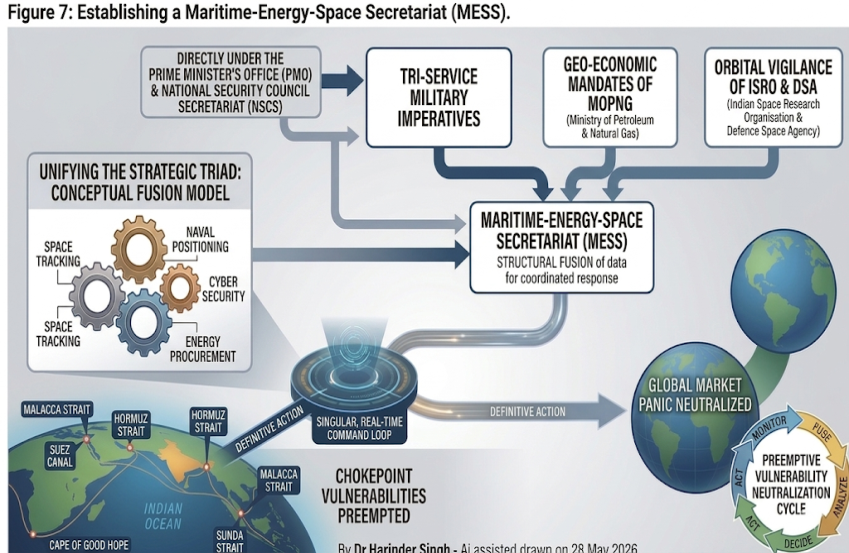
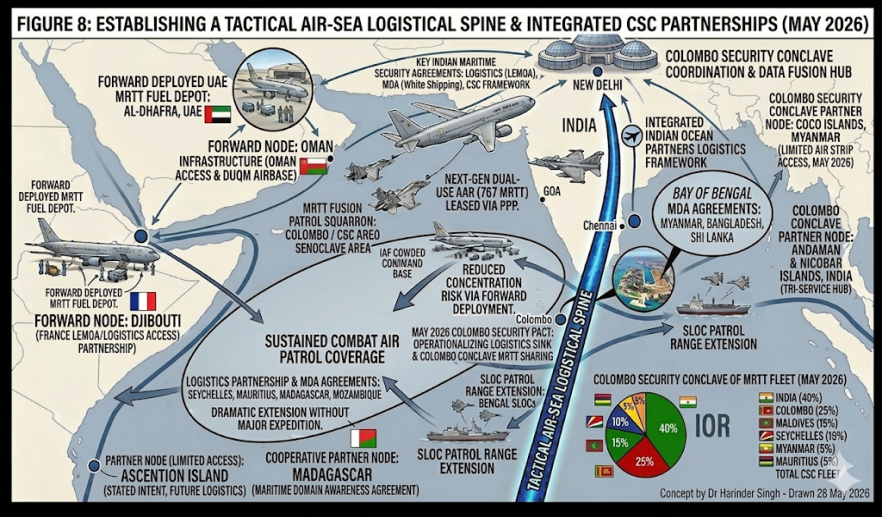
- Tactical Air-Sea Logistical Spine: Next-Gen dual-use AAR Leasing.
To overcome critical Air-to-Air Refuelling (AAR) shortfalls and mitigate tanker vulnerability, India must implement a ‘Tactical Air-Sea Logistical Spine’ – an integrated air-sea logistics framework – via a dual-use ‘Public-Private Partnership’ (PPP). By leasing and converting commercial wide-body airliners (e.g., A330S and 767s) into Multi-Role Tanker Transports (MRTTs), India can bypass the lengthy capital acquisition process. Forward deployment of these assets through bilateral logistics agreements with partners such as Oman, the UAE and Djibouti will help decentralise refuelling infrastructure and reduce concentration risk. This will also dramatically extend sustained combat air patrol coverage over critical SLOCs
without major additional expenditure.
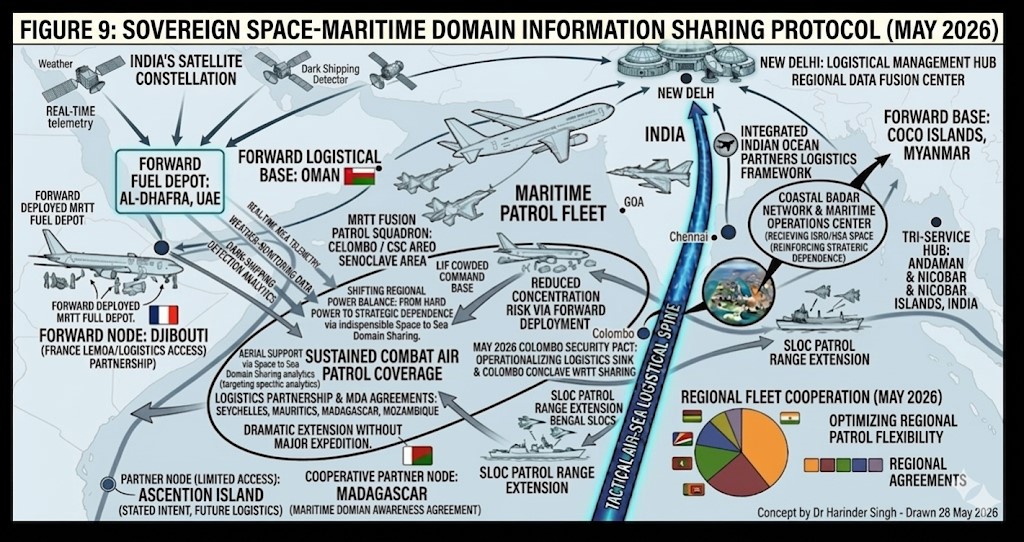
- Space-to-Sea Domain Sharing and Maritime Surveillance.
There is a need to use space-based capabilities as a form of strategic diplomatic engagement. It is proposed to establish a ‘Sovereign Space-Domain Sharing Protocol’ with IOR littoral states. Through this framework, India’s DSA and ISRO will share real-time, non-classified maritime domain awareness (MDA) telemetry, weather-monitoring data, and dark-shipping detection analytics directly with the coastal radar networks and maritime operations centres of regional partners. By acting as a regional space-based maritime surveillance partner, India will reinforce its status as a trusted and indispensable partner. It will also shift the regional balance of power from a purely hard-power approach to one of ‘long-term strategic
dependence’ in maritime matters.
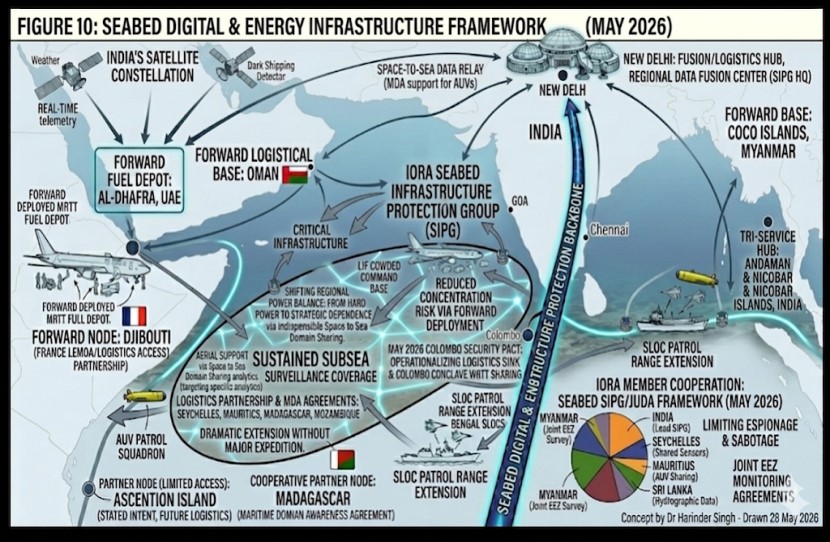
- Seabed Digital & Energy Infrastructure Framework: Indian Ocean Seabed Framework.
One of the major infrastructural vulnerabilities lies in the hidden, unprotected seabed lattice. To address this, India should spearhead a ‘Seabed Infrastructure Protection Group’ within IORA to foster regional cooperation on subsea security. Through Joint Underwater Domain Awareness (JUDA), India can support littoral states with hydrographic surveys, shared sensor networks, and indigenous autonomous underwater vehicles (AUVs) to monitor their EEZs. Such cooperation would improve the protection of critical digital and energy infrastructure. It would also limit opportunities for underwater espionage and sabotage while improving regional underwater awareness.
- Sovereign “Goodwill Bonds” and the Blue Economy Resilience Fund.
To counter the predatory infrastructure diplomacy of rival powers, India should establish a ‘Blue Economy Resilience Fund’ backed by government-guaranteed “Goodwill Bonds” to offer littoral nations sustainable, transparent development alternatives. This fund will finance non-predatory maritime infrastructure, such as solar-powered coastal ports, ecological conservation zones, and sustainable fisheries, across key island chains and critical littoral nodes. Unlike competitors’ debt traps, this developmental model preserves the host nations’ sovereignty, earning India immense diplomatic capital that translates directly into long-term transit safety for its energy fleets.
- Corporate Fiduciary Mandate “Boardroom to Bridge” ESG Disclosures.
Energy security is a shared responsibility. To bridge the gap between military commands and corporate headquarters, energy security must be treated as a boardroom-level fiduciary duty rather than an external logistics externality. It is recommended that the Securities and Exchange Board of India (SEBI) and the Ministry of Corporate Affairs (MCA) mandate major energy PSUs and private conglomerates to incorporate a quantitative “Maritime Supply Chain Integrity & Geopolitical Risk Index” into their annual Business Responsibility and Sustainability Reporting (BRSR) under the Environment, Security and Governance (ESG) framework. Recognising these geopolitical risks in ESG reporting can encourage corporate investment in regional stability initiatives, vessel protection measures, and mariners’ welfare.
Conclusion: Beyond the Gauntlet
India’s long-term maritime security cannot rely solely on Carrier Battle Groups (CBGs) or air power supported by AAR. The evolving Indo-Pacific environment demands a broader framework that integrates maritime resilience, energy security, regional trust, and cooperative statecraft. India’s Maritime Goodwill Curve (IMGC) links regional cooperation to operational stability across critical maritime corridors. In an era shaped by hybrid threats, vulnerable SLOCs and chokepoints, disrupted supply chains, and weaponised interdependence, goodwill must be understood not merely as symbolic diplomacy but as a practical strategic asset.
For India, functioning solely as a “Net Security Provider” is no longer sufficient. The changing maritime environment requires sustained regional influence, trust, and cooperative engagement. India must increasingly become a “Net Influence Generator” capable of shaping long-term maritime stability across the Indo-Pacific. From satellite-enabled maritime awareness and seabed infrastructure security to petroleum reserves and regional partnerships, sovereignty in the twenty-first century has become multidimensional. Maritime influence today depends not only on deterrent capability but also on resilience, connectivity, credibility, and sustained engagement.
Strategy must therefore move beyond reactive security responses toward a maritime order founded upon credible partnerships, economic resilience, and cooperative regional frameworks.
Author Brief Bio: Captain (IN) (Dr.) Harinder Singh, a scholar-warrior, holds a PhD (BITS Pilani), MBA (JBIMS), MSc (DSSC), CSSBB (MSME Agra), BSc, ADIT (CDAC) et al. He is also an MCA-certified Corporate Governance expert & an Independent Director (IICA). Pioneer of “India’s Maritime Goodwill Curve,” he specialises in space-aviation-sea integration, Sciences & national security, developmental economics, and corporate ESG frameworks, effectively bridging joint naval statecraft and boardroom geo-economics.
Endnotes
[1] Harinder Singh, “India’s Maritime Goodwill Curve (IMGC): Prospects & Feasibility Analysis,” Research at BITS 2020, BITS Pilani HSS Serial 22 (2020): 15, http://hdl.handle.net/10603/472806.
[2] Angus Maddison, The World Economy: A Millennial Perspective (Paris: OECD Development Centre Studies, 2006).
[3] Amitav Acharya, “After Liberal Hegemony: The Advent of a Multiplex World Order,” Ethics & International Affairs 31, no. 3 (September 2017): 271–285, https://www.ethicsandinternationalaffairs.org/2017/multiplex-world-order/
[4] Kishore Mahbubani, The Great Convergence: Asia, the West, and the Logic of One World (New York: PublicAffairs, 2014).
[5] Christian Bueger and Timothy Edmunds, “Beyond Sea Blindness: A New Agenda for Maritime Security Studies,” International Affairs 93, no. 6 (November 2017): 1293–1311.
[6] Henry Farrell and Abraham L. Newman, “Weaponized Interdependence: How Global Economic Networks Shape State Coercion,” International Security 44, no. 1 (Summer 2019): 42–79.
[7] Alfred Thayer Mahan, The Influence of Sea Power Upon History, 1660–1783 (Boston: Little, Brown and Company, 1890).
[8] Harinder Singh, “India’s Maritime Goodwill Curve (IMGC),” 15. http://hdl.handle.net/10603/472806
[9] R. Puchala, Asymmetric Threats in the Blue Economy (London: Maritime Press, 2025).
[10] Harinder Singh, “India’s Maritime Goodwill Curve (IMGC),” Chapter 1, http://hdl.handle.net/10603/472806
[11] Robert Jervis, “Cooperation Under the Security Dilemma,” World Politics 30, no. 2 (January 1978): 167–214.
[12] Lloyd’s Joint War Committee, Amended Transit Areas and Surcharges for the Southern Red Sea and Gulf of Aden, JWLA-032 (London: Lloyd’s Market Association, 2024); S&P Global Commodity Insights, Red Sea Disruptions and the Impact on Global Freight Rates and War Risk Premiums (London: S&P Global, 2024).
[13] Mark F. Cancian, “The Cost of Protecting Red Sea Shipping,” Center for Strategic and International Studies (CSIS), February 15, 2024, https://www.csis.org/analysis/cost-protecting-red-sea-shipping; Congressional Research Service, U.S. Navy Red Sea Operations: Cost and Operational Implications for Air Defense, CRS Report R47981 (Washington, D.C.: Congressional Research Service, 2024).
[14] Harinder Singh, “Incomplete Combat Arcs: Tanker Vulnerability and AAR Bottlenecks in the Western Indian Ocean,” LinkedIn, March 2026, https://www.linkedin.com/posts/harrywads_geopolitics-supplychain-economy-activity-7456192740557709312-6udF.
[15] Ibid.
[16] Idid.
[17] R. P. Pradhan and Harinder Singh, “Island Chains & India’s Maritime Goodwill Curve: Revisiting Mackinder’s Round World,” in Connecting Asia: Understanding Foreign Relations, Organizations & Contemporary Issues, ed. Debasish Nandy (New Delhi: Kunal Books, 2020), 1–19.
[18] Harinder Singh, “Mackinder’s Round World & IMGC: A Perspective Towards Winning Peace in the Indo-Pacific,” in India’s Engagement with Global Powers: Issues and Challenges (New Delhi: Book Chapter, 2021), 140–159.
[19] Harinder Singh, “India’s Maritime Goodwill Curve (IMGC),” http://hdl.handle.net/10603/472806.
[20] International Cable Protection Committee, Submarine Cable Vulnerability in Chokepoints: A Briefing on the Bab-el-Mandeb Incident (Lymington: ICPC, 2024).
[21] Harinder Singh, “India’s Maritime Goodwill Curve (IMGC),” Chapter 4, http://hdl.handle.net/10603/472806
[22] Harinder Singh, “International Diplomacy and Maritime Operations: Synergy Important,” LinkedIn, 2024, https://www.linkedin.com/pulse/international-diplomacy-maritime-operations-synergy-dr-harinder-rrsuc/
[23] ISPRL, Strategic Petroleum Reserves Phase II Expansion: Status Report (New Delhi: Indian Strategic Petroleum Reserves Limited, 2024).
[24] Harinder Singh, “India’s Maritime Goodwill Curve (IMGC),” 15. http://hdl.handle.net/10603/472806.
[25] Harinder Singh, “Sailing Towards Sustainability in Maritime Ops,” LinkedIn, June 2025, https://www.linkedin.com/posts/harrywads_environmental-sustainability-in-maritime-activity-7387817153556750336-hGfx.
[26] Ibid.