
Abstract
Strategic competition and war are reshaping the routes linking the Indian Ocean to the Mediterranean. The Indo-Mediterranean is best understood as the space formed by the movement of goods, energy and data, and by the security arrangements that sustain them. It is more than a commercial corridor. Its viability depends on infrastructure, political alignment and the ability to keep connections open during crises.
Israel is the only viable candidate to serve as the western anchor of India’s Indo-Mediterranean strategy. No other node combines access to the Gulf-Levant route, an Indian-operated port asset, and a mature security and technological relationship with India. Haifa alone, however, cannot fulfil this role. Greece, Cyprus and Italy provide the anchor with European reach and redundancy; they do not replace it. The attacks of 7 October 2023, the Gaza war, disruption in the Red Sea and the wider West Asian crisis culminating in March 2026 exposed how politically and operationally fragile the proposed corridor remains.
The crises did not render IMEC irrelevant. They clarified what the project would need to survive: alternative routes, protected infrastructure, regulatory coordination and practical cooperation among regional partners. Israel can anchor the western segment only as a secure node within a wider Eastern Mediterranean network, not as a single point through which every flow must pass.
Keywords: Indo-Mediterranean; IMEC; India; Israel; Eastern Mediterranean; strategic connectivity
The Indo-Mediterranean as a strategic space
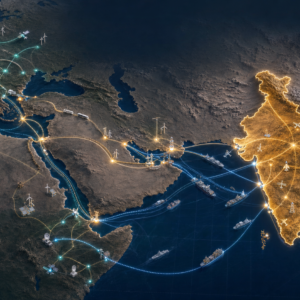
The Memorandum of Understanding announced at the New Delhi G20 summit in September 2023 described the India-Middle East-Europe Economic Corridor (IMEC) in functional terms. An eastern corridor would connect India with the Gulf; a northern corridor would link the Gulf to Europe via maritime routes, railways, roads, and associated energy and digital infrastructure.1 The map, however, advanced a broader proposition. It brought together regions usually treated as separate theatres: the Indian Ocean, the Arabian Peninsula, the Levant, and the Mediterranean. IMEC thus provided a material basis for thinking about an Indo-Mediterranean space.
This article argues that Israel is the only viable western anchor for India’s Indo-Mediterranean strategy because it uniquely combines geographic access to the Gulf-Levant segment with an established security and technological partnership capable of safeguarding the corridor’s critical infrastructure. Greece, Cyprus and Italy extend this anchor into Europe; they do not constitute alternatives to it.
The Indo-Mediterranean is neither a settled region nor simply the Indo-Pacific extended westward. It is a form of connectivity-based competitive regionalism: trade, capital, energy and data flow through infrastructure that is itself subject to political competition. Recent studies place IMEC at the intersection of India, the Gulf, the Abraham Accords and European initiatives. Banerjee and Singh treat it as collaborative infrastructure linking North-South and South-South trade with transport, digital and energy systems.2 The 2026 ISPI report likewise reads the corridor through the lens of diversification and supply-chain resilience.3
The Gulf states’ ongoing ties with China prevent the Indo-Mediterranean from becoming an exclusively Western bloc. Chinese firms already operate infrastructure that could be part of IMEC, while India continues to pursue the International North-South Transport Corridor through Iran and Eurasia. IMEC adds a route to India’s multi-alignment strategy rather than replacing its other options.
A western anchor must do five things. It must link the Gulf-Levant land segment to Mediterranean routes, transfer goods, energy and data across multiple infrastructure types, and connect the Levant to more than one European gateway. It must also support India’s capacity to coordinate partners on standards, investment and security, and keep flows moving or restore them quickly after disruption. These are practical tests of geographic centrality, multimodal capacity, network reach, coordination and resilience. A node that concentrates traffic without providing alternatives is a chokepoint. A port without cross-border political access is an endpoint.
IMEC is more likely to supplement the Suez Canal than replace it. It can provide selective redundancy for time-sensitive, high-value trade while supporting energy and digital links.4 Banerjee and Singh’s simulations also reject simplistic claims of universal gain: network expansion distributes opportunities more widely, but economic and emissions objectives create policy trade-offs, especially for Asian members.
The analysis draws on the September 2023 government announcement, policy reports published between 2024 and March 2026, and assessments of conflicts along the route. It asks why Israel is the only viable Western anchor and what conditions must be met for it to fulfil that role. It defines the anchor as an assessable strategic function rather than a geographic metaphor. For India, this approach links resilient connectivity and secure supply chains directly to the national interest.
India’s capacity to coordinate partners under regional pressure
IMEC was announced at a moment of optimism about regional integration. The Abraham Accords had created formal ties between Israel and several Arab states; I2U2 brought India, Israel, the United Arab Emirates and the United States into a practical minilateral framework; and Washington was attempting to advance Saudi-Israeli normalisation. India’s relations with both Israel and the Gulf had deepened without forcing New Delhi to choose between them. IMEC appeared to translate those diplomatic changes into infrastructure.
The attacks of 7 October 2023 and the war that followed broke the political sequence on which the proposed northern corridor tacitly relied. The original memorandum did not list Israel or Jordan among its signatories, even though the projected railway had to cross both countries to reach the Mediterranean. After October 2023, cooperation with Israel became far more difficult for Arab governments to justify publicly. Saudi-Israeli normalisation stalled, while fighting in Gaza, clashes on Israel’s northern front and Houthi attacks on commercial shipping widened the conflict’s geographical reach.5
The Red Sea crisis offered a paradoxical lesson. It complicated investment, raised insurance and transport costs, and showed that infrastructure could be targeted for political purposes. Yet it also strengthened the case for alternative connections. A corridor designed solely to reduce costs under normal conditions would be difficult to justify against established maritime shipping. A corridor that provides additional options during disruption has a different strategic rationale. This distinction explains why the language surrounding IMEC shifted from efficiency to resilience and redundancy.
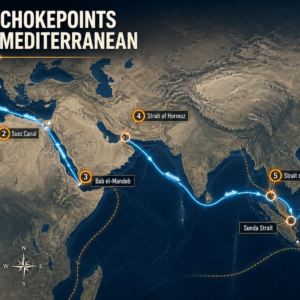
The escalation of the West Asian crisis in March 2026 sharpened that logic. US-Israeli strikes on Iran and Iranian retaliation threatened energy infrastructure and shipping around the Gulf, while the Strait of Hormuz again became a focal point of global risk.6 For India, the exposure was immediate: energy imports, trade, investment and the welfare of Indian citizens across the Gulf all depended on regional stability. The crisis also exposed an important limit to corridor thinking. A route that links several chokepoints is not resilient merely because it is new. Resilience requires spare capacity, alternative ports, interoperable procedures and institutions able to respond when a segment fails.
India’s exposure can be measured. An estimated 40–50 per cent of its crude-oil imports pass through the Strait of Hormuz. In 2024–25, Saudi Arabia and the UAE supplied about 22 per cent of India’s crude-oil imports and 54 per cent of its liquefied petroleum gas imports, while the UAE alone supplied roughly 13 per cent of its liquefied natural gas imports.7 More than nine million Indian citizens live in the Gulf, and their remittances account for an estimated 38 per cent of the total remittances received by India. A regional crisis would therefore affect not only energy prices but also household incomes in states such as Kerala, Uttar Pradesh and Bihar.8
India already has several ways to shape this environment. Its market creates demand and lends commercial weight to new connections. Indian firms can also secure positions at selected nodes, as the Adani investment in Haifa demonstrates. New Delhi’s distinctive advantage, however, lies in combining security and technology cooperation with diplomacy. Its trust with Israel, relations with the Gulf, participation in I2U2, engagement with Greece, and cooperation with the United States and Europe allow it to connect partnerships that no single regional institution presently governs. Used together, these relationships could give India a steadier strategic presence in a region where its economic exposure has long been greater than its political influence.9
India’s capacity to coordinate partners is limited. New Delhi can modernise its own ports and support investment abroad, but it cannot build the missing Saudi-Jordanian-Israeli links by itself, compel Saudi-Israeli normalisation, or set European customs and rail standards. It also lacks the financial weight of the Gulf states and the infrastructure portfolio China has accumulated across the region. Its citizens and energy imports remain exposed to crises around Hormuz and the Red Sea. India must also preserve the Iran-centred INSTC to protect the strategic autonomy and flexibility at the heart of its multi-alignment. It can sponsor, invest and coordinate, but it cannot command the corridor.
Indian influence diminishes as the route moves west of the Gulf. An anchor would not give New Delhi control over that space, but it would provide a partner able to organise the transition from the Arabian Peninsula to European markets and to protect the infrastructure on which that transition depends. Israel is the only viable candidate. No alternative combines access to the Gulf-Levant segment, an Indian-operated port asset, established defence and technology cooperation with India, and the capacity to secure physical and digital infrastructure.
Geographic centrality, multimodal capacity and security provision
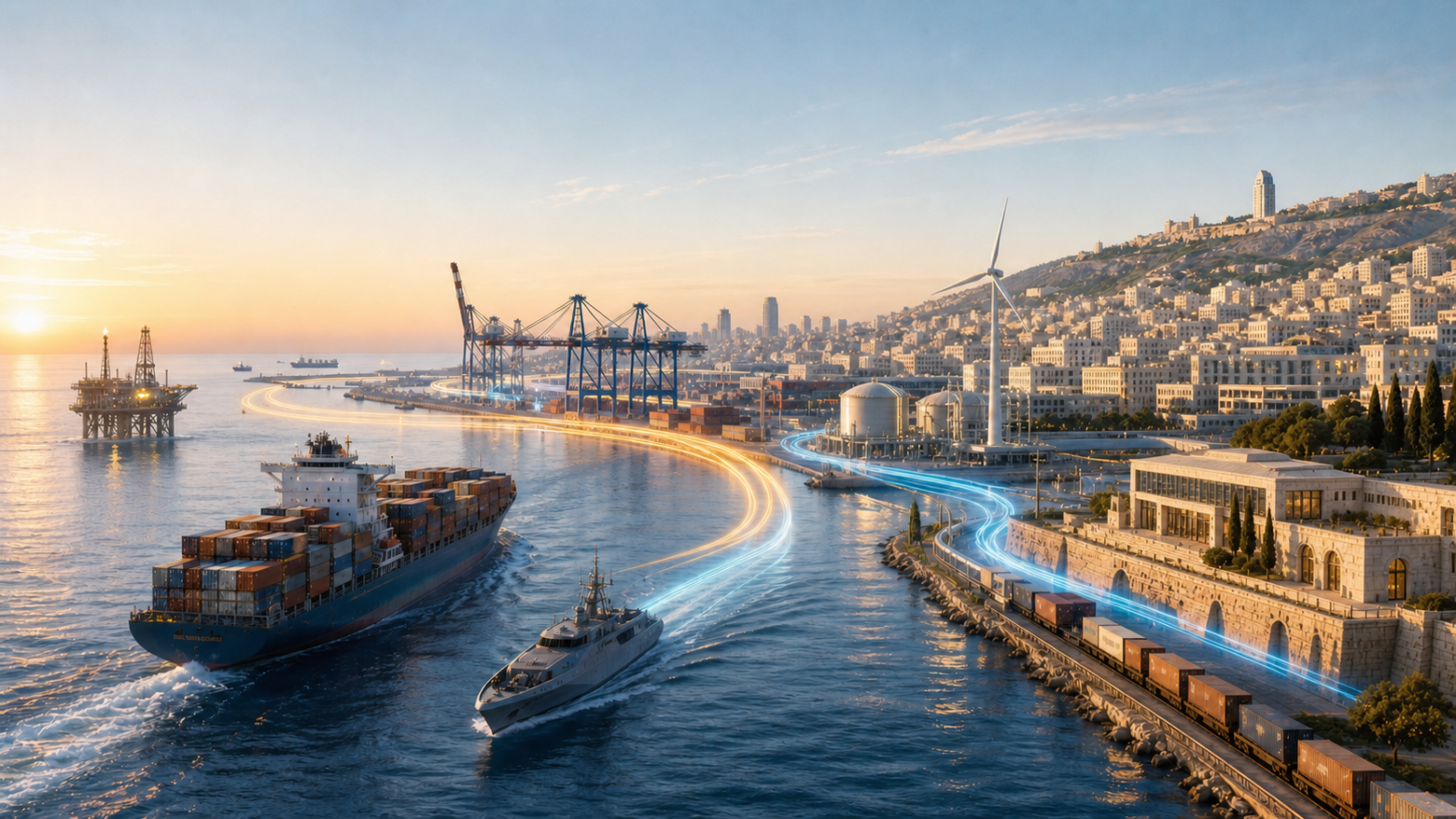
Geography gives Israel its initial claim to the role. Goods moving by rail from Saudi Arabia and Jordan would reach the Mediterranean through Israel, most plausibly at Haifa. The railway from Haifa to Beit She’an already exists. What is missing is the short, politically difficult connection to the Jordanian network. Haifa matters because it is where an overland Gulf-Levant route could return to sea and divide among several European ports.
The physical gap is limited but strategically significant. The operational Haifa–Beit She’an railway is approximately 60 kilometres long. An additional 15 kilometres would be required to connect Beit She’an to the Sheikh Hussein crossing and the Jordanian network. Haifa’s annual cargo capacity has been estimated at roughly 30 million tonnes, while its pre-war container capacity was reported at about 1.5 million TEU. The tonnage and TEU figures measure different forms of throughput and should be assessed separately when judging whether the port can absorb additional IMEC traffic.10
Indian investment turns this geographic connection into a bilateral one. By acquiring a controlling interest in the older Haifa port, the Adani Group placed an Indian operator at the prospective western end of a corridor shaped in part by Indian strategy.11 The acquisition preceded IMEC and should not be recast as an IMEC project. Its importance lies in giving India a commercial presence in a location where it already has a diplomatic interest. It also sits alongside Chinese involvement in the newer Haifa Bay terminal and in Piraeus. IMEC’s Mediterranean segment will not be insulated from Chinese infrastructure. India’s more realistic aim is to avoid dependence on any single operator.
The deeper foundation is the India-Israel security and technology relationship. Years of cooperation have built trust in sectors where states do not readily share access. For IMEC, the relevant question is not which weapons system India buys from Israel. It is whether the relationship can protect ports, digital networks and maritime traffic through cyber defence, intelligence exchange, maritime-domain awareness and continuity planning. Israeli policy studies argue that this experience could improve the corridor’s reliability.12 The claim needs qualification: exposure to missile attack does not make a state a secure logistics hub. Israel’s value lies in its ability to recover quickly and keep essential systems operating under pressure.
The security requirement also alters the meaning of bilateral cooperation. Corridor security is a collective-action problem: protecting a port does not secure its railway, and hardening a cable landing station does not prevent interruption elsewhere. India and Israel would therefore need to move beyond a supplier-client model towards joint standards and risk assessment with Jordan, Gulf partners and European operators. Shared threat assessments, port-recovery exercises, cyber-incident reporting and links among maritime fusion centres can begin below the level of a formal alliance. Israel meets the resilience criterion only if these arrangements lower risk across the route rather than merely strengthen Israeli assets.
Digital infrastructure also requires route-wide protection. Submarine cables carry the bulk of intercontinental data, and damage to cables in the Red Sea after the Rubymar was struck in February 2024 showed how an attack on shipping could interrupt data flows between Asia and Europe.13 Israel’s land bridge and the Blue-Raman cable system offer geographic diversification, but they also create new landing stations and terrestrial segments that require protection. A resilient network needs alternative landing points and repair capacity, not a single cable presented as an escape from Suez.
Blue-Raman is designed to connect India with Europe via Saudi Arabia, Israel and Italy, adding a digital layer to the corridor’s ports and railways. Its strategic value also reflects competition over data routes. The China-linked PEACE cable, which connects Pakistan with Djibouti, Egypt and France, has a reported capacity of 192 Tbps. Blue-Raman should therefore be assessed not only as commercial infrastructure but also as part of India’s effort to diversify secure data connections to Europe.14
Energy links add another layer. The Eastern Mediterranean already hosts overlapping projects involving Israeli and Cypriot gas, Egyptian liquefaction capacity, and a proposed electricity connection linking Israel, Cyprus, Greece and continental Europe. The Great Sea Interconnector has faced financial and political obstacles, but it illustrates what an Indo-Mediterranean architecture would look like: the Levant connected to the European system via Cyprus and Greece.15 Green hydrogen remains a longer-term prospect. Electricity, gas and renewable-energy cooperation offer more immediate foundations.
Israel meets more of the anchor criteria than any alternative. Haifa provides geographic centrality; the port, railway, cable and energy projects offer multimodal capacity; and the India-Israel relationship provides the required security and technological foundation. Network reach still depends on improved relations and functioning links with Jordan, while the full overland corridor requires progress towards Saudi-Israeli normalisation. Cyprus, Greece and Italy provide onward reach and redundancy, but none can secure or replace the Gulf-Levant segment. For India, Israel is therefore the indispensable partner for protecting the western end of its secure supply chains.
Network reach: the Eastern Mediterranean
Haifa does not, by itself, connect India to Europe. Cargo must then move to ports capable of handling transhipment and distributing goods to European rail and road networks. Greece and Italy are therefore part of the strategic argument, not decorative additions to it.
Greece is close to the Levant and has strengthened political relations with both India and Israel. Its accession to the Three Seas Initiative in 2023 also offers a potential link between Eastern Mediterranean ports and Central and Eastern Europe.16 Yet COSCO’s control of Piraeus makes it difficult to present IMEC as a clean alternative to the BRI. Piraeus still matters. Its ownership shows that competition with China will occur within shared infrastructure networks, not only between rival corridors.
At the European end, Italy adds depth and choice. ISPI’s comparison of Piraeus, Marseille-Fos, Genoa and Trieste shows that no port meets every requirement. Trieste offers rail access to Central Europe and a free-port regime; Genoa provides scale and links to northern Italy; Marseille offers another western outlet.17 Using several ports would reduce congestion and political dependence while allowing cargo to follow its destination and type. It would also address the concern that IMEC merely replaces one chokepoint with another.
Cyprus matters for a different reason. It is not a major rail gateway, but it links the energy and security systems of Israel and Greece. Electricity interconnection, gas development and maritime cooperation give the island a role that exceeds its market size. Israel, Cyprus and Greece can form the bridge; Italy can connect it to the European interior.
India has already moved towards this broader geometry. Its engagement with Greece has expanded, and Indian strategy increasingly treats the Mediterranean as the western extension of its maritime interests rather than a distant European periphery. Italy’s formal participation in the IMEC memorandum and its renewed promotion of Trieste reinforce this trend. The western anchor should thus be understood as a distributed system: Israel is its central Levantine node, while Greece, Cyprus and Italy provide that node with reach and redundancy.
The network also needs practical governance. IMEC’s signatories should establish a small coordinating mechanism for transport, digital systems, energy and infrastructure protection, including Israel, Jordan and other indispensable non-signatories in technical bodies. Border-crossing times, rail capacity, port dwell time, cable-repair arrangements, insurance premiums and interoperable customs procedures would provide measurable benchmarks of performance. For India, these arrangements would turn diplomatic access into resilient connectivity with European markets.
Resilience and political limits
The hardest problem is political. Israel cannot establish a complete overland corridor without Saudi cooperation, and Saudi-Israeli normalisation remains absent. Das’s warning that the corridor places India within an unstable and asymmetric framework of normalisation is therefore well founded. The Gaza war raised the domestic cost of visible cooperation with Israel across the Arab world, while the March 2026 crisis exposed ports, railways and energy routes to direct attack. Treating normalisation as inevitable would turn a strategic preference into an analytical assumption.
Political legitimacy is not a secondary issue to be resolved after construction. A corridor marketed as a framework for regional prosperity will remain fragile if its gains accrue mainly to distant markets and large infrastructure firms. Jordan bears the costs of transit, border management and new construction; Palestinian exclusion would make the project easier to attack as an attempt to bypass the conflict rather than to change regional conditions. This does not mean that IMEC can deliver a peace agreement. It means that planners should identify concrete local benefits, including logistics employment, industrial zones, energy access and improved Palestinian trade capacity. Functional inclusion would not eliminate opposition, but it would make cooperation less dependent on elite diplomacy alone.
Phased implementation offers a more credible path than either waiting for comprehensive Saudi-Israeli normalisation or ignoring the political obstacle. Partners can improve port, border, digital and energy connections, which have independent value, develop technical standards among willing states, and preserve the option to join the full rail corridor when diplomatic conditions permit. Normalisation would enable the complete route, but it cannot replace planning.
IMEC still lacks binding commitments on financing, governance and construction. Rail links remain incomplete, border procedures are slow, and customs systems are not integrated. Private investors require predictable volumes, risk guarantees, transparent regulation, and evidence that multimodal transfers can compete on time and cost. Analysts have therefore called for private-sector participation, competition among ports and operators, and two-way trade rather than a conveyor belt serving only India-to-Europe traffic.18
China’s position in Gulf infrastructure, Haifa Bay and Piraeus makes exclusion expensive and perhaps impossible. The Gulf states are unlikely to abandon BRI relationships for an underfunded alternative. India’s national interest lies in competitive diversification, not rigid alignment: it should prevent any single state, company or route from controlling the system while preserving its own multi-alignment.
India must also safeguard its interests in Iran and the International North-South Transport Corridor. Disengaging from Iran would weaken the strategic autonomy that makes New Delhi a valuable partner. At the same time, Iranian capabilities and allied armed groups can threaten the maritime and physical infrastructure on which IMEC depends. India must manage this competition without assuming that economic interdependence will resolve security conflicts.
Israel can fulfil the anchoring role only if it reduces risk rather than concentrates it. That requires four practical shifts: completing and modernising links to Jordan; embedding Haifa in a multi-port Mediterranean network; protecting physical, digital and energy infrastructure through shared protocols; and creating benefits for transit states and neighbouring populations. These steps would advance India’s national interest by combining strategic autonomy with resilient connectivity and more secure supply chains. Without them, “anchor” will remain a metaphor.
Conclusion
Israel is the only viable western anchor, combining the necessary geography and infrastructure with a security and technological relationship that can support India’s westward strategy. Greece, Cyprus and Italy are essential to the network’s European reach, but they extend the anchor rather than replace it. Even so, Israel cannot fulfil this role fully without improved relations and operational connectivity with Jordan, as well as progress towards Saudi-Israeli normalisation.
India can advance this architecture by combining security-technology cooperation with diplomatic coordination, thereby translating extensive economic interests into a more visible regional presence. It cannot impose normalisation, finance every missing link, or control the regulatory systems through which the corridor must pass. The strategy therefore depends on a division of functions: India supplies investment, technology cooperation and diplomatic coordination; Israel anchors and secures the Gulf-Levant transition; Eastern Mediterranean partners provide European reach and redundancy.
Author Brief Bio: Dr. Lauren Dagan Amoss is a researcher specialising in India’s foreign and security policy, with a regional focus on the Indo-Pacific. She is a Senior Fellow at the Begin-Sadat Centre for Strategic Studies (BESA) and a lecturer at Bar-Ilan University. Her doctoral research examined India’s policy toward the Israeli–Palestinian conflict, analysing the evolution of New Delhi’s diplomatic positioning from independence through the contemporary period. Her current research interests include strategic realignment in the Indo-Pacific, India’s security doctrine, and India–Israel relations. Dr. Dagan Amos is a member of the Deborah Forum, which promotes women’s leadership in Israel’s foreign and defence policy community.”
References
- Ministry of External Affairs, Government of India, “Partnership for Global Infrastructure and Investment (PGII) & India-Middle East-Europe Economic Corridor (IMEC),” September 9, 2023, https://www.mea.gov.in/press-releases.htm?dtl/37091/.
- Adam Krzymowski, “India-Middle East-Europe Economic Corridor in Strategic Connection with the Abraham Accords and the Three Seas Initiative,” Journal of International Studies 17, no. 4 (2024): 179–94, https://doi.org/10.14254/2071-8330.2024/17-4/11; Suvajit Banerjee and Surendar Singh, “Examining the India-Middle East-Europe Economic Corridor (IMEC) as a Collaborative Infrastructure for Transcontinental Policymaking: An ICIO-LP Analysis,” Asia Europe Journal 22 (2024): 482–84, https://doi.org/10.1007/s10308-024-00712-1.
- Filippo Fasulo, Nicola Missaglia, and Valeria Talbot, eds., IMEC: The Backbone of an Indo-Mediterranean Region-Italy and the Future of Transcontinental Connectivity (Milan: ISPI, 2026), 6–
- Fasulo, Missaglia, and Talbot, IMEC, 20–45; Navdeep Suri et al., India-Middle East-Europe Economic Corridor: Towards a New Discourse in Global Connectivity (New Delhi: Observer Research Foundation, 2024), 3–8; Banerjee and Singh, “Examining IMEC,” 500–
- Suri et al., India-Middle East-Europe Economic Corridor, 3–6; Fanny Sauvignon and Stefania Benaglia, “An India-Middle East-Europe Corridor for Peace: The EU’s Role in Transforming a Grand Announcement into an Inclusive Forum,” Policy Brief no. 136 (Barcelona: European Institute of the Mediterranean, 2024), 2–
- Drishti IAS, “The Escalating Crisis in West Asia,” March 6, 2026,https://www.drishtiias.com/daily-updates/daily-news-editorials/the-escalating-crisis-in-west-asia.
- Sukalp Sharma, “With Red Sea Disrupted, India May Have to Import More Russian Oil. That Comes with Risks,” The Indian Express, updated July 28, 2026, https://indianexpress.com/article/explained/explained-economics/india-oil-supply-saudi-disruption-russian-crude-10806998/
- Ivy Handique, “Indian Migrant Workers in the Gulf Amid the West Asia Crisis: Challenges, Vulnerabilities and Policy Responses,” Vivekananda International Foundation, July 2, 2026, https://www.vifindia.org/article/2026/july/02/Indian-Migrant-Workers-in-the-Gulf-Amid-the-West-Asia-Crisis.
- Research and Information System for Developing Countries, India-Middle East-Europe Economic Corridor (IMEC): Strategic Choices and Way Forward (New Delhi: RIS, 2025), 1–12; Debasish Das, “Revisiting the Contours of the Evolving Middle Eastern Order through the India-Middle East-EU Corridor: Mapping India’s Scopes and Limitations,” Asian Journal of Political Science 32, no. 1 (2024): 35–56, esp. 35–37, 49–51, https://doi.org/10.1080/02185377.2024.2322498; Banerjee and Singh, “Examining IMEC,” 484–
- Nilanjan Ghosh, “IMEC and the Future of Global Connectivity,” Observer Research Foundation, January 8, 2026, https://www.orfonline.org/expert-speak/imec-and-the-future-of-global-connectivity. length and operational status of the Haifa–Beit She’an railway; proposed 15-kilometre connection to the Sheikh Hussein crossing.]
- Sauvignon and Benaglia, “Corridor for Peace,” 5; Asher Fredman and Joseph Rozen, The India-Middle East-Europe Economic Corridor: A Catalyst for Regional Integration and Global Prosperity (Jerusalem: Misgav Institute for National Security and Konrad-Adenauer-Stiftung Israel, 2025), 31.
- Gopi Bhamidipati, “India’s Tightrope Walk: Navigating U.S.-Israel-Iran Tensions,” New Lines Institute, March 25, 2025, https://newlinesinstitute.org/strategic-competition/indias-tightrope-walk-navigating-u-s-israel-iran-tensions/; Fredman and Rozen, India-Middle East-Europe Economic Corridor, 31–
- Ned Leadbeater, “Fiber Optics and the Hidden Politics of Connectivity,” Middle East Report, October 20, 2025, https://www.merip.org/2025/10/fiber-optics-and-the-hidden-politics-of-connectivity/ ,
- “Blue-Raman,” Submarine Networks,https://www.submarinenetworks.com/en/systems/asia-europe-africa/blue-raman
- Fasulo, Missaglia, and Talbot, IMEC, 46–
- Krzymowski, “India-Middle East-Europe Economic Corridor,” 179–
- Fasulo, Missaglia, and Talbot, IMEC, 11–19, 20–
- Amir Hayek, “What’s Needed to Unlock the Power and Promise of IMEC,” Atlantic Council, August 22, 2025, https://www.atlanticcouncil.org/blogs/menasource/whats-needed-to-unlock-the-power-and-promise-of-imec/