
Introduction: The Crisis of Existing Strategic Frameworks
International politics is undergoing a structural transition unmatched since the Soviet Union’s collapse. The geopolitical certainties that characterised the post-Cold War era are giving way to a far more complex strategic environment, marked by great-power competition, technological disruption, fragmented supply chains, economic coercion, maritime insecurity, and the weaponisation of trade, finance and critical technologies. These changes are not isolated developments; they are interconnected manifestations of a broader transformation in the architecture of global power.
Traditional geopolitical analysis remains largely organised around geographically bounded regions – Europe, the Middle East, South Asia, Central Asia, and the Indo-Pacific. These constructs served an important analytical purpose in earlier eras, when strategic interactions were primarily determined by territorial proximity and military geography. Today, however, the density of economic, technological, logistical and maritime interdependence has fundamentally altered the character of strategic space.
A disruption in the Red Sea rapidly drives up freight costs for Indian exporters. Tensions in the Strait of Hormuz immediately affect India’s energy security and inflation. Political instability in Afghanistan affects India’s overland access to Central Asia. Israeli innovation contributes to India’s defence modernisation, while sovereign wealth funds from the Gulf finance infrastructure, technology and renewable energy projects across India. Although these developments occur in different countries, they generate immediate and interconnected strategic consequences for India.
The central argument of this paper is that these developments should no longer be analysed as discrete regional events. They constitute components of a single strategic ecosystem. Existing analytical frameworks illuminate important aspects of this environment but fail to explain the increasingly systemic interactions among maritime security, continental connectivity, technology, finance, logistics, and diplomacy.
The Western Strategic Continuum is proposed as a response to this intellectual gap. It is not a replacement for existing geopolitical theories but an integrative, India-centric framework that explains how strategic systems interact across the western approaches to the Indian subcontinent.
From Classical Geopolitics to Functional Strategic Geography
Strategic thought has evolved alongside changes in technology, economics and political power. Kautilya’s Arthashastra emphasised the dynamic nature of interstate relations, arguing that alliances and rivalries should be understood in terms of shifting interests rather than permanent ideological commitments. His relational understanding of power anticipated many features of contemporary strategic behaviour.
The industrial age produced the classical geopolitical theories of Halford Mackinder, Alfred Thayer Mahan and Nicholas Spykman. Mackinder highlighted the strategic importance of continental control through the Heartland Theory. Mahan emphasised the centrality of sea power and maritime commerce. Spykman argued that the Rimland was the decisive arena of geopolitical competition. While these theories differed in emphasis, they shared a common assumption: geography was primarily understood in terms of territory.
The Indo-Pacific concept marked a major intellectual advance by recognising the strategic integration of the Indian and Pacific Oceans. It reflected the growing importance of maritime connectivity and economic interdependence. Yet even the Indo-Pacific framework pays relatively little attention to the western strategic environment, stretching from the Eastern Mediterranean to Central Asia.
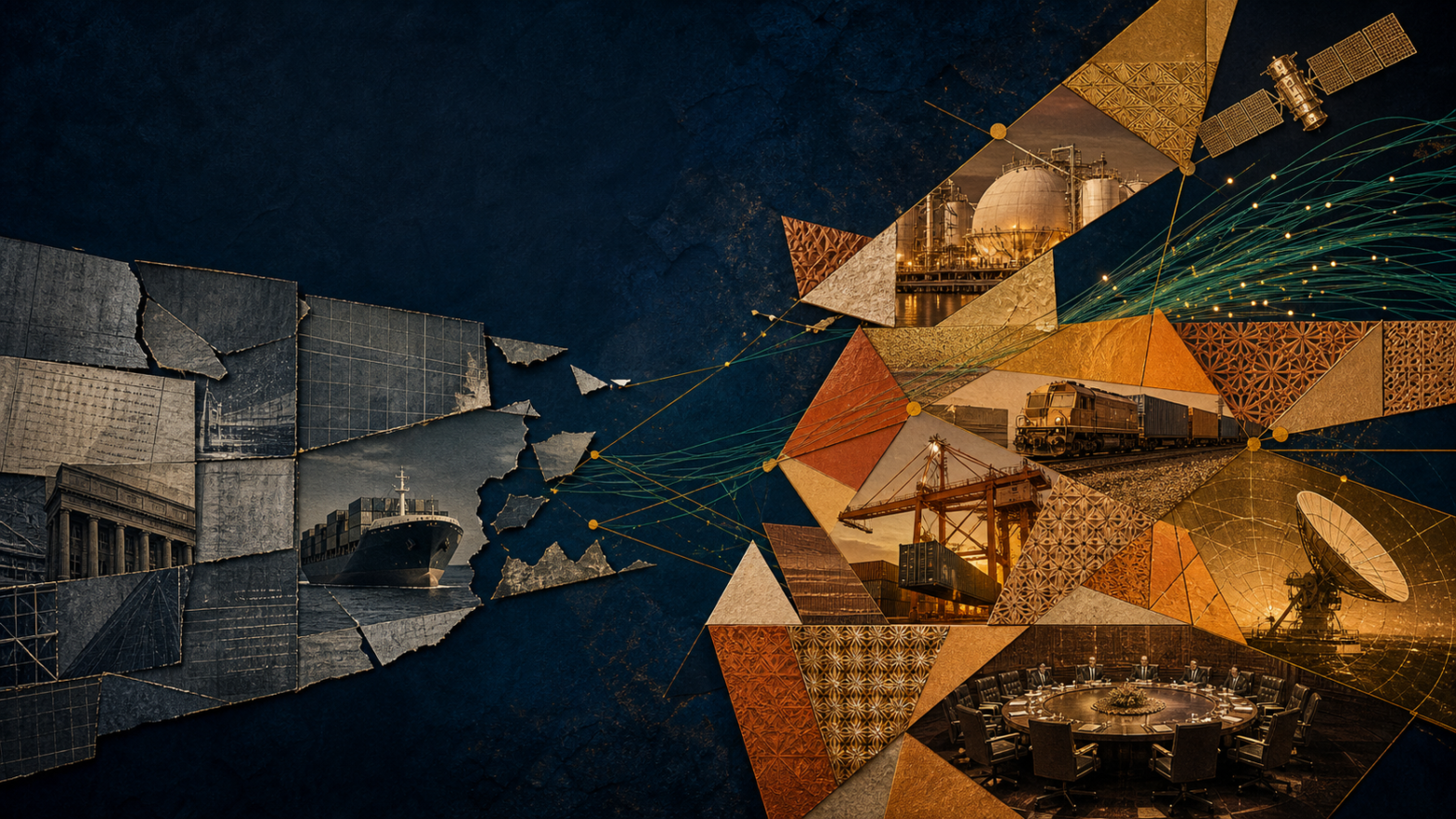
The Western Strategic Continuum builds on these traditions but argues that twenty-first-century geography is increasingly functional rather than territorial. Power no longer flows solely through land or sea; it flows through ports, logistics hubs, undersea cables, digital infrastructure, financial systems, technology ecosystems and resilient supply chains. Strategic geography is therefore increasingly determined by connectivity rather than proximity.
In this context, the paper introduces Functional Geography as an India-centric framework that organises strategic space by the interaction of economic, technological, maritime, energy and security functions rather than by conventional political boundaries. Regions become strategically contiguous not because they share borders but because developments in one produce direct consequences in another.
The Western Strategic Continuum: An India-Centric Theory of Twenty-First Century Strategic Geography
The central proposition of this paper is that India’s western strategic environment should no longer be understood as a collection of independent regions, but as an integrated strategic ecosystem in which developments across the Eastern Mediterranean, the Levant, the Gulf, Iran, the Strait of Hormuz, Afghanistan, Pakistan and Central Asia interact continuously. The Western Strategic Continuum (WSC) therefore represents a strategic systems framework rather than a geographical construct.
Unlike traditional geopolitical models that organise analysis around sovereign boundaries, the WSC defines strategic space through interconnected functions. Its analytical focus shifts from states to networks, from territory to systems, and from regional boundaries to strategic interdependence. It is not intended to replace existing concepts such as the Indo-Pacific or Eurasia, but to complement them by providing an India-centric framework for understanding developments to India’s west.
The defining characteristic of the Continuum is functional interdependence. Energy security depends on maritime stability. Maritime security enables connectivity. Connectivity facilitates trade and investment. Technology strengthens defence capabilities. Economic statecraft reinforces diplomacy. In turn, diplomacy creates the political confidence necessary for long-term economic and technological cooperation. These domains do not operate in isolation; they reinforce one another through continuous interaction.
This interconnectedness has become increasingly evident over the past decade. Attacks on commercial shipping in the Red Sea significantly increased freight costs for Indian exports to Europe. The escalation around the Strait of Hormuz immediately affected international energy markets. Instability in Afghanistan affected India’s continental connectivity via Chabahar. Israeli technological innovation strengthened India’s defence ecosystem, while sovereign wealth investments from the Gulf accelerated infrastructure and digital transformation in India. Each development occurred in a different geographical location, yet all had direct consequences for India’s national power.
The Western Strategic Continuum therefore argues that the strategic question facing Indian policymakers is no longer “Where is India’s western neighbourhood?” but rather “Which interconnected strategic systems directly shape India’s national power?”
The Original Theoretical Contributions of the Western Strategic Continuum
The principal contribution of the Western Strategic Continuum lies not merely in redefining a geographical space, but in introducing a coherent conceptual vocabulary for analysing twenty-first-century geopolitics. The framework advances seven interrelated concepts that together constitute an original theory of strategic geography.
- A. Functional Geography
Traditional geopolitics measures geography primarily by territorial proximity. Functional Geography holds that strategic relevance increasingly stems from the interaction of functions rather than physical distance. Ports, maritime corridors, digital infrastructure, financial centres, technological ecosystems, energy networks and logistics chains collectively organise strategic space. Under this framework, regions become strategically contiguous when developments in one generate measurable consequences in another.
Accordingly, the Eastern Mediterranean, the Gulf, Iran, Afghanistan and Central Asia constitute a single functional strategic space for India, as they collectively shape energy security, maritime trade, technological cooperation, continental connectivity and economic resilience.
- B. Strategic Gravity
Building on Functional Geography, the WSC introduces the concept of Strategic Gravity. Whereas classical geopolitics associated power with territory, population or military strength, Strategic Gravity explains why certain locations exert influence disproportionate to their physical size by concentrating multiple strategic functions. The Strait of Hormuz, Bab el-Mandeb, the Suez Canal, Jebel Ali, Chabahar and Haifa are not strategically important because of their geography alone. Their influence derives from the convergence of maritime commerce, logistics, energy flows, finance, technology and geopolitical competition.
Similarly, financial centres such as Abu Dhabi and Dubai, technology ecosystems in Israel, sovereign wealth funds across the Gulf, and semiconductor and artificial intelligence clusters are emerging centres of Strategic Gravity that increasingly shape global strategic behaviour. Strategic Gravity therefore extends the meaning of geopolitical power beyond military geography to encompass infrastructure, technology, finance and connectivity.
- C. Continuum Effects
Perhaps the most original theoretical innovation of the WSC is the concept of Continuum Effects. Traditional strategic analysis often treats crises as geographically contained events. The WSC argues, by contrast, that strategic disruptions propagate through interconnected systems, producing cascading consequences that transcend their point of origin.
A conflict in the Gulf may increase shipping insurance premiums, alter freight rates, reduce investor confidence, disrupt energy markets, affect Chabahar’s commercial viability, influence Afghanistan’s trade options, reshape India’s continental strategy and alter diplomatic calculations across Central Asia. The original event is maritime. Its consequences become economic, then technological, then diplomatic, and finally geopolitical. This process constitutes Continuum Effects. Understanding these cascading interactions enables policymakers to anticipate second- and third-order strategic consequences rather than merely responding to immediate crises.
- D. Strategic Interdependence
The twentieth century emphasised Strategic Depth – territorial buffers, spheres of influence and military space. The twenty-first century increasingly rewards Strategic Interdependence.
Strategic Interdependence refers to the deliberate creation of multiple political, technological, logistical and economic relationships that reduce dependence upon any single corridor, alliance or partner while enhancing national resilience. India’s simultaneous participation in IMEC, the International North–South Transport Corridor (INSTC) and Chabahar illustrates this principle. These initiatives should not be viewed as competing projects but as complementary components of a diversified connectivity strategy that enhances resilience and preserves strategic autonomy.
- E. Strategic Redundancy
Closely related is the concept of Strategic Redundancy. Rather than seeking a single optimal supply chain or transport corridor, states increasingly build multiple interoperable alternatives capable of absorbing geopolitical shocks. For India, this means that IMEC, INSTC, Chabahar, Duqm, Haifa and maritime partnerships across the Gulf should be understood collectively as elements of one integrated strategy rather than as isolated infrastructure projects. Redundancy becomes resilience. Resilience becomes strategic power.
- F. Adaptive Legitimacy
Contemporary diplomacy increasingly engages political authorities on the basis of strategic necessity rather than formal recognition. The WSC conceptualises this phenomenon as Adaptive Legitimacy.
India’s calibrated engagement with Afghanistan following the Taliban’s return to power illustrates this principle. Without extending formal diplomatic recognition, New Delhi reopened its technical mission and expanded practical engagement to safeguard humanitarian interests, connectivity and regional stability. The concept also offers a framework for analysing evolving regional engagement amid political transitions elsewhere, including in Syria. Adaptive Legitimacy does not replace international law; rather, it explains how states pragmatically manage relationships amid political uncertainty.
- G. Networked Strategic Balancing
The WSC further argues that the rigid alliance structures characteristic of the Cold War are increasingly being replaced by Networked Strategic Balancing. States maximise resilience by participating in multiple overlapping strategic networks simultaneously.
India exemplifies this approach through strategic partnerships with the United States, France, Israel, the UAE, Saudi Arabia and Japan, while maintaining dialogue with Russia, Iran and Central Asia through forums such as BRICS and the SCO. Rather than indicating inconsistency, this multidirectional diplomacy is a deliberate strategy to preserve strategic autonomy within an increasingly fragmented international system.
The Six Strategic Systems of the Western Strategic Continuum
The Western Strategic Continuum argues that twenty-first-century geopolitical competition is increasingly organised around six mutually reinforcing strategic systems rather than by geography alone. These comprise:
- The Security System – encompassing military deterrence, maritime security, intelligence cooperation, counter-terrorism, and emerging domains such as cyber and space.
- The Logistics System – including ports, multimodal transport corridors, aviation, shipping, strategic chokepoints, and resilient supply chains.
- The Economic System – trade, finance, sanctions, sovereign wealth funds, energy markets and investment.
- The Technology System – artificial intelligence, semiconductors, quantum technologies, cyber infrastructure, unmanned systems and digital public infrastructure.
- The Political System – diplomacy, governance, coalition building and adaptive legitimacy.
- The Societal System – diaspora networks, labour mobility, education, narratives and public diplomacy.
The strategic significance of these systems lies not merely in their individual importance but in their interaction. A disruption in one system rapidly propagates across the others, triggering cascading Continuum Effects. The Western Strategic Continuum therefore supplants the traditional image of separate geopolitical theatres with that of a dynamic strategic ecosystem, in which constituent systems continuously reinforce, reshape and influence one another.
India’s Grand Strategy within the Western Strategic Continuum
The Western Strategic Continuum is more than an analytical construct; it provides a framework for formulating India’s grand strategy in an era of strategic disruption. It seeks to integrate maritime security, continental connectivity, technology partnerships, economic statecraft and diplomacy into a coherent strategic architecture. Unlike traditional approaches that compartmentalise these domains, the WSC argues that they are mutually reinforcing instruments of national power.
As India aspires to become a Viksit Bharat by 2047 and to emerge as one of the world’s leading economic and technological powers, its western strategic theatre assumes unprecedented importance. Nearly 95 per cent of India’s merchandise trade by volume moves by sea, and around half of its crude oil imports originate in West Asia. The Gulf Cooperation Council (GCC) has become one of India’s largest trading partners. Nearly ten million Indians reside across the Gulf, forming one of the world’s largest overseas communities and reinforcing economic, technological and societal linkages.
Consequently, India’s western approaches can no longer be viewed simply as an external neighbourhood. They constitute a strategic extension of India’s own economic and security architecture.
Maritime Security: Protecting India’s Strategic Lifelines
The maritime domain underpins the Western Strategic Continuum. India’s prosperity depends on secure Sea Lines of Communication (SLOCs) stretching from the Arabian Sea through the Gulf of Aden, the Red Sea, the Suez Canal and the Eastern Mediterranean. These routes carry not only energy but also manufactured exports, critical minerals, food supplies, digital infrastructure and commercial shipping.
Within the WSC, maritime security is no longer confined to naval deterrence. It encompasses maritime domain awareness, cyber resilience, the protection of undersea communication cables and offshore energy infrastructure, resilient logistics networks, and cooperative maritime security arrangements. The attacks on commercial shipping in the Red Sea in 2024 demonstrated how a localised security challenge could generate global economic consequences, including higher insurance premiums, rerouting vessels around the Cape of Good Hope, and significantly higher freight costs. India’s SAGAR doctrine (Security and Growth for All in the Region) aligns naturally with the logic of the Western Strategic Continuum. It reflects an understanding that maritime security is a regional public good that underpins economic prosperity, connectivity and strategic stability.
Connectivity as Grand Strategy
One of the central propositions of the Western Strategic Continuum is that connectivity is no longer merely an economic activity; it has become an instrument of geopolitical influence. Infrastructure projects increasingly shape strategic alignments, supply-chain resilience and regional power balances. Accordingly, India’s objective should be to avoid exclusive reliance on any single corridor and to develop multiple, complementary and resilient connectivity networks.
Three initiatives illustrate this strategy:
- The International North–South Transport Corridor (INSTC) provides India with diversified access to Russia, Central Asia and Europe through Iran and the Caspian region.
- Chabahar Port remains indispensable for continental connectivity to Afghanistan and Central Asia while bypassing Pakistan.
- The India–Middle East–Europe Economic Corridor (IMEC) integrates maritime transport, rail infrastructure, digital connectivity and clean-energy networks linking India with the Gulf and Europe.
These initiatives should not be viewed as competing geopolitical projects. Through the lens of the Western Strategic Continuum, they represent complementary elements of a diversified connectivity architecture designed to enhance strategic resilience and preserve India’s strategic autonomy. This reflects the broader concept of Strategic Redundancy: creating multiple interoperable pathways to ensure continuity under conditions of geopolitical disruption.
Strategic Gravity and India’s Overseas Infrastructure Strategy
The concept of Strategic Gravity also underscores the growing importance of India’s overseas commercial investments. Historically, ports were viewed primarily as commercial assets. Within the Western Strategic Continuum, they are understood as strategic nodes that organise logistics, finance, technology and geopolitical influence. India’s expanding overseas infrastructure footprint illustrates this evolution.
The Adani–Gadot consortium’s acquisition of Haifa Port has given India its first significant commercial presence in the Eastern Mediterranean, complementing IMEC’s objectives and extending India’s maritime reach beyond the Suez Canal. Chabahar remains India’s continental gateway to Afghanistan and Central Asia, while participation in the Colombo West Container Terminal and cooperation with Duqm in Oman further strengthen India’s logistics network across the Indian Ocean. Taken together, these investments signal the emergence of an Indian overseas infrastructure strategy spanning the Mediterranean and the Arabian Sea. Rather than isolated commercial ventures, they constitute interconnected strategic assets that contribute to supply-chain resilience, diversified connectivity and geopolitical influence.
Economic Statecraft and the Indian Commercial Footprint
Perhaps the most underappreciated aspect of India’s rise is the remarkable expansion of Indian private enterprise across the Gulf. The United Arab Emirates has emerged as India’s principal commercial gateway to West Asia, Africa and Europe. More than 80,000 Indian-owned businesses operate in the UAE, supported by a diaspora of nearly four million Indians. These enterprises span logistics, healthcare, retail, construction, banking, advanced manufacturing, technology and financial services.
Major Indian companies—including the Tata Group, Adani Group, Larsen & Toubro, Infosys, TCS, Wipro, Lulu Group, Landmark Group and Aster DM Healthcare—have become integral to the Gulf’s economic transformation. Their activities generate employment, facilitate technology transfer, strengthen supply chains and reinforce India’s long-term strategic presence. The WSC therefore broadens the concept of economic statecraft. National influence is no longer exercised solely by governments but increasingly through private enterprise, sovereign wealth partnerships, innovation ecosystems and transnational business networks.
Technology and Atmanirbhar Bharat
Technology is the principal strategic multiplier within the Western Strategic Continuum. Artificial intelligence, cyber resilience, autonomous systems, quantum technologies, semiconductors and digital infrastructure increasingly determine both military capability and economic competitiveness.
Israel occupies a central position in this technological ecosystem. Defence cooperation has evolved from procurement to joint research, co-development and technology transfer across missile systems, electronic warfare, cyber security, unmanned systems and artificial intelligence. Simultaneously, the UAE, Saudi Arabia and Qatar are investing heavily in advanced manufacturing, AI, digital infrastructure and knowledge-based industries, creating opportunities for deeper collaboration with India’s expanding technology ecosystem.
These developments directly support the objectives of Atmanirbhar Bharat, which aims to enhance indigenous capabilities through innovation, domestic manufacturing, technology transfer and research collaboration. Within the WSC, technology is not a standalone sector but the connective tissue linking maritime security, logistics, defence industrialisation and economic growth.
Afghanistan: The Continental Pivot
No country illustrates the logic of the Western Strategic Continuum more clearly than Afghanistan. Traditionally seen primarily as a security challenge, Afghanistan should instead be understood as the continental pivot linking India’s maritime and Eurasian strategies. Its significance stems not merely from geography but from its role in wider networks of connectivity, logistics and regional trade.
India’s long-standing development engagement, spanning the Afghan Parliament, the Salma Dam, highways, healthcare, and education, has generated enduring goodwill among the Afghan people. Following the Taliban’s return to power in August 2021, New Delhi adopted a calibrated approach, reopening its technical mission while maintaining its security concerns. This pragmatic engagement reflects the WSC concept of Adaptive Legitimacy, in which strategic engagement is shaped by functional necessity rather than formal diplomatic recognition alone.
For India, Afghanistan is not merely a frontier state; it is the bridge linking the Arabian Sea’s maritime systems to the continental networks of Central Asia. Its future stability is therefore inseparable from India’s broader connectivity strategy via Chabahar and the INSTC.
Strategic Autonomy through Networked Partnerships
The Western Strategic Continuum ultimately reinforces India’s long-standing doctrine of strategic autonomy. Rather than choosing between competing geopolitical blocs, India has cultivated productive partnerships with Israel, Saudi Arabia, the UAE, Qatar, Oman, Egypt, Iran and Afghanistan, while deepening engagement with the United States, Europe, BRICS and the Shanghai Cooperation Organisation.
This multidirectional engagement exemplifies the WSC’s concept of Networked Strategic Balancing. In an increasingly fragmented international system, resilience stems from diversified partnerships rather than exclusive alliances. The objective is not neutrality but the maximisation of strategic options. This approach uniquely positions India among major powers. It enables New Delhi to act as a bridge between regions, institutions and competing strategic networks while preserving its freedom of action.
Theoretical Significance, Policy Implications and the Future of India’s Grand Strategy
The Western Strategic Continuum is proposed not merely as another regional framework but as an original contribution to the evolution of strategic thought. Just as Sir Halford Mackinder’s Heartland Theory explained the geopolitical dynamics of the industrial age, Alfred Thayer Mahan illuminated the importance of maritime power, Nicholas Spykman redefined the significance of the Eurasian Rimland, and the Indo-Pacific concept reflected the maritime integration of the Indian and Pacific Oceans, the Western Strategic Continuum seeks to explain the changing character of strategic geography in an era defined by interconnected systems rather than isolated territories.
Its principal innovation lies in recognising that twenty-first-century geopolitics is no longer organised primarily around contiguous regions or military alliances. Instead, it is structured by the interaction of strategic systems spanning logistics, technology, finance, maritime security, political legitimacy, economic statecraft and societal networks. Strategic influence increasingly derives from the ability to organise, protect and shape these systems rather than from territorial control alone. The Western Strategic Continuum therefore marks a transition from classical geopolitics to systems geopolitics.
From Strategic Geography to Strategic Systems
For much of the twentieth century, geography was treated as a relatively static determinant of power. Mountains, rivers, coastlines, and territorial buffers shaped military planning and alliance structures. Strategic advantage depended on controlling physical space. The twenty-first century presents a markedly different reality.
Today, geography acquires strategic significance through the density of networks that traverse it. A narrow maritime chokepoint such as the Strait of Hormuz influences global energy markets by concentrating maritime trade and energy flows. A port such as Haifa acquires geopolitical importance by connecting the Mediterranean to emerging connectivity initiatives such as IMEC. Chabahar derives strategic value by linking India’s maritime strategy with its continental access to Afghanistan and Central Asia. Likewise, digital infrastructure, undersea communication cables, financial centres and artificial intelligence ecosystems increasingly exercise geopolitical influence comparable to traditional military assets. Accordingly, the Western Strategic Continuum advances a broader understanding of strategic geography in which connectivity has become as important as proximity.
Policy Implications for India
The Western Strategic Continuum offers a practical framework for India’s long-term strategic planning. Several policy implications follow. First, India should adopt the Western Strategic Continuum as an integrated analytical framework for national security planning. Institutional structures often continue to examine West Asia, the Gulf, Afghanistan and Central Asia separately. While administrative specialisation remains necessary, strategic planning should increasingly recognise the functional interdependence among these regions. Energy security, maritime strategy, technological cooperation, connectivity and diplomacy should therefore be analysed collectively rather than through isolated bureaucratic lenses.
Second, India should continue to build strategic redundancy across connectivity corridors. The International North–South Transport Corridor (INSTC), the India–Middle East–Europe Economic Corridor (IMEC), Chabahar Port and India’s expanding maritime partnerships should be seen as complementary rather than competing initiatives. Diversified connectivity reduces vulnerability to sanctions, conflict, maritime disruption and geopolitical coercion. This approach reflects the principle of Strategic Redundancy developed within the WSC.
Third, India should strengthen its overseas infrastructure strategy. Strategic investments in ports, logistics hubs and industrial corridors should become a permanent component of India’s foreign policy. The acquisition of Haifa Port, participation in the Colombo West Container Terminal, the development of Chabahar and expanded cooperation with Duqm illustrate the emergence of such a strategy. Collectively, these assets extend India’s strategic reach from the Mediterranean to the Indian Ocean and enhance supply-chain resilience.
Fourth, technology partnerships should become a central pillar of national strategy. Within the Western Strategic Continuum, technology is not merely an economic sector but a strategic enabler. India’s collaboration with Israel in defence innovation, artificial intelligence, cyber security and unmanned systems, together with expanding partnerships with the UAE and Saudi Arabia in advanced manufacturing and digital infrastructure, complements the objectives of Atmanirbhar Bharat and strengthens India’s long-term strategic competitiveness.
Fifth, economic statecraft should become an integral component of grand strategy. The activities of Indian businesses across the Gulf, sovereign wealth partnerships, infrastructure investments and digital cooperation increasingly reinforce India’s geopolitical influence. The more than 80,000 Indian-owned businesses operating in the UAE, together with the broader Indian commercial presence across the Gulf, constitute strategic assets that complement formal diplomacy and enhance India’s economic resilience.
Finally, India should preserve strategic autonomy through diversified partnerships. The Western Strategic Continuum reinforces India’s long-standing commitment to multi-alignment. Rather than viewing the international system through rigid alliance blocs, India should continue to pursue what this paper describes as Networked Strategic Balancing, deepening partnerships with the United States, Europe, Israel and the Gulf while maintaining constructive engagement with Iran, Russia, Central Asia and the wider Global South. This approach maximises strategic flexibility and reduces vulnerability to geopolitical fragmentation.
Conclusion: Towards an India-Centric Theory of Strategic Geography
The transition currently reshaping international politics is more profound than a redistribution of power among states. It is a transformation of the architecture through which power is generated and exercised. Military capability remains indispensable, but it is increasingly complemented, and in many cases conditioned, by resilience across logistics, technology, energy, finance, maritime connectivity, digital infrastructure and economic statecraft. The defining feature of the contemporary strategic environment is therefore not simply the interdependence of regions but the interdependence of strategic systems.
The Western Strategic Continuum offers an India-centric conceptual framework for understanding this transformation. By integrating the Eastern Mediterranean, the Gulf, Iran, the Strait of Hormuz, Afghanistan, Pakistan and Central Asia into a single strategic ecosystem, it provides a more comprehensive explanation of how developments across these regions collectively shape India’s national security, economic resilience and geopolitical influence.
Its theoretical contribution extends beyond defining a new strategic theatre. Through the concepts of Functional Geography, Strategic Gravity, Continuum Effects, Strategic Interdependence, Strategic Redundancy, Adaptive Legitimacy and Networked Strategic Balancing, the framework provides an integrated conceptual vocabulary for analysing twenty-first-century geopolitics. Together, these concepts explain why disruptions propagate across regions, why infrastructure has become an instrument of power, why connectivity increasingly determines strategic advantage, and why resilience now depends on participation in multiple overlapping networks rather than on exclusive alliances.
For India, the implications are profound. The country’s western approaches are no longer peripheral to its strategic outlook; they are central to its emergence as a leading global power. Secure maritime routes, resilient connectivity, advanced technology partnerships, overseas infrastructure investments, trusted commercial networks and diversified diplomatic relationships together form the foundations of India’s future grand strategy.
Looking ahead, the Western Strategic Continuum also presents a broader intellectual proposition. If the twentieth century was defined by the geopolitics of territory and the early twenty-first century by the geopolitics of oceans, embodied in the Indo-Pacific, the coming decades are likely to be characterised by the geopolitics of interconnected strategic systems. In that evolving landscape, the decisive question for states will no longer be who controls the greatest territory, but who most effectively shapes the networks through which energy, technology, capital, information, logistics and influence flow.
The Western Strategic Continuum seeks to provide India with the conceptual framework for understanding and ultimately shaping that emerging strategic order.
Author Brief Bio: Sumeer Bhasin is Founder & CEO of Anaar Global, an accomplished investment banker, adventurous entrepreneur, and geopolitical analyst with over 35 years of experience across investment banking, strategic advisory and venture-building in complex and emerging markets. His career spans India, Afghanistan, Central Asia, and the Middle East, where he has built businesses and advised stakeholders navigating political and economic uncertainty. A leading Afghanistan specialist, he has played an active role in regional dialogue, Track 1.5 diplomacy and strategic engagement across policy and business platforms. Through think-tank collaborations, international policy forums, podcasts, panel discussions and regular articles on geopolitical developments from an Indian strategic perspective, he offers actionable insights on governance, diplomacy and economic integration.