
Introduction
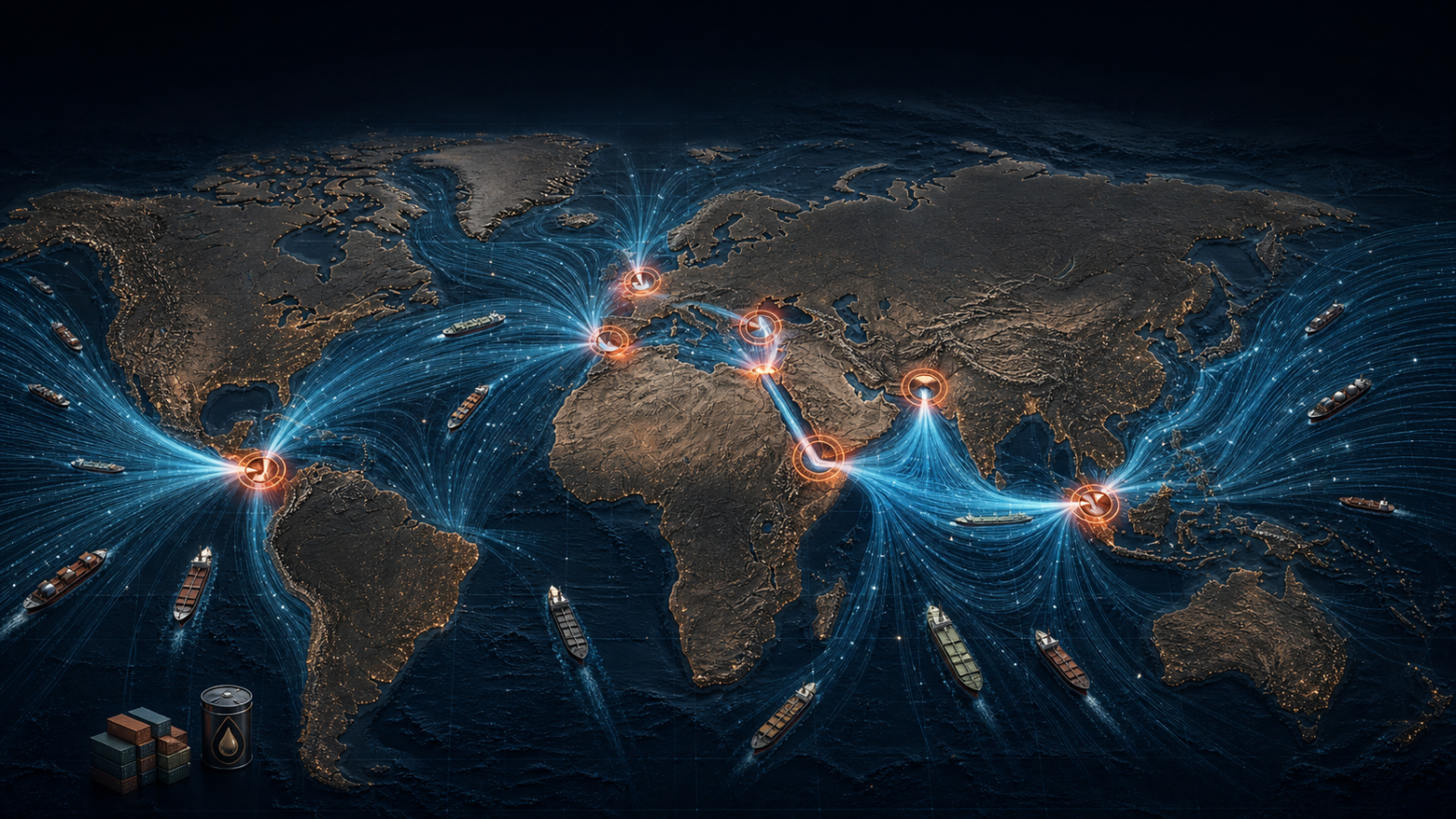
More than 80 per cent of world trade by volume moves by sea, and almost all of it is forced, at some point, through a small number of narrow passages that geography has turned into strategic bottlenecks. These maritime “chokepoints” — straits, canals, and channels sometimes only a few kilometres wide — carry oil tankers, container ships, and bulk carriers past coastlines controlled by a handful of states, non-state militias, or under contested territorial claims. Unlike most infrastructure vulnerabilities, chokepoints cannot easily be hardened, rerouted cheaply, or replaced; a port can be rebuilt in a few years, but a strait cannot be moved. That immovability is what makes them potent instruments of coercion, and why control over them — formal or informal — has been a preoccupation of naval powers since the age of sail.
When a chokepoint closes or even slows, the effects ripple out within days: freight rates spike, insurance premiums soar, fuel prices shift, and supply chains thousands of miles away seize up. A tanker delayed by three weeks does not just cost its owner money; it can leave a refinery short of crude, a power plant short of gas, or a retailer short of inventory during a critical selling season. Because so much of modern trade runs on just-in-time logistics with minimal buffer stock, even a temporary chokepoint disruption can cascade through an economy far faster than the physical distance involved would suggest.
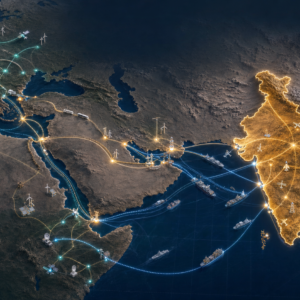
2026 has been a brutal demonstration of this fragility, compressing decades’ worth of chokepoint risk into a single year. The Strait of Hormuz has been effectively shut for months by war between the United States, Israel, and Iran — the most severe disruption to Gulf oil shipping since the tanker wars of the 1980s. The Red Sea and Suez Canal corridor, still recovering from the Houthi campaign that began in late 2023, has been rattled by a fresh blockade of Saudi ports. And in the eastern Indian Ocean, India has been quietly building military and commercial muscle around the Andaman and Nicobar Islands, precisely because it understands what happens when a rising power loses the ability to watch, and if necessary, contest, a chokepoint like the Strait of Malacca. Layered on top of all this is India’s push for the India-Middle East-Europe Economic Corridor (IMEC), an ambitious attempt to build an entirely new trade route that sidesteps both the most exposed sea lanes and a Chinese network of ports many in New Delhi see as a slow-motion encirclement.
This essay examines four of the world’s most consequential maritime chokepoints — Hormuz, Suez, Malacca, and the Andaman and Nicobar Islands overlooking it — alongside IMEC, the corridor designed to reduce India’s exposure to both chokepoint closures and Chinese strategic pressure. Together, they illustrate a single, uncomfortable truth about the modern global economy: its arteries run through a handful of narrow spaces that no single power fully controls.
Why Chokepoints Matter: A Brief Anatomy of Vulnerability
Before turning to the specific cases, it is worth understanding why chokepoints carry such outsized strategic weight relative to their physical size. Three features set them apart from ordinary trade routes. First, they concentrate risk that would otherwise be diffuse: the open ocean offers ships an almost infinite number of paths, whereas a strait offers one, or at most a few. An actor who can credibly threaten it — through mines, missiles, small boats, or simply the assertion of sovereign control — affects a volume of trade wildly disproportionate to their military or economic size. The Houthi movement in Yemen, a lightly resourced non-state actor fighting a civil war, has redirected a meaningful share of world container shipping using little more than drones, small missiles, and speedboats, purely because of its location.
Second, energy chokepoints carry unique macroeconomic power: oil and gas are priced globally and consumed almost everywhere, so a supply shock at Hormuz does not stay local — it shows up in fuel prices in Tokyo, Rotterdam, and Los Angeles within days. Third, the alternatives are almost always inferior, not merely different. Rerouting around the Cape of Good Hope instead of Suez adds roughly two weeks and hundreds of thousands of dollars in fuel costs; rerouting around Malacca adds distance and is poorly suited to the largest vessels. This asymmetry is precisely what gives states and armed groups near a chokepoint their leverage: they need not block trade outright, only make the alternative expensive enough to hurt.
The Strait of Hormuz: The World’s Oil Tap
The Strait of Hormuz, a waterway barely 33 kilometres wide at its narrowest point between Iran and Oman, is the single most important chokepoint in the global energy system. In 2025, roughly a quarter of the world’s seaborne crude and petroleum products, and close to a fifth of global liquefied natural gas, passed through it, feeding refineries and power grids across Asia, Europe, and beyond. No other chokepoint carries a comparable share of a commodity as globally essential as oil, which is why Hormuz has functioned for decades as shorthand in energy markets for worst-case geopolitical risk.
That importance has made Hormuz the epicentre of the most serious chokepoint crisis in decades. Since late February 2026, when a US-Israeli air campaign against Iran escalated into open war — including the assassination of Iran’s supreme leader — Iran has treated the strait as a weapon of retaliation. The Islamic Revolutionary Guard Corps issued blanket warnings that no ship was permitted to pass, laid sea mines, and boarded and attacked merchant vessels it deemed non-compliant. The toll has been severe: a tugboat sunk, more than a dozen merchant ships damaged or abandoned, two vessels captured, more than a dozen seafarers killed or missing, and port workers killed in strikes on Bahrain. The United States, in turn, imposed a naval blockade on Iran, launched an aerial campaign against Iranian missile sites and mine-laying vessels, and organised escort operations to help commercial ships navigate the strait safely.
What makes the Hormuz crisis particularly instructive is its resistance to diplomatic resolution. A ceasefire and memorandum of understanding reached in spring 2026 briefly promised to reopen the strait, but conflict resumed by midsummer as Iranian forces attacked shipping deemed non-compliant. By August, Iran’s Supreme National Security Council had set out sweeping conditions for reopening the waterway: an end to the US naval blockade and sanctions, withdrawal of American forces, war reparations, and a halt to US strikes on Iran’s regional allies. Gulf states have responded by forming new defence arrangements among themselves, including a “Mecca Joint Defence Pact,” reflecting recognition that no single country’s navy can now guarantee safe passage.
The economic outcome has been exactly what energy officials feared: fuel shortages in parts of Asia, sharply higher shipping and insurance costs, and — as the head of the International Energy Agency warned in mid-2026 — a broader threat to global energy security that will persist as long as the Strait remains a war zone rather than a normal commercial waterway. Hormuz is, in short, a reminder that even the most heavily patrolled chokepoint in the world can be closed by a determined regional power willing to accept enormous economic self-harm to do so.
The Suez Canal and the Red Sea: Commerce Under Fire
If Hormuz is the world’s oil tap, the Suez Canal is its trade artery — the shortest sea link between Asia and Europe, saving ships a multi-week detour around the Cape of Good Hope and carrying around 12 per cent of global trade in a normal year. The canal’s vulnerability lies not in the 193-kilometre ditch itself, which is well defended and entirely under Egyptian control, but in its approaches: the Red Sea and the Bab el-Mandeb Strait, a passage between Yemen and the Horn of Africa, within range of missiles and drones launched from Yemeni territory.
The Houthi campaign, which began in November 2023 and was ostensibly in solidarity with Gaza, showed how a lightly armed non-state actor could impose costs on global trade far beyond its size. It began with the seizure of the cargo ship Galaxy Leader and rapidly escalated into a sustained campaign against commercial shipping linked, in the Houthis’ judgment, to Israel, the United States, or their allies. More than a hundred merchant vessels have been targeted, several ships have been sunk or seized, and at least a dozen seafarers have been killed. The disruption to trade was immediate and severe: container traffic through Suez collapsed from roughly 80 ships a week before the crisis to as few as 26 by early 2026, as major carriers — Maersk prominent among them — rerouted their Asia-Europe services around the Cape of Good Hope, incurring hundreds of millions of dollars in losses along the way.
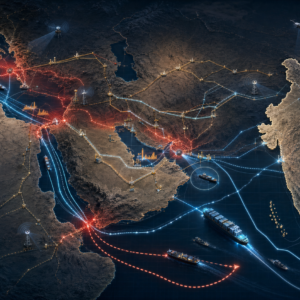
Traffic began to recover in early 2026 as attacks paused for roughly three months, and new infrastructure — including a semi-automated container terminal at Egypt’s Sokhna Port — was built in anticipation of a full reopening. But the respite proved temporary. In July 2026, the Houthis announced a blockade on vessels calling at Saudi Arabian ports, warning that any vessel calling at ports within their operational reach could be sanctioned or targeted. Weekly transits through the Bab el-Mandeb, which had climbed to their highest levels since December 2023 as confidence returned, fell sharply again — mainstream tanker traffic dropped by more than 40 per cent within a week. Saudi Arabia responded by increasing exports through its Red Sea port of Yanbu by roughly fivefold, and by using the Sumed pipeline to move crude overland around the most exposed stretch of water, since a fully laden supertanker cannot transit Suez without first offloading part of its cargo.
The lesson of the Red Sea crisis is that a chokepoint’s security depends not only on the chokepoint itself but also on the political stability of every coastline within missile range— and that instability can be imported from a conflict, such as Gaza or the wider Iran standoff, that has nothing directly to do with shipping. It also illustrates the interconnection between the chokepoints examined here: the same Iran-aligned Houthi movement waging war on Red Sea shipping is itself a proxy actor in the broader confrontation at Hormuz, so the two crises have at times moved in tandem, with each escalation in one theatre raising the risk of escalation in the other.
The Strait of Malacca: Asia’s Indispensable Corridor
Between Sumatra and the Malay Peninsula, the Strait of Malacca funnels an estimated 25–30 per cent of global trade and nearly half of the world’s seaborne oil through a stretch of water so narrow — under 3 kilometres at its tightest point, the Phillips Channel — that it is one of the most severe bottlenecks in international shipping. More than 90,000 vessels transit it each year, making it, by traffic volume, arguably the busiest chokepoint on earth. It carries oil from the Persian Gulf towards China, Japan, and South Korea, and manufactured goods the other way towards Europe and North America.
Malacca’s risks differ in character from those of Hormuz or Suez. There is no single hostile state currently threatening closure; instead, the danger is a composite of piracy, the sheer density and narrowness of traffic (raising collision and grounding risks to levels unmatched almost anywhere else), and its status as a long-term geopolitical pressure point. Chinese strategists have, for two decades, spoken openly of the “Malacca Dilemma,” a phrase associated with former President Hu Jintao: the recognition that China’s energy and trade lifelines pass through a strait China does not control and that could, in a crisis, be interdicted by a rival navy — chiefly the United States, but increasingly India as well. Roughly 80 per cent of China’s crude oil imports are estimated to transit Malacca, a dependency Beijing has spent billions trying to hedge against, including through the string of ports discussed below.
That dilemma is precisely why the strait’s approaches have become an arena of quiet yet intensifying strategic competition. Malaysia controls the western flank, Indonesia the eastern and southern approaches, and Singapore sits at the confluence with the South China Sea. None wants Malacca closed, since all depend on its traffic, but each is a small or medium power navigating between larger patrons. Against this backdrop, India’s posture in the Andaman and Nicobar Islands, which sit almost directly athwart the strait’s northern and western entrances, takes on outsized significance.
Andaman and Nicobar: India’s Watchtower on the Malacca Approaches
The Andaman and Nicobar Islands sit astride the western entrance to the Strait of Malacca, and India has spent the past two decades transforming this archipelago from a remote, lightly garrisoned outpost into its principal maritime power-projection base in the east. The islands host India’s only tri-service command, uniting army, navy, and air force assets. New Delhi has been sharply accelerating investment there: a dual-use civilian-military airport on Great Nicobar under Indian Navy control, capable of hosting large transport and surveillance aircraft; reinforced runways and fuel storage on Car Nicobar; and, most significant commercially, the Great Nicobar Project — a deep-water international transhipment port at Galathea Bay designed to intercept containerised cargo moving between West Asia, South Asia, and East Asia, while giving India persistent surveillance over shipping entering and leaving Malacca.
The strategic logic is clear in Indian policy circles: Great Nicobar lies only about 230 kilometres from the strait’s northern entrance, near the maritime boundary with Myanmar and Indonesia, giving India the ability to monitor — and, in a crisis, potentially contest — one of the world’s most important shipping lanes. The islands also give India oversight of the Six Degree and Ten-Degree Channels, which ships must use to approach Malacca from the west.
This has been reinforced diplomatically as well as militarily. In mid-2026, India and Indonesia — which controls the strait’s southern gateway — signed a new maritime safety and security framework during Prime Minister Modi’s visit and agreed to jointly develop Indonesia’s port of Sabang, which sits at the strait’s western mouth. Analysts describe the resulting configuration as a maritime arc bracketing Malacca’s western entrance from both sides. The stated aims are twofold: to give India leverage over a chokepoint that China depends on for the great majority of its energy imports, and to reduce India’s reliance on any single chokepoint — including Hormuz, from which India sources a substantial share of its crude.
IMEC: Building a Way Around the Chokepoints
If the Andaman and Nicobar buildup is India’s answer to defending a chokepoint it does not own, the India-Middle East-Europe Economic Corridor is its answer to reducing dependence on chokepoints altogether — and to countering a much older, more diffuse Chinese strategy aimed squarely at India’s maritime periphery. For nearly two decades, Indian strategists have warned of a Chinese “String of Pearls”: a network of commercial ports and dual-use facilities — Gwadar in Pakistan, Hambantota in Sri Lanka, Kyaukpyu in Myanmar, Chittagong in Bangladesh, and a base in Djibouti — those arcs from the South China Sea to the Horn of Africa and encircles India’s coastline on almost every side. Individually commercial and mostly Belt and Road-financed, these facilities collectively give China’s navy potential access points around India’s maritime backyard.
Gwadar is often singled out as the most consequential “pearl,” offering China a deep-water port on the Arabian Sea that bypasses Malacca entirely, thereby undercutting one of the few points of leverage India might otherwise hold over China’s energy supply lines. India’s naval response has been dubbed the “Necklace of Diamonds” strategy — an expanded network of bases, partnerships, and surveillance posts intended to counter-encircle China’s access to the Indian Ocean, with the Andaman and Nicobar buildup forming the eastern anchor.
IMEC, announced at the 2023 G20 summit in New Delhi and involving India, Saudi Arabia, the UAE, the EU, and the US as core signatories, adds an economic dimension to that counter-strategy. The plan links India to Europe via two legs: an eastern maritime corridor connecting Indian ports to Gulf ports, and a northern corridor of rail, energy, and data links running overland through Saudi Arabia, Jordan, and Israel to Mediterranean ports and beyond into Europe. Because the northern leg moves cargo by rail, it would allow India-Europe trade to bypass Suez, the Red Sea, and Bab el-Mandeb entirely — precisely the corridor repeatedly closed by Houthi attacks. Proponents have also cast IMEC as the Western-backed answer to China’s Belt and Road Initiative: an alternative connectivity architecture that does not run through Chinese-financed ports.
For India specifically, IMEC serves a second, less publicised function: it provides a direct land-and-sea bridge to the Middle East and Europe that does not depend on chokepoints China can influence through its Pakistani and Sri Lankan footholds. Roughly half of India’s total exports, and nearly four-fifths of its exports to Europe, currently move via the Red Sea route — a dependency the Houthi crisis has made painfully visible and that IMEC is designed to reduce. Combined with the Andaman and Nicobar posture watching Malacca from the east, IMEC gives India a second axis of connectivity to the west. Commerce Minister Piyush Goyal has described IMEC as positioning India as “a trusted bridge of global connectivity,” with projected reductions in logistics costs of up to 30 per cent and transit times of up to 40 per cent.
The reality, however, has lagged well behind the ambition. As of mid-2026, IMEC remains largely in the planning and early-construction phase, three years after its announcement. Working groups have been formed among signatories; India and the UAE have signed an intergovernmental framework agreement covering a shared logistics platform; Saudi Arabia has pledged roughly $20 billion; and some component projects — rail lines, port upgrades — have broken ground independently of any unified financing mechanism. Yet there is still no dedicated funding structure, no binding US legislation, and no firm construction timeline for the corridor as a whole. Critically, its central land route runs through Saudi Arabia, Jordan, and Israel, meaning its viability hinges on a degree of Saudi-Israeli normalisation that the Gaza war has significantly complicated. The 2026 Hormuz war has, if anything, strengthened the strategic case for IMEC — but strategic logic alone has not yet translated into a fully financed, fully built alternative route. IMEC today is best understood less as an operating corridor than as a live option kept open in case Hormuz, Suez, or Malacca fail all at once.
The Common Thread: Concentration Risk in a Networked World
Taken together, these cases illustrate a single structural problem: global trade’s dependence on maritime chokepoints has not been “designed away” by decades of globalisation — if anything, it has deepened, since just-in-time supply chains and containerised shipping reward the shortest, most efficient routes, which usually means the narrowest ones. A handful of states or armed groups sitting on a few kilometres of coastline can impose costs measured in the tens of billions of dollars on the rest of the world.
Several patterns recur across Hormuz, Suez, and Malacca, helping explain why chokepoint crises have become more frequent and consequential rather than less over the past three years:
- Escalation elsewhere spills into shipping lanes. None of the current crises began as a shipping dispute. Hormuz was closed in retaliation for a war over Iran’s nuclear programme; the Red Sea was attacked in solidarity with Gaza; Malacca’s tensions stem from the much larger rivalry between China, India, and the United States. Chokepoints serve as pressure-release valves for conflicts fought primarily on land or in the air.
- Diversion is possible, but never free. Ships can reroute around the Cape of Good Hope, offload cargo at Sumed, or use the Sunda and Lombok Straits — but each alternative adds transit time, fuel costs, and steep war-risk insurance premiums, which are ultimately passed on to consumers.
- Control is as much about presence as about ownership. No state legally “owns” Hormuz, Malacca, or the approaches to the Red Sea. Yet naval presence and credible interdiction confer practical control that legal ownership never could — exactly what India is building in the Andamans and what China has built through the String of Pearls.
- Costs fall disproportionately on distant, uninvolved economies. Fuel shortages from the Hormuz closure have hit Asian consumers with no stake in the conflict; Red Sea disruptions have squeezed European manufacturers; a Malacca disruption would hit China, Japan, and South Korea hardest, none of which control the strait. This asymmetry is precisely what gives initiatives such as IMEC their political appeal.
Conclusion
The security of global commerce rests on a surprisingly small set of narrow waterways, and 2026 has made clear, with unusual force, how easily that security can fracture. Hormuz shows what happens when a chokepoint becomes an active theatre of war and how difficult such a crisis is to resolve once both sides have committed to it. Suez and the Red Sea show how a determined non-state actor, equipped with comparatively cheap missiles and drones, can keep a share of global trade at risk for years, with periods of recovery and relapse tied to a conflict hundreds of miles away. The buildup around the Andaman and Nicobar Islands shows how rising powers now treat chokepoint access as a long-term strategic asset, secured deliberately in peacetime rather than improvised in a crisis. And IMEC shows the emerging, if still unproven, alternative: building new overland and maritime routes that let trade sidesteps the most exposed straits entirely, even as its own slow progress shows how hard such alternatives are to finance compared with how easy they are to announce.
None of these responses offers a complete solution. A more heavily defended Hormuz does not stop Iran from mining it; an Indian naval presence around Malacca constrains but does not eliminate the “Malacca Dilemma” for China; and IMEC, even if fully built, would carry only a fraction of the volume currently moving through Suez. What all four responses share is a recognition that redundancy, not invulnerability, is the only realistic goal. As rivalries between major powers intensify and regional conflicts continue to spill into shipping lanes never designed to absorb them, the resilience of world trade will depend less on making any single chokepoint permanently safe and more on how much redundancy — alternative routes, forward-deployed naval partnerships, and diversified trade corridors — states and shipping companies can build before the next chokepoint closes, and the one after that.
Author Brief Bio: Vibhuti Jha is an International Banker & Geopolitical Strategist.