

Abstract
The Indo-Mediterranean region has become a strategic space that connects the Indian Ocean and the Mediterranean, gaining increasing significance in the geopolitical, economic, and energy sectors and for the resilience of global supply chains. However, the region’s economic and connectivity potential and growth continue to be threatened by an increasing number of proxy wars, state-sponsored armed groups and terrorist organisations. Proxy actors have been used as tools of foreign policy and to advance strategic aims, particularly by regional powers that may not wish to risk direct military action. These have created low-intensity conflicts involving numerous countries and kept the Eastern Mediterranean and West Asia unstable.
The article analyses the impact of proxy networks built through terrorist groups and armed militias on state institutions, maritime security, critical infrastructure, and sea lines of communication (SLOCs), such as the Suez Canal, Bab el-Mandeb Strait, and the Eastern Mediterranean maritime domain. Insurance rates have risen, global trade and supply lines have been disrupted, and foreign investors in the energy industry are uncertain about the security of their investments due to attacks on commercial shipping, ports, pipelines, and energy infrastructure. The resulting instability has diminished tourism, foreign investment, regional trade, and energy markets, and has lowered the economic potential of the Indo-Mediterranean corridor. The paper states that proxy war is now a structural issue, which poses a threat to regional order, backed by the ideology of extremism, hybrid warfare, cyber warfare and transnational financing of terrorism, and great power rivalry. This makes diplomatic conflict resolution more difficult and undermines efforts to establish cooperative regional security arrangements that could sustain economic integration. Based on recent incidents involving state-sponsored proxy groups in the Levant, the Red Sea, and the Eastern Mediterranean, the research recommends a comprehensive security policy that includes strengthening maritime cooperation, information sharing, counterterrorism cooperation, financial sanctions against state-sponsored proxy groups, and multilateral diplomacy. It views connectivity and infrastructure as key elements of sustainable prosperity in the Indo-Mediterranean, and emphasises the importance of ending the chain of proxy wars that drives instability and hinders long-term development.
Keywords: Indo-Mediterranean; Proxy Warfare; Regional Security; India-Middle East-Europe Economic Corridor (IMEC); Global Trade.
Introduction: A New Strategic Continuum
The Indian Ocean and the Mediterranean were long treated as separate theatres for most of the 20th century, linked only by the narrow waterway of the Suez Canal. This division is crumbling. The region is now envisioned as a single strategic corridor, the Indo-Mediterranean, which connects the Indian Ocean and Europe via the Gulf, the Red Sea and the Levant. Policymakers in New Delhi, Rome, Athens, Abu Dhabi and Brussels endorse its development. Italy and India have both described the India-Middle East-Europe Economic Corridor as the fulcrum of this new space. The Indian Ocean and the Mediterranean had long been a single region of exchange, transporting spices, cloth, ideas and religiosity from South Asia to Arabia, the Levant and southern Europe for centuries before the modern era. The novelty of this moment is that governments, not merchants, now seek to institutionalise that continuity through treaties, corridors and defence agreements. It was an organic way of doing business; now it’s a state-sponsored effort in statecraft. Security becomes a high-level policy issue rather than a matter of private risk.
The idea isn’t just a talking point. The economic rationale for the Indo-Mediterranean is the free flow of goods, energy, and data along these trading corridors, covering around 12 per cent of the world’s trade that normally uses the Suez Canal and 15 per cent that goes through the Red Sea. This is exactly what is happening in proxy warfare. What makes the region valuable also makes it fragile: a small share of traffic is concentrated through a few narrow gateways, and a few armed groups can make using them more expensive. This article argues the following three points: First, proxy war in the region is not a transient phenomenon but a fundamental aspect of the region’s security. Second, the economic injury is quantifiable and substantial, and it affects shipping, energy, investment, and connectivity. Third, without a security cooperation architecture in the Indo-Mediterranean region, the promise of an Indo-Mediterranean corridor of connectivity cannot be realised. The analysis is based on incidents documented in the Levant, the Red Sea, and the Eastern Mediterranean from the end of 2023 to July 2026.
Proxy Warfare is a tactic
A proxy war involves using non-state armed groups (or weaker states) to achieve the sponsor’s strategic objectives with minimal direct involvement. It has three attractions. It is less expensive than traditional warfare. It provides deniability, as the sponsor can claim it is not responsible for actions taken by a supposedly independent group. It allows a state to impose costs on a more formidable opponent without triggering the full consequences that would otherwise follow. However, the practice of proxy warfare is not unique to any state, with Iran being the most systematic in West Asia, having established a network of propped-up militias and movements in a corridor stretching from Lebanon to Yemen and from Gaza to Iraq over the past almost 50 years[1].
Regionally, the practice of using armed customers to influence outcomes, to exclude space for competitors, and to bargain with deniability is repeated. This is a persistent conflict, hard to attribute to a sponsor, and hard to stop through traditional diplomatic means, since the sponsor is always a step back from the conflict. The approach also poses a potential risk to the sponsor. A proxy isn’t a wholly subservient machine. It has its own authority, its own incentives, and its own appetite for risk, and the less you control, the more likely it is to do things you didn’t expect. This escalation-control issue lies at the core of proxy warfare. One wrong move by a militia, one wrong ship, or a hit on the wrong rocket, and patrons can find themselves in a fight they didn’t sign up for. The economic impact is a burden on all of us, irrespective of who instigated the attacks, and that’s why the Indo-Mediterranean shouldn’t consider proxy violence as another country’s affair.
The Proxy Landscape After 2024: Weaker but Wilder
This marked an abrupt shift in the Indo-Mediterranean proxy landscape from 2023 to 2026. After the Hamas attack on Israel on 7 October 2023, Israel systematically attacked its regional partners. In late 2024, a ceasefire was observed in Lebanon following catastrophic losses suffered by Hezbollah, including the deaths of its leader, Hassan Nasrallah, and most of its command[2]. The collapse of the government of Bashar al-Assad in Syria put an end to the land route that Iran had used to resupply Hezbollah. The government of Bashar al-Assad was defeated by Israel in June 2025[3], and a wider war between Israel, the United States and Iran erupted in late February 2026, with a ceasefire being consolidated through a memorandum of understanding on 14 June 2026[4]. The tightly controlled network of satellites that Tehran once controlled has become a more informal group of players[5]. Some components remain dangerous. The Houthis in Yemen have been the most impactful in the maritime domain, precisely because they are far from Israel and the terrain in Iraq is difficult to neutralise. Their remaining proxies retain their missiles, drones and naval mines, and their smaller control centres make their operating patterns unpredictable and difficult to deter[6].
Chokepoints Under Pressure
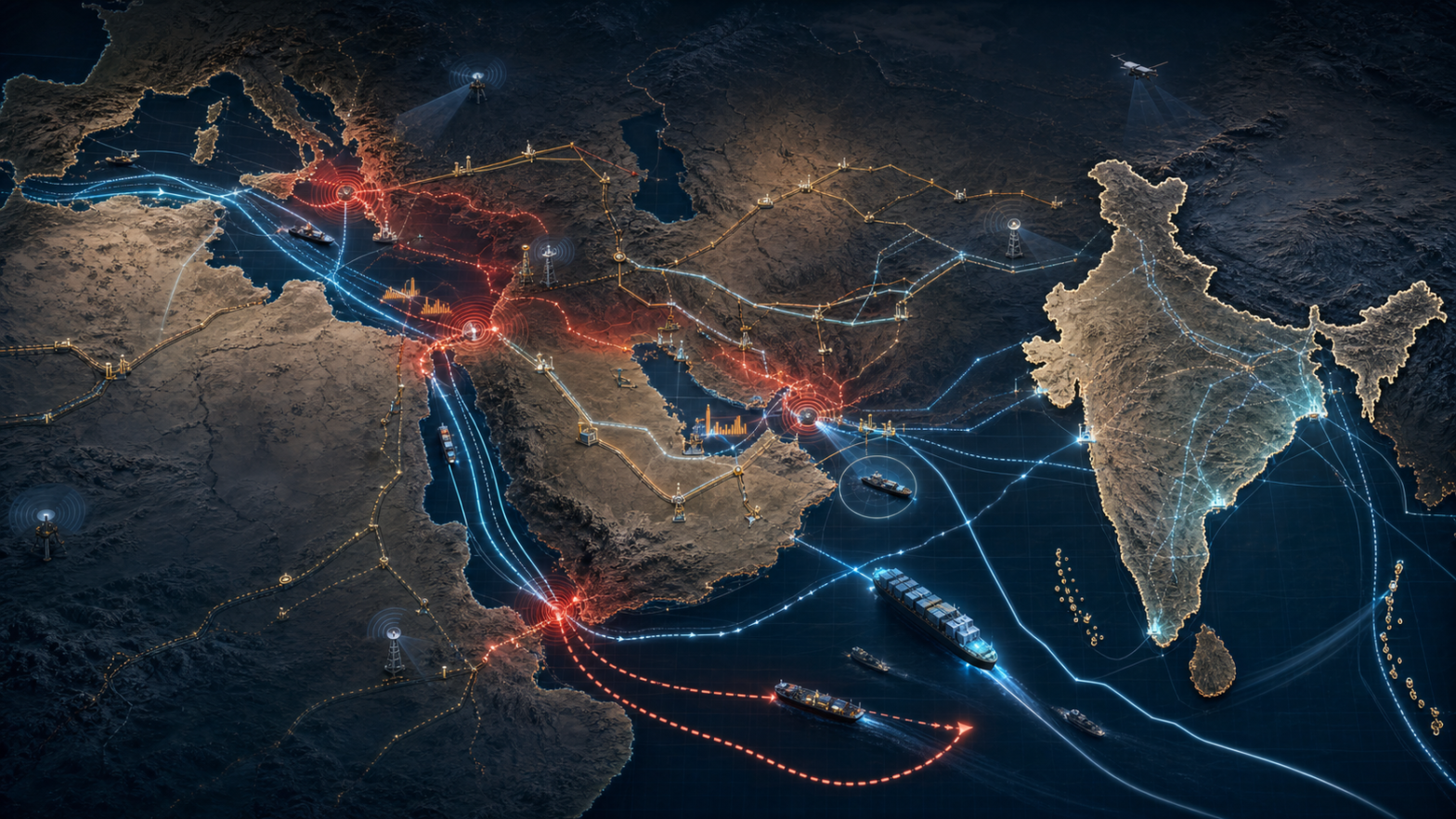
The most noticeable example of proxy warfare in the region has been the attack on maritime chokepoints. Many of the world’s largest shipping companies diverted around the Cape of Good Hope[7] to avoid the Bab el-Mandeb Strait, which is roughly twenty-nine kilometres wide at its narrowest point. The Bab el-Mandeb Strait had been the target of the campaign since November 2023, when the Houthis launched over a hundred attacks on shipping, including the sinking of at least two vessels and the killing of several seafarers, in solidarity with Palestinians in Gaza[8]. This has been the pattern since then: pause and relapse, in line with the broader conflict. When the war between Israel, the United States and Iran broke out in late February 2026, the Houthis resumed their attacks, then paused again after the Gaza ceasefire in June 2026[9]. By July 2026, Houthis’ threats against Saudi-associated shipping and an announced naval blockade had once again brought the region to a crisis[10]. The lesson is that the chokepoint risk is now chronic[11]. It always goes up and down with the political tide, but it never goes away entirely. A second front is the Eastern Mediterranean. This uncertainty is a major disincentive to investment in Israel’s offshore gas fields[12], which are projected to produce approximately 4.7 billion cubic metres of gas annually, or a third of the country’s total gas needs[13]. For an energy province Europe had hoped would free it from Russian gas, this insecurity is a clear obstacle to investment. It’s not confined to offshore platforms. Subsea pipelines, export terminals and the modern electric and data cables that criss-cross the Eastern Mediterranean are all soft targets.[14] A proxy can target them with drones or naval mines at low cost. The asymmetry of high costs of infrastructure and low costs of arms is the maritime side of proxy warfare[15]. This is because the major energy companies still invest in the basin despite this shadow, with Chevron approving a new investment in an Israeli gas field in January 2026, indicating the size of the prize and the magnitude of the risk of any disruption that would put it in play[16]. The safety of these assets is thus closely tied to the broader issue of making the Indo-Mediterranean into a reliable energy corridor for Europe.
The Economic Ledger
The economic impact of this instability is neither abstract nor small. It shows up in insurance, rerouting, trade volume, energy, and investment. The first indication is insurance[17]. Before the escalation in mid-2025, war-risk costs for voyages to the southern Red Sea reportedly rose by as much as 60 per cent for ships with strong Saudi connections, not counting additional expenses for fuel, crew, or delays. Redirection exacerbates the burden[18]. The fiscal impact on Egypt has been severe, as the share of east-to-west traffic using the canal has fallen to approximately 18.7 per cent, down from the pre-crisis figure of about 80.2 per cent[19]. After a brief dip in early 2026, the canal’s performance recovered slightly, with revenue climbing to approximately 449 million dollars in the first weeks of 2026, compared with 368 million dollars in the same period of 2025[20], but still well below the previous day’s record[21].
The costs extend beyond transit. Regional uncertainty would deter investment in Eastern Mediterranean gas, and in the ports, pipelines, and connectivity hubs it relies on, and would immediately affect prices if the Bab el-Mandeb Strait closed, cutting off Saudi oil exports to Asia. The disruptions also show in trade volumes. The cost of maritime container transport didn’t fall only on the states along the route; according to data cited by the International Monetary Fund, maritime container transport through the region fell by nearly a third in early 2024 compared with the same period a year earlier, as carriers shied away from the Red Sea. The stigma of being a war zone deters tourism, FDI and regional trade, reinforcing the perception of risk and, in turn, slowing the very development that would make the region more stable. The eventual effect is to weaken the economic dynamism that underpinned the Indo-Mediterranean idea, turning a potent growth centre into a source of global price.
Connectivity at Risk: IMEC and the Indo-Mediterranean Promise
The flagship of the Indo-Mediterranean vision is the India-Middle East-Europe Economic Corridor. Eight partners, including the European Union, France, Germany, India, Italy, Saudi Arabia, the United Arab Emirates and the United States, announced it at the G20 summit in New Delhi on 9 September 2023 and regard it as a more secure and diversified alternative to the congested Suez route and China’s Belt and Road Initiative. Indian officials estimate that it could reduce logistics costs by up to 30 per cent and transit time by up to 40 per cent[22]. But the corridor is largely paper-based. It remains in the feasibility and planning stage as of early 2026, while some national projects, like the Gulf rail and port projects, are already underway[23]. It has one major political drawback. The corridor’s “Gulf leg” relies on the cooperation between Israel and Saudi Arabia, which has become much more difficult to achieve in the wake of the Gaza war and the wider regional conflict[24].
Another drawback is financial. The European gateways, Trieste and Marseille, are vying to become the Mediterranean landing points for the corridor, and, consequently, the security and connectivity maps converge most closely at these gateways, as all flows will pass through the contested waters discussed above. In this sense, proxy warfare and connectivity are directly linked. No corridor linking the Levant and the Gulf can be funded, insured or completed while the region is in constant turmoil due to proxy attacks. No investor will invest in an infrastructure project that might be the object of a takeover, and no government will risk its political capital on an infrastructure project vulnerable to attack by force[25]. Proxy warfare does not just impede existing commerce. It denies the future architecture envisioned for the Indo-Mediterranean, whose rationale is that the corridor is more of an enabler than a substitute for regional security.
The Structural Turn
The Indo-Mediterranean conflict has moved beyond a few isolated cases to become a structural status quo, aided by several reinforcing mechanisms. Ideological extremism provides a constant supply of recruits and an excuse for violence beyond any single ceasefire. The combination of regular and irregular military operations in hybrid warfare allows sponsors to gauge the force and then disavow responsibility. Cyber operations have broadened the battlefield to ports, shipping systems, and energy grids, where a compromise in the cyber domain can affect physical trade. Finally, external patronage for regional actors will be found in transnational financing, which follows informal circuits and illicit trade, while the probability of international action will be reduced after the disappearance of the Syrian land route from Iran. These mechanisms combine to make proxy conflict a self-propelling mechanism that defies traditional conflict resolution.
Toward a Cooperative Security Architecture
If the conflict is a proxy war, the answer is a proxy war. Five elements are essential, and their value lies in their combination, not in any individual element. The first is cooperation at sea. The Indo-Mediterranean chokepoints are a common interest, and protecting them requires a concerted naval presence, escort arrangements, and rapid response by littoral and user nations. One building block is the evolving partnerships between India and the West of Suez, as described in the emerging partnerships between India and Greece, Cyprus, and Israel, but only if they are grounded in tasks, not symbols[26].
The second is information sharing. Maritime domain awareness (MDA), the real-time monitoring of vessels and threats, can be effective only if shared among navies, coastguards, and commercial operators. A common threat picture also reduces mistaken targeting, which has contributed to higher insurance prices.
The third is counterterrorism coordination. All intelligence on proxy networks, their leadership and logistics should be consolidated, and enforcement should be uniform across jurisdictions to prevent proxy networks from exploiting gaps in the system. The fourth is monetary pressure. Targeted sanctions, together with measures against informal financing and smuggling that support proxy networks, can increase the cost of a proxy model. This tool is evident in the three European states that reimposed U.S., European, and UN sanctions on Iran in August 2025, but its success will depend on enforcement[27].
The fifth is multilateral diplomacy. Symptoms can be controlled through sanctions and naval presence, but only through diplomacy can the underlying political conflicts, foremost the yet-to-be-solved Israeli-Palestinian issue, be resolved, conferring proxies with their cause. The relentless Houthis’ recidivism of their attacks whenever the Gaza ceasefire was violated clearly shows that the maritime issue is intertwined with the political one.
Conclusion
The Indo-Mediterranean indeed holds real promise as a trade, energy, and data link between the Indian Ocean and Europe, with India, the Gulf, and southern Europe as pivot points. This promise is genuine, and it’s reflected in major states’ willingness to invest in it, as with IMEC, an initiative. However, this promise comes with the condition of proxy war. Instability in the Red Sea, pressure on the Eastern Mediterranean, and the paralysis of the IMEC route show that instability in one part of the system increases the costs of the whole system. The clear results, including increased insurance, diverted trade, canal revenue loss and a loss of investment, are not transient events but symptoms of a structural problem.
The connectivity agenda is not the humanitarian side dish to resolving the proxy conflict. It is its prerequisite. Otherwise, the Indo-Mediterranean will remain a corridor of potential rather than prosperity. The argument has a practical twist for India, in particular, which sits at the eastern end of the space and has invested a portion of its economic destiny in going westwards. New Delhi cannot create a secure route to Europe if it does not secure one itself. It is not charity to others; it is an expression of its own growth, driven by its interest in maritime cooperation, stable energy supplies, and open sea lines. The Indo-Mediterranean will finally be made secure – if it is – by the states that most need it to be successful, through mutual action and a shared interest in the stability of the area, not as a favour to be bargained for.
Author Brief Bio: Dr Nanda Kishor M. S. is the Head & Associate Professor at the Department of Politics & International Studies, Pondicherry University.
Endnotes
[1] “Iran’s ‘Axis of Resistance’ Weakened But Still Dangerous,” Stimson Center, January 16, 2025, https://www.stimson.org/2025/irans-axis-of-resistance-weakened-but-still-dangerous/.
[2] “Fracturing the Axis: Degrading and Disrupting Iran’s Proxy Network,” Institute for National Security Studies (INSS), September 2025, https://www.inss.org.il/publication/fracturing-the-axis/.
[3] “Iran’s Network of Proxies ‘Activated’ As Possible War With US Looms,” RFE/RL, February 3, 2026, https://www.rferl.org/a/iran-trump-hezbollah-iraq-huthis/33666970.html.
[4] “Iran’s Proxy Network: Diminished, Dangerous,” The Hill, February 27, 2026, https://thehill.com/opinion/international/5756940-iran-proxy-network-weakens/.
[5] “The Red Sea,” Monthly Forecast, Security Council Report, July 2026, https://www.securitycouncilreport.org/monthly-forecast/2026-07/the-red-sea.php.
[6] The Hill, “Iran’s Proxy Network.”
[7] “War Risk Insurance in 2026: What Ship Owners Need to Know,” Nautilus Shipping, July 2026, https://www.nautilusshipping.com/news-and-insights/war-risk-insurance-in-2026-what-ship-owners-need-to-know.
[8] “Yemen’s Houthis to Only Target Israel-Linked Ships Following Gaza Ceasefire,” Al Jazeera, January 20, 2025, https://www.aljazeera.com/news/2025/1/20/yemens-houthis-to-only-target-israel-linked-ships-following-gaza-ceasefire.
[9] “Red Sea Corridor Slips Back into Crisis as Houthi Threats Resurface,” gCaptain, April 2026, https://gcaptain.com/red-sea-corridor-slips-back-into-crisis-as-houthi-threats-resurface/.
[10] Security Council Report, “The Red Sea.”
[11] Jonathan Saul, “Red Sea War Insurance Costs Rise After Houthi Blockade, Sources Say,” Insurance Journal, July 21, 2026, https://www.insurancejournal.com/news/international/2026/07/21/878345.htm.
[12] “Israel’s Offshore Gas and the New Maritime Security Frontier,” Middle East Forum, March 9, 2026, https://www.meforum.org/mef-observer/israels-offshore-gas-and-the-new-maritime-security-frontier.
[13] “Is Israel’s ‘Buffer Zone’ Inside Lebanon an Attempt to Grab Gas Reserves?,” Al Jazeera, June 12, 2026, https://www.aljazeera.com/features/2026/6/12/is-israels-buffer-zone-inside-lebanon-an-attempt-to-grab-gas-reserves.
[14] “The Ebbs and Flows of Eastern Mediterranean Gas Politics in 2025,” Policy Center for the New South, February 26, 2025, https://www.policycenter.ma/publications/ebbs-and-flows-eastern-mediterranean-gas-politics-2025.
[15] “War Risk Insurance Costs Surge for Southern Red Sea Voyages After Houthi Attacks,” Insurance Journal, July 23, 2026, https://www.insurancejournal.com/news/international/2026/07/23/878788.htm.
[16] “War Insurance Premium in the Red Sea Increased to 3 Percent,” SeaNews, July 25, 2026, https://www.seanews.com.tr/article/war-insurance-premium-in-the-red-sea-increased-to-3-percent-ms052x8l.
[17] Saleem Khan, “War Risk Insurance Costs Surge: How to Stem the Tide,” Pole Star Global, 2026, https://www.polestarglobal.com/resources/war-risk-insurance-cost/.
[18] “Red Sea Crisis Update: Route Alternatives and Cost Impacts,” Docshipper, March 2026, https://docshipper.com/shipping/red-sea-crisis-update-route-alternatives-cost-impacts/.
[19] “Red Sea Shipping Reopens, but Renewed Houthi Threats Keep Route Uncertainty High,” S&P Global Market Intelligence, February 2026, https://www.spglobal.com/market-intelligence/en/news-insights/research/2026/02/red-sea-shipping-reopens.
[20] “Suez Canal Revenue Down $10bn Due to Regional Conflicts,” AGBI, March 2026, https://www.agbi.com/transport/2026/03/suez-canal-revenue-down-10bn-in-regional-conflict/; and “Egypt Incurs Losses of about $10.5 Billion in Suez Canal Revenues,” EgyptToday, July 4, 2026, https://www.egypttoday.com/Article/3/148162/Egypt-incurs-losses-of-about-10-5-billion-in-Suez.
[21] “Egypt’s Suez Canal Revenue Fell Sharply in 2024 on Regional Tensions” (Suez Canal Authority figures), Yahoo News, 2025, https://www.yahoo.com/news/egypts-suez-canal-revenue-fell-105608471.html.
[22] “IMEC to Reduce Logistics Costs by up to 30% and Transportation Time by 40%: Piyush Goyal,” IMEC International, accessed August 2026, https://www.imec.international/news-press-release/.
[23] Afaq Hussain, “The India-Middle East-Europe Economic Corridor: Connectivity in an Era of Geopolitical Uncertainty,” Atlantic Council, November 2025, https://www.atlanticcouncil.org/in-depth-research-reports/report/the-india-middle-east-europe-economic-corridor-connectivity-in-an-era-of-geopolitical-uncertainty/.
[24] “IMEC: The India-Middle East-Europe Economic Corridor Explained,” The Middle East Insider, February 27, 2026, https://themiddleeastinsider.com/2026/04/16/imec-india-middle-east-europe-corridor/.
[25] “The India-Middle East-Europe Economic Corridor,” Middle East Institute, June 5, 2026, https://mei.edu/backgrounder/the-india-middle-east-europe-economic-corridor/.
[26] “Conceptualising a ‘Mediterranean Arc’: A Functional Framework for Maritime Cooperation between India, Greece, Cyprus, and Israel,” National Maritime Foundation, April 11, 2026, https://maritimeindia.org/conceptualising-a-mediterranean-arc-a-functional-framework-for-maritime-cooperation-between-india-greece-cyprus-and-israel/.
[27] “Iran: The End of the Axis and Strategic Adaptation,” Reset DOC, 2026, https://www.resetdoc.org/story/iran-end-axis-strategic-adaptation/.