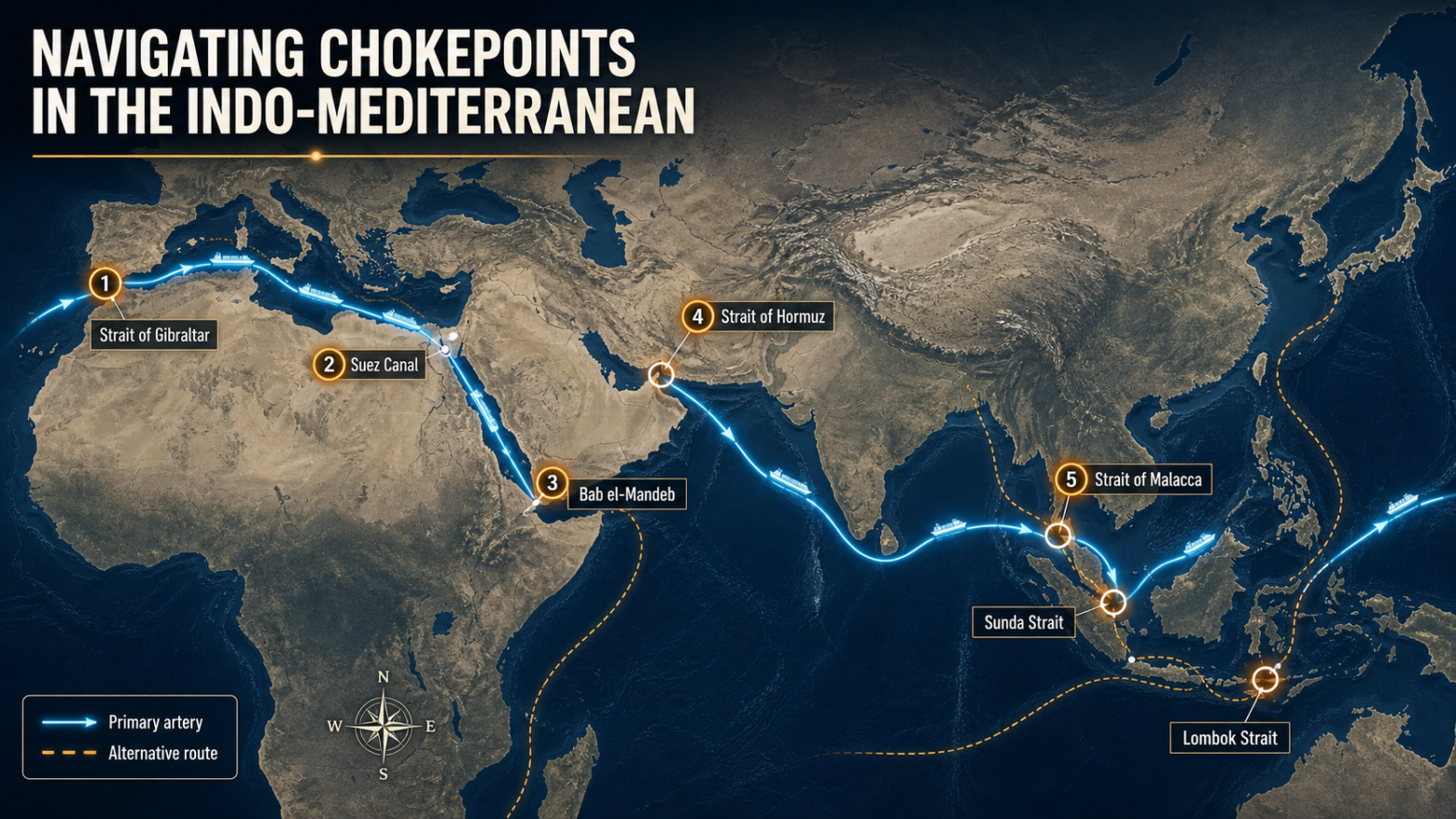
India aims to reach a GDP of USD 30 trillion by 2047 as part of its push to become a developed nation. This would require sustained real GDP growth of about 7 per cent while keeping inflation between 3 and 4 per cent. The target is ambitious but achievable. However, it would require a complete overhaul of its maritime trade architecture. To that end, India has launched the “Maritime Amrit Kaal Vision 2047” (MAKV 2047), which aims to transform India into a dominant global maritime power by 2047, with an investment of about USD 1 trillion. This involves expanding port capacity, upgrading domestic shipbuilding capabilities, activating inland waterways and coastal shipping, and bypassing global geopolitical chokepoints to protect trade.[1]
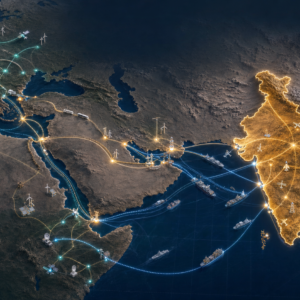
For India, two projects are significant for global chokepoints. To the east is the ongoing Galathea Bay Project on Great Nicobar Island, overlooking the vital Strait of Malacca. To the west is the India-Middle East-Europe Economic Corridor (IMEC), a multimodal ship-to-rail network designed to bypass volatile Red Sea bottlenecks and cut transit times to Europe by 40%. The IMEC concept was announced on 9 September 2023 at the G20 Summit in New Delhi, where leaders of India, the US, Saudi Arabia, the UAE, France, Germany, Italy, and the European Union signed a Memorandum of Understanding. The IMEC comprises an Eastern Corridor connecting India to the Gulf region and a Northern Corridor connecting the Gulf region to Europe. It will include a railway and ship-rail network, along with road transport routes.[2]
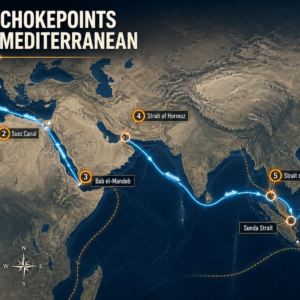
Maritime trade accounts for nearly 95 per cent of India’s trade by volume and 70 per cent by value. This leaves India vulnerable to disruptions at chokepoints. At present, the Mediterranean shipping route via the Suez Canal and the Red Sea connects India directly to European, North African, and North American markets. About 35% of India’s maritime traffic passes through this corridor, supporting Indian exports of agricultural goods, engineering equipment, textiles, and chemicals.[3] Imports primarily consist of industrial machinery, advanced electronics, and components sourced from European trading hubs. This trade route has been heavily affected by turbulence around the Red Sea and Bab el-Mandeb, forcing vessels to reroute around the Cape. As a consequence, transit times and costs have increased.[4]
India meets most of its energy needs from the Gulf, with ships transiting the Strait of Hormuz carrying crude oil, liquefied natural gas (LNG), LPG, and chemical fertilisers to Indian ports. This route accounts for a third of India’s total ship-borne trade. Earlier, it accounted for over 55 per cent of India’s crude imports, but the ongoing war between the US and Iran has forced India to diversify its energy basket, reducing its dependence on this route to about 30 per cent of its energy needs.
About 30-35 per cent of India’s trade with Southeast Asia, East Asia and the Americas passes through the Strait of Malacca. The bulk is non-oil trade. Imports include palm oil, finished electronic products, semiconductors, and manufactured goods from China, Japan, South Korea, and ASEAN states. Exports largely comprise iron ore, marine products, and organic chemicals. India’s protective positioning in Galathea Bay, with the ongoing construction of a deep-sea port and a transhipment hub, makes securing this trade route through its eastern gateway a key focus. For Western trade routes, the connection between the Indian Ocean and the Mediterranean Sea is highly significant. This is India’s strategic geography—extending from the Indian Ocean into the Mediterranean via the Gulf, the Red Sea and the Eastern Mediterranean. Secure Gulf and Red Sea routes are vital for India’s commerce; the alternative is the longer, costlier Cape route. This underscores IMEC’s importance in India’s trade calculus, but its success would also depend on a peaceful West Asia.
While the Indo-Mediterranean is not a formal geographical region or institutional grouping, it can be conceptualised as a strategic link connecting the Western Indian Ocean to the Mediterranean via the Arabian Sea, Gulf, Red Sea, Suez Canal and Eastern Mediterranean, highlighting the interconnectedness of these growing strategic spaces. For India, it is the gateway to Europe, North Africa and the Atlantic. India can no longer confine its strategic horizon to the Arabian Sea in the West, ending at Africa’s eastern shores. The Western Arc must now extend to the Mediterranean and Italy, providing a gateway to Western Europe and the Atlantic. Any instability anywhere along this chain will adversely affect India’s trade, energy security and connectivity. The key driver is connectivity. The India–Middle East–Europe Economic Corridor (IMEC), through ports, railways, energy corridors, digital connectivity and supply chains, can integrate India more closely with Europe.
The security challenges, however, are immense. The ongoing US-Iran war has exposed the Strait of Hormuz’s fragility, while the Suez Canal-Red Sea-Bab el Mandeb linkage is increasingly vulnerable, highlighting how easily hostile actions can disrupt global commerce. India, along with other naval powers, would need to cooperate to keep these sea links open.
The Indo-Mediterranean framework also highlights growing shared interests in energy, trade, technology, infrastructure, and maritime security among India, West Asia, and Europe. This is why Israel, Egypt, Greece, Italy, France, and the UAE can become important nodes in this wider network. It offers India an opportunity to build partnerships and strengthen its resilience during crises without establishing a formal alliance. Such a link would help counter China’s expanding presence in the region and provide alternatives to the Chinese Belt and Road Initiative.
India’s peninsular position on the Indian Ocean gives it a geographical advantage, making it a natural connectivity hub linking the Pacific, the Indian Ocean, and the Mediterranean Sea. This would benefit South Asia, West Asia, and North Africa. India’s strong diplomatic standing with Israel, the Gulf, Egypt, and the US and European powers could provide the diplomatic heft needed for such a corridor to come about. All this, of course, is predicated on peace and stability in West Asia. Importantly, we must not think of the Mediterranean as essentially Europe’s southern sea. As India’s strategic geography expands westward, the Indo-Mediterranean is a useful concept that can propel Bharat towards its ‘viksit’ status.
Author Brief Bio: Maj. Gen. Dhruv C. Katoch is Editor, India Foundation Journal and Director, India Foundation.
Endnotes:
[1] Press Information Bureau, Government of India. “Maritime Amrit Kaal Vision 2047.” Ministry of Ports, Shipping and Waterways, December 3, 2024.
[2] Ministry of External Affairs, Government of India, “Partnership for Global Infrastructure and Investment (PGII) & India-Middle East-Europe Economic Corridor (IMEC),”
[3] Rahul Saikia, “What’s the Extent of India’s Dependence on Maritime Chokepoints? Why Alternatives Are Stunted,” ThePrint, April 20, 2026.
[4] Dimitris Gavalas, “Safeguarding Maritime Flows in an Age of Turbulence,” Observer Research Foundation, July 30, 2026.