
Contents
Overview…………………………………………………………………………………
01 Capt Alok Bansal…………………………………………………………………….
02 Amb. Shyam Saran………………………………………………………………….
03 Amb. Meera Shankar………………………………………………………………
04 Prof. C. Raja Mohan……………………………………………………………….
US MIDTERMS 2026: DOMESTIC POLITICAL SHIFTS AND GLOBAL GEOPOLITICAL IMPLICATIONS
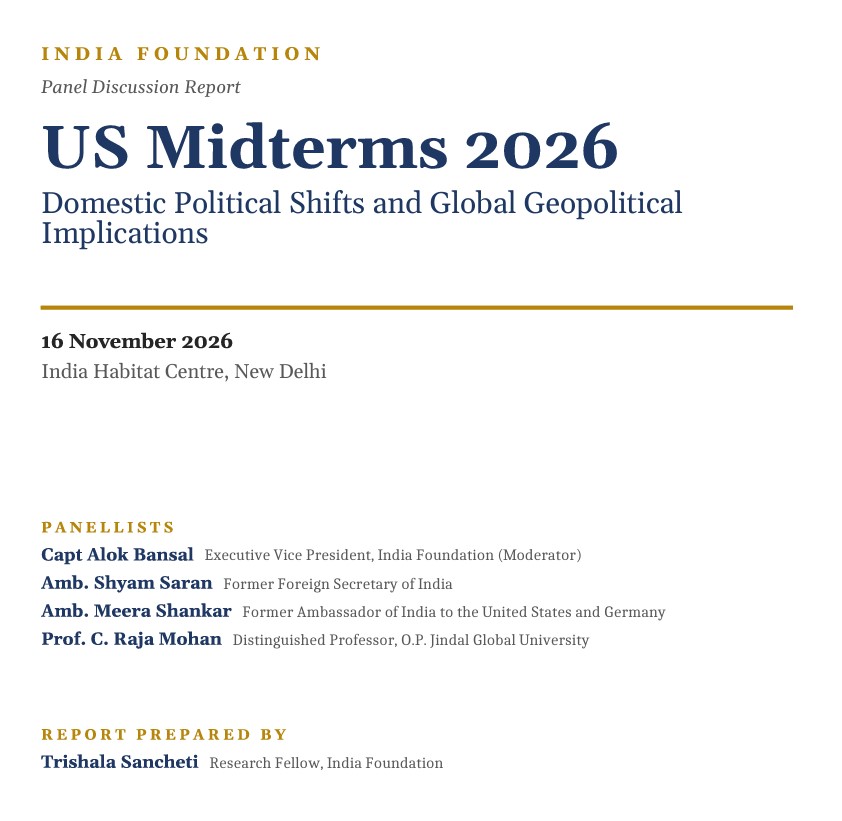
A panel discussion on the US mid-term elections was held on 16 November 2026 at the India Habitat Centre. The panellists were Ambassador Shyam Saran, Former Foreign Secretary of India; Amb. Meera Shankar, Former Ambassador of India to the United States and Germany; and Prof. C. Raja Mohan, Distinguished Professor, O.P. Jindal Global University. The discussion was moderated by Capt. Alok Bansal (IN), Executive Vice President, India Foundation.
In his opening remarks, Capt. Alok Bansal established the political context and international significance of the election. Thereafter, Ambassador Shyam Saran examined the implications for China, the wider geopolitical balance and India, while Ambassador Meera Shankar provided a more detailed assessment of domestic constraints, international conflicts and bilateral economic relations. The final speaker, Prof. C Raja Mohan, placed the developments in the context of
America’s enduring structural strengths and drew out the strategic lessons for India. The central policy recommendation that emerged was that India must engage not merely with the US administration of the day, but with the wider American political, institutional and strategic establishment
Capt Alok Bansal
Moderator · Executive Vice President, India Foundation
For over six decades, few US midterm elections have matched the level of enthusiasm and international interest seen this time. It has undoubtedly been an extraordinary election. During my visit to the United States in October, there was already widespread expectation that the House of Representatives would change hands, though considerable uncertainty remained over the Senate. The results have now confirmed a decisive shift in the political landscape.
The elections have produced several remarkable outcomes. Nine Senate seats have reportedly changed hands, while the Democrats have made significant gains in the House. Republican gerrymandering in Texas largely failed to deliver the anticipated results, with nearly all the seats targeted by redistricting going to the Democrats. The strategy did not produce the desired outcome in Florida either. Kansas elected a Democratic Senator for the first time since 1932, while Mississippi elected a Black Senator for the first time since Reconstruction. The elections also saw several historic firsts, including the election of a Native American woman as Governor, a Hispanic Governor in Texas, a Black woman Governor, the first Muslim Senator, and the first openly gay man to serve in the Senate.
The significance of these elections extends well beyond American domestic politics. Their implications will be felt across the world, and several international leaders have already responded to the results. European governments, in particular, will be watching closely to see whether a politically weakened President Trump resorts to further sanctions or tariffs. The Norwegian Prime Minister, who had been at odds with President Trump over the Nobel Peace Prize, observed that the voices emerging from the American electorate were more closely aligned with Oslo’s principles than with Trump’s approach. South African President Cyril Ramaphosa, who had also been the subject of Trump’s criticism and allegations regarding the treatment of white South Africans, described the election results as heralding a new era in international relations.
Perhaps the most striking reaction came from Iran. Its chief negotiator interpreted the results as indicating that the American people had rejected war. He cautioned that if the US administration disregarded this public sentiment to serve external interests and succumb to international pressure, it could face serious consequences. This response reflects how other countries interpret the American elections through the prism of their own strategic interests and bilateral relations with Washington.
Another noteworthy feature of the elections was the extraordinary amount of money spent, much of it from sources beyond the traditional political parties. Elon Musk contributed approximately $158 million to the Senate Leadership Fund, which transferred the money to a Texas Republican super PAC. The winning candidate, Talarico, pointed out that the election sent a clear message to the world’s only trillionaire: the people of Texas were not for sale. The statement captured the broader significance of the election as a contest not merely between political parties but also over the influence of money and powerful individuals in democratic processes.
The political repercussions were evident almost immediately after the results. Vice President JD Vance made a series of extended public statements that appeared to signal some distance from the President’s political position. Such positioning is perhaps understandable given his own presidential ambitions and the prospect of a longer political career. As Vice President, he also occupies a relatively secure constitutional position compared with other members of the
administration, who may be more vulnerable to political pressures and shifts in the administration’s fortunes.
The consequences of this election will be felt globally, including in India. Although the Democratic victory has been welcomed in some quarters in India, largely because of dissatisfaction with the Trump administration’s tariff policies, it would be premature to assume that a Democratic resurgence will necessarily translate into a more favourable approach towards India. A significant number of Democrats who have gained ground belong to the party’s progressive left, including those who identify with Democratic Socialism. Their positions on several international and domestic issues could pose their own challenges for India-US relations.
The American midterm elections therefore merit close scrutiny. They represent more than a domestic political setback for the Republican Party or a victory for the Democrats. They could influence the remainder of the Trump administration’s tenure, shape the political calculations of its principal figures, and alter the trajectory of American foreign policy. In an increasingly interconnected world, developments within the United States inevitably have consequences far beyond its borders, and India must carefully assess their implications.
Amb. Shyam Saran
Former Foreign Secretary of India
The central question is: what are the implications of the US midterm elections for India? Some consequences will be direct, while others will be indirect. I would begin by reiterating a point Alok made. Although the election results could bring significant changes to US domestic politics, particularly by giving Congress greater control and influence over domestic policy, the impact on foreign policy may be less pronounced. Foreign policy remains primarily an executive responsibility. Consequently, the broad trends observed over the past two years under the Trump administration, or Trump 2.0, are likely to continue. This is an important distinction to bear in mind when assessing the implications for India.
The first geopolitical development I would highlight is the controversy surrounding Jensen Huang, which emerged almost immediately after the election results. I see this episode as reflecting an ongoing tussle within the Trump administration between what may be described as the ‘China doves’, led by President Trump, and the ‘China hawks’. The latter are represented across both the Republican and Democratic parties.
Reports suggest that when President Trump was preparing to travel to Beijing, Marco Rubio, the Secretary of State and National Security Adviser, submitted a memorandum raising concerns about a reported relationship Huang had with an individual suspected by US intelligence of being a Chinese intelligence asset. Trump apparently disregarded these concerns and even arranged to pick up Huang in Anchorage before travelling to Beijing with him.
I interpret the subsequent controversy as a counter-move by the China hawks. The underlying information was not entirely new; what is significant is how it surfaced and became a political controversy. This suggests a possible shift in the balance of influence within the Trump administration between the China doves and the China hawks. Since the latter have considerable support in both parties, and perhaps even stronger representation within the Democratic Party,
Trump is likely to face greater pressure over his approach to China. This could have important consequences for US-China relations.
The second development concerns the series of international summits scheduled for the coming months, including the Quad Summit in Manila, the ASEAN Summit, the East Asia Summit and, finally, the APEC Summit. The latter is particularly significant, as it is expected to bring together President Trump, President Vladimir Putin and President Xi Jinping in an unprecedented trilateral meeting. Had the election results been different, Trump might have sought to present this meeting as a major diplomatic achievement, demonstrating America’s ability to bring the other two principal global leaders together and to shape the emerging international order. He might even have sought to use the occasion to influence developments in the war in Ukraine and in the security situation in East Asia.
The election results, however, have altered the political context. Trump will approach these engagements from a position of domestic political weakness. The possibility of Putin and Xi coordinating their positions, whether explicitly or otherwise, could leave Trump at a disadvantage. The extent to which this will affect discussions of major geopolitical issues remains to be seen.
China’s principal objective has been to exploit its engagement with Trump to gradually weaken America’s commitment to Taiwan. It is pursuing this through a strategy of attrition, seeking to erode Washington’s willingness to support Taiwan over time. Technology is another major area of contention. The Jensen Huang controversy is particularly relevant in this context, as the relatively liberal approach the Trump administration has taken toward exporting advanced
semiconductor chips to China is now likely to face greater scrutiny and resistance. China, for its part, has already indicated that any tightening of restrictions could prompt retaliatory measures, including curbs on the export of rare earth elements and critical metals to the United States. This could trigger a fresh round of economic and technological tensions. How the Trump administration responds to this pressure will be important, particularly given America’s dependence on Chinese supply chains for several critical materials.
Turning to India, I do not anticipate a fundamental change in the Trump administration’s policy towards us. However, the Democratic victory, particularly the strong performance of its progressive wing and the growing influence of the Democratic Socialists of America (DSA), could introduce a new dimension to bilateral relations.
Democratic lawmakers are likely to pay closer attention to India’s domestic political developments, particularly issues relating to human rights and minority rights. So far, India has arguably found the Trump administration a relatively comfortable interlocutor, as Trump has shown limited interest in making human rights and minority rights central to his foreign policy engagements. A stronger Democratic presence in Congress could change this. Greater scrutiny of India’s domestic politics may create additional strains in India-US relations, and we should watch this closely.
Another possible consequence of the election results is that Trump may increasingly seek quick, demonstrable foreign policy victories. A weakened domestic political position could make such achievements more appealing. In this context, Cuba appears to be a potential area of concern. There are signs of mounting pressure on Cuba, and Trump may view it as a relatively easy opportunity to demonstrate decisive action. As for Iran, I do not expect Trump to pursue further military escalation, although his unpredictability means this possibility cannot be entirely discounted.
Finally, the implications for technology policy, particularly artificial intelligence, warrant attention. The United States’ relatively laissez-faire approach to AI development may give way to a more measured, regulated framework. Several candidates who performed well in these elections campaigned against establishing large data centres in their constituencies. Since data centres are fundamental to expanding AI infrastructure, growing political resistance to their establishment could constrain the pace of investment and development. This may, in turn, slow the headlong rush towards AI development that we have witnessed in recent years. The emerging political consensus could therefore favour greater regulation, oversight and consideration of the social and economic consequences of technological expansion.
These, in my assessment, are some of the principal implications of the US midterm elections. Their impact will extend beyond America’s domestic political landscape to its relations with China, the wider geopolitical environment, and its engagement with countries such as India.
Amb. Meera Shankar
Former Ambassador of India to the United States and Germany
Governments and policymakers around the world are trying to assess what the outcome of the US midterm elections means for them. This is understandable, as American actions, and equally its inactions, have consequences far beyond its own shores. The elections produced a decisive anti Trump swing, with Democrats making substantial gains in both chambers of Congress. The scale of the victory is significant, extending beyond traditionally Democratic strongholds into states that have historically supported the Republicans. The immediate question is what these results mean for US domestic policy and for its international engagements.
Domestically, President Trump can expect considerably greater scrutiny and pressure on his priorities. The Democrats campaigned primarily on the cost of living, making reductions in household expenses their central concern. Other key issues included strengthening workers’ rights, raising the minimum wage, lowering energy costs, and improving access to healthcare. On foreign policy, the Democratic agenda included ending the war with Iran, moderating US relations with Israel, including reconsidering defence cooperation and military assistance, and adopting a more supportive position towards Ukraine than that pursued by Trump.
The President will now face greater congressional oversight. Congress controls the purse strings through its authority over budgetary appropriations. Traditionally, tariff-making authority also rested with Congress, although much of it has since been delegated to the executive. The Democrats could use their strengthened position to investigate the administration’s policies and decisions. There has also been discussion of impeachment, although opinion within the party remains divided over whether this should take precedence over pursuing its legislative agenda.
There are also indications of a possible leadership transition within the Democratic Party. Senator Chris Van Hollen has reportedly expressed interest in challenging Chuck Schumer for Senate leadership, reflecting dissatisfaction among some Democrats with the party’s approach to Israel. Similar criticism has been directed at other senior party leaders, including Hakeem Jeffries. How this internal contest develops remains to be seen.
Despite these differences, there is broad agreement within the Democratic Party on key economic priorities. Reducing the cost of living and improving workers’ wages are foremost among them. Real wages for many American workers have remained largely stagnant for decades. Democrats argue that the Trump administration’s policies have disproportionately benefited the wealthy, contributing to an unprecedented concentration of wealth and political power. This, they contend, has undermined the American Dream and weakened prospects for social and economic mobility, which have traditionally been central to the American ethos.
The election results could constrain Trump’s authority, particularly through congressional control of appropriations. For instance, the Democrats could seek to reduce or redirect defence spending. Trump has proposed a defence budget of approximately $1.5 trillion, comprising $1.1 trillion in discretionary funding and $350 billion in mandatory funding. These proposals are likely to attract greater scrutiny.
Healthcare will be another major area of contention. Democrats are likely to push to reverse cuts to Medicare and Medicaid and may seek to advance a broader framework for universal healthcare, including Medicare for All. Restoring healthcare benefits and improving access to affordable medical services were key elements of their election campaign. However, the President retains substantial constitutional and executive powers. He can veto legislation passed by Congress and continue to govern through executive orders. Even when these orders are challenged in court, the legal process can be protracted. The experience with Trump’s tariffs illustrates this point: it took considerable time for the Supreme Court to rule on the issue, and the lack of an interim stay allowed the policy to remain in effect during the proceedings. Consequently, while congressional oversight will increase, the immediate effect may be less
active policymaking and greater political contestation within the US government.
Turning to foreign policy, Shyam has already discussed the implications for China and Russia, particularly in the context of the forthcoming international summits. I would focus on the two major conflicts facing the international community: Iran and Ukraine.
On Iran, there is likely to be pressure on Trump from both Democrats and sections of the Republican Party to bring military operations to a close and avoid further escalation. Trump has indicated that, for now, he would prefer to prioritise negotiations over further military action, although he has maintained that the United States remains prepared to use force. This is consistent with his familiar approach of combining military threats with an apparent willingness to negotiate.
Developments in the Persian Gulf since the midterm elections suggest the situation remains volatile. There have been military exchanges between the United States and Iran, including reported US strikes on Qeshm Island and Iranian attacks on a radar installation linked to the US military presence in Bahrain. There have also been unconfirmed reports that the United States is considering a ground operation. At one stage, speculation even arose about the possible use of
tactical nuclear weapons against facilities at Pickaxe Mountain, where Iran is believed to have stored enriched uranium and possibly maintained centrifuge-related infrastructure. That possibility appears to have receded for now. However, Trump has indicated that economic pressure on Iran will continue. The blockade affecting the Strait of Hormuz remains a critical element of this strategy.
For India, a cessation of military operations would certainly be welcome. However, the situation remains complex. Iran is targeting vessels attempting to transport oil through the Strait of Hormuz without its approval, while the United States is targeting vessels carrying Iranian oil. The resulting uncertainty continues to disrupt maritime traffic and energy supplies.
For India to derive any meaningful benefit from reduced tensions, the restrictions on the Strait of Hormuz must be lifted. Only then can oil and other energy supplies flow freely from the Gulf to India. Although some shipments continue to move, normal maritime traffic has not yet been restored. There is also a wider regional concern. The Houthis have once again become active around the Bab-el-Mandeb Strait, while the Saudi-backed Yemeni government has reportedly withdrawn from certain positions in the area. This adds another layer of uncertainty to maritime security. If both the Strait of Hormuz and the Bab-el-Mandeb Strait remain vulnerable, the consequences for international trade and energy supplies could be particularly serious.
Regarding Ukraine, the Democrats are likely to press for greater American support. Trump’s attempts to push Ukraine towards a negotiated settlement with Russia, potentially involving territorial concessions, could therefore become more complicated. European governments will also seek to exert greater influence over the direction of negotiations. The Democrats may seek to restore or increase appropriations for Ukraine, though the extent of such support remains uncertain. Their principal domestic priority remains the cost of living, and they will have to balance foreign policy commitments against the economic concerns of American voters.
At the same time, they are likely to resist further appropriations for the conflict with Iran. American military deployments in the region have increased substantially, with additional ships, personnel and other military assets. Democrats may seek to limit further spending and push for a reduction in the US military footprint.
As far as negotiations with Iran are concerned, two fundamental differences remain unresolved. The first concerns the future of Iran’s enriched uranium stockpiles. Iran has indicated a willingness to down-blend or otherwise reduce the enrichment level of its stockpiles, but insists that this be done within Iran. The United States, on the other hand, wants the material removed from Iranian territory and transferred elsewhere, possibly to the United States. The second issue concerns Iran’s right to enrich uranium, even to low levels of around 3 per cent. It remains uncertain whether a mutually acceptable compromise can be found on either issue. Consequently, neither the Iran conflict nor the Ukraine war appears likely to reach an early resolution.
Turning specifically to India, I do not anticipate any major immediate change in bilateral relations. India is not currently a priority for either the Republicans or the Democrats, whose attention is focused primarily on Iran, Ukraine and domestic economic concerns. Nor should India assume that a Democratic-controlled Congress will necessarily oppose Trump’s tariff policies. There is considerable bipartisan support in the United States for tariffs as a means to encourage domestic manufacturing, bring jobs back to America and reduce dependence on overseas supply chains. This protectionist sentiment is not confined to the Republican Party.
However, as Shyam has noted, India may face increased scrutiny of its domestic policies. Several members of the Democratic Progressive Caucus have previously raised concerns about human rights, Kashmir, and other domestic political developments in India. With a stronger Democratic presence in Congress, these issues could attract renewed attention.
How should India respond? It must continue to engage closely with the US executive, given the considerable discretion the President enjoys in foreign policy. At the same time, it would be a mistake to confine India’s diplomatic engagement solely to the administration. India needs to reach out to all sections of American political opinion, including Republicans, Democrats and progressives, as well as to think tanks, civil society organisations and other institutions that shape public and policy perceptions. American political opinion is diverse, and ideas emerging from these constituencies will increasingly influence the country’s policy direction. India must ensure that its perspectives are represented across this wider political spectrum.
Finally, there is the question of the proposed India-US trade agreement. India has been seeking preferential tariff treatment vis-à-vis its competitors in Asia. However, following the US Supreme Court’s decision on the legality of the tariff regime, it is no longer clear how the proposed arrangement will be structured. The Court ruled that the International Emergency Economic Powers Act (IEEPA) did not authorise the President to impose tariffs. However, it did not strike down all US tariffs or all presidential tariff-making powers.
Under the earlier understanding, India was offered an 18 per cent tariff rate, while it was expected to reduce tariffs to zero on all US industrial goods. In my assessment, this was a considerably asymmetric arrangement. Traditionally, preferential trade treatment has been extended to developing countries to facilitate their integration into the global economy. In this instance, however, the proposed arrangement would have effectively offered preferential treatment to a developed economic superpower at India’s expense.
India was nevertheless prepared to consider the arrangement because its principal Asian competitors faced broadly comparable tariff rates, with some marginally higher by one or two percentage points. The proposed rate therefore offered India a degree of relative competitiveness. We will now have to wait until the United States sets out the contours of its revised tariff structure. Only then will it become clear whether India can retain the preferential position it sought and how the proposed trade agreement will ultimately be negotiated.
Overall, India’s approach must be pragmatic. While the midterm elections may not immediately transform US policy towards India, they will reshape the domestic political environment in which American foreign policy is formulated. India must remain engaged with the executive while strengthening its outreach across the political spectrum in Washington.
Prof. C. Raja Mohan
Distinguished Professor, O.P. Jindal Global University
I would like to make three broad points: first, the domestic political situation in the United States; second, how the domestic debate is shaping American foreign policy; and third, the implications for India and the issues we need to watch in the coming months.
Discussions like this matter because we often view the United States as a black box, seeing it primarily through the lens of bilateral relations or the day’s headlines. We need to understand the structural factors that shape American domestic politics and influence its global outlook.
An election is a contest of ideas, interests and competing visions of how a nation should develop. However, not every election fundamentally changes a country. It is useful here to recall the Marxist distinction between the base and the superstructure. At the visible level, there may be considerable political churn, leadership changes and shifts in electoral fortunes. Beneath this surface, however, lie the deeper structures of the state and society, which tend to endure. We
must distinguish between these two levels when assessing the significance of the American midterm elections. In this context, I would make three observations about the United States’ underlying strengths.
First, the United States is not in decline. Some in India may welcome such a prospect, but the economic fundamentals do not support it. The American economy is valued at approximately $33 trillion and continues to show considerable resilience and growth.
Second, America’s share of global GDP has increased over the past four years, from approximately 24 per cent to nearly 26 per cent, while China’s share has declined marginally. This is a significant indicator of the relative strength of the American economy.
Third, the United States continues to dominate in technology and remains the principal destination for global capital. As Ruchir Sharma observed in a recent Financial Times column, nearly 80 per cent of global equity flows are directed to the United States. The depth and sophistication of American capital markets, together with the dollar’s continuing appeal, remain powerful magnets for international investment. These structural advantages are unlikely to disappear in the foreseeable future. The broader point, therefore, is that the United States will remain the pre-eminent global power for a considerable period. Political turbulence and electoral reversals should not be mistaken for a fundamental erosion of American power.
My second point concerns the relationship between America’s internal political debates and the direction of its foreign policy. This is not simply a contest between Republicans and Democrats, or between President Trump and Congress. The deeper divisions within American society and its political establishment cut across party lines. On trade, for instance, both free traders and protectionists are found within the Republican and Democratic parties. Similarly, advocates of open borders and those who favour restrictive immigration policies are found across the political spectrum. The Republican Party has moved decisively towards a more restrictive position on immigration, but these debates are not new. They reflect enduring differences over America’s engagement with globalisation.
There is, however, considerable continuity in the economic policies pursued by successive administrations. What Trump initiated during his first term was, in important respects, continued under President Biden and has now been reinforced under Trump 2.0. The central objective has been to reduce American economic exposure to global supply chains, particularly those originating in China; to develop an industrial policy that encourages the reshoring of manufacturing; and to restructure aspects of the global economic system to ensure the United States derives greater economic advantage.
There is considerable bipartisan support for these objectives. Consequently, regardless of which party controls the White House or Congress, we should expect a continued emphasis on economic nationalism, industrial revival and reduced strategic dependence on China.
The more fundamental difference between the two parties concerns America’s attitude to alliances and partnerships. President Trump has repeatedly questioned the value of alliances, viewing them as burdens that impose costs and obligations on the United States. The Democrats, and the Biden administration in particular, regard alliances and partnerships as indispensable instruments of American strategy.
This commitment to cultivating allies and friends extends beyond the Democratic Party. It is also deeply embedded in the broader American strategic establishment, which recognises the value of partnerships in sustaining US global influence. Trump has challenged this conventional wisdom, yet it remains a powerful current within the American establishment. The tension between these competing approaches will continue to shape US foreign policy.
My third point concerns the implications of these internal debates for the direction of American foreign policy. On Russia, there is considerable opposition across the American political spectrum to any attempt by Trump to normalise relations without addressing the underlying issues stemming from the war in Ukraine. While Trump appears keen to rebuild relations with Moscow and negotiate an end to the conflict, resistance within Congress remains substantial. This could constrain his ability to make unilateral concessions to Russia.
China is also the subject of a growing contest between Trump’s preference for a different model of engagement and the concerns of the wider American strategic establishment. The controversy surrounding Nvidia is particularly revealing. I see it as an indication that the establishment is pushing back against what it considers excessive concessions to China, especially in advanced technology. The message is that the President cannot unilaterally dilute restrictions on
technology transfers if such decisions are perceived to undermine American national security.
I expect this controversy to have further repercussions. Regulatory and statutory agencies, including the Securities and Exchange Commission, could examine various aspects of Nvidia’s business dealings. The United States has an intensely litigious environment, and once such questions are raised, the company’s activities are likely to face close scrutiny for several years. More broadly, the debate over technology exports to China is unlikely to be settled by a presidential decision alone. Powerful institutional and political forces will seek to influence its outcome.
On multilateralism, the Democrats are generally more favourably disposed towards international institutions and multilateral engagement. However, we should not have exaggerated expectations of a return to the traditional American commitment to multilateralism. The underlying political and economic pressures driving American scepticism towards globalisation and international institutions are unlikely to disappear.
The Middle East will be another flashpoint for intense debate within the Democratic Party. Divisions over Israel and Gaza are likely to deepen. Senior Democratic leaders, including Chuck Schumer and Hakeem Jeffries, have faced criticism from the party’s progressive and Democratic Socialist factions for being too supportive of Israel. However, the broader Democratic establishment is unlikely to favour abandoning the relationship with Israel. It would prefer to
exert greater pressure on Israel and impose stricter discipline on its policies, rather than fundamentally dismantle the strategic relationship.
In South Asia, Trump has sought to present himself as a peacemaker, challenging established assumptions about how the United States should handle regional rivals and conflicts. However, his efforts to position himself as the principal mediator are unlikely to succeed in every case. His approach has also raised questions about the traditional American understanding of regional sensitivities and the importance of established diplomatic processes.
Human rights and democracy will remain part of the American foreign policy discourse. These concerns have long featured in the country’s engagement with the world, though their importance varies with the administration and the strategic context. It is important to recognise that American foreign policy is shaped by several competing constituencies: those who emphasise democracy and human rights, those who favour free trade, those primarily concerned with national security, and those who prioritise strategic partnerships. No single constituency determines policy. The interaction and contestation among these forces ultimately shape the direction of American policy.
This brings me to the central question: how should India respond to the changing political dynamics in the United States? The answer is that we need to engage much more actively with America, not merely with its administration but also with its domestic political and institutional landscape. We must better understand the multiple political forces shaping American policy and engage with them in a sustained and sophisticated manner. This does not mean intervening in American domestic politics, but rather cultivating relationships across the political spectrum and ensuring that India’s perspectives are understood by the different constituencies that influence policy.
We should not take the United States for granted. Our engagement must extend beyond the White House to Congress, political parties, think tanks, universities, business groups and other institutions that shape American public opinion and strategic thinking. It is also important to recognise how far India-US relations have evolved. Compared with the 1990s, when Washington exerted considerable pressure on India over Kashmir and its nuclear weapons programme, we are in a substantially stronger position today. Our relationship has gained considerable depth and resilience, despite the difficulties created by Trump’s tariffs. Indeed, Indian exports to the United States have reportedly increased by 11.5 per cent ($51 billion during April–September 2026, compared with $45.73 billion in the corresponding period previously). This illustrates the depth of our economic interdependence and the difficulty of separating the two economies.
The United States has become an integral part of India’s economic, technological and strategic environment. We cannot disengage from it, nor can we afford to view it through the narrow lens of the day’s political leadership. Our task is to understand its internal dynamics, engage with its diverse centres of influence, and manage the relationship with greater confidence and sophistication. That, I believe, is the broader lesson India should draw from the American midterm elections.