
Oceans cover nearly three-quarters of the Earth’s surface and remain central to global economic and social life. A significant proportion (75 per cent) of the world’s population lives in coastal areas (within 200nm), and the vast majority of global trade by volume and value travels by sea. Maritime space serves multiple roles: as a resource base, a transport medium, a domain of sovereignty, and an information conduit. These functions, however, are increasingly strained by challenges on land and at sea. As these pressures intensify, the need for cooperative maritime governance becomes more urgent.
Governance at sea safeguards maritime frontiers, ports, and offshore areas; establishes an EEZ to protect marine ecosystems, lives, and property; protects sea lines of communication; and prevents smuggling, poaching, piracy, gun-running, and trafficking. A ‘Crisis of the Oceans’ was caused by pollution, jurisdictional disputes, over-exploitation, and widespread ignorance.[i] Two-thirds of the world’s population lives within 100 kilometres of the coast, and the situation is expected to worsen with population growth and coastal urbanisation.[ii]
Maritime Security in the Indian Ocean
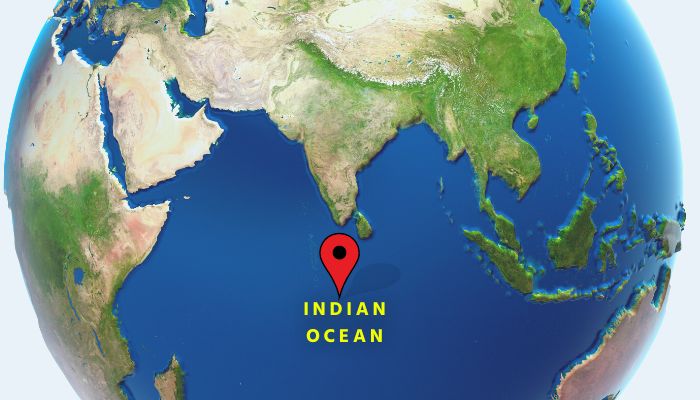
The Indian Ocean basin, the third-largest ocean basin in the world, covers more than 75 million square kilometres and has a total coastline of 70,000 km. It is home to about 39 countries, which together account for 35 per cent of the world’s population and 40 per cent of the world’s coastline. Almost eighty per cent of the world’s sea trade and two-thirds of the world’s oil trade pass through the Indian Ocean. The Indian Ocean is at the centre of global trade, with crucial chokepoints such as the Straits of Malacca and Hormuz. The sea routes connect West Asia, Africa, and East Asia with Europe and the Americas. About 40 per cent of the world’s offshore oil production comes from the Indian Ocean basin.[iii] At the same time, the region is increasingly vulnerable to a complex spectrum of traditional and non-traditional security threats, ranging from piracy, armed robbery, and maritime terrorism to other forms of illicit maritime activity. Ensuring maritime security in the Indian Ocean, therefore, is not only vital for safeguarding International Shipping Lanes and Sea Lines of Communication but also for maintaining regional stability and sustaining the broader architecture of global economic interdependence.
At the same time, maritime security in the Indian Ocean is increasingly shaped by great power competition, adding a strategic and military dimension to what was traditionally viewed as a space of commerce and connectivity. The growing presence of major powers has intensified geopolitical rivalries, particularly over control of critical sea lanes, chokepoints, and maritime infrastructure. The expanding footprint of China – through port development, logistics networks, and dual-use facilities (also known as Strategic Strong Points) across the Indian Ocean littoral – has raised concerns about strategic encirclement and long-term military access.
India’s maritime approach is increasingly articulated through its policy statement, encapsulated in the acronym MAHASAGAR (Mutual and Holistic Advancement for Security and Growth Across Regions), which builds on the earlier SAGAR policy. MAHASAGAR reflects an integrated approach to maritime security that combines economic development, regional connectivity, environmental sustainability, and cooperative security. It positions India as a provider of security while emphasising inclusivity and partnership rather than confrontation.
This evolving strategic environment has led to the gradual militarisation of the Indian Ocean, evident in increased naval deployments, joint exercises, and the establishment or expansion of overseas bases and access agreements. While these developments may contribute to deterrence and stability, they also heighten the risk of strategic mistrust, competition for influence, and the securitisation of maritime spaces vital to global commerce. Consequently, maritime security in the Indian Ocean must now be understood not only in terms of non-traditional threats but also within the broader context of shifting power dynamics and geopolitical contestation. The following are a few challenges that can be seen as maritime threats in the region.
Environmental Challenges and Climate Change
Environmental issues are a primary concern for most countries in the Indian Ocean region. In the long run, environmental degradation will have serious implications not only for marine ecology but also for the livelihoods of fishing communities. Apart from overfishing, factors such as coral reef degradation due to climate change, ship emissions, and land-based pollution significantly affect fish stocks. Mangroves – essential for coastal protection and biodiversity – are being destroyed by reduced freshwater inflows and human encroachment. Rising sea levels and climate variability will further exacerbate vulnerabilities, potentially displacing around 250 million people globally by 2050.
Humanity will face numerous problems (rising sea levels, migration of people living in low-lying areas, environmental hazards, cyclones, droughts, impacts on health, reduced crop yields, water scarcity, and so on) due to greenhouse gas emissions. Climate change poses multiple challenges for island states in the Indian Ocean. With changes in temperature, precipitation, and humidity, the main sectors, such as agriculture and rural development, will likely be severely affected. The impact can already be seen in heatwaves, cyclones, floods, and the salinisation of coastal waters, as well as in their effects on agriculture, fisheries, and health. A rise in sea levels would result in the gradual submergence of coastal states. As a result, large-scale migration from coastal zones is anticipated. This will create many environmental refugees, mainly from low-lying regions. Seawater intrusion into groundwater and temperature changes can reduce agricultural and fishing incomes in coastal states.
Maritime Domain Awareness and Governance Gaps
A critical challenge in addressing maritime threats in the Indian Ocean is the lack of comprehensive Maritime Domain Awareness (MDA) – the effective understanding of activities at sea that could affect security, safety, the economy, or the environment. The vastness of the ocean, coupled with limited technological and institutional capacities among many littoral States, creates significant blind spots in monitoring maritime activity.
The MDA integrates data from multiple sources, including coastal radar systems, satellite surveillance, automatic identification systems, and intelligence-sharing networks. However, disparities in technological capabilities across the region lead to uneven surveillance coverage, allowing illicit activities such as piracy, trafficking, and illegal fishing to persist.
Strengthening MDA requires not only technological investment but also enhanced regional cooperation. Information-sharing mechanisms, joint patrols, and coordinated surveillance initiatives are essential for bridging existing gaps. Regional frameworks and partnerships can facilitate capacity-building, enabling smaller states to monitor their exclusive economic zones more effectively. In this regard, collaborative approaches involving both regional and extra-regional actors can significantly enhance situational awareness and maritime governance.
In this regard, India has taken a proactive role by establishing the Information Fusion Centre – Indian Ocean Region (IFC-IOR). The IFC-IOR serves as a regional hub for maritime information sharing, integrating data from multiple sources, including coastal radar systems, satellites, and partner countries. It enables real-time monitoring of shipping movements and enhances situational awareness across the Indian Ocean.
By collaborating with partner nations and multinational agencies, IFC-IOR addresses critical gaps in surveillance and coordination. It is a practical implementation of India’s MAHSAGAR vision, promoting transparency, trust-building, and collective security. Strengthening these mechanisms is essential to effectively counter piracy, trafficking, and other illicit activities.
Critical Maritime Infrastructure and Vulnerabilities
The security of critical maritime infrastructure has become a central concern across the Indian Ocean. This includes ports, offshore energy installations, shipping lanes, and submarine communication cables. These assets underpin the global economy and are indispensable for trade, energy security, and digital connectivity.
Submarine cables, in particular, carry the vast majority of global internet and data traffic, making them highly strategic yet vulnerable assets. Disruptions – whether from natural hazards, accidents, or deliberate sabotage – can have far-reaching economic and security consequences. Similarly, major ports and energy infrastructure are increasingly targeted by both physical and cyber threats.
The growing digitisation of maritime logistics and port operations has introduced new vulnerabilities, particularly in the cyber domain. Cyberattacks on port infrastructure, navigation systems, or shipping networks can disrupt global supply chains and undermine economic stability. In a region as critical as the Indian Ocean, such disruptions could have cascading global effects.
Protecting critical maritime infrastructure therefore requires a multi-layered approach that combines physical security, cybersecurity measures, regulatory frameworks, and international cooperation. Ensuring resilience in these systems is essential to maintaining the stability and reliability of global maritime networks.
Non-state Actors
Due to the vastness of the oceans, unhindered access, the absence of national jurisdiction on the high seas, and the limited maritime capabilities of most nations in the Indian Ocean region, non-state actors are operating without detection by security agencies. Coastal states can address maritime threats by sharing their experiences, collaboratively analysing the current situation, and assessing future scenarios and prospects for human development.
Piracy and Transnational Crime
The persistence of piracy[iv], particularly in the Gulf of Aden and the Horn of Africa, remains a major concern. The Flag of Convenience (FOC) facility is offered by 30 small states, and nearly 50 per cent of global shipping is registered under such arrangements. This complicates regulation.[v] According to World Bank estimates, piracy costs the global economy approximately US$18 billion annually.[vi]
Maritime trade has been affected by the resurgence in piracy and naval theft since the beginning of the 1990s.[vii] It depends on the security of routes and passages. This explains the growing number of projects, i.e., the opening of new communication channels, which may alter the geopolitics of world maritime transport. Conventional merchant ships carry heroin and opium from the Golden Triangle (Myanmar, Laos, and Thailand) to Europe via major ports such as Karachi, Mumbai, Dubai, and Istanbul. Drugs also travel through the Golden Crescent (Afghanistan, Pakistan, and Iran) to the West and the Far East. Drugs worth US$500 billion a year are being transported, which is larger than the global oil trade.[viii]
Illegal fishing has long been a problem in the region and has been linked to the rise of piracy off Somalia’s coast. It has been estimated that unregulated Iranian fishing vessels catch up to 100,000 metric tonnes of fish from Somali waters each year.[ix] The Minister of Fisheries and Marine Resources of the Federal Government of Somalia, Abdilahi Bidhan Warsame, said, “It is very concerning to see that foreign fleets are not prepared to go through the legitimate channels to gain access to fish in Somalia. We call on all distant water fishing nations to ensure they control their flagged vessels and respect our management regime.”
[x] Due to ineffective policy, “a generation that did not find education, that did not find employment, that did not find a way to learn the good traditions and customs of the Somali people. Hunger, poverty, and refugees all impacted the new generation that has grown since… In the absence of the responsibility of a government, many young people who should have been on the path to a good and bright future were neglected.[xi]”
The overexploitation of fisheries by both international commercial and illegal foreign fishing has marginalised Somali fishers. The fishers need more infrastructure and technology to maximise their catch. Many of these fishers were previously farmers who had to switch to fishing to survive. Due to the depletion of local fish stocks and the presence of foreign trawlers, half of Somalia’s population has become poor.[xii] Somali pirates justify their activities by claiming that they protect Somalia’s natural resources and that payment should be considered legitimate taxation—necessary steps to address their problems, particularly the eradication of poverty in ungoverned areas. Pirates attack from the shore in motorboats, and most attacks are carried out under cover of darkness. It is also easy to attack at anchorage, when the crew is preparing for upcoming cargo operations. Maritime pirates are increasingly exploiting the world’s ungoverned spaces with growing success. The pirates of today could become terrorists of tomorrow.[xiii]
Maritime Terrorism
After the Cold War, maritime terrorism took on a transnational dimension, making it difficult for states to curb such activities. Hence, this evil must be fought collectively by all states. As threats from the sea increase, littoral states need to enhance their cooperation on maritime security. The rise of maritime terrorism disrupts peace and stability at sea. Ships and other vessels can themselves become ‘tools of terror’.
The growing commercial activity at sea makes it the preferred route for terrorist elements such as Al Qaeda, Lashkar-e-Taiba (LeT), and other groups that have carried out a series of incidents by using the sea route to attack targets. The Mumbai (India) attack has only reiterated the urgency for the navy to fight against terrorist activities. LeT sought to conduct its activities at sea and established its ‘sea wing.’ It is believed that the Indian Ocean region has a large number of merchant vessels belonging to various terrorist organisations such as Al Qaeda. One cannot ignore the possibility of a nexus between pirates and terrorists in the maritime domain.
Conclusion
Maritime security in the Indian Ocean is increasingly shaped by the intersection of traditional and non-traditional threats and by intensifying great-power competition. Environmental challenges, technological vulnerabilities, and governance gaps further complicate the security landscape. Addressing these challenges requires a comprehensive, cooperative approach involving regional and extra-regional actors. Enhancing maritime domain awareness, securing critical infrastructure, and managing geopolitical competition are essential to a stable maritime order. The future of the Indian Ocean will depend on states’ ability to balance competition with cooperation, ensuring that this vital maritime space continues to serve as a conduit for global prosperity rather than a zone of conflict.
Author Brief Bio: Professor Adluri Subramanyam Raju is a Professor at the Centre for South Asian Studies. He is also the Coordinator of Centre for Maritime Studies at Pondicherry University, Puducherry.
References:
[i] Geoffrey Till, Sea Power: A Guide for the Twenty-First Century, London: Routledge, 2009, p. 303.
[ii] Ibid.
[iii] See https://incois.gov.in/documents/iogoos/pdfs/IOGOOS_Strategy.pdf, accessed 14 November 2024.
[iv] The International Maritime Bureau (IMB) defines piracy and armed robbery as “an act of boarding or attempting to board any ship with the apparent intent to commit theft or any other crime and with the apparent attempt or capability to use force in the furtherance of that act.” See Rupert Herbert-Burns, Sam Bateman, and Peter Lehr (eds), Lloyd’s MIU Handbook of Maritime Security, New York: CRC Press, 2009, p. 75.
[v] P.K. Ghosh, “Maritime Security Challenges in South Asia and the Indian Ocean: Response Strategies”, American-Pacific Sealanes Security Institute Conference on Maritime Security in Asia, Center for Strategic and International Studies, 18-20 January 2006, Honolulu, Hawaii, cited in Alok Bansal, “Maritime Threat Perceptions: Non-State Actors in the Indian Ocean region”, Maritime Affairs, vol. 6, no.1, Summer 2010, p. 16.
[vi] Salman Khurshid, Julie Bishop and Marty Natalegawa, “Putting out to Sea a new Vision”, The Hindu, 2 November 2013, p. 9.
[vii] Till, n.1, p. 296.
[viii] Louis Kraas, “US Anti-Narcotics Strategy at War with Reality”, Strategic Comments, London: IISS, 5 March 2000, cited in Till, n.1, p. 296.
[ix] See https://stopillegalfishing.com/news-articles/iranian-fishing-vessels-continueto-ignore-regulations-in-somalia-and-yemen/#:~:text=This%20challenge%20is%20not%20new, Federal%20Government%20of%20Somalia%2C%20HE,
accessed 20 March 2024.
[x] Ibid.
[xi] “Somalia at a Crossroads and the Duty of the International Community”, address given by HE Sheikh Sharif Sheikh Ahmed, President of the Transitional Federal Government of Somalia to the Royal Institute of International Affairs, Chatham House, London, 8 March 2010.
[xii] Rubrick Beigon, “Somali Piracy and the International Response”, Foreign Policy in Focus, Commentary dated 29 January 2009, www.fpif.org/fpitxt/5827, cited in Alok Bansal, “Maritime Threat Perceptions: Non-State Actors in the Indian Ocean region”, Maritime Affairs, vol. 6, no.1, Summer 2010, p. 16.
[xiii] Michael Mc Nicholas, Maritime Security: An Introduction, Amsterdam: Elsevier Inc., 2008, p. 167.