
Introduction: Naming the Logic, Not the Place
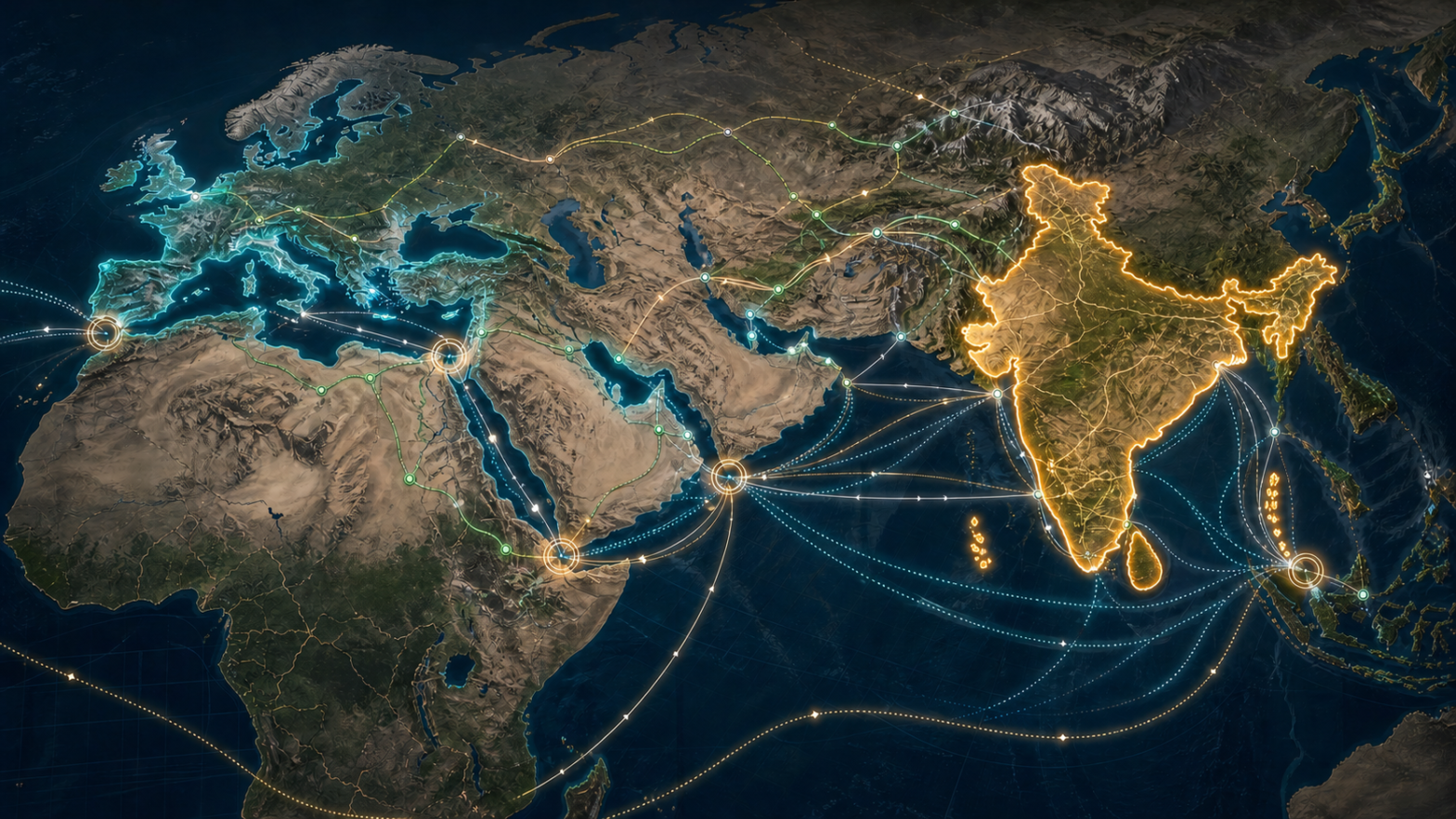
A new strategic geography is taking shape along the arc stretching from India’s western seaboard, through the Arabian Sea and the Gulf, across the Levant, and into the Mediterranean. Its threads are the seaborne trade of three continents, the energy that powers them, the undersea cables that carry their data, and the financial systems that settle their transactions. Strategic discourse in India and Europe has begun to call this space the Indo-Mediterranean. In a joint statement, the leaders of India and Italy described the emergence of “what might be termed the Indo-Mediterranean, an important corridor for trade, technology, energy, data and ideas tying the Indian Ocean to Europe.”1 The phrase is more than a diplomatic ornament. It recognises that a single band of physical geography now carries the systems on which two continents depend.
The temptation is to define this space as the Indo-Pacific’s western extension, applying the same logic of maritime competition beyond the Arabian Peninsula. This paper argues that this temptation should be resisted, as it obscures what is genuinely new about the space and therefore disarms strategy before it begins. Naming a place is the work of cartographers. Naming the logic by which a place must be understood is the work of strategy. Mahan did not name the oceans; he named sea power. Mackinder did not name Eurasia; he named the pivot. The Indo-Mediterranean does not need another mapmaker. It needs its organising logic identified.
This paper offers a logic and gives it a name: correlated risk. The argument proceeds through five propositions, each contestable and consequential. The paper claims no new theory. It applies established reasoning, drawn from reliability engineering, portfolio theory, and the scholarship on weaponised interdependence, to an emerging strategic space. Its single contribution is that application, demonstrated through the crisis of 2026.
Proposition I: A New Geography Exists, and It Is Not the Indo-Pacific
The claim that the Indo-Mediterranean is a distinct strategic geography must be earned, not asserted, because the obvious objection is that it is merely a sub-region of the Indo-Pacific or an arena of European neighbourhood policy. The distinction rests on three structural features that together give the space a logic the Indo-Pacific framing cannot capture.
The first is the absence of a hegemon. The Indo-Pacific, as a strategic construct, is organised around a single peer competitor. For the United States, India, Japan, and Australia alike, the central question is how to balance China’s rising power, and the characteristic instruments are those of balance: presence, deterrence, and alliance. The Indo-Mediterranean has no such organising pole. China is present through its commercial reach, from Indian Ocean ports to the Mediterranean terminus at Piraeus, but it is not hegemonic there; nor are the United States, the European Union, India, or the Gulf states. The space is genuinely plural: several powers of comparable but partial weight, none able to impose order.
The second feature is chokepoint density. No comparable stretch of the world’s surface concentrates so many critical maritime passages in such a confined space. The Strait of Hormuz, the Bab el-Mandeb, the approaches to the Suez Canal, and the contested waters of the eastern Mediterranean lie within a few days’ sailing of one another, and through them passes a share of the world’s energy and trade out of all proportion to their physical extent. The Indo-Pacific has its chokepoints, Malacca above all, but they are dispersed across an ocean. The Indo-Mediterranean is defined by chokepoints, strung close together along a single thread. A geography defined by the proximity of its chokepoints behaves differently under stress, because a single disturbance can affect several at once.
The third feature is the coupling of domains. Across the Indo-Mediterranean, the energy, trade, data, and financial systems do not run on parallel tracks; they run along the same physical geography. Undersea cables follow the shipping lanes through the same straits; energy flows and container traffic traverse the same passages; financial settlement tracks trade. In the wider Indo-Pacific, these systems retain some independence through sheer dispersion. In the Indo-Mediterranean, they are bundled so tightly that they constitute a single coupled system. A coupled system is defined by the fact that its parts fail together.
These three features define a category of strategic space that requires a distinct doctrine. While the Indo-Pacific asks how to balance a rival, the Indo-Mediterranean asks how to keep a coupled, chokepoint-dense system from failing all at once in a space where no one is in charge. While the Indo-Pacific rewards the accumulation of presence, the Indo-Mediterranean rewards the building of resilience. The Indo-Pacific is a balance-of-power geography. The Indo-Mediterranean is a resilience geography. They are distinct categories of strategic space, and they require different doctrines.
The structural forces shaping this geography are not transient. The gravitational shift of the world economy towards the Indian Ocean, the rewiring of the strategic map by the energy transition, the superimposition of a digital and data layer over the physical one, and the return of multipolar competition are deep currents, not cyclical fluctuations. They will not reverse with an administration or a ceasefire. The resilience geography is emerging because the foundations of the world economy, the energy system, the information order, and the balance of power are shaping it. The only open question is what logic will be brought to bear on it.
Proposition II: The Governing Logic Is Correlated Failure
If the Indo-Mediterranean is a resilience geography, its governing strategic question is how its components fail, and specifically whether they fail together. This is the heart of the paper, and it can be stated as a principle that, once seen, is hard to unsee.
The case for connectivity infrastructure rests on redundancy. If one route closes, another absorbs the traffic; alternative corridors are an insurance policy against disruption. The India-Middle East-Europe Economic Corridor (IMEC), whose Memorandum of Understanding was signed on 9 September 2023 at the G20 summit in New Delhi by India, the United States, Saudi Arabia, the United Arab Emirates, the European Union, France, Germany, and Italy, is routinely justified in exactly these terms.2 But redundancy delivers resilience only if the failure modes of the alternative are independent of the risks that disable the primary. A backup that fails for the same reason, and at the same moment, as the primary provides no protection at all.
This is not a novel insight in other fields. In reliability engineering, it is known as common-cause failure: an event that causes the simultaneous failure of two or more redundant channels, thereby defeating the redundancy intended to guarantee the system.3 In portfolio theory, it is the problem of correlation, formalised by Harry Markowitz, who demonstrated that diversification reduces risk only to the extent that the assets held are not correlated with one another.4 A portfolio of assets that all move together is no safer than a single holding. Applied to strategic geography, the principle is simple: two routes that pass through, or depend on, the same conflict-prone zone is correlated. Building the second does not hedge the first.
There is a counterpoint worth confronting. In 1990, Edward Luttwak argued that the post-Cold War world would see “the methods of commerce” displace military methods, with “disposable capital in lieu of firepower” and “market penetration in lieu of garrisons and bases.”5 On that expectation, corridors would be governed by the grammar of commerce. However, the corridors of the Indo-Mediterranean have instead been weaponised. As Henry Farrell and Abraham Newman have shown, states with jurisdiction over the central nodes of global networks can exploit that position through a “chokepoint effect,” denying adversaries access to flows of energy, goods, and information.6 The corridor is not neutral plumbing. It is an instrument, and coercion is applied at its nodes.
The comparative evidence supports the correlated-failure reading. The Middle Corridor across the Caspian has gained relevance precisely because it offers a route independent of both Russian territory and the volatile maritime chokepoints. A World Bank assessment concluded that it could provide resilience and route diversification for China-Europe trade, thereby shielding supply chains from geopolitical shocks.7 By contrast, the International North-South Transport Corridor has struggled because its nodes are linked to sanctioned or conflict-prone jurisdictions in Iran and Russia, so the risks it carries are correlated with the very disruptions a hedge is meant to avoid.
Proposition III: The 2026 Crisis Was the Proof
The theoretical case became empirical in early 2026. The sequence warrants careful attention. Following the Gaza ceasefire of October 2025, the Houthis suspended their campaign against commercial shipping, and traffic through the Red Sea began to partially recover.8 That recovery was interrupted. On 28 February 2026, the United States and Israel launched strikes against Iran; Iran responded by attacking targets across the region and moving to close the Strait of Hormuz.9 The waterway was effectively shut within days. The stakes were considerable: in 2025, an average of 20 million barrels of crude oil and oil products per day moved through the strait, around one quarter of the world’s seaborne oil trade, while the Qatari and Emirati LNG passing through it represented almost one fifth of global LNG exports.10 By early April, an estimated 1,000 vessels were caught in a holding pattern in and around the Gulf.11 QatarEnergy declared force majeure on long-term LNG supply contracts as Ras Laffan output was disrupted.12 On 28 March 2026, the Houthis fired a ballistic missile at Israel, their first attack since the ceasefire, threatening the Red Sea once again.13 Hormuz and the Red Sea were now disrupted simultaneously, a condition without recent precedent. A conditional ceasefire was announced in April, but shipping did not recover: well into 2026, Suez Canal traffic remained roughly half of its pre-crisis peak.14
Here is the analytical point. The proposed overland alternatives within IMEC, the Levant leg linking the Gulf through Jordan and Israel to the Mediterranean, run through the very conflict zone whose instability closed the sea lanes. The corridor’s redundancy and the risk it is meant to hedge are correlated. Had the rail spine existed in February 2026, it would have failed at the same moment and for the same reason as the maritime routes it was intended to back up. The conditional phrasing is deliberate: the IMEC rail does not yet exist. That is precisely why the point is a warning about sequencing rather than a post-mortem.
The crisis also clarifies how the corridor’s benefits have been presented. The claim that IMEC will make trade between India and Europe forty per cent faster is attributed to European Commission President Ursula von der Leyen’s 2023 State of the Union address.15 The companion figure of thirty per cent lower cost has no verifiable official measurement behind it.16 Both are political projections for a route that has not been built. In a resilience geography, projected efficiency gains are worth little if they are not weighted by the independence of the route’s failure modes.
The lesson is not that the Indo-Mediterranean lacks strategic value. The diversification imperative argues powerfully for it, and the crisis once again demonstrated that concentrating the world’s energy and trade through a handful of narrow passages is a first-order fragility. The lesson is that the corridor’s value must be built on components genuinely independent of regional conflict risk, not asserted on the basis of redundancy the geography does not in fact provide. That requirement turns the logic of correlated risk into a strategy.
Proposition IV: The Strategy Is Sequencing by Independence
If correlated failure is the governing risk, the operational doctrine is to sequence investment by the product of standalone value and failure-mode independence. A component earns priority when it delivers benefit on its own, without waiting for the rest of the corridor, and when its vulnerabilities are uncorrelated with those already in place.
The corridor’s substantive agenda can be organised around six pillars: strategic security; economic integration, anchored by the free trade agreement between India and the European Union, concluded on 27 January 2026;17 digital and artificial-intelligence infrastructure; the energy transition; innovation and human capital; and adaptive governance. None of these pillars is presented as original. They synthesise established frameworks, including the G20 Principles for Quality Infrastructure Investment, endorsed at Osaka in 2019.18 The contribution lies in the ordering rule applied to them, which produces three tiers.
Tier one comprises the independent foundations, the elements that stand alone and whose failure modes are least correlated with regional conflict. The India-Gulf maritime leg is already operational; bilateral India-UAE trade reached 65 billion US dollars in 2024, supported by the intergovernmental framework agreement on IMEC, signed on 13 February 2024.19 An interoperable digital layer for trade documentation and payments can be built without laying a single rail, does not prescribe any single nation’s platform, and is largely immune to land-based conflict. The western, Mediterranean section of the Blue-Raman submarine cable is complete and in service, while its Red Sea segment has been delayed due to security risks.20 Cheapest of all and highest in leverage is a permanent coordinating secretariat: the corridor still lacks one, and creating it costs almost nothing relative to the value it would unlock.
Tier two comprises conditional investments, to be made only when specified enabling conditions are met: cross-border digital identity, port-clustered manufacturing, and the exposed segments of the data-cable network. Tier three comprises what should be held in reserve: the Gulf-Levant rail spine and the cross-Israel connection, the components most correlated with regional conflict and carrying the least standalone value until the entire chain is complete. This is not an argument for abandoning them. It is an argument for hedging them by advancing alternative routings, for instance via Egypt or around the Arabian Peninsula through Oman, thereby bypassing Hormuz entirely. Atlantic Council analysts estimate that a network of such corridors could displace roughly sixty per cent of the container traffic now vulnerable to Hormuz disruption.21
The financing profile reinforces the point. An Atlantic Council assessment finds that IMEC faces about 5 billion US dollars in costs to become minimally operational, with costs concentrated in the Jordan-Israel segment, exactly the leg most exposed to the conflict that closed the sea lanes.22 Meanwhile, India has committed some 10 billion US dollars to port modernisation, and Saudi Arabia has pledged around 20 billion US dollars towards corridor-linked infrastructure, investments whose value does not depend on the Levant leg.23 Sequencing by independence prevents states from pouring capital into the most vulnerable nodes first.
Proposition V: India Anchors the Order Through Independent Capability
An honest analysis must address an objection. By conventional measures, India is the weakest of the major actors in the western half of this space. Its naval reach beyond the Arabian Sea is limited; it maintains no presence in the Mediterranean; and its economic weight in the Gulf, though growing, is surpassed by China’s. If the Indo-Mediterranean were a balance-of-power geography, these facts would settle the question: India could not lead.
The resolution lies in the distinction drawn at the outset. In a balance-of-power geography, leadership flows from presence. In a resilience geography, leadership flows from providing the independent capabilities that keep the system functioning when parts of it fail. India’s position is strong. India operates digital public infrastructure at a scale few states can match, in payments, identity, and data exchange, exactly the kind of low-correlation, standalone capability that a resilience geography rewards. It provides maritime security across the Arabian Sea and the western Indian Ocean, the eastern approach on which the whole corridor depends. Through the free trade agreement of January 2026, it anchors the corridor’s economic integration with Europe. And its long tradition of strategic autonomy suits the plural governance of a space with no hegemon, allowing it to engage all parties without being captured by any.
India leads, therefore, not by being present everywhere, which it cannot be, but by owning the independent capabilities that geography rewards. This is a role that fits India’s actual capabilities rather than its aspirational ones, and it is a more durable role for exactly that reason: it does not depend on parity of presence India will not soon achieve, but on leadership in capability India already holds. The weakest power by the old measure becomes the natural anchor by the new one, provided it understands geography correctly and acts on the logic that geography demands.
The Doctrine
The five propositions constitute a single doctrine, and a doctrine, to be worth the name, must be expressible in one sentence and then unfolded. Here is the sentence. In a chokepoint-dense geography without a hegemon, strategic advantage comes not from controlling routes but from building capabilities whose vulnerabilities are independent of one another; and India’s role is to anchor an open Indo-Mediterranean order by leading in precisely those independent capabilities. From that sentence, everything in this paper follows. The geography’s distinctiveness makes control of routes the wrong objective and resilience the right one. The logic of correlated failure makes independence of vulnerabilities the measure of value. The 2026 crisis proves that the measure is real and that the conventional redundancy rationale is unsafe. The sequencing strategy is the doctrine’s operational form. And India’s role is its application to the one power whose capabilities fit the logic.
Four working principles are derived from the same sentence: independence over redundancy, because an alternative route has strategic value only if its failure modes are independent of the primary’s risks; capability over geography, because influence in a non-hegemonic space belongs to the provider of resilient standalone capabilities rather than to the power with the largest footprint; sequencing over completion, because staging investment by independence keeps the corridor valuable even if the full physical link is never completed; and openness over control, because connectivity organised as a commons lowers costs for all participants, whereas connectivity organised as an instrument of exclusion invites the very coercion the doctrine is designed to escape.
Conclusion
This paper has argued that the Indo-Mediterranean is not the Indo-Pacific extended westward but a distinct category of strategic space, a resilience geography, chokepoint-dense and without a hegemon, and that the logic governing it is the logic of correlated risk. It has argued that the redundancy on which the strategic case for the space conventionally rests is, when the alternatives’ failures are correlated with the risks they hedge, no redundancy at all; that the 2026 crisis demonstrated this in a contemporary case; that the strategy the logic demands is to sequence investment by standalone value and independence; and that India’s role is to anchor an open order by leading in the independent capabilities the geography rewards.
Looking towards 2050, the objective is a resilient, sequenced, and open Indo-Mediterranean order: one in which investment is staged for failure-mode independence rather than headline efficiency, in which no single conflict can sever energy, trade, data, and finance at once, and in which India stands as the indispensable anchor rather than an aspirant hegemon. The corridor’s promise is real, but it will be realised only if its builders treat correlation, not distance or cost, as the variable that matters most. The 2026 crisis was a rehearsal. The lesson it taught was sequencing by independence, and that lesson is available to anyone willing to read established reasoning into a new map.24
Author Brief Bio: Suryanarayanan Dinakaran is the Founder and Director of Webronic Industries Private Limited, India, and Co-Founder of Thingsatweb Sweden AB, where he has led technology and infrastructure ventures spanning India and Scandinavia for over a decade. He is a Research Scholar in Public Administration, with research interests at the intersection of geopolitics, geoeconomics, and strategic decision-making under uncertainty. His current work examines how states should plan, sequence, and build resilient infrastructure and connectivity in an increasingly multipolar world, with particular attention to India’s emerging strategic role across the Indo-Mediterranean.
Endnotes
- Narendra Modi and Giorgia Meloni, “Italy and India: A Strategic Partnership for the Indo-Mediterranean,” joint op-ed, The Times of India and Corriere della Sera, 2026.
- “Memorandum of Understanding on the Principles of an India-Middle East-Europe Economic Corridor,” 9 September 2023, Ministry of External Affairs, Government of India.
- Marvin Rausand and Mary Ann Lundteigen, “Common Cause Failures,” in Reliability of Safety-Critical Systems: Theory and Applications (Hoboken, NJ: Wiley, 2014); International Electrotechnical Commission, IEC 61508: Functional Safety of Electrical/Electronic/Programmable Electronic Safety-Related Systems (Geneva: IEC, 2010).
- Harry Markowitz, “Portfolio Selection,” Journal of Finance 7, no. 1 (1952): 77–91.
- Edward N. Luttwak, “From Geopolitics to Geo-Economics: Logic of Conflict, Grammar of Commerce,” The National Interest, no. 20 (1990): 17–23.
- Henry Farrell and Abraham L. Newman, “Weaponized Interdependence: How Global Economic Networks Shape State Coercion,” International Security 44, no. 1 (2019): 42–79.
- World Bank, Middle Trade and Transport Corridor: Policies and Investments to Triple Freight Volumes and Halve Travel Time by 2030 (Washington, DC: World Bank, 2023).
- “Timeline of the Red Sea Crisis,” gCaptain, 2025.
- House of Commons Library, US-Iran Ceasefire and Nuclear Talks in 2026, Briefing Paper CBP-10637 (London: UK Parliament, 2026).
- International Energy Agency, “Strait of Hormuz,” factsheet, 2026; U.S. Energy Information Administration, “Amid Regional Conflict, the Strait of Hormuz Remains Critical Oil Chokepoint,” Today in Energy, 2025.
- Congressional Research Service, The Strait of Hormuz in Brief: Non-Oil Shipments and Effects on U.S. Shippers, Report R48903 (Washington, DC: CRS, 2026).
- “QatarEnergy Declares Force Majeure on Some LNG Contracts Due to Iran War,” Al Jazeera, 24 March 2026.
- “A Houthi Missile Attack on Israel Raises Concerns About Red Sea Shipping Routes Being Blocked,” Associated Press, 28 March 2026.
- House of Commons Library, Israel/US-Iran Conflict 2026: Reopening the Strait of Hormuz, Briefing Paper CBP-10636 (London: UK Parliament, 2026); Niels Rasmussen, “Suez Canal Traffic Stalls at 60% Below Normal Despite 100 Days Without Houthi Attacks,” gCaptain, January 2026.
- Ursula von der Leyen, “2023 State of the Union Address,” European Commission, Strasbourg, 13 September 2023.
- Asher Fredman and Joseph Rozen, The India-Middle East-Europe Economic Corridor: A Catalyst for Regional Integration and Global Prosperity (Jerusalem: Misgav Institute, 2025).
- European Commission, “EU and India Conclude Landmark Free Trade Agreement,” press release, 27 January 2026.
- G20, G20 Principles for Quality Infrastructure Investment, Osaka Summit, June 2019.
- Press Information Bureau, Government of India, “Cabinet Approves Inter-Governmental Framework Agreement between India and the United Arab Emirates on Cooperation for the Empowerment and Operation of the IMEC,” 13 February 2024; Allison Minor et al., “It Is Europe’s Time to Shine on IMEC,” Atlantic Council, 2025.
- “Blue-Raman,” Submarine Networks, updated 2026.
- Nicholas Shafer and Afaq Hussein, “A Network of Corridors Is the Only Reliable Hedge Against Middle East Chokepoint Disruptions,” Atlantic Council, 2025.
- Nicholas Shafer and Afaq Hussein, The India-Middle East-Europe Economic Corridor: Connectivity in an Era of Geopolitical Uncertainty (Washington, DC: Atlantic Council, 2025).
- Shafer and Hussein, The India-Middle East-Europe Economic Corridor; Begin-Sadat-Center for Strategic Studies, “IMEC: A Corridor for Peace and Regional Stability,” 2025.
- The analytical instruments applied here are established: common-cause failure in reliability engineering, portfolio diversification, weaponised interdependence, and decision-making under deep uncertainty; see Vincent A. W. J. Marchau et al., eds., Decision Making under Deep Uncertainty: From Theory to Practice (Cham: Springer, 2019).