
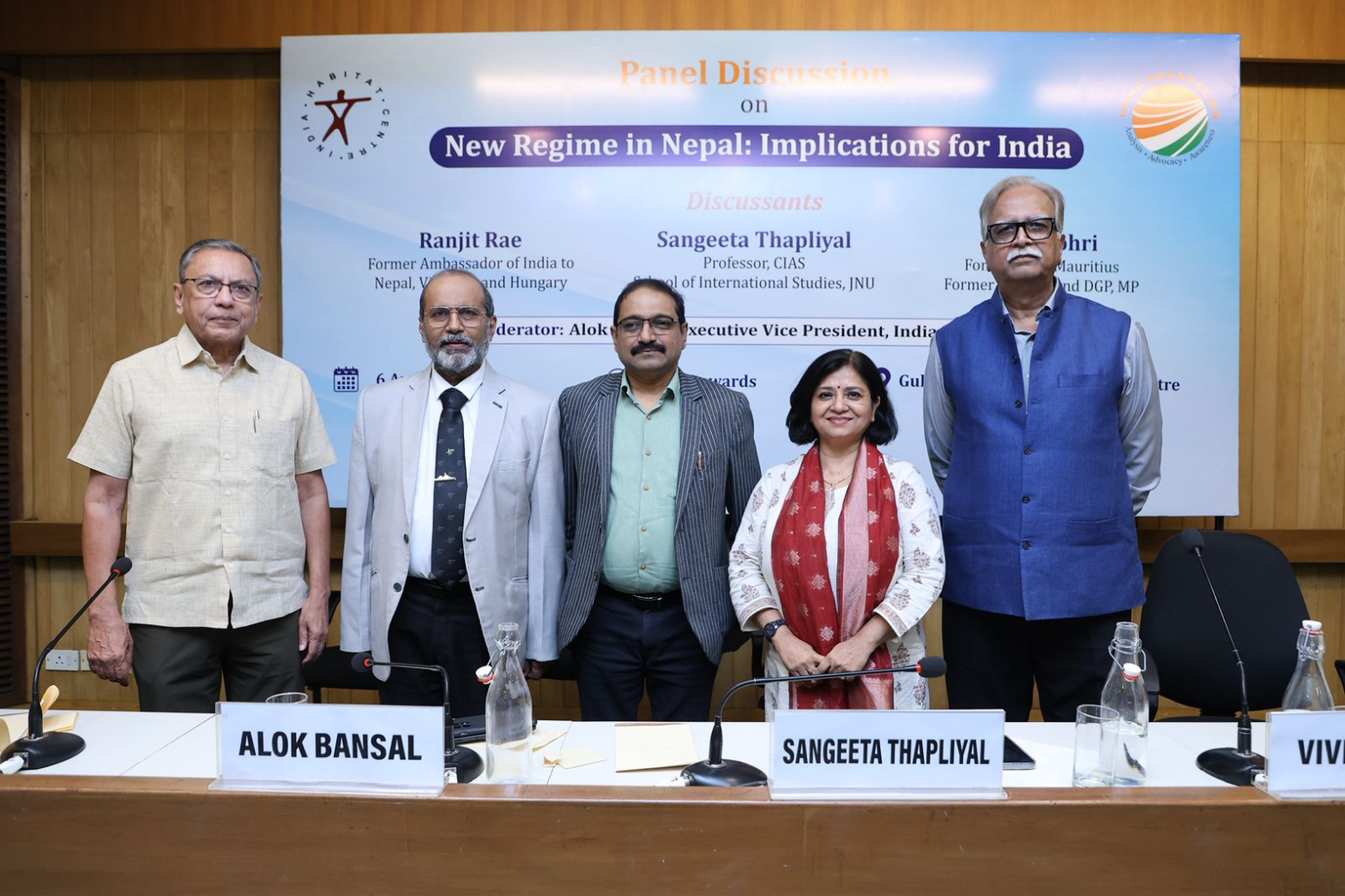
On 6th April 2026, India Foundation, in collaboration with the India Habitat Centre, organised a panel discussion on “New Regime in Nepal: Implications for India.” The panel featured Ambassador Ranjit Rae (former Ambassador to Nepal, Vietnam, and Hungary), Professor Sangeeta Thapliyal (CIAS, School of International Studies, JNU), and Shri Vivek Johri (former National Security Advisor of Mauritius and former DG, BSF). The session was moderated by Captain Alok Bansal (Executive Vice President, India Foundation).
The panelists highlighted that the recent general election in Nepal brought a new paradigm shift in the Himalayan nation’s political landscape, with the emergence of the Rashtriya Swatantra Party (RSP) and a shift towards a younger, digitally empowered set of leaders. The panel discussed this paradigm not only as a change of government in Nepal but also as the transformation in its domestic aspirations and the strategic outlook towards its immediate neighbours, implying a transition from ideological dichotomies to more pragmatic considerations.
One of the central pillars of discussion was how digital mobilization came into its own as the dominant political force through the use of complex digital algorithms and social media interaction, allowing the RSP to circumvent the conventional grassroots network by appealing to a disgruntled electorate. In effect, this mandate was seen as a rejection of the musical chairs game played by established political elites for decades, choosing accountability, meritocracy, and service delivery.
The panel observed there had been a shift towards an interest-based foreign policy strategy; the country, being landlocked, will have to continuously practice balancing acts between India and China, albeit becoming more aggressive about them. The former regime was characterized by ideological politics; the new regime is expected to assess the financial feasibility of infrastructure investments, including the Belt and Road initiative, implying the old system of “ideological balancing” no longer works.
The panelists emphasised that India must urgently recalibrate the “Neighbourhood First” approach by prioritizing implementation to offset the perception of “India promises and China delivers”. This requires evolving beyond diplomatic engagement to integrate Nepal’s digitally literate youth and IT ecosystem into the bilateral relations framework and simultaneously start formal dialogues on the 1950 Treaty and Kalapani issue to prevent their weaponization by domestic opposition, ensuring cooperative growth. The session concluded with a reflection on the “New Regime” marking a new era where performance supersedes ideology as the main criterion of legitimacy. It was observed that the future success of India will be contingent upon whether it can align with a proactive Nepal, determined to achieve financial sovereignty through pragmatic accomplishments.