
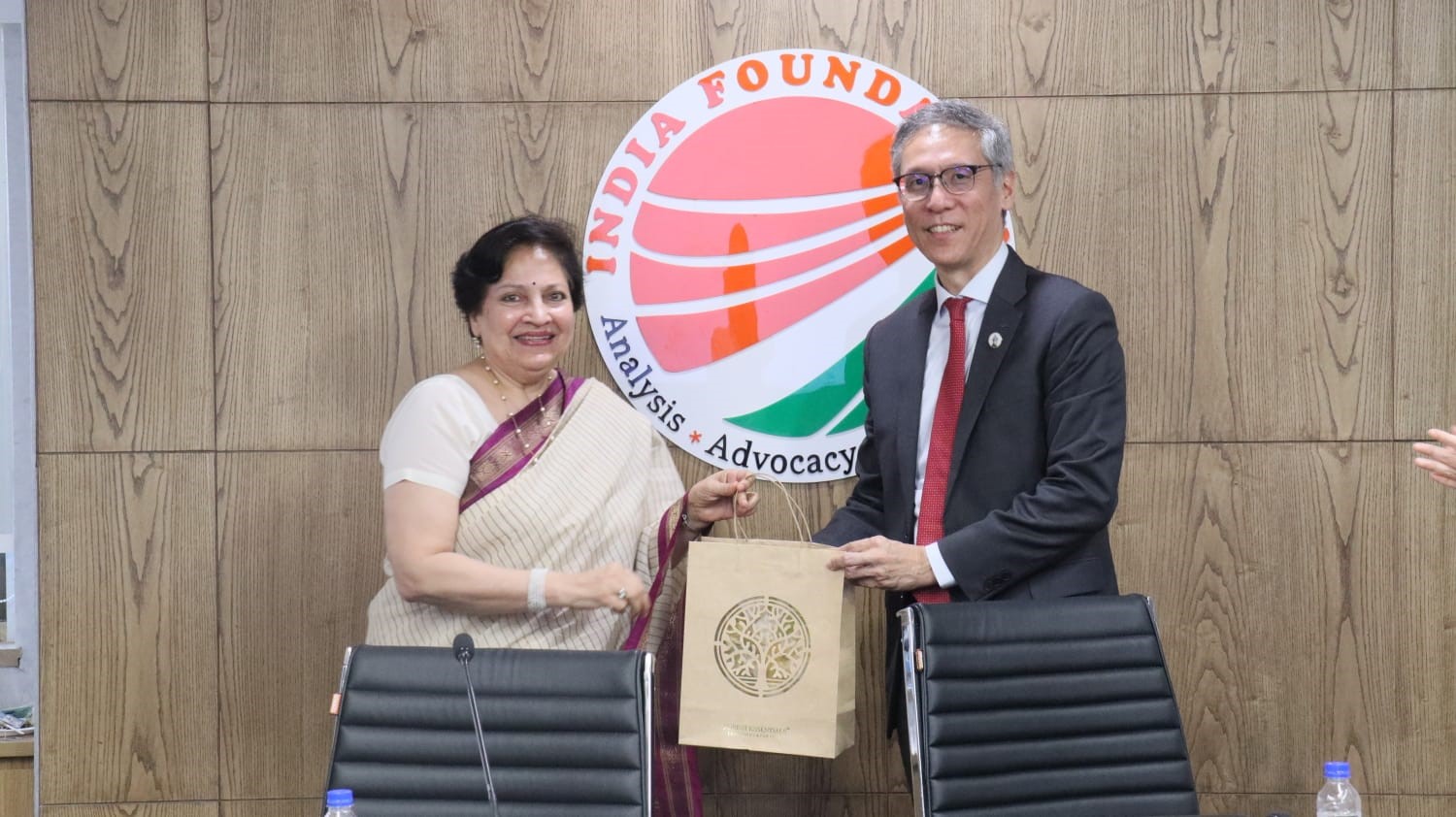
On 12 May 2026, the India Foundation hosted its 107th India Foundation Dialogue on the theme “Gelephu Mindfulness City (GMC)”. The session was addressed by H.E. Jonathan Tow, Former Ambassador of Singapore to Türkiye and Former Deputy High Commissioner of Singapore to India, Bhutan and Nepal. The discussion was moderated by Ambassador Ruchira Kamboj, former Permanent Representative of India to the United Nations.
In her introductory remarks, Ambassador Kamboj described Bhutan’s Gelephu Mindfulness City as a development initiative that has attracted international attention because it seeks to combine economic progress with cultural values, environmental sustainability and societal well-being. She noted that Bhutan has long pursued a distinctive approach to development, balancing modernisation with cultural continuity and ecological stewardship.
In his presentation, Jonathan Tow outlined the vision behind GMC, an ambitious project being developed under the leadership of His Majesty King Jigme Khesar Namgyel Wangchuck. According to the speaker, the project seeks to offer an alternative model of development that combines prosperity, mindfulness and sustainability while addressing Bhutan’s domestic challenges, including economic diversification, employment generation and youth migration.
Tow explained that GMC has been established as a Special Administrative Region (SAR) with considerable autonomy to adopt global best practices in governance, regulation and investment facilitation. He described the initiative as part of a long-term strategy aimed at transforming southern Bhutan into a globally connected economic hub while remaining rooted in Bhutanese values and traditions. The proposed city will focus on eight key sectors: spirituality, wellness, education and knowledge, agri-tech and forestry, green energy and technology, finance and digital assets, aviation and logistics, and tourism. The speaker emphasised that Bhutan’s cultural and spiritual heritage would remain central to the project’s identity.
A major component of the initiative is the development of a new international airport at Gelephu, which Tow described as a potential game-changer for Bhutan’s connectivity. He also highlighted India’s commitment to constructing a railway link from Kokrajhar in Assam to Gelephu, underscoring the importance of India-Bhutan cooperation for the success of the project.
Environmental sustainability featured prominently throughout the presentation. According to the speaker, only a limited portion of the proposed area will be developed, while large sections will remain forested and ecologically protected. Urban planning is intended to integrate rivers, wildlife corridors and green spaces into the city’s design.
Tow also discussed emerging initiatives in digital finance, including a gold-backed digital token known as “Ter”, which he described as a digital asset linked to physical gold rather than speculative cryptocurrencies. The discussion concluded with an interactive question-and-answer session covering issues such as investment opportunities, connectivity, sustainability, governance and the challenges of balancing rapid development with environmental and cultural preservation. The dialogue provided participants with an overview of Bhutan’s vision for Gelephu Mindfulness City and its potential implications for regional connectivity and sustainable development.