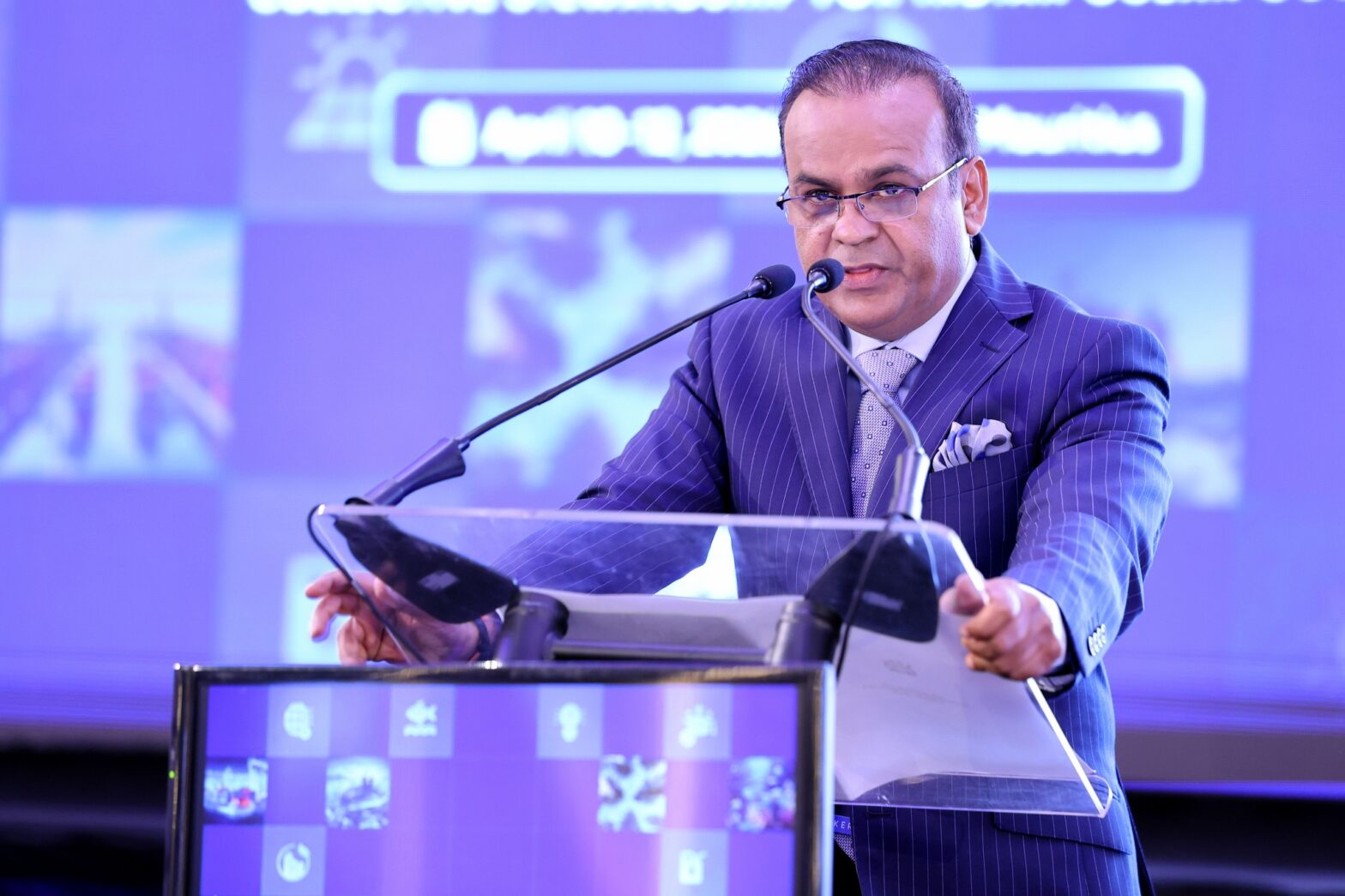
Allow me at the outset to highlight that we have nine African countries bordering the Indian Ocean, and I take pride in being the first African state to host this annual event, which aspires to become a perennial feature of the diplomatic agenda of the Indian Ocean region.
This year’s theme for the Indian Ocean conference, “Collective Stewardship for Indian Ocean Governance,” is highly relevant given the current geopolitical context. Little did we know that when the theme was adopted, the Indian Ocean region and beyond would be affected by the conflict in the Middle East. For over six weeks, the world has experienced major disruptions to the global economy, and some economists are warning that the worst energy crisis in history is on the horizon. The recently concluded ceasefire offers a glimmer of hope. The ceasefire is fragile; the US-Iran talks could end the war or escalate it, but it holds the desperate hope of a possible way forward towards the eventual end of hostilities. The current situation compels us to reflect and reassess our priorities, and to reorient our collective efforts towards effective governance of the Indian Ocean for the interests of the region and beyond.
As far as Mauritius is concerned, the foundation of our foreign policy is to realise a prosperous and sustainable economy. Mauritius is a small island developing state, fully integrated into a globalised and equitable world. Globalisation and equity have never been more relevant, especially for us, the states of the Indian Ocean, and their partners beyond. The national anthem of Mauritius sings of the population of the country gathered as one people, one nation, in peace, justice, and liberty.
We in Mauritius are diverse, hailing from Africa, Asia, and Europe. Our ancestors were forcibly brought to Mauritius; others came by choice. The population of Mauritius has many histories. Diversity is a wealth; it is also a challenge. It calls for the contributions and efforts of all to work towards a common goal and forge a common destiny, especially as we seek to build the bridge to the future. That is the objective of the government of the day. We might not always have common positions, but we all have a common interest in addressing our immediate priorities and building the future we want for our children and the generations to come. The story of Mauritius is thus that of the states of the Indian Ocean and the stakeholders beyond the Indian Ocean. Our governments might not have common positions, but the Indian Ocean is our common interest.
When this government was elected in November 2024, it pledged in its programme to explore all opportunities arising from bilateral and multilateral cooperation to address, among other priorities, the development of the ocean economy, the promotion of regional cooperation, and the enhancement of economic integration, particularly with the coastal states of the Indian Ocean. It also pledged to enhance cooperation with the Indian Ocean Commission and the Indian Ocean Rim Association, and to press for more equitable arrangements for the allocation of marine resources in the Indian Ocean. This is in line with our desire to see ourselves no longer as a small island state, but to position ourselves as a large ocean state. This obviously calls for a change in mindset; it also calls for cooperation and synergy with and beyond the Indian Ocean states.
Respect for sovereignty and territorial integrity has always been and remains a constant in our foreign policy. It is a principle we uphold with conviction and defend consistently. Today, the recognition of our sovereignty over the Chagos Archipelago, as enshrined in our constitution, is a reality acknowledged across the international arena. This is a matter of justice; it is also a reaffirmation of an outcome after more than 50 years of struggle, grounded in international law. I wish to take this opportunity to thank all of you present today for your continuous support in this long struggle for unfinished post-colonial business. We will spare no effort to pursue any diplomatic or legal avenue to complete the decolonisation process in this part of the Indian Ocean.
Yet, for Mauritius, sovereignty has never meant isolation; it has never excluded cooperation. On the contrary, it has guided us towards constructive partnership. While today some dispute the right of passage through international straits, back in 2012 Mauritius and the Republic of Seychelles chose a path of collaboration. We concluded treaties to exercise joint sovereign rights and joint management of the continental shelf in the Mascarene Plateau region. This was a deliberate choice, to avoid lengthy and unnecessary maritime disputes and to act in the shared interest of our peoples. The Mauritius-Seychelles Joint Management Area was a first in history. It is a pioneering model. It is widely regarded as a textbook case of maritime cooperation, delivering tangible benefits to both parties and creating opportunities for others to engage alongside us. Our experience in establishing the Joint Management Area shows that cooperation is possible, that sovereignty and collaboration can go hand in hand, and that together we can build a framework for the collective stewardship of the Indian Ocean.
This is the spirit that must guide us in the Indian Ocean: partnership, pragmatism, and shared responsibility. In line with the principles of the Non-Aligned Movement, Mauritius has remained steadfast in its commitment to sovereignty, territorial integrity, and non-interference in the internal affairs of states. These principles are not abstract; they are essential to stability and fundamental to trust. We do not seek to influence the internal affairs of others; that is not our role. But we are ready to share our experience and to contribute. This is our vision, and this is our commitment.
Effective governance requires a rules-based order to which all parties agree to abide. This ensures coherence, coordination, and organisation for the good of all. On that score, we are fortunate to have the United Nations Convention on the Law of the Sea (UNCLOS), which sets the legal framework for all ocean space, including the Indian Ocean. UNCLOS thus provides all Indian Ocean states and beyond with the legal parameters for marine activities and resource management, and defines maritime zones and jurisdictions, amongst others. UNCLOS is therefore a grand maritime architecture.
More recently, the UN agreement on Marine Biological Diversity of Areas Beyond National Jurisdiction, the BBNJ agreement, entered into force in January 2026. The BBNJ addresses gaps in the sustainable use of marine biodiversity in areas beyond national jurisdiction. The Indian Ocean is vast. We, the coastal states of the Indian Ocean, are already hard-pressed to manage our EEZs. This is why UNCLOS, BBNJ, and the two other implementation agreements under UNCLOS are welcome. Their legal frameworks provide the context in which we can work towards our collective stewardship of Indian Ocean governance. Those UN legal frameworks provide the context in which the Indian Ocean Commission and the Indian Ocean Rim Association operate, respectively, for peace and stability in our region of the Indian Ocean, and for socio-economic and other peaceful considerations. Both organisations are, in fact, hosted by Mauritius.
Our cooperation with parties in the Indian Ocean, such as Exercise Cutlass Express led by the USA and Exercise PAPANGUE led by France, contributes to the upholding and respect for those UN legal instruments. More recently, following the recognition of Mauritius’s sovereignty over the Chagos Archipelago, half a century after our independence in 1968, Mauritius has initiated action to establish a marine protected area in the archipelago and to campaign for the protection and preservation of the terrestrial and marine environments of the archipelago. This project is being organised with the support of the International Union for Conservation of Nature and the British authorities, as both Mauritius and the UK share the same environmental ambitions in the Indian Ocean.
Our commitment to the Indian Ocean cannot be ignored. We must look beyond our shores and towards the horizon. We will work with the region, with the states of the Indian Ocean Rim, and with partners – be they states or organisations beyond the Indian Ocean – to enhance collective governance of the ocean. We also acknowledge the contributions of our partners: Australia, France, India, Japan, the United Kingdom, and the United States of America, in enhancing our governance capacities for the Indian Ocean.
Mauritius Prime Minister, the Honourable Dr Navin Chandra Ramgoolam, highlighted India’s MAHASAGAR, which has expanded India’s maritime vision beyond the Indian Ocean while maintaining its focus on the Global South. Behind this vision lies the practical reality of India’s multifaceted contribution to the collective governance of the Indian Ocean, whether through its current chairmanship of the Indian Ocean Rim Association (IORA) or through its Information Fusion Centre, which enhances maritime safety and security in the Indian Ocean region by sharing information on threats such as piracy, terrorism, drug trafficking, and human trafficking. India’s Information Fusion Centre aligns with the information feeds from the Regional Coordination Operations Centre in Seychelles and the Regional Maritime Information Fusion Centre in Madagascar, both supported by the European Union.
Although at the antipodes of Mauritius, Australia contributes significantly to the Indian Ocean security architecture through its chairmanship of the IORA Working Group on Maritime Safety and Security. Japan is equally far from Mauritius; yet the government’s commitment to taking Mauritius-Japan relations to a new level is evidenced by our opening an embassy in Tokyo in October 2025, during Prime Minister Navin Chandra Ramgoolam’s participation in the 9th Tokyo International Conference on African Development, at which the then-Prime Minister Ishiba announced Japan’s economic region initiative for the Indian Ocean-Africa. The initiative seeks to promote Africa’s regional integration and industrial development in the Indian Ocean-Africa economic region, thereby contributing to global economic growth.
The states of the Indian Ocean are thus aligned on the relevance of collective stewardship for the Indian Ocean. We are looking into developing our port with eventual support from India. This development will undoubtedly contribute to our national development, but the expansion of our port facilities and infrastructure will also facilitate the servicing of all Indian Ocean states, Indian Ocean partners, and state entities beyond the Indian Ocean, thereby improving Indian Ocean governance. It is through the enhancement of collective capacity, bilateral and organisational, that the collective stewardship of the Indian Ocean will gain credibility.
Mauritius is committed to collective stewardship in the governance of the Indian Ocean. Since independence, we have been convinced that multilateralism is the preferred path towards the collective good. This has been our approach to recognising our territorial integrity, promoting the interests of small island developing states, and governing the Indian Ocean. We live in troubled times marked by geopolitical and existential challenges. All of us here today are different; we have different histories and will travel different pathways, yet our presence here at this conference reflects our common interest in the Indian Ocean. Its reach, whether economic, financial, or security-related, extends far beyond the shores of its littoral states. I believe that more than ever, it behoves us to work on our shared interest for our greater good, both today and tomorrow.
Author Brief Bio: H.E. Dhananjay Ramful is the Minister of Foreign Affairs, Mauritius