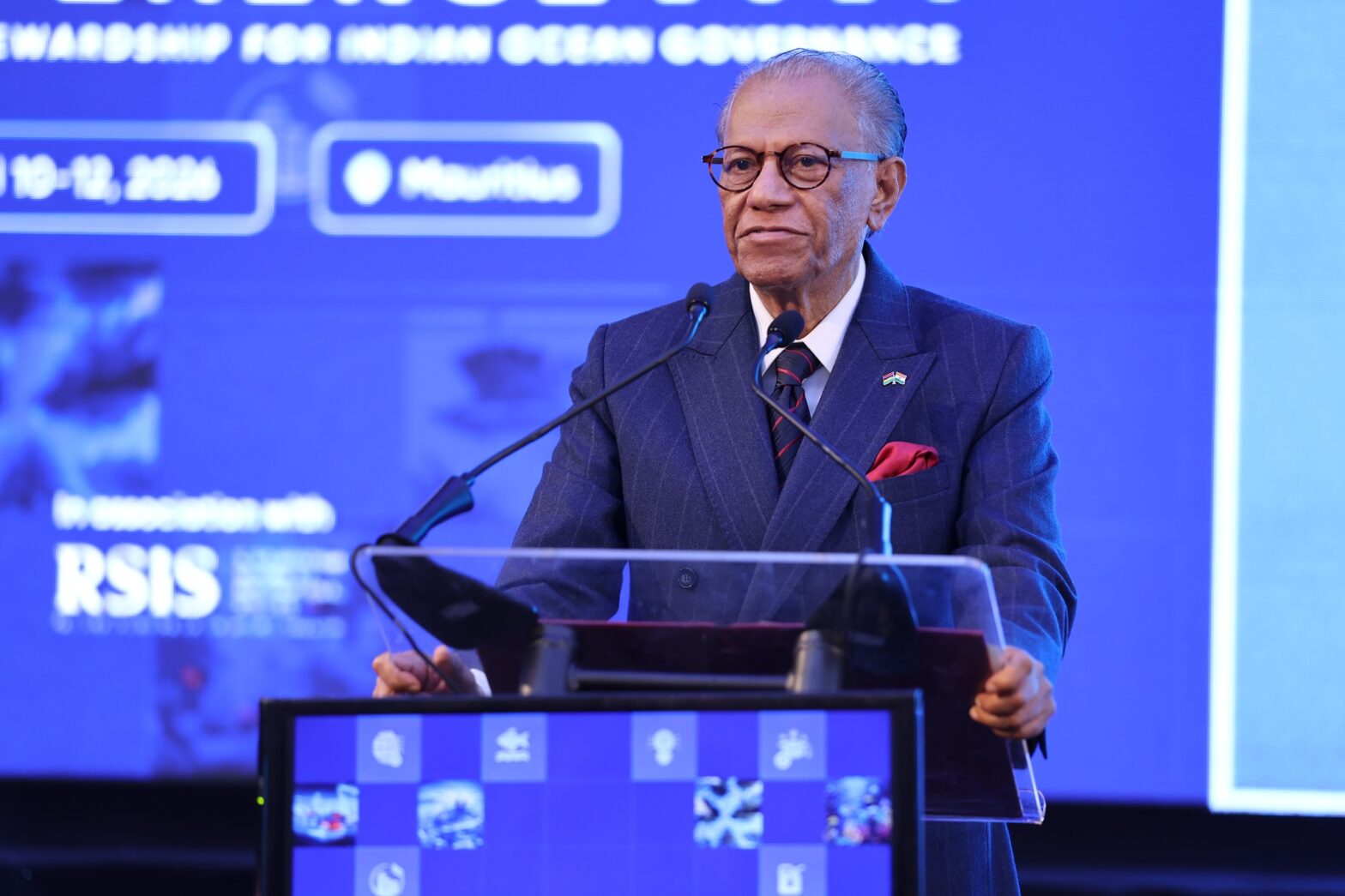
Your Excellencies, Heads of Delegations, Members of the Diplomatic Corps, and Distinguished Guests. I extend a warm welcome to all of you to the 9th Indian Ocean Conference. As you know, this conference is organised by the India Foundation in partnership with the Government of Mauritius. It gives me great pleasure to host this important initiative.
Thank you to the Indian Foundation and its president, Dr Ram Madhav, for their support in organising this conference. The theme of the 9th Indian Ocean Conference could not be more topical or relevant: “Collective Stewardship for Indian Ocean Governance”. Over the next two days, regional leaders, officials, and distinguished experts will discuss matters of vital importance to all their countries and, indeed, to the whole world.
We are navigating a world in turmoil. A confluence of geopolitical upheavals, threats to peace and stability, rapid technological transformation, climate change, and the erosion of diversity has posed grave challenges for humanity—challenges no previous generation has had to confront. The question is, how do we rise to meet them? Your presence in Mauritius today, despite the prevailing circumstances, is not mere symbolism; it is a concrete demonstration that, despite these uncertainties, we can still put dialogue before confrontation and collaboration before conflict.
Whilst we welcome the two-week ceasefire reached a couple of days ago, it remains fragile. We must not be lulled into complacency. We should all work together towards a peaceful and permanent resolution of the crisis. We strongly believe that this can be achieved only through dialogue and diplomatic efforts. We are all aware, as so many international experts and observers say, that the war’s impact will be long-lasting, with devastating effects on our economies. Even now, we’re feeling its impact.
Ladies and Gentlemen, I acknowledge in our midst the presence of Dr Jaishankar, the distinguished Minister of External Affairs from the Republic of India.
The 8th Indian Ocean conference, under the theme “Voyage to New Horizons of Maritime Partnerships”, was hosted by the Sultanate of Oman. His Excellency Sayyid Badr Albusaidi, the Foreign Minister of the Sultanate of Oman, was unable to attend because of the war, but we heard him, and we welcome the inspiring address that we just delivered.
And I salute the presence of leaders and high officials from across the African continent, a continent whose mighty strength is increasingly felt throughout the world. If we join together, united in a common endeavour to promote the goals of peaceful coexistence, dialogue and cooperation in these maritime and other spheres, we will be a powerful force for the good of the world in a troubled world. This would not have been possible without India’s presidency of the G20 from 2022 to 2023 and the commitment of Prime Minister Narendra Modi to advance the cause of the African continent. During India’s presidency, the African Union was admitted as a permanent member of the G20, and we thank Prime Minister Narendra Modi for this initiative.
One of the most influential naval strategists in history, the American Alfred Mahan, emphasised the strategic importance of the Indian Ocean, predicting its central role in future world geopolitics. His words proved prophetic, as he wrote, “whoever controls the Indian Ocean dominates Asia. This ocean is the key to the seven seas in the 21st century. The destiny of the world will be decided on its waters”. The extraordinary thing is that these words were written in the 19th century.
More recently, in 2010, Robert Kaplan, well known for his work on politics and foreign affairs, identified the Indian Ocean and the surrounding region as the new pivot of world politics. The region connects energy producers, manufacturing centres, and major markets across continents. Its sea lanes carry a substantial share of global trade, and its choke points are critical to the functioning of the global economy. But it is now much more than that. It is becoming a strategic system in its own right. In an era of renewed great power rivalry, such geography inevitably attracts strategic attention. For the region’s states, this critical juncture presents both opportunities and risks. We cannot allow the future shape of our maritime region to be determined solely by others.
And that must be combined with the way to which I have alluded. The risk is that individual voices will be drowned out in the strident roar of the biggest beasts. The central challenge lies in ensuring that the Indian Ocean remains an area of cooperation rather than of confrontation. But this requires a shift in approach and perspective, moving away from geographical relevance to strategic relevance, from individual positioning to regional awareness, and from passive adaptation to a policy of shaping the future of the region in which we all dwell.
Conflicts propagate through interconnected systems, affecting many non-belligerents. The situation in the Middle East illustrates what I am saying. How many countries in the Gulf area are today concerned spectators and collateral victims of the war in the region? Modern conflict is no longer conducted solely through military means; it is also shaped by narratives, framing events, justifying actions, and managing perception.
In such an environment, uncertainty itself can become an instrument of strategy. Conflicting claims, shifting justifications and inconsistent messages create a fog in which decisions are taken. The risk is not only misjudgement but also miscalculation. You have been told that we cannot plan the future based on yesterday’s assumptions, yet we have reached a stage where we doubt whether you can chart a future course of action based on today’s assumptions. History reminds us that conflicts can expand not only through deliberate design but also through misinterpretation of intent and overreaction to perceived threat. The contemporary environment is an element of that pattern. For small states in particular, our task is to navigate this landscape with discernment, resisting the pull of competing narratives while remaining anchored in principles and clarity. Within this broader context, Mauritius occupies a position that carries both opportunity and responsibility.
Situated at the crossroads of maritime routes and maintaining constructive relations across regions, Mauritius is well placed to play an important role in dialogue and cooperation within the Indian Ocean. This role doesn’t require the muscular assertion of exorbitant rights; it requires facilitation, encouraging consultation among states facing similar vulnerabilities, promoting adherence to international norms and the rule of law, and supporting initiatives that reinforce stability and cooperation.
We shall not cease to be the quiet voice of reason, the still, small voice that constantly reminds the world that another, better path is open to us, to which we shall inevitably be driven once the turbulent fever of this time abates and the goals of international peace are once again restored to their rightful place as the best flights of humanity. In a region of growing strategic importance, even modest contributions to collective understanding can have a meaningful impact.
We are facing harsh realities today, driven by structural changes in economic trade and geopolitical architecture. But these are the realities of our times; we can no more avoid them than our forebears could avoid theirs. And we must take the same time to prepare for the future.
The future of the Indian Ocean would seem more uncertain today than it did a decade ago. And I’ve said that the times demand sustained and coordinated engagement among the states of the Indian Ocean, between those states and their partners, whether state or institution, within and beyond the borders of our region. That coordination must include the small island developing states and address issues relevant to us, such as climate change, maritime domain awareness, economic integration, capacity building and sustainable development. The states of the Indian Ocean and the partners have already taken measures to coordinate their actions.
Commission de l’Océan Indien
The focus of the Portuguese declaration of 1982 is on regional solidarity in the western Indian Ocean through cooperation on projects such as ecosystem preservation, sustainable management of natural resources, maritime security, and sectors related to sustainable development.
Alongside the Indian Ocean Commission (Commission de l’Océan Indien – COI), Mauritius has also hosted the Indian Ocean Rim Association (IORA) since its establishment in 1997. The IORA complements the COI’s regional dimension by bringing together both the island States and the littoral States of the Indian Ocean. Through the IORA, member States embrace the entire Indian Ocean. Having the world’s powers as dialogue partners gives the Association an additional layer of influence. Our dialogue partners add another dimension to collective stewardship for Indian Ocean governance.
While stewardship and governance of the Indian Ocean are the responsibility of the Indian Ocean states, there is awareness far beyond the region, as those far-sighted have noted, foreshadowing that the Indian Ocean will be crucial to the future of the world.
The ocean is vast. Monitoring and securing the maritime domain pose a challenge, as His Excellency, the Minister of External Affairs of India, rightly pointed out. Yet we must do so if we are to ensure that the Indian Ocean remains open to free passage, which is essential to global trade. Its position and importance demand, as well as contribute to, the health of the world’s oceans. This is for the good of the states, both in the Indian Ocean and beyond it.
I’m deeply grateful that India contributes so significantly to our regional cooperation frameworks. Through the Information Fusion Centre in Gurugram, India participates with partner nations, including Mauritius, in enhancing maritime safety and security in the Indian Ocean and adjoining seas.
India is also the current chair of the Indian Ocean Naval Symposium, which works towards enhancing maritime cooperation among the littoral states of the Indian Ocean, including Mauritius. It is also the anchor of the Colombo security conclave, which includes Mauritius. This is an important platform for security cooperation among Indian Ocean states. These maritime assets are complemented by aerial elements, including aircraft and helicopters, to cover a range of operations.
During the state visit to Mauritius in March of last year, Prime Minister Narendra Modi unveiled India’s expanded maritime vision, “MAHASAGAR” (Mutual Area for Holistic Advancement of Security for Growth across Regions), to the world.
MAHASAGAR builds on the previous SAGAR vision, announced again in Mauritius in 2015. It is an overarching framework that goes beyond a solely maritime security perspective to include the realms of economy, technology and environmental sustainability. All of which concerns are of immediate relevance to the Indian Ocean States and the littoral states.
MAHASAGAR was born of the philosophy of the oneness of all oceans, forming, in effect, one great ocean. Mauritius strongly supports this vision. But alongside this philosophy, there is a hard-edged reality and urgency to our immediate needs. So I’ll ask again: what is the way forward?
The way forward is to:
- First, in collective solidarity to advance peace, maritime stability and security in the Indian Ocean, guided by the three themes of freedom of navigation, maritime law and governance, and maritime security. This Indian Ocean conference offers a sure platform to make progress on these matters. Freedom of navigation is the cornerstone of international law. Maritime law and governance regulate activities on the oceans, including shipping, navigation and commerce. Maritime security primarily protects ships, boats and critical sea lanes from piracy, terrorism and environmental disasters, and has become an essential part of foreign policy. Each is a strand that weaves into our immediate reality. Altogether, they form the geopolitical tapestry in which we are embedded.
- Second, we already contribute actively to regional cooperation frameworks and to bilateral engagement towards the governance of the Indian Ocean. We can do more and we should do more, collectively, for the interests of the Indian Ocean that unites all of us.
- Third, these reflections converge on a common conclusion. The future stability of the Indian Ocean and indeed of the wider international environment cannot be left solely to the interests and ephemeral priorities of power blocs and superpowers. It will also depend on whether the states that inhabit those shores recognise their shared interests and act with the confidence that comes from cooperation and strategic clarity.
Distinguished Guests, Ladies and Gentlemen, unity and solidarity are not vain words; they are the imperatives in times of crisis and in the changing world. The ability to think and act together will prove to be the most enduring safeguard of all. Alone, we can do so little, but together we can do so much. Let us not allow the tidal currents of world-shaking events, now upending long-held competencies and assumptions, to go to waste. These lines from William Shakespeare’s play Julius Caesar capture the risks and opportunities I’ve spoken about.
Which, taken at the flood, leads on to fortune;
Omitted, all the voyage of their life
Is bound in shallows and in miseries.
On such a full sea are we now afloat;
And we must take the current when it serves,
Or lose our ventures.”
With these words, I wish you productive and fruitful deliberations during this conference’s sessions.
Thank you.
Author Brief Bio: Dr the Hon Navinchandra RAMGOOLAM, GCSK, FRCP, is the Hon’ble Prime Minister of Mauritius.