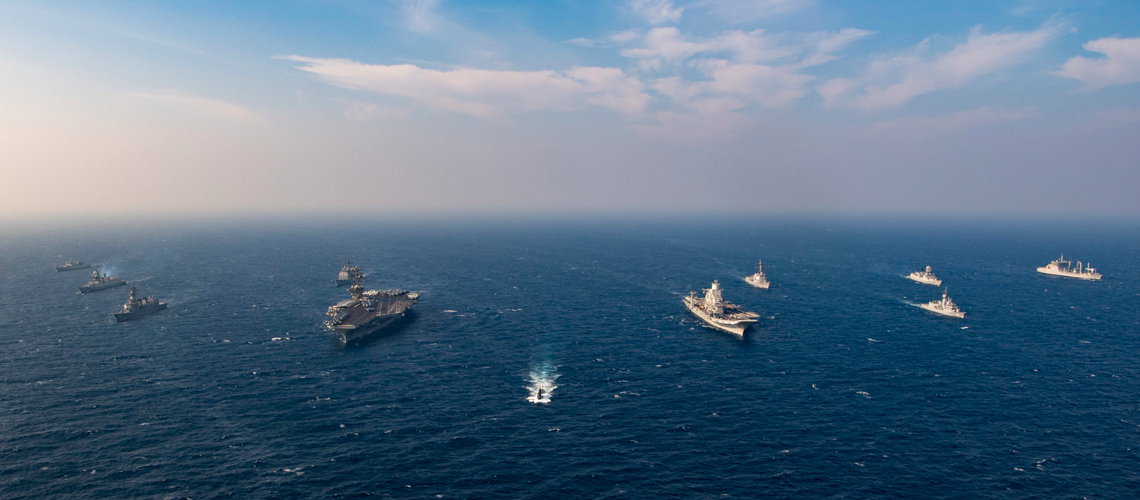
The Bay of Bengal is a natural waterway linking India to Southeast Asia. It is a rich, biodiverse region, shaped by the monsoons that determine food and water security, livelihoods and navigation. India shares land and/or maritime boundaries with all the countries around the Bay of Bengal. India is the foremost link for regional connectivity, prosperity and security. India’s participation, cooperation and facilitation are essential to the smooth flow of goods, services and people across this wider geography.
Countries in the region share a civilisational connection, bound by history, language, culture, costumes, textiles, dance, music, religion, agricultural practices, cuisine, dietary habits, and myriad other commonalities and cultural traditions. The ancient Hindu and Buddhist temples in Indonesia, Cambodia, Laos, Vietnam and Thailand are living examples of deep-rooted historical, religious and commercial links. Accounts of monsoon-linked trade routes between India and Southeast Asia are legendary. This includes the ‘Bali Jatra’ of Odisha, yet another example of affinity among the people of India and Southeast Asia from ancient times. This civilisational connectivity has played an important role in India’s renewed engagement with the dynamic economies of Southeast Asia, including invigorated bilateral strategic partnerships and engagements through ASEAN mechanisms, namely the regular ASEAN-India bilateral summits, the East Asia Summit, the ASEAN Regional Forum, and the Mekong-Ganga Cooperation.
The Northeastern states of India form a unique land bridge between India and Southeast Asia, spanning cultural, ethnic, linguistic and historical ties. These states have emerged as major connectivity hubs, with networks of roads, railways, waterways, grids, and pipelines. Once completed, the India-Myanmar-Thailand Trilateral Highway will connect India’s North East to the Pacific Ocean. India has focused its efforts on regional integration, keeping this geo-strategic factor in mind.
The fallout from the ongoing conflict in West Asia reveals the flip side of an interconnected and interdependent world. The Bay of Bengal, although ensconced within its own geographical space in the northeast of the Indian Ocean, is not immune to developments elsewhere. The blockade of the Strait of Hormuz and the destruction of energy infrastructure have adversely affected global trade and energy supplies. If the conflict escalates further or persists longer, it will seriously affect the growth prospects of littoral states around the Bay of Bengal, undermining their energy and food security, inward remittances, and the livelihoods of millions.
Smaller neighbours have approached India for support to address the current energy crisis. With the longest coastline on the Bay of Bengal and as the first responder in times of crisis, India will step in to help, as it did during the COVID pandemic and other past calamities and natural disasters.
Even as we take stock of our response to the new threats and challenges emerging from developments in West Asia, this is an opportune moment for countries around the Bay of Bengal to recall the rationale for strengthening cooperation, given India’s links with Southeast Asia. Enhancing regional cooperation, notably through the Bay of Bengal Initiative for Multisectoral Technical and Economic Cooperation (BIMSTEC), is imperative. As articulated by Dr S. Jaishankar, the External Affairs Minister of India, during the Ministerial meeting before the 6th BIMSTEC Summit in Bangkok on April 3, 2025: “What we make of our prospects is very much dependent on ourselves. As developing nations who face a multitude of challenges, that is better done in concert with each other than individually”.
Since its establishment, BIMSTEC has become the obvious choice for regional cooperation among the seven member states – Bangladesh, Bhutan, India, Myanmar, Nepal, Sri Lanka and Thailand. The inclusion of two landlocked Himalayan countries alongside five littoral states underscores the ecosystem’s composite nature.
BIMSTEC promotes regional cooperation across seven broad pillars: Agriculture and Food Security; Connectivity; Environment and Climate Change; People-to-People Contact; Science, Technology and Innovation; Security; and Trade, Investment and Development. Cooperation spans eight sub-sectors: Blue Economy, Mountain Economy, Energy, Disaster Management, Fisheries and Livestock, Poverty Alleviation, and Health and Human Resource Development.
The 6th BIMSTEC Summit Declaration, the Bangkok Vision 2030, and the Eminent Persons Group Report have provided the organisation with a clear direction and a roadmap for collective prosperity. The conclusion of the BIMSTEC Maritime Transport Agreement ensures a free, open, secure, and safe Indian Ocean. This is particularly relevant in the wake of the conflict in West Asia, where freedom of navigation is under grave strain, underscoring the importance of open sea lanes and respect for international law.
Despite comprising 22% of the world’s population (1.7 billion people) and a combined GDP of nearly US$4 trillion, the Bay of Bengal region’s intra-regional trade remains woefully inadequate. New and innovative ways to engage the private sector, encourage micro-trade, regional value chains and trade in local products are needed to give a major fillip to regional trade. Trade facilitation to promote regional value chains in agriculture and related sectors can also give a major boost to regional trade, pending the finalisation of an FTA.
The adoption of the BIMSTEC Masterplan for Transport Connectivity is another important step towards building land, marine, energy, digital and people-to-people connectivity. Rapid and expeditious implementation of this Plan will help integrate waterways, rail, road and digital connectivity.
The Bay of Bengal region is highly vulnerable to cyclones, rising sea levels and other natural disasters. This is an existential reality. Collective cooperation to address climate change, disaster management, the preservation of both Himalayan and marine ecology, and their sustainable development is crucial and necessitates urgent collective action.
Addressing climate change and disaster management enhances security as much as it supports prosperity and connectivity. These are interconnected. Establishing a consultative mechanism among the NSAs and Home Ministers is an important step towards addressing the Bay of Bengal’s common security challenges, including combating cybercrime, addressing cybersecurity threats, terrorism, drug trafficking, and human trafficking, as well as other traditional and non-traditional security threats.
For India, regional cooperation within the BIMSTEC framework represents a combination of its Neighbourhood First, Act East and MAHASAGAR policies. As the largest country in the region and one of the fastest-growing larger economies, India recognises its greater responsibility and is prepared to play that role. India has taken several initiatives since the inception of BIMSTEC. The most recent include: the establishment of the Energy Centre in Bengaluru to explore an energy grid connection across the region; an offer to share its experience with Digital Public Infrastructure to enhance good governance, transparency, and financial inclusion in the delivery of public goods; a proposed connectivity between India’s Unified Payments Interface and the payment systems of BIMSTEC member states, to bring substantial benefits across trade, industry, and tourism, enhancing economic activity at all levels; a proposed establishment of a BIMSTEC Chamber of Commerce for greater collaboration among the business communities and annual BIMSTEC Business Summits to foster greater economic engagement; possible trade in local currencies within the BIMSTEC region; the establishment of a Sustainable Maritime Transport Centre to focus on capacity building, research, and innovation, foster greater coordination in maritime policy, and enhance cooperation in maritime security across the region; the establishment of a BIMSTEC Centre of Excellence for Disaster Management in India to facilitate cooperation in disaster preparedness, relief, rehabilitation, and joint exercises among the BIMSTEC Disaster Management Authorities; an offer of training and capacity building in cancer care across BIMSTEC countries and the establishment of a Centre of Excellence to promote research and dissemination of traditional medicines; the establishment of another Centre of Excellence, focused on the exchange of knowledge and best practices, research collaboration, and capacity building in the agriculture sector; and an offer to share Indian expertise and experience in the area of space, including the establishment of a ground station for manpower training, development, and the launch of nano-satellites, and the use of remote sensing data for the BIMSTEC countries.
In addition to these initiatives, India has undertaken several training and capacity-building programmes to equip youth and develop human resources. Sports and cultural connectivity are other areas of cooperation offered by India to promote people-to-people contacts, including the BIMSTEC Games, a Music Festival, a Youth Leaders’ Summit, a Hackathon, and the Young Professional Visitors Programme, all of which encourage innovation and collaboration.
From India’s perspective, cooperation in the Bay of Bengal, whether bilateral, sub-regional, or through established ASEAN and BIMSTEC mechanisms, embodies the spirit of “Sabka Saath, Sabka Vikas, Sabka Prayas”. This was emphasised by Prime Minister Shri Narendra Modi at the 6th BIMSTEC Summit in Bangkok on April 4, 2025, when he said: “BIMSTEC serves as a vital bridge between South and Southeast Asia and is emerging as a powerful platform for advancing regional connectivity, cooperation, and shared prosperity…. For us, BIMSTEC is not merely a regional organisation. It is a model for inclusive development and collective security. It stands as a testament to our shared commitments and the strength of our unity.”
Author Brief Bio: Ambassador Preeti Saran is currently a Member of the UN’s Committee on Economic, Social and Cultural Rights (CESCR). She was Secretary (East) at the Ministry of External Affairs, Government of India. She joined the MEA in 1982, and has most recently served as Ambassador of India to the Socialist Republic of Vietnam. She has also undertaken diplomatic postings to Toronto, Geneva, Cairo, Dhaka and Moscow. In New Delhi, she has served as Joint Secretary (SAARC/North), Deputy Secretary/ Director (Establishment) / East Asia, and Under-secretary (ICCR/AMS).