Oceans beyond the immediate maritime zones have been a key global common, and since the beginning of human history, the human race has progressed by harnessing them and their resources. After the Second World War, rapid technological advances have further enhanced the importance of oceans by making them significant sources of hydrocarbons and critical minerals. Numerous laws were enacted to manage this critical medium and its resources. The Nineteenth and Twentieth Centuries were initially dominated by events in the Atlantic Ocean and subsequently by those in the Pacific. All the while, the Indian Ocean remained in the background.
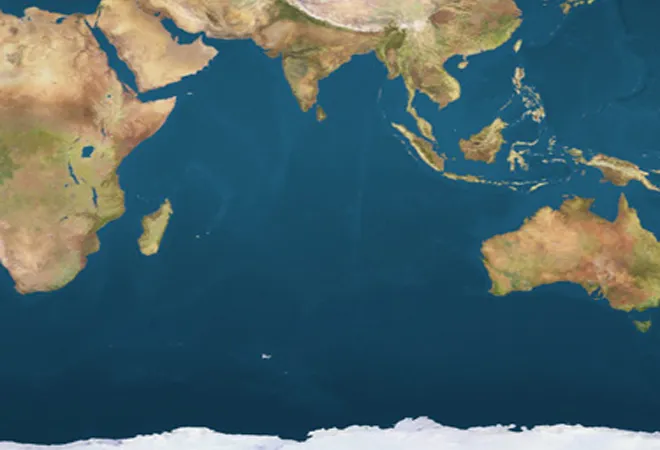
Today, the Indian Ocean is no longer merely a “neglected ocean” or a secondary theatre of global geopolitics. It has become the epicentre of global energy and trade corridors, through which one-third of the world’s bulk cargo and two-thirds of its oil shipments pass. Yet this vital expanse—stretching from the African coast to the Indonesian archipelago and Australia—faces a “tragedy of the commons” on a monumental scale. Overfishing, maritime piracy, plastic pollution, contested maritime zones and the escalating climate crisis threaten the structural integrity of littoral states. To secure the region’s future, the paradigm must shift from competitive exploitation to collective stewardship.
The Geopolitical and Ecological Imperative
Unlike the Pacific and the Atlantic, the Indian Ocean is unique. Geographically, it is bounded to the north by the vast Eurasian Landmass and consequently has no opening to the North Pole, which restricts access and creates significant choke points of immense geopolitical significance. Geoeconomically, it is predominantly an ocean of the “developing world”. Unlike the North Atlantic, the IOR is characterised by vast disparities in economic capability and maritime infrastructure. Consequently, most countries are constrained to focus on short-term gains rather than the collective good. This creates a fragmented security architecture in which non-traditional threats—such as Illegal, Unreported, and Unregulated (IUU) fishing and transnational maritime crimes—thrive in the gaps between national jurisdictions.
The Indian Ocean also faces a significant ecological threat, as it is warming faster than the global average. Global warming and the consequent rise in sea levels erode coastlines and vast mangrove forests. It also threatens the very existence of some island nations, such as the Maldives. Many of them lack resources, and even those with resources often bear the consequences of others’ actions. As a result, there is a pressing need for a unified response to tackle these problems. The degradation of coral reefs and the acidification of waters do not confine themselves to Exclusive Economic Zones (EEZs). Therefore, governance must transition from a state-centric “security” model to a holistic “stewardship” model.
Today, collective stewardship is not merely a diplomatic preference; it is an existential necessity.
Pillars of Collective Stewardship
For a strategy of collective stewardship to be effective, it must be built on three functional pillars:
1. Integrated Maritime Domain Awareness (MDA)
Stewardship begins with observation. Currently, many littoral states lack the technological capacity to monitor their own waters. Collective stewardship requires a “plug-and-play” data-sharing environment.
- Action: Strengthening hubs like India’s Information Fusion Centre-Indian Ocean Region (IFC-IOR) to act as a transparent clearing house for real-time data on vessel movements.
- Goal: To eliminate “blind spots” that allow for illegal poaching and environmental dumping.
2. The Blue Economy and Sustainable Resource Management
The Indian Ocean holds roughly 15mu% of the world’s total fish catch. However, fish stocks are migratory. If one nation over-extracts, the entire ecosystem suffers.
- Collective Approach: Establishing regional quotas and shared “no-take” marine protected areas (MPAs), as well as “no-fishing” periods, so that fish stocks can recover and biodiversity is preserved.
- Incentive: Moving towards “Blue Carbon” credits, in which nations are financially rewarded for preserving mangroves and seagrasses that sequester carbon.
3. Disaster Risk Reduction and Climate Adaptation
The IOR is one of the world’s most disaster-prone regions. It is affected by cyclones in the Bay of Bengal and by rising sea levels, which exact a heavy toll on human lives and resources.
- Stewardship in Action: It is almost impossible to deal with mega-disasters individually. The human and material resources required within a short time frame are usually not available to a single country. Hence, there is a need to create a regional “Climate Response Force” with shared early-warning systems. This would move the needle from reactive humanitarian aid to proactive collective resilience.
Challenges to the Stewardship Model
The primary obstacle to collective governance is the “Great Power Rivalry.” The growing militarisation of the Indian Ocean by extra-regional powers often forces littoral states to make binary choices, while undermining regional solidarity. When naval competition takes centre stage, environmental conservation and soft-security cooperation are often pushed to the background.
In addition, the region suffers from a significant “Capability-Capacity Gap”. While a large state may still have the assets to patrol its vast maritime zones, including the high seas, smaller states often struggle to enforce maritime law within their own waters. Collective stewardship requires a “security as a service” model, in which larger maritime forces provide training and support to smaller coast guards without infringing on sovereignty. This requires common operating procedures, compatible communications and frequent interactions amongst them.
Frameworks for Cooperation: IORA and Beyond
The Indian Ocean Rim Association (IORA) is the natural vehicle for this stewardship. However, IORA must move beyond ministerial declarations to concrete actions. Some of these initiatives are listed below.
| Focus Area | Proposed Initiative |
| Legal | Steps need to be taken to harmonize maritime laws to ensure that the “flags of convenience” cannot be used to bypass environmental regulations. |
| Technical | Share research vessels and expertise to map the Indian Ocean floor and monitor acidification levels. |
| Diplomatic | Adopting a “Code of Conduct” for the Indian Ocean that prioritizes ecological stability over military posturing. |
Challenges: Great Power Rivalry and the Capacity Gap
The primary obstacle to this model is the “Great Power Rivalry.” The increasing militarisation of the Indian Ocean by extra-regional powers and the resulting contestation often force littoral states to make binary choices. Invariably, when power projection takes centre stage, environmental conservation is pushed to the background.
Furthermore, there is a significant Capability-Capacity Gap. While large nations like Australia, India, or Indonesia might have the assets to patrol vast areas, smaller states with extensive maritime zones often struggle to even conduct law enforcement in their territorial waters. Collective stewardship requires pooling resources, with larger navies providing training and unmanned aerial vehicles (UAVs) to smaller coast guards, enabling them to focus on “soft security” issues such as disaster relief and the preservation of marine ecology rather than projecting just “hard power”.
The Path Forward: A “G-IOR” Framework
To institutionalise collective stewardship, the Indian Ocean Rim Association (IORA) must be empowered. It is proposed to establish a “G-IOR” (Group of Indian Ocean Residents)—a dedicated working group focused exclusively on the linkages between climate change and maritime security.
Conclusion: Managing the Commons
The Indian Ocean is the lifeblood of the 21st century. The era of viewing the ocean as an infinite resource to be guarded by individual navies is over. Collective stewardship offers a middle path: one that respects national sovereignty while acknowledging complete ecological and economic interdependence.
By prioritising the health of the ocean over competition for its surface, the littoral states of the Indian Ocean can create a blueprint for maritime governance that is inclusive, sustainable, and resilient. The choice is clear: either we manage the commons together, or we witness their collapse individually. The Indian Ocean does not belong to the states that border it; the states belong to it. Stewardship is the only way to honour that relationship.
Author Brief Bio:
Alok Bansal: Capt. Alok Bansal is the Executive Vice President of India Foundation & the Secretary General of Asian Eurasian Human Rights Forum (AEHRF). A seasoned strategic affairs analyst, he has previously served as the Executive Director of the National Maritime Foundation (NMF) and has held research positions at leading Indian think tanks including the Institute for Defence Studies and Analyses (IDSA) and the Centre for Land Warfare Studies (CLAWS). He has authored/ edited 10 books. His work focuses on maritime security, South Asian geopolitics, and internal dynamics of Pakistan. A former naval officer, he served in the Indian Navy for 32 years and commanded two warships. A PhD in international Affairs, he has been a visiting Professor at Jamia Millia Islamia.
Shristi Pukhrem: Dr. Shristi Pukhrem is Director, Act East Centre & Visiting Fellow at India Foundation. She is also currently the Dean of the School of Global Leadership. She holds a Doctorate from the School of International Studies (SIS), Jawaharlal Nehru University, New Delhi. Formerly employed as a Researcher at the Institute for Defence Studies and Analysis (IDSA), New Delhi, Dr. Pukhrem’s research areas cover India-ASEAN relations, India’s bilateral relations with South-East Asian countries, and the Act East Policy with a broader focus on the Indo-Pacific region.