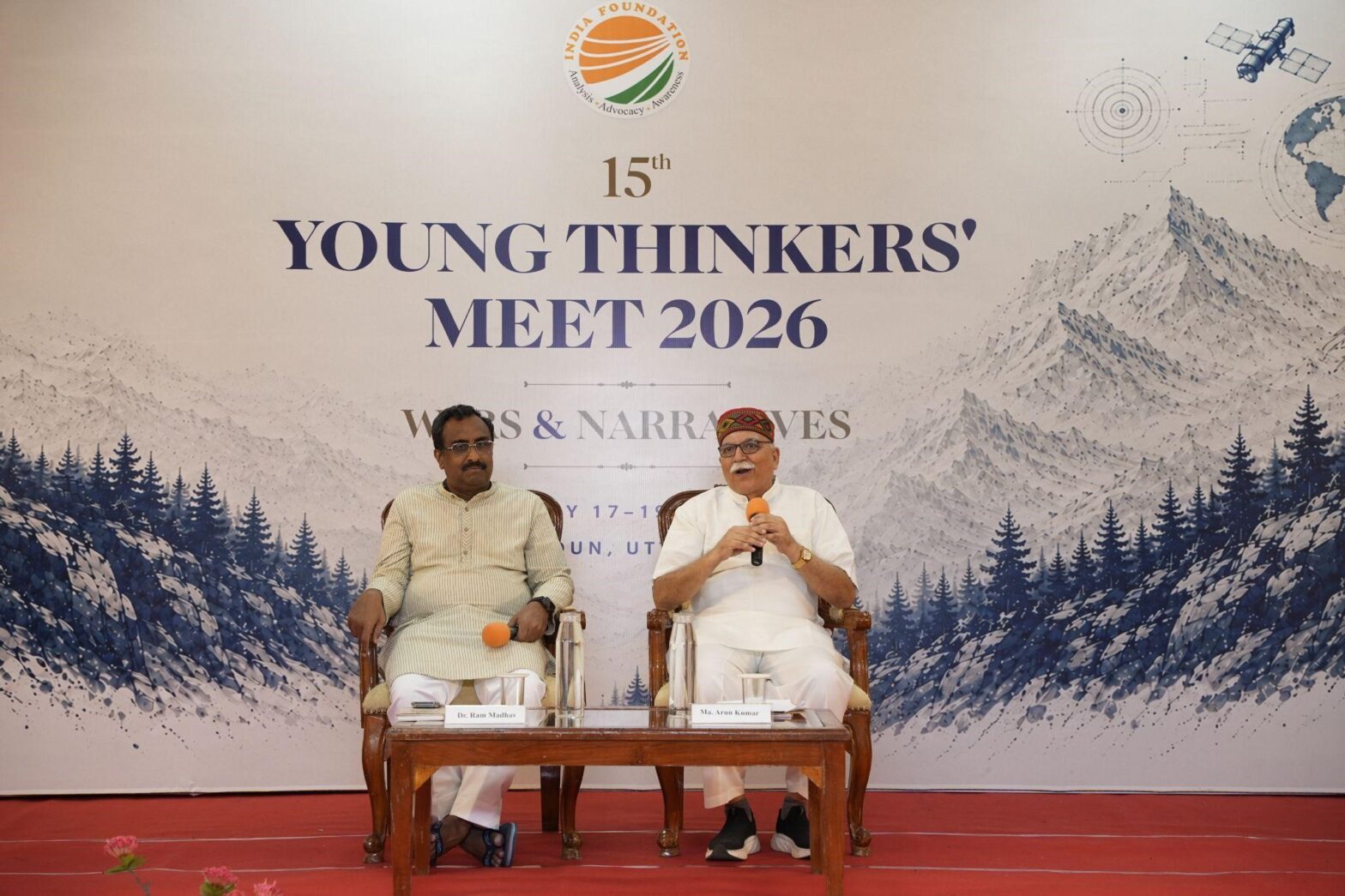
The 15th edition of the Young Thinkers’ Meet (YTM) was held in Dehradun, Uttarakhand, from 17 to 19 July, 2026. Young Thinkers’ Meet is an initiative of the India Foundation that began its journey in 2012 at Coorg, Karnataka. The annually held event acts as a confluence of young nationalistic minds hailing from varied walks of life across India. Today, YTM has an alumni base of over 350 individuals from different parts of India, with unique life experiences and skill sets. There are social activists, political activists, NGO workers, academics, journalists, scientists, corporate professionals, and students from reputed national and international universities. Participants in the YTM come from all parts of the country and immerse themselves in deliberations and debates on issues of contemporary national importance. The format of the meet is immersive and experiential rather than lecture-based, with the number of delegates varying from seventy-five to eighty-five over two to three days of freewheeling discussion. Each year, YTM moves to a new location and helps young delegates explore the country’s incredible diversity.
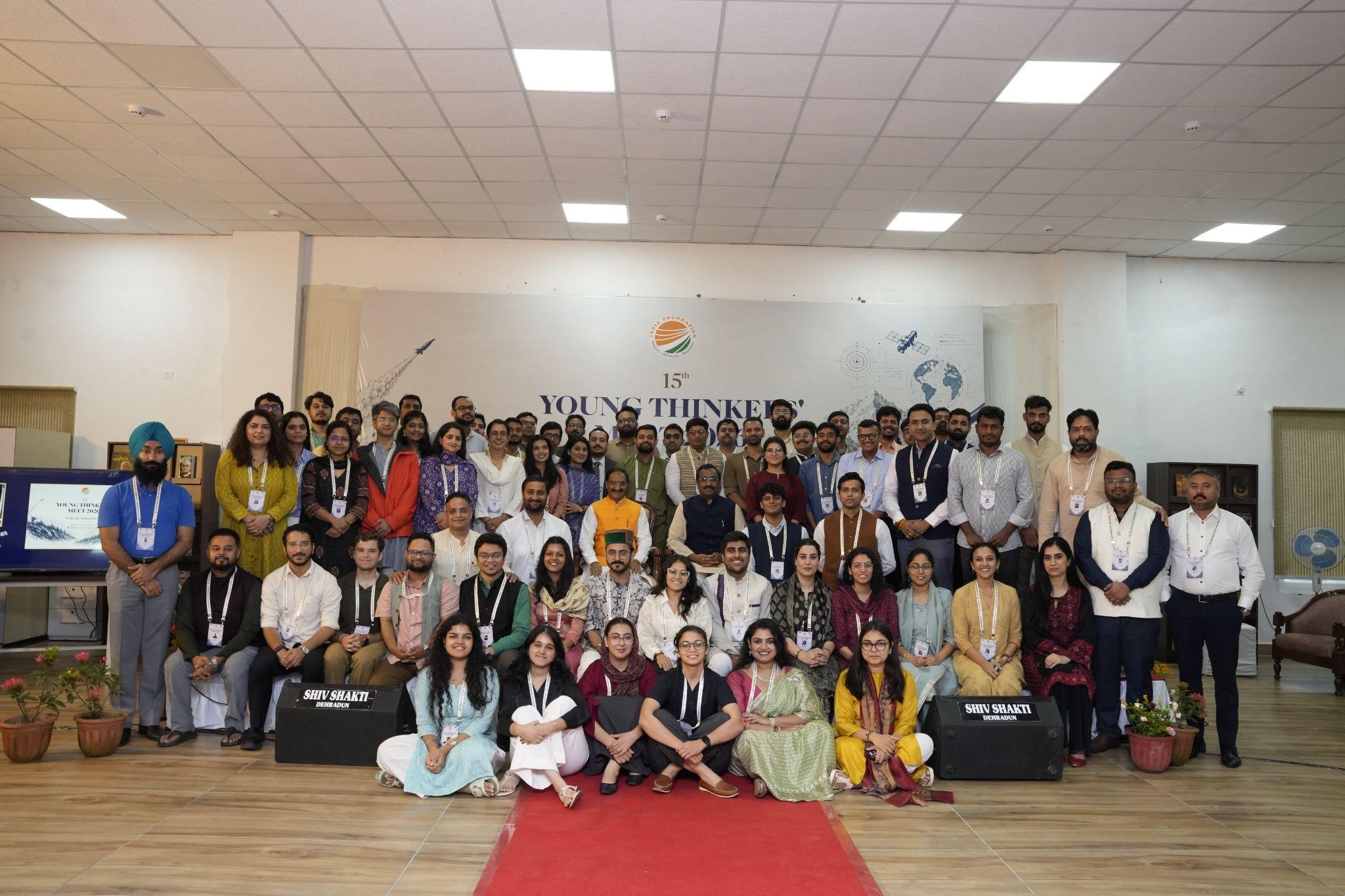
Group Photograph
Themed “War and Narratives,” the 15th edition drew an impressive turnout of 80 participants, predominantly under the age of 35 and united by a shared vision of a New India, reflecting the growing reach and resonance of this distinguished platform.
The inaugural day opened with an introduction of all delegates and mentors, followed by a Mock Parliament exercise chaired by Dr. Jigar Inamdar, Visiting Fellow, India Foundation, in which the delegates were divided into ruling party and opposition to debate the “Implementation of the Women’s Reservation Bill in Legislative Bodies.”
The inaugural session, titled “Sangh’s Historical Journey: RSS@100,” was chaired by Dr. Ram Madhav, President of the India Foundation, and featured Dr Ramesh Pokhriyal Nishank, former Minister of Education, and Ma. Arun Kumar, Sah Sarkaryavah of the Rashtriya Swayamsevak Sangh (RSS), as speakers. The address reflected on how the British came to rule India despite the country being far larger and more populous than Britain, observing that the decline arose from within rather than from any external strength, and that there was little reason to blame others for it. Over time, the shared sense of being one nation and one people gradually broke apart into smaller identities of religion, region, and language. The idea of man-making was offered as a way forward, one that seeks to restore the sense of one nation and one people and, through it, to build a strong nation grounded in a clear sense of national identity, deshbhakti, unity and discipline, and self-confidence.
The interaction that followed centred on the theme of “Panch Parivartan,” drawing attention to the family as the cornerstone of Indian society. It reflected on how the modern shift towards smaller families, shaped largely by patterns of consumption inherited from the West, has weakened the traditional joint family and, with it, the support once available to both children and the elderly. The importance of sustaining a healthy population was emphasised, along with the view that family and career can be pursued together rather than at one another’s expense. The discussion also carried forward the idea of swadeshi as a means of strengthening employment and self-reliance grounded in the country’s own resources.
A book review of Worth Dying For: The Power and Politics of Flags examined the political and religious symbolism embedded in national flags, noting that nearly a third of the world’s flags carry religious symbols, mostly Abrahamic, even among nations that describe themselves as secular. This drew a thematic link between symbolism and identity on one hand and Bengal’s political mandate on the other, providing a transition into the panel on the state’s recent elections.
Moderated by Ms. Chitra Shekhawat, Research Fellow, India Foundation, the session on the “Bengal Elections: Implications for National Security” featured Dr. Guru Prakash Paswan, Ms. Neha Joshi, Mr. Swayam Baral, Mr. Nishant Azad, and Mr. Ashutosh Poddar as panellists. The discussion noted how campaign strategy had shifted decisively towards mobile-first digital outreach in closely contested constituencies, and turned to Bengal’s geostrategic position, its proximity to the Bay of Bengal, the Northeast, and the Siliguri Corridor, and its long-unfenced border with Bangladesh. Panellists linked this porous border to concerns around smuggling, trafficking, and irregular migration, and reflected on the state’s industrial decline and the opportunity to reverse capital flight.
The session on the “Changing Nature of Warfare” was led by Shri Abhinav Kumar, Director General, Intelligence and Security/Prisons, Uttarakhand, and Capt. Alok Bansal, Executive Vice President of the India Foundation, with Mr. Apurv Mishra, Ms. Aditi Avinash, Mr. Akash Kumar, and Mr. Radhey Tambi as discussants. It traced how conflict and technology have evolved together, from the coded warfare of the Mahabharata, where battle paused at sunset and dialogue endured even between opposing camps, through successive advances in cavalry, naval seamanship, air power, and underwater warfare, to contemporary conflicts such as the wars in Ukraine and West Asia, which have shown how low-cost weapon systems can overwhelm sophisticated defences. Reflecting on recent events, including the Pahalgam attack and Operation Sindoor, the conversation brought out the value of jointness across the armed forces and intelligence agencies, the growing importance of civil defence and information warfare, and the need to manage escalation carefully in a nuclear neighbourhood, alongside a shift towards a more proactive security doctrine since 2014. It observed that the traditional Western model of war, with its clear lines between war and peace, is giving way to constant competition across economic, technological, and societal domains, and reflected that future security will rest on an invisible framework of space, cyber, and artificial intelligence, captured in the three Cs of compute, cognition, and control.
The delegates also engaged with Sir Paul Collier’s Left Behind: A New Economics for Neglected Places (2024), which examines places locked in persistent decline. Arguing that development is path dependent, the work advocates place-based policies and “shared collective agency” over redistribution, and challenges the idea of self-interested economic man in favour of humans as inherently pro-social beings.
The session on “The Battle for Global Opinion: Diplomacy and Strategic Communication” featured Mr. Ashok Malik, Partner and Chair of India Practice at The Asia Group, and Ms. Rami Desai, Distinguished Fellow, India Foundation, with Mr. Chetan Aggarwal, Ms. Gargi Dangwal, Ms. Jyotsna Mehra, and Mr. Samarth Tiwari as discussants. The panel framed today’s world as one defined by silent, ambiguous wars fought through the construction of narratives, heavily shaped by control over a fragmented media landscape. It weighed India’s record in narrative-building against instances where delayed or complex messaging allowed adversaries to dominate the conversation, and concluded that effective communication requires consistency, simplicity, and adaptability to fragmented global audiences.
Dr. Ram Madhav, President of the India Foundation, conducted a fireside chat titled “India’s Narrative in a Multipolar World,” offering a reflective look back at the key takeaways from the meet and situating them within the broader question of India’s positioning in a multipolar world. Drawing together threads from the earlier sessions on modern warfare, the changing character of conflict, and the centrality of narrative-building, the conversation connected these themes to questions of leadership and what it means for the participants to think as future leaders in a world where perception carries as much weight as conventional strength. Mr. Om Ranjan, Ms. Radhika Gupta, Ms. Richa Bahuguna, and Ms. Shabnam Batool were discussants in this session.
The second day opened with an engaging simulation exercise designed to test strategic thinking under pressure. Participants were divided into seven groups, each guided by mentors drawn from diverse professional backgrounds. The exercise was built around a hypothetical crisis scenario involving India and China, set against the backdrop of a live conflict and a disinformation campaign shaping public narrative in real time. Groups were assigned distinct roles, including the media, international organisations, hackers, and the union government, and were tasked with navigating the crisis from within their assigned mandate. The exercise proved both enriching and enjoyable, offering participants a hands-on understanding of how different actors perceive, respond to, and shape a crisis, often with competing incentives and information. At its conclusion, the group representing international organisations was adjudged the best-performing team, with the group representing elected representatives placed second, both recognised for their clarity of strategy and coherence of response.

The valedictory session brought the gathering to a fitting close in the presence of Dr. Ram Madhav, the Governor of Uttarakhand Lt. Gen (Retd.) Gurmeet Singh. The proceedings opened on a note of unity and reverence, with the singing of the national song and the national anthem. The discussion centred on the idea of national consciousness, urging participants to look beyond the self and think of the nation as a whole. Each participant was reminded that they carry the responsibility of representing 2.4 crore fellow citizens, a scale of representation that calls for clarity of thought and seriousness of purpose, and all were encouraged to see themselves as the world leaders of tomorrow and to dream without limitation. As part of the closing proceedings, the Governor felicitated participants with a memento, and honoured Dr. Ram Madhav with a set of books authored by him, closing the session on a note of gratitude and camaraderie. The gathering concluded with the national song and national anthem resounding through the hall, uniting all present in a shared spirit of pride and purpose.