


Introduction
In his 80th Independence Day address on 15 August 2026, the Prime Minister set out Sapt Dhara, seven streams of national strength.[1] As the nation advances towards Viksit Bharat@2047, this articulated concept will provide a powerful framework for India’s growth and national strength. Of particular significance is “Raksha Shakti”, the fifth stream of Sapt Dhara, with its emphasis on defence self-reliance, becoming a global supplier, drones and counter-drone systems, leadership in hypersonic defence technologies and cyber security as a field for Indian youth.[2] The armed forces play a vital role in realising this vision through technological advancement, indigenous capability development and operational excellence. The number also recalls Kautilya’s Arthashastra, which held that “the king, the minister, the country, the fort, the treasury, the army and the friend are the elements of sovereignty.”[3] The two lists differ in content and purpose, but they share a premise: national strength arises from the relationship among its elements rather than from any one of them.
Applying that premise to the defence industry, this article proposes organising strategy around five operational domains and three enabling layers. It also proposes shifting the unit of planning from the platform to the integrated combat ecosystem and broadening the measure of success from indigenous manufacture to indigenous design, integration and operational effectiveness. Overall, the article analyses a shift from prioritising where equipment is manufactured to prioritising who owns its design, intellectual property and source code – summarised as a move from “Made in India” to “Owned by India”.
The Changing Logic of Military Power
For much of the twentieth century, military power was largely measured by inventory: the number of army divisions, aircraft, warships and tanks a country could field and sustain. But the outcomes of recent conflicts have turned less on the quantity of platforms than on how quickly and coherently forces can integrate sensors, weapons, communications, intelligence and command decisions into a single operational system. Unmanned aerial and maritime systems, space-based surveillance and navigation, cyber operations, electronic warfare and artificial intelligence now operate alongside conventional military platforms such as tanks, aircraft and warships. Military effectiveness is increasingly a property of networks rather than of individual machines.
Traditionally in India, indigenisation has been tracked using straightforward metrics: production volumes, the share of indigenous content, and the number of platforms delivered from domestic lines.[4] These indicators show genuine progress, but they reveal little about whether Indian industry can supply the software, sensors, secure data links, components and integration expertise on which modern capability depends. Therefore, the challenge is not merely to ramp up production but also to ensure that industrial output meets the armed forces’ requirements. Defence-industrial reform is thus bound up with national security and technological innovation. It is also central to the ambition of Viksit Bharat@2047, which assumes a country capable of designing, not merely assembling, advanced systems.
A Platform-Centric Defence-Industrial Base
India’s defence-industrial base comprises public sector undertakings (PSUs), which produced about 76 per cent of output in 2025–26; the Defence Research and Development Organisation (DRDO) and other government PSUs; the private sector, whose share reached 24 per cent; and a growing layer of start-ups and Micro, Small and Medium Enterprises (MSMEs).[5] Production reached a record ₹1.78 lakh crore and exports ₹38,424 crore that year, yet India remained the world’s second-largest importer of major arms during 2021–25.[6]
The defence-industrial architecture remains largely organised around platforms. Individual services generally set requirements, and official reports emphasise outputs and indigenised items. The weak point, in the author’s assessment, is the connecting layer: data links, mission software, sensor fusion, resilient networks and decision-support tools. Control of this layer depends on the platform’s origin. Imported systems usually arrive with this layer closed and vendor-controlled. Indian-built systems often rely on foreign components, selected programme by programme. The Air Force’s Integrated Air Command and Control System (IACCS) and the Army’s Akashteer network show that India can design this layer. Still, they emerged from service programmes rather than from industrial strategy. The performance of these networked air defence architectures during Operation Sindoor showed what these foundations can deliver when systems are designed to work together.[7]
The draft Defence Acquisition Procedure 2026 would increase indigenous content for the Buy (Indian-IDDM) category from 50 to 60 per cent and introduce a test of indigenous design based on ownership of design documents, source code and core architecture. The next challenge is to connect and deepen existing capabilities by linking programmes, technologies and military users.
Five Domains, Three Enabling Layers
This article proposes organising defence-industrial strategy around five operational domains, namely air, land, maritime, space, and cyber, supported by three enabling layers: artificial intelligence; networks and secure communications; and unmanned and autonomous systems. Here, a domain is a medium in which a force can be denied or defeated. Electronic warfare is placed in the networks layer instead, because it operates across all five by contesting the spectrum their communications use.
Figure 1: Five Domain Missions Resting on Three Shared National Capability Layers
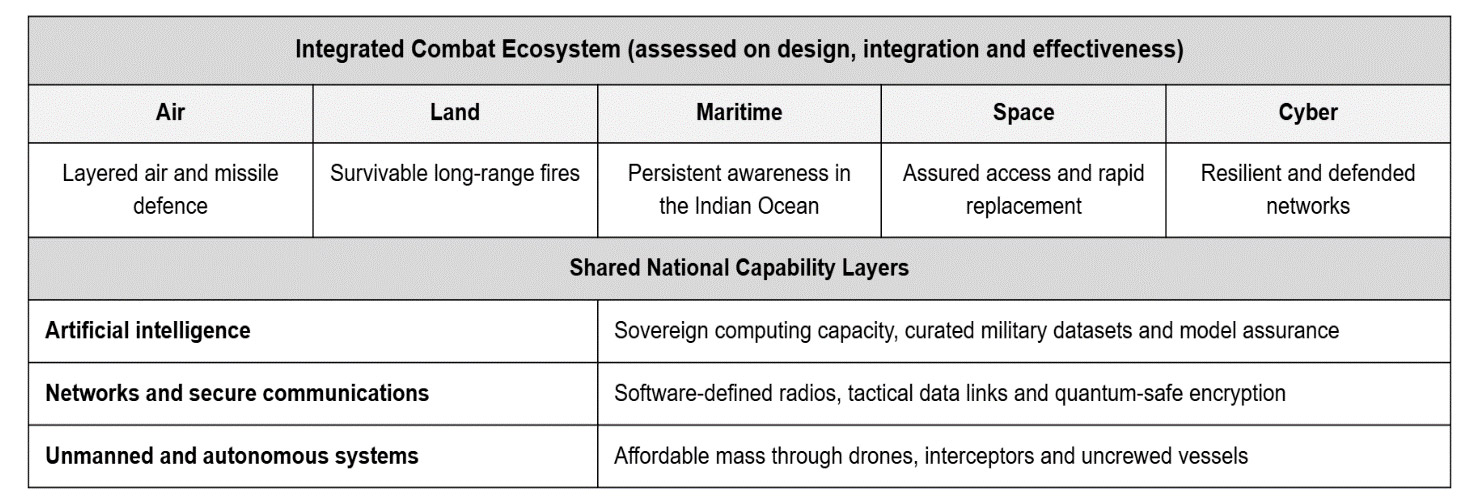
The diagram sets out the author’s proposal; it does not describe current practice.
Each domain could host a joint capability mission defined by an operational outcome, such as layered air and missile defence or persistent maritime awareness across the Indian Ocean. Platforms would remain essential but would be specified as nodes within a mission architecture. The three enabling layers would be treated differently from platforms. They would be developed as shared national assets, with common standards for data formats, interfaces, encryption and autonomy safety that would apply to every platform, whether Indian or imported.
Consider the defence of a forward airbase against a combined drone and missile attack. In platform-level planning, the question is which aircraft, radars and missiles to buy. Planned as a mission, the question becomes what sensors, networks, software, munitions, repair capacity and personnel are needed to keep the base defended over a period of time, and how well they connect. That is the first shift this article proposes: making the integrated combat ecosystem, rather than the platform, the unit of planning. The second shift follows. If the mission is the unit, then where a component is manufactured matters less than whether India designed it, can integrate it and has shown that it works. Domestic manufacture retains value for employment, skills and wartime production, but a licence-built platform remains exposed to its supplier’s decisions.
Two further tests would complete what the draft DAP has begun with its ownership-based definition of design.[8] The first, integration authority, asks whether the Indian side holds the interface documents, and, if necessary, the source code, to connect a system to national networks without seeking the vendor’s permission. The second, demonstrated effectiveness, asks whether the system has passed a mission-level trial, run by the services’ trial and testing teams at shared facilities, against a pass mark set by the capability board for that mission (proposed below).
Space: Dual-Use Foundations without Militarisation
India’s space programme was conceived to serve national development.[9] The Indian Space Policy 2023 frames its vision around augmenting space capabilities and fostering a commercial space sector in support of socio-economic development and security, and it opens end-to-end space activities to non-government entities through IN-SPACe. Earth observation, navigation, satellite communications, launch capability, systems engineering and supplier depth all have clear dual-use potential. The line this article draws is between programmes, not technologies. The civilian programme retains its developmental purpose, the industrial base is shared, and military space capability is built separately and answers to the defence establishment.
In October 2024, the Cabinet Committee on Security approved a constellation of at least 52 surveillance satellites, 31 of which are to be built by private firms.[10] Capabilities developed to safeguard civilian satellites are directly relevant to protecting national assets in orbit. This should also include enhancing space situational awareness, resilient navigation and secure satellite communications. Gaganyaan shows why these matters. A crewed mission demands reliability engineering, precision manufacturing and careful systems integration, the same skills that dependable defence systems require. The engineers who master them become a strategic asset in their own right.
But there are gaps to be addressed. India still has no national space law. The Space Activities Bill remains pre-legislative.[11] Other gaps include an unclear IP regime for ISRO-private collaborations, weak demand aggregation, and limited insurance and launch-pad capacity beyond Sriharikota. The IP gap is directly linked to DAP 2026: the ownership questions the draft procurement procedure seeks to answer for defence remain unresolved for space as well.
Alignment and the Path to Production
Beyond space, India has a deep talent base in software and electronics, established public scientific institutions, and a growing defence start-up ecosystem. Closer alignment among the armed forces, DRDO, space institutions, private industry, start-ups, and academia could be pursued through standing joint capability boards for each domain mission, led by the relevant operational commander. The boards would define mission-level requirements, set interface standards, fund technology gaps, and maintain the dependency map, with the armed forces remaining the customer and the final judge of effectiveness. Four measures would give the boards practical means to act:
- Procurement. A capability board can shape the industry only if successful prototypes lead to orders. The draft DAP’s Minimum Pilot Order Quantity for successful iDEX and TDF prototypes is a start;[12] framework contracts with defined production quantities would turn it into a path to scale.
- Testing. Shared national test facilities for drones, electronic warfare, AI assurance and space hardware, if made available to private firms at a predictable cost, would serve both acquisition trials and developers’ own testing.
- Intellectual property. Developers would own the IP they create by default, with government use rights. For foreign systems that connect to Indian networks, contracts would secure access to interface documentation and source code.
- Innovation finance. iDEX and the Technology Development Fund would provide follow-on funding and production tooling; DPSUs would act as anchor customers and integrators. This would bridge the gap between a funded prototype and a production line.
From Atmanirbharta to Strategic Interdependence: The Global Dimension
Atmanirbharta is better understood as control over critical dependencies than as domestic production of everything. Complete technological independence is neither achievable in the near term nor necessarily desirable. Even the largest military powers do not produce every component or technology used by their armed forces. India needs credible domestic alternatives in critical areas so that it can retain freedom of decision and keep its forces effective even when external supplies, technologies or partnerships are constrained.
The positive indigenisation lists are one instrument for this: they set timelines after which listed items must be purchased from Indian manufacturers.[13] International partnerships can accelerate progress in other areas and provide specialised expertise, research networks and access to global supply chains. However, their value depends on the terms. Assembly rights alone may not provide access to intellectual property, independent maintenance, future upgrades, or the freedom to modify a system without external approval. Arrangements that strengthen domestic design, engineering, testing, integration and production should be prioritised. Joint development, co-production and sustained technical collaboration can serve this purpose when they include meaningful technology access and genuine domestic learning.
Exports can help domestic manufacturers achieve economies of scale, sustain production lines between domestic orders, and finance further research. To realise these benefits, export promotion must be grounded in product reliability, long-term support, competitive pricing, and consistent delivery. The BrahMos sale to the Philippines illustrates the point: a system developed through an Indo-Russian joint venture and proven in Indian service secured its first foreign customer.[14] India should aim to develop selected systems that meet both domestic operational requirements and international market needs.
Strategic autonomy does not require isolation. It requires the capacity to select partners, manage dependencies and retain control over critical national security decisions.
A Roadmap for Viksit Bharat@2047
Viksit Bharat@2047 is a development goal, but it is also a national-security goal. A country that aims to be advanced and self-directed by 2047 cannot rely on others for the systems and materials its forces will need in a crisis. Defence capability takes decades to build, and many of the programmes that will equip the armed forces in the 2040s are being decided now. The Ministry of Defence’s Technology Perspective and Capability Roadmap 2025 already looks fifteen years ahead.[15] The transition from platforms to ecosystems proposed in this article can therefore be organised into three phases, each building the connective capacity that multi-domain operations demand. The dates below are proposed planning horizons derived from this analysis.
Phase I: Consolidation and Integration (2027–2032)
The first priority is to connect existing capabilities and remove barriers to collaboration. This should begin with a systematic assessment of critical technology and supply-chain dependencies. China’s April 2025 licensing requirements for certain medium and heavy rare earths put at risk supplies of materials used in combat aircraft, submarines, missiles and radars. Before 2023, China handled about 99 per cent of heavy rare earth processing, showing how a seemingly minor dependence can quickly become a strategic vulnerability.[16] India has begun responding through the National Critical Mineral Mission and a magnet-manufacturing scheme approved in November 2025.[17]
Procurement needs further streamlining, as start-ups have often struggled to secure follow-on orders after successful trials. The Ministry has acknowledged this difficulty, and the proposed Defence Acquisition Procedure 2026 seeks to address it through faster routes and assured orders.[18] This phase should also set out common interoperability and upgradeability requirements, so that systems built for one service can share data across air, land, maritime, space and cyber operations. Priority development programmes should begin with the shared layers on which every domain depends: artificial intelligence, secure networks and unmanned systems.
Phase II: Scale and Technological Depth (2032–2040)
The second phase should convert successful domestic technologies into dependable, scalable industrial capabilities. Production should expand first where Phase I’s dependency assessment shows India to be most exposed. Indian firms should take a larger role in systems integration and lifecycle support, including cross-domain integration, not only within individual platforms, since much of a programme’s long-term value and operational knowledge resides there. Testing is likely to become a bottleneck as more firms reach the prototype stage. The Defence Testing Infrastructure Scheme, approved in 2020 with ₹400 crore for six to eight new facilities, was a sensible start,[19] but its scale reflects the industry of 2020, not the larger and more varied base that Phase II envisages.
Phase III: Ecosystem Maturity (2040–2047)
The measure of the defence-industrial base would have changed by the final phase. Capability would be judged by how well systems work together across domains, not by how many platforms leave the production line. Major systems would be designed from the outset for continuous upgrades, and Indian industry would be able to integrate new technologies into them. Some external dependencies would remain, but only those the dependency map deems acceptable. The ₹1 lakh crore Research, Development and Innovation scheme, which finances private research in strategic and sunrise sectors, is the kind of instrument through which civilian advances in enabling technologies could be drawn into this effort.[20]
Limitations and Counterarguments
The ecosystem approach has costs that need to be made clear. The first concern is coordination. Planning at the mission level rather than for individual platforms requires many organisations, including the three services, research laboratories, public sector undertakings and private firms, to agree on shared goals and to continue working together over many years. The joint capability boards proposed in this article carry an obvious risk: they could become yet another layer of review in a system that is already slow. To avoid this, each board should take over an existing approval step rather than add a new one. It would also be prudent to start small. Air and missile defence and counter-drone systems are natural candidates, since both depend on linking sensors, weapons and command systems across services and quickly expose integration gaps. Success there could then justify extending the approach to other missions.
The second concerns competition. Central architecture and open competition pull in opposite directions. The more precisely the government specifies a system, the easier it becomes to integrate, and the harder it is for a firm with an unconventional approach, often a smaller one, to offer something better. The way through is to standardise interfaces rather than designs: fix how systems connect and exchange data, and leave the rest to industry.
The third concerns urgency. The armed forces must be ready for the threats they face now, and some gaps will open before any Indian programme can fill them. In those cases, a proven foreign system may be the responsible choice. Insisting on indigenous design regardless of timing would raise costs, delay inductions and leave units short of equipment. Self-reliance should shape long-term choices without overriding operational necessity. Vendors may refuse to provide, or charge heavily for, interface documents and source code for systems that connect to Indian networks. For urgent purchases, interface documents alone may be the realistic minimum: enough to connect the system, though not to modify it.
The fourth concerns perception abroad. India’s reputation as a peaceful space power is an asset, and a closer civil-military relationship in space could put that reputation at risk if other states interpret shared industrial capacity as a sign of militarisation. The separation of programmes proposed in the space section is the main safeguard: civilian institutions retain their developmental mandate while military capability is developed and governed separately.
The fifth lies outside industry altogether. As noted earlier, requirements are still generally written by individual services. Mission-level planning needs a joint view of how the forces will fight, and that depends on progress towards theatreisation and joint doctrine.
Conclusion
For Viksit Bharat@2047, this article argues for a shift from “Made in India” to “Owned by India”. Higher production and fewer imports remain worthwhile, but the broader goal is for India to design, integrate and export the technologies and architectures that shape multi-domain warfare, rather than remaining chiefly a market and a manufacturing base.
The aim should be to develop a defence-industrial ecosystem that can translate Indian research into operational capability, connect indigenous technologies across domains, sustain military systems throughout their service lives, and preserve strategic freedom of action during a crisis. The central proposition is simple: India’s next defence-industrial leap must be measured not merely by what the country manufactures, but by what its industrial ecosystem enables the armed forces to achieve.
Kautilya distinguished three kinds of strength: “the power of deliberation is intellectual strength,” “the possession of a prosperous treasury and a strong army is the strength of sovereignty,” and “martial power is physical strength.”[21] India has invested heavily in the second and third. An ecosystem-based strategy is, in part, an investment in the first: the capacity to see, decide and act coherently.
Author Brief Bio: Squadron Leader Saurabh Sharma is an Indian Air Force Officer and a Fighter Pilot with over a decade of Operational Experience. He has served in diverse operational appointments, gaining first hand exposure to contemporary air operations, military technology and evolving requirements of the warfighting capabilities. He has also served as ADC to the Honourable President of India from 2020-24 where he got first-hand experience of India’s Constitutional Framework, national security environment, strategic engagements and functioning of the Highest levels of the State.
References :
[1] Prime Minister’s Office, “PM Gives Clarion Calls for India’s Next Leap towards Viksit Bharat in 80th Independence Day Address,” PMIndia, 15 August 2026, https://www.pmindia.gov.in/en/news_updates/pm-gives-clarion-calls-for-indias-next-leap-towards-viksit-bharat-in-80th-independence-day-address/.
[2] Prime Minister’s Office, “PM’s Address from the Ramparts of Red Fort on the Occasion of 80th Independence Day,” PMIndia, 15 August 2026, https://www.pmindia.gov.in/en/news_updates/pms-address-from-the-ramparts-of-red-fort-on-the-occasion-of-80th-independence-day/; Prime Minister’s Office, “PM Gives Clarion Calls.”
[3] Kautilya, Arthashastra, trans. R. Shamasastry (Bangalore: Government Press, 1915), bk. 6, chap. 1.
[4] Ministry of Defence, “Make in India Powers Defence Growth,” backgrounder, Press Information Bureau, 3 April 2025, https://static.pib.gov.in/WriteReadData/specificdocs/documents/2025/apr/doc202543531401.pdf.
[5] Ministry of Defence, “Defence Production Soars to a Record Rs 1.78 Lakh Crore in Financial Year 2025-26,” press release, Press Information Bureau, 17 June 2026, https://www.pib.gov.in/PressReleasePage.aspx?PRID=2273824.
[6] Ministry of Defence, “Defence Exports Skyrocket to Record Rs 38,424 Crore in Financial Year 2025-26, a Massive 62.66% Increase over Previous Fiscal,” press release, Press Information Bureau, 2 April 2026, https://www.pib.gov.in/PressReleasePage.aspx?PRID=2248124; Mathew George et al., Trends in International Arms Transfers, 2025, SIPRI Fact Sheet (Stockholm International Peace Research Institute, March 2026), 10, https://www.sipri.org/sites/default/files/2026-03/fs_2603_at_2025.pdf.
[7] Santosh Kumar, Ritu Kataria, and Kritika Rane, “Akashteer: The Unseen Force behind India’s New War Capability,” Press Information Bureau, May 2025, https://static.pib.gov.in/WriteReadData/specificdocs/documents/2025/may/doc2025516556201.pdf; Ashish Vohra, “Operation Sindoor: India’s Atmanirbharta Success Story,” Defence and Diplomacy Journal 14, no. 3 (April–June 2025): 11–20, https://capssindia.org/wp-content/uploads/2025/10/2-Ashish-Vohra.pdf.
[8] Harsh V. Pant and Ankit K, “The Many Firsts in India’s New Defence Acquisition Policy,” commentary, Observer Research Foundation, 28 February 2026 (originally published by NDTV), https://www.orfonline.org/research/the-many-firsts-in-india-s-new-defence-acquisition-policy.
[9] Department of Space, “Vision, Mission and Objectives of the Department of Space,” Indian Space Research Organisation, accessed 23 October 2026, https://www.isro.gov.in/Vision-Mission-Objectives.html.
[10] Vijay Mohan, “Space-Based Assets Crucial for Defence, Lot of Technology Being Developed: ISRO Chief,” Tribune (Chandigarh), 8 December 2025, https://www.tribuneindia.com/news/defence/space-based-assets-crucial-for-defence-lot-of-technology-being-developed-isro-chief.
[11] Paridhi Adani et al., “Space Law 2026: India,” Chambers and Partners Global Practice Guides, last modified 14 July 2026, https://practiceguides.chambers.com/practice-guides/space-law-2026/india.
[12] Pant and Ankit K, “Many Firsts.”
[13] Ministry of Defence, “‘Aatmanirbharta’ in Defence: MoD Approves 4th Positive Indigenisation List of 928 Strategically-Important Line Replacement Units/Sub-Systems/Spares & Components,” press release, Press Information Bureau, 14 May 2023, https://mod.gov.in/sites/default/files/pre3_26623.pdf.
[14] “India Gets First-Ever Export Order for BrahMos Missiles; Philippines Signs USD 374 Million Contract,” Tribune (Chandigarh), 28 January 2022, https://www.tribuneindia.com/news/nation/india-gets-first-ever-export-order-for-brahmos-missiles-philippines-signs-usd-374-million-contract-364962.
[15] Ministry of Defence, Technology Perspective and Capability Roadmap 2025 (New Delhi: Ministry of Defence, 2025), https://www.mod.gov.in/dod/sites/default/files/FINAL-TPCR-2025.pdf.
[16] Gracelin Baskaran and Meredith Schwartz, “The Consequences of China’s New Rare Earths Export Restrictions,” Critical Questions, Center for Strategic and International Studies, 14 April 2025, https://www.csis.org/analysis/consequences-chinas-new-rare-earths-export-restrictions; “China’s Rare Earth Export Curbs to Hit Defence, Auto and Consumer Electronics Sectors,” Tribune (Chandigarh), 23 October 2025, https://www.tribuneindia.com/news/business/chinas-rare-earth-export-curbs-to-hit-defence-auto-and-consumer-electronics-sectors.
[17] Prime Minister’s Office, “Cabinet Approves ‘National Critical Mineral Mission’ to Build a Resilient Value Chain for Critical Mineral Resources Vital to Green Technologies, with an Outlay of Rs.34,300 Crore over Seven Years,” news release, PMIndia, 29 January 2025, https://www.pmindia.gov.in/en/news_updates/cabinet-approves-national-critical-mineral-mission-to-build-a-resilient-value-chain-for-critical-mineral-resources-vital-to-green-technologies-with-an-outlay-of-rs-34300-crore-over-seven-years; Prime Minister’s Office, “Cabinet Approves Rs.7,280 Crore Scheme to Promote Manufacturing of Sintered Rare Earth Permanent Magnets (REPM),” news release, PMIndia, 26 November 2025, https://www.pmindia.gov.in/en/news_updates/cabinet-approves-rs-7280-crore-scheme-to-promote-manufacturing-of-sintered-rare-earth-permanent-magnets-repm.
[18] Shruti Tripathi, “Govt to Launch Dedicated Procurement Window for Defence Tech Start-Ups beyond iDEX in 3–4 Months: MoD Secy,” Outlook Business, 14 August 2025, https://www.outlookbusiness.com/start-up/news/govt-to-launch-dedicated-procurement-window-for-defence-tech-start-ups-beyond-idex-in-34-months-mod-secy; “DAP 2026 Has Been Designed to Bolster Self-Reliance, Accelerate Acquisition Timelines & Empower Indian Defence Industrial Ecosystem: Ministry of Defence,” All India Radio News, 13 February 2026, https://www.newsonair.gov.in/dap-2026-has-been-designed-to-bolster-self-reliance-accelerate-acquisition-timelines-empower-indian-defence-industrial-ecosystem-ministry-of-defence.
[19] “Defence Minister Approves Rs 400 Crore Defence Testing Infrastructure Scheme,” Raksha Anirveda, 15 May 2020, https://raksha-anirveda.com/defence-minister-approves-rs-400-crore-defence-testing-infrastructure-scheme.
[20] Prime Minister’s Office, “Cabinet Approves Research Development and Innovation (RDI) Scheme to Scale Up Research, Development and Innovation in Strategic and Sunrise Domains,” news release, PMIndia, 1 July 2025, https://www.pmindia.gov.in/en/news_updates/cabinet-approves-research-development-and-innovation-rdi-scheme-to-scale-up-research-development-and-innovation-in-strategic-and-sunrise-domains.
[21] Kautilya, Arthashastra, bk. 6, chap. 2.