Introduction
India’s geographical location has historically provided it with significant maritime advantages. This has enabled India to emerge as an important centre of trade, cultural exchange and regional interaction since ancient times. Access to coastal resources, knowledge of monsoon winds and the development of seafaring technologies have facilitated India’s maritime commerce. India occupies a strategic position between West Asia, East Africa and Southeast Asia, connecting the Arabian Sea in the west with the Bay of Bengal in the east. Proximity to major maritime trading networks has facilitated the movement of goods, people and ideas across distant regions. From ancient maritime trade networks to contemporary global connectivity, cultural interactions and political power clearly demonstrate the maritime domain’s relevance to the nation. Over time, the maritime domain evolved from a space primarily associated with trade, navigation and cultural exchange into an arena of colonial expansion, naval competition and strategic control. Industrialisation, technological advancements, the expansion of global supply chains and growing economic interdependence have further transformed the oceans into critical spaces for international trade. These oceans have also become central to energy security, infrastructure development and geopolitical competition.
In a world where countries seek to build economic resilience and secure supply chains, they diversify their trade routes and extend their regional influence. As a result, marine connectivity has become increasingly important. Kautilya, in the Arthashastra, also emphasised the role of marine operations in military and economic planning, providing detailed accounts of trade routes and naval strategies.[1]
But the changing global economic environment, geopolitical competition and technical breakthroughs have heightened the importance of marine connectivity in India’s modern foreign policy. In this evolving geopolitical and economic landscape, India’s maritime strategy can be understood through four interconnected perspectives: geoeconomics, connectivity, the Blue Economy, and maritime diplomacy. Together, these approaches help explain how India seeks to translate its geographical advantage into economic growth, sustainable development and regional influence.
Why does the Indian Ocean Matter?
India’s position in the northern Indian Ocean provides access to major international shipping routes, linking it to energy-producing regions, global markets and the wider Indo-Pacific. Growing requirements for energy security, international trade, manufacturing, export expansion and supply-chain resilience have further underscored the importance of the maritime domain. At the geopolitical level, China’s expanding presence in the Indian Ocean, its Belt and Road Initiative (BRI) and the China-Pakistan Economic Corridor (CPEC) create economic opportunities for China but also raise strategic concerns in India.
These developments have encouraged India to strengthen its maritime capabilities, infrastructure and regional partnerships. Morgenthau assumes that states seek to protect their national interests and security in an international system without a central authority to guarantee their survival. From this perspective, India has incentives to strengthen its naval capabilities, develop ports, diversify connectivity and deepen partnerships with other maritime powers.
Meanwhile, political tensions with Pakistan and unresolved boundary issues with China constrain aspects of India’s overland connectivity, highlighting the need to diversify transport routes and reduce strategic dependencies. These developments can be examined through Kautilya’s emphasis on geographical position, relative power, strategic calculation and alliances.
India’s growing maritime emphasis does not replace land-based connectivity but complements continental security by providing maritime access, economic resilience and regional cooperation. In this context, initiatives such as PM Gati Shakti, the Sagarmala Programme and SAGAR can be analysed as complementary policy frameworks through which India seeks to translate its geographical advantages into economic growth, sustainable development and greater regional influence, thereby contributing to its long-term vision of Viksit Bharat@2047. A substantial share of India’s merchandise trade by volume travels by sea. Consequently, the efficiency of its ports, shipping networks and coastal infrastructure directly affects its economic competitiveness and strategic autonomy.
However, geographical advantage alone does not automatically translate into maritime power. India must connect its ports to inland production centres, reduce logistics costs, develop modern port infrastructure, promote coastal economic activities, secure sea lanes, and build cooperative relationships with neighbouring countries. These requirements demonstrate that maritime development cannot be achieved solely as an infrastructure or transport issue.
China’s dependence on existing maritime routes depends on the development, cost and capacity of the associated transport networks. China’s economic growth depends significantly on international trade, including maritime imports of crude oil and other energy resources. Its manufacturing industries also rely on access to international markets and global supply chains. China’s investments in overseas infrastructure, port access, shipping networks and maritime capabilities can be understood, in part, as efforts to protect its economic interests and maintain access to international trade. China’s growing maritime presence is a strategic consideration for India. India has incentives to strengthen its naval capabilities, improve port infrastructure, expand maritime surveillance and deepen partnerships with Indian Ocean countries.
Consequently, the security of maritime routes has economic and strategic implications for both China and India. Their maritime policies reflect the interplay of economic dependence, geographical advantages and security concerns. Hans J. Morgenthau also offers a useful lens for understanding the pursuit of national interests and the power dynamics driving engagement between the two countries.[2] However, India is not simply reacting to China. Its maritime development also supports manufacturing, international trade, energy security, employment and the broader ambition of Viksit Bharat@2047.
India has made significant strides to shake off the old vestiges of sea blindness and has once again regained its civilisational confidence. This resurgence is evident in Prime Minister Narendra Modi’s Sagarmala and Neel Kranti initiatives, as well as in India’s vision document for the region, SAGAR. Alfred Thayer Mahan also emphasised the importance of indigenous mercantile marines to nations in his seminal work, The Influence of Sea Power upon History. He famously wrote that the profound influence of sea commerce on the wealth and strength of countries is clearly seen before the true principles which govern their growth and prosperity are detected.[3]
PM Gati Shakti 2021 represents India’s policy commitment to integrated infrastructure planning and multimodal connectivity. It seeks to coordinate infrastructure development across ministries and sectors, improving links among roads, railways, ports, airports and logistics networks.[4] Edward N. Luttwak’s geoeconomic perspective explains that this initiative demonstrates how infrastructure can strengthen national economic competitiveness.[5] Better coordination can reduce logistical bottlenecks, improve the movement of goods, support industrial development and enhance export efficiency.
In this context, PM Gati Shakti supports coordinated multimodal infrastructure planning, while the Sagarmala Programme strengthens port connectivity and port-led development. SAGAR complements this domestic economic dimension by providing a framework for India’s maritime engagement with Indian Ocean countries, centred on security, growth and cooperation. PM Gati Shakti provides policy-level evidence of India’s efforts to translate infrastructure investment into economic capacity, productivity and long-term development.
The Sagarmala Programme, launched in 2015, aims to promote port modernisation, port connectivity, port-led industrialisation and coastal community development.[6] Its geoeconomic significance lies in strengthening links among maritime infrastructure, domestic production and international trade. Modern ports and efficient hinterland connections can reduce transport costs, improve cargo handling and facilitate access to global markets. These improvements enhance the competitiveness of Indian industries and create opportunities for investment and employment. Luttwak helps explain how economic infrastructure such as Sagarmala can serve as an instrument of national development and competitiveness while supporting India’s broader maritime economic objectives.[7]
Figure 1 : Major Ports of India
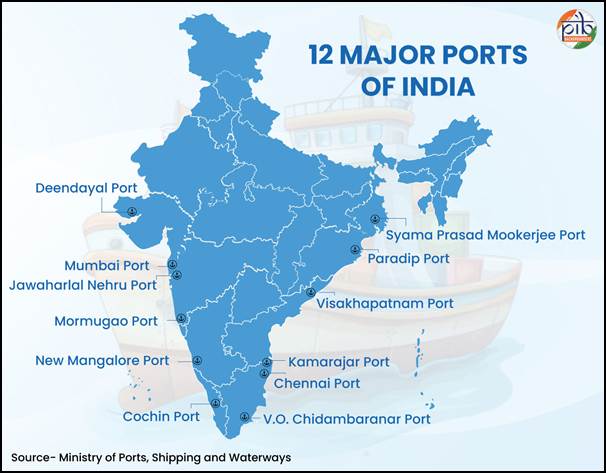
Source: Ministry of Ports, Shipping and Waterways, Government of India, “Sagarmala: Transforming India’s Maritime Landscape,” press release, Press Information Bureau, 11 April 2026.
Security and Growth for All in the Region (SAGAR), articulated in 2015, provides a policy framework for India’s engagement with countries in the Indian Ocean. It emphasises maritime security, regional cooperation, capacity-building and shared economic development. From a geoeconomic perspective, SAGAR shows how maritime partnerships can complement domestic infrastructure by strengthening regional connectivity, trade and economic relationships. Its significance extends beyond naval security to cooperation in areas such as maritime safety, humanitarian assistance and sustainable development. Although distinct from PM Gati Shakti and Sagarmala, SAGAR complements India’s maritime policy by linking regional engagement to broader objectives of economic growth, strategic autonomy and international cooperation.
Vision behind Sapt Dhara
The idea of Shakti ki Saptadhara offers an interesting way to understand the evolving direction of India’s development strategy. Rather than treating infrastructure, economic growth, sustainability, technology and national security as separate areas, the framework brings them together as interconnected dimensions of national development. For India’s maritime sector, two of these dimensions are particularly significant: Gati Shakti, which focuses on connectivity and infrastructure, and the Green and Blue Economy, which recognises the economic and ecological importance of India’s maritime resources.[8] When these are considered alongside Sagarmala and the SAGAR framework, a broader picture emerges in which maritime infrastructure is increasingly integrated with economic development, regional connectivity and strategic engagement.[9]
The question behind this convergence is straightforward: India has invested heavily in ports, roads, railways and waterways, but has this investment begun to change how cargo moves? How does trade connect with the hinterland?[10] And how do coastal communities participate in the maritime economy? The three major initiatives can be understood as serving distinct yet overlapping functions. Gati Shakti provides the planning architecture, Sagarmala connects maritime infrastructure with economic activity, and SAGAR extends the maritime framework into regional cooperation. The Blue Economy raises the question of whether this growth can be sustained through responsible use of marine resources and continued support for coastal livelihoods.
Geography is the natural starting point. India’s coastline has been reassessed from the long-quoted 7,516.6 kilometres to 11,098.81 kilometres, following the use of updated GIS and high-resolution data by the National Hydrographic Office and the Survey of India, with the coastal States and Union Territories concurring.[11] India also has an Exclusive Economic Zone of about 2.4 million square kilometres and more than 14,500 kilometres of potentially navigable inland waterways.[12]
India’s Sapt Dhara vision can be examined through the interplay of geography, economic development and maritime strategy. According to the Ministry of Ports, Shipping and Waterways, nearly 95 per cent of India’s trade by volume and around 70 per cent by value is handled through ports.[13] In 2025–26, India’s major and non-major ports handled 1,668 million tonnes of cargo.[14] These figures underscore the importance of linking ports to roads, railways, inland waterways, logistics centres and industrial clusters. Effective maritime connectivity depends not only on ports but also on the efficient movement of goods between production centres and international markets.[15] These initiatives can be understood through Edward N. Luttwak’s concept of geoeconomics, which explains how economic instruments and infrastructure can strengthen national competitiveness and international influence.
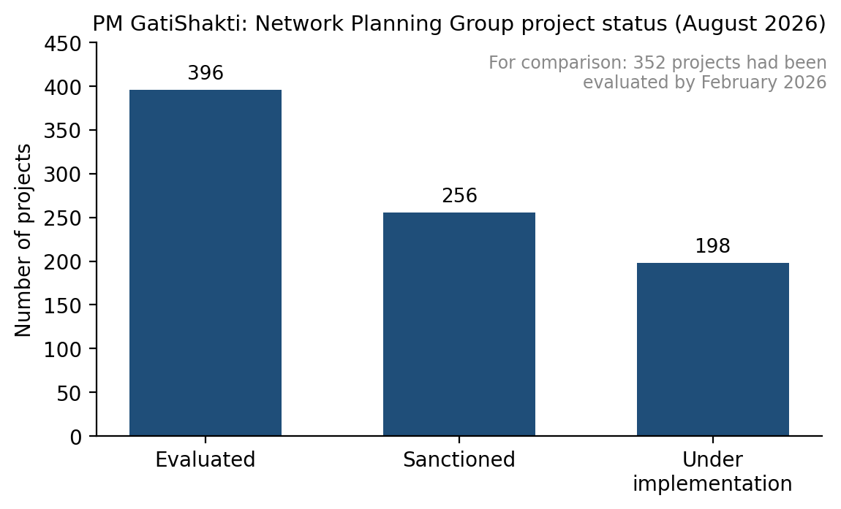
Three policy frameworks support this objective. PM Gati Shakti, launched in October 2021, promotes integrated infrastructure planning through a shared digital platform, helping coordinate transport networks and reduce logistical bottlenecks. As shown in Figure 2, by August 2026, the Network Planning Group had evaluated 396 infrastructure projects worth approximately ₹18.66 lakh crore.[16] The National Master Plan integrates 58 ministries and departments and uses about 1,800 data layers. Sagarmala complements this approach through port modernisation, port connectivity and port-led development, linking maritime infrastructure with trade, industrial growth and coastal livelihoods.
Figure 2. PM Gati Shakti: Network Planning Group project status
Source: Ministry of Commerce and Industry, “PM GatiShakti National Master Plan Enables Integrated and Coordinated Infrastructure Planning,” Press Information Bureau, 11 August 2026; February 2026 comparison from Ministry of Commerce and Industry, “PM GatiShakti Network Planning Group Evaluates 352 Infrastructure Projects worth ₹16.10 Lakh Crore,” Press Information Bureau, 10 February 2026.
SAGAR extends India’s maritime engagement through regional cooperation, maritime security and capacity-building across the Indian Ocean.[17] Inland waterways create another link between the hinterland and the maritime economy and can offer an alternative to road and rail where navigable routes exist. The Ministry estimates inland water transport at ₹1.06 per tonne-kilometre, compared with ₹1.36 for railways and ₹2.50 for highways, at 2014 price levels.[18] Here, the concept of complex interdependence, associated with Robert Keohane and Joseph Nye, helps explain the importance of connectivity and regional cooperation. The Blue Economy adds a sustainability dimension by linking maritime growth with environmental protection and coastal livelihoods.[19] Together, these frameworks illustrate how India can translate its geographical advantages into economic growth, regional engagement and sustainable development.
Sagarmala: Port-led development
If Gati Shakti provides the connectivity architecture, Sagarmala gives that connectivity an economic purpose. Launched in 2015, the programme promotes port-led development across five broad areas: port modernisation, port connectivity, port-led industrialisation, coastal community development, and coastal shipping and inland waterways. It is the largest of the three layers and the one with the best data, and its size has grown over time.
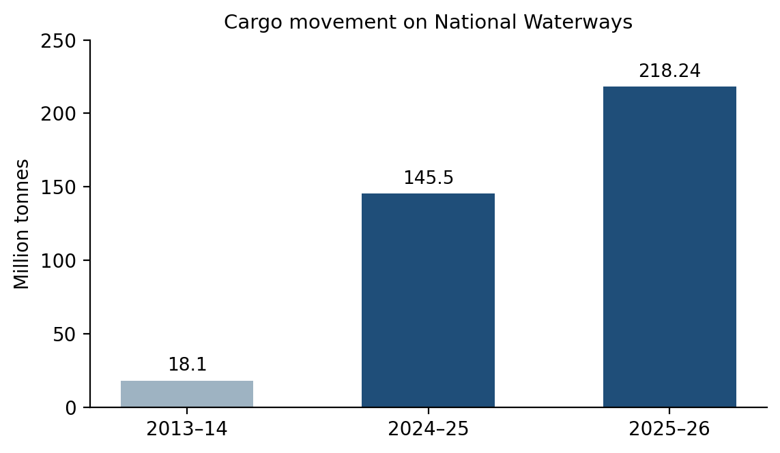
Figure 3. Cargo movement on National Waterways, 2013–14 to 2025–26
Source: Ministry of Ports, Shipping and Waterways, “National Logistics Policy, Inland Waterways Development and Multimodal Connectivity,” Press Information Bureau, 21 July 2026 (2013–14 and 2025–26); Ministry of Ports, Shipping and Waterways, “Sagarmala: Transforming India’s Maritime Landscape,” Press Information Bureau, 11 April 2026 (2024–25).
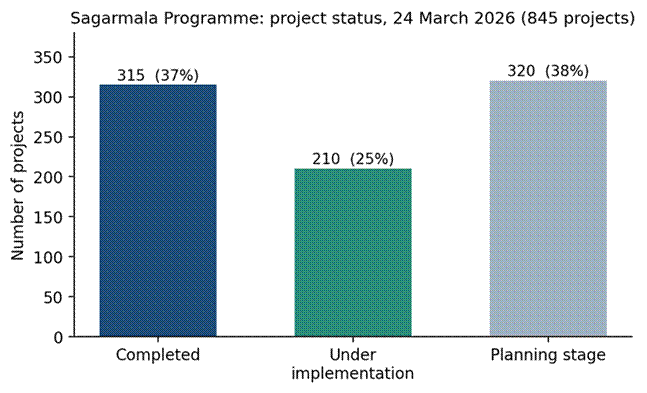
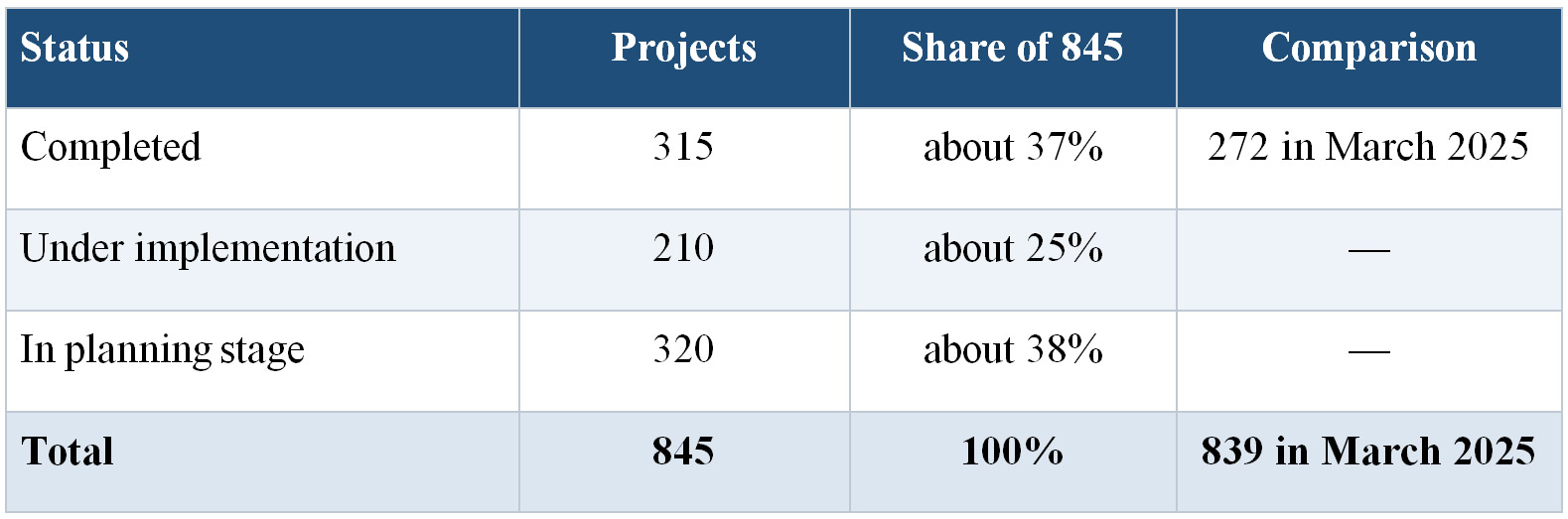
By March 2026, it covered 845 projects worth ₹6.06 lakh crore. Of these, 315 projects worth ₹1.57 lakh crore had been completed, 210 were under implementation, and 320 remained at the planning stage.[20] Meanwhile, cargo movement on National Waterways rose from 18 million tonnes in 2013–14 to 218.24 million tonnes in 2025–26, as shown in figure 3.
Figure 4. Sagarmala Programme: project status as of 24 March 2026
Source: Ministry of Ports, Shipping and Waterways, “Sagarmala: Transforming India’s Maritime Landscape,” Press Information Bureau, 11 April 2026.
As depicted in Figure 4, 210 projects were under implementation, and 320 were at the planning stage.[21] In a single year, 43 more projects were finished.
Table 1. Where Sagarmala stands (as of 24 March 2026)
Source: Ministry of Ports, Shipping and Waterways, “Sagarmala: Transforming India’s Maritime Landscape,” Press Information Bureau, 11 April 2026 (status as of 24 March 2026); Ministry of Ports, Shipping and Waterways, “Sagarmala Programme: Powering India’s Maritime Revolution,” Press Information Bureau, 27 March 2025 (March 2025 comparison).
Operational National Waterways rose from three to 32.[22] However, only about 37 per cent of Sagarmala projects had been completed, indicating substantial work remains. Together, Gati Shakti and Sagarmala demonstrate how integrated connectivity and port-led development can reduce logistics costs, improve market access and support industrial growth and coastal livelihoods.
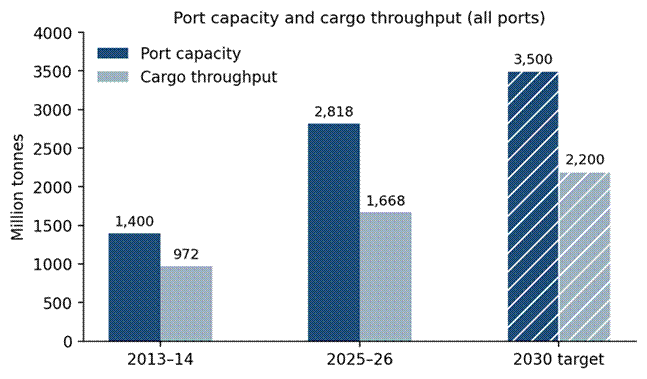
Under the Maritime India Vision 2030, India’s total port capacity rose from 1,400 million tonnes per annum in 2013–14 to 2,818 million tonnes in 2025–26, while cargo throughput increased from 972 million to 1,668 million metric tonnes. The 2030 targets are 3,500 million tonnes of capacity and 2,200 million tonnes of throughput.[23]
Figure 5. Port capacity and cargo throughput, 2013–14, 2025–26 and 2030 targets
Source: Ministry of Ports, Shipping and Waterways, “Maritime India Vision 2030,” Press Information Bureau, 21 July 2026.
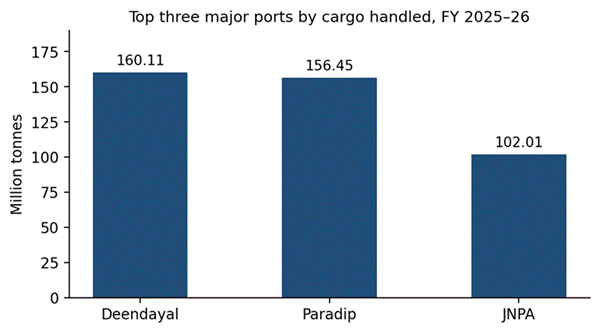
In FY 2025–26, major ports handled 915.17 million tonnes, exceeding their target of 904 million tonnes and recording 7.06 per cent annual growth.[24] Deendayal, Paradip and Jawaharlal Nehru Port Authority were the leading ports. These figures distinguish major-port cargo from the 1,668 million tonnes handled by major and non-major ports combined.
Figure 6. Top three major ports by cargo handled, FY 2025–26
Source: Ministry of Ports, Shipping and Waterways data, as reported in “Major Ports Handle Record 915 Million Tonnes Cargo in FY26, Surpass Target,” DD News (Prasar Bharati), 5 April 2026.
Sagarmala has completed 120 port-modernisation projects, adding over 400 million tonnes per annum of capacity, alongside 106 road and rail connectivity projects.[25] Its emphasis on coastal shipping and inland waterways is reflected in cargo growth from 87 to 195 million tonnes and from 18.10 million tonnes in 2013–14 to 145.50 million tonnes in 2024–25, respectively. These alternatives can improve logistics efficiency and reduce pressure on land transport.
Sagarmala also supports coastal communities through fisheries, tourism, fish processing and port-related employment. Its estimated potential of one crore jobs, 40 lakh direct and 60 lakh indirect, is a projection, not actual employment created.[26] Thus, its contribution to the Blue Economy depends on combining efficient maritime infrastructure with sustainable development and inclusive coastal livelihoods.
SAGAR (Security and Growth for All in the Region)
Introduced by Prime Minister Narendra Modi in Mauritius in 2015, SAGAR provides the regional and diplomatic dimension of India’s maritime strategy. It envisages a free, open, inclusive, peaceful and prosperous Indo-Pacific, grounded in a rules-based order, freedom of navigation, respect for sovereignty and the peaceful settlement of disputes.[27] With nearly 95 per cent of India’s trade by volume moving by sea,[28] maritime security and reliable regional connectivity are essential to India’s economic interests. SAGAR links security with growth by promoting maritime cooperation, disaster response and regional capacity-building.
India–Bangladesh connectivity exemplifies this approach. The Protocol on Inland Waterways Trade and Transit, operational since 1972, facilitates trade and transit through shared river systems. In 2023, the two countries operationalised arrangements allowing India to use the Chittagong and Mongla ports for transit cargo between mainland India and the Northeast.[29] These routes can reduce transport time and costs for a region connected to the rest of India by a narrow land corridor. Similarly, the Kaladan Multimodal Transit Transport Project connects India’s eastern coast with Mizoram through Myanmar. Its planned route combines 539 kilometres of maritime transport between Kolkata and Sittwe, 158 kilometres of inland-waterway transport between Sittwe and Paletwa, and onward road connectivity towards the India-Myanmar border. Sittwe Port became operational in May 2023, when the first Indian cargo vessel arrived from Kolkata.[30]
India’s western connectivity via Chabahar Port highlights the political challenges facing regional infrastructure. In May 2024, India and Iran signed a long-term contract to develop and operate the Shahid Beheshti Terminal, thereby strengthening access to Afghanistan and Central Asia.[31] However, the expiry of the US sanctions waiver on 26 April 2026 introduced uncertainty about India’s continued role.[32] Through geoeconomics and complex interdependence, SAGAR demonstrates how infrastructure agreements can create alternative trade routes and strengthen regional cooperation. However, their success depends on political stability, commercial viability and sustained cooperation among participating countries.
The Blue Economy and Economic Growth
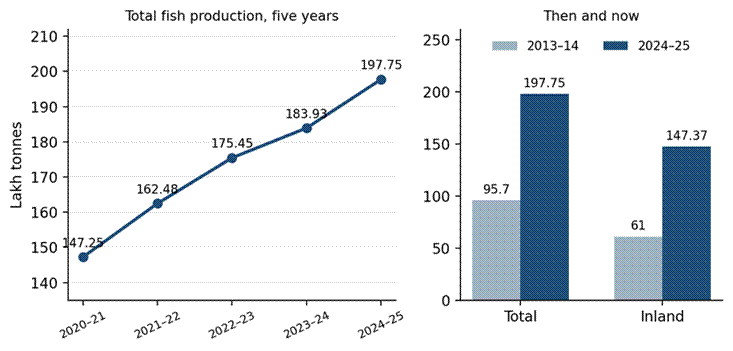
The Blue Economy is a key pillar of India’s Sapt Dhara vision, linking marine resources to economic growth, coastal livelihoods and environmental sustainability. India is the world’s second-largest fish producer, accounting for approximately 8 per cent of global output. Fisheries production rose from 95.79 lakh tonnes in 2013–14 to 197.75 lakh tonnes in 2024–25.[33] The sector supports over 30 million livelihoods, while coastal states account for 72 per cent of India’s fish production and 76 per cent of seafood exports.[34] Fisheries exports reached ₹73,890 crore (approximately US$8.46 billion) in 2025–26, reflecting the sector’s growing contribution to foreign exchange earnings.[35] However, frozen shrimp accounted for ₹49,037.93 crore, or approximately 66.5 per cent of export earnings in US-dollar terms, highlighting the need for product and market diversification.[36]
Figure 7. India’s fish production: five-year trend and long-run comparison
Source: Press Information Bureau, “Advancing India’s Fisheries Sector: Institutions, Investment, and Inclusion,” 6 April 2026; Department of Fisheries, Ministry of Fisheries, Animal Husbandry and Dairying, annual fish production data.
Government initiatives such as the Pradhan Mantri Matsya Sampada Yojana, approved with an investment of ₹20,050 crore, aim to strengthen fisheries, infrastructure and fisher welfare.[37] The Blue Economy extends beyond fisheries to include port services, shipbuilding, marine tourism, offshore renewable energy and sustainable ocean resource management. Its economic potential depends on connecting production with processing, cold-chain infrastructure, transport and export markets. These initiatives support fisheries development and fisher welfare.[38]
From a geoeconomic perspective, these activities can strengthen India’s trade competitiveness, create employment, and expand its participation in the global maritime economy. However, economic expansion must not undermine the ecological systems on which coastal livelihoods depend. Marine pollution, declining fish stocks, and illegal, unreported, and unregulated fishing require stronger monitoring, conservation, and international cooperation.[39] The Blue Economy therefore advances Sapt Dhara by pursuing economic growth, equitable livelihood opportunities, and ocean conservation together, thereby supporting India’s sustainable-development ambitions under Viksit Bharat@2047.
Integrated Maritime Connectivity and Geoeconomic Transformation
Together, PM Gati Shakti, Sagarmala, SAGAR and the Blue Economy illustrate four complementary dimensions of India’s maritime transformation: infrastructure integration, port-led economic development, regional engagement and sustainable livelihoods. Their significance is particularly evident in the Bay of Bengal, where eastern ports connect to inland waterways, the Northeast, Bangladesh and Myanmar. The India–Bangladesh port arrangement, the inland-waterway protocol and the Kaladan project demonstrate how maritime networks can extend inland and across national borders.
From a geoeconomic standpoint, transport infrastructure affects the flow, price, and accessibility of goods. Cross-border rivers, ports, and logistics corridors can increase regional influence, strengthen economic interdependence, and ease trade. However, infrastructure does not always confer strategic advantages. Underutilised corridors can limit efficiency, while customs barriers, political disputes, and shifting external circumstances also constrain capacity. India’s maritime policy requires sustainable resource management, effective implementation, long-term regional partnerships, and commercially viable infrastructure. Transforming physical connectivity into inclusive economic growth and long-term regional cooperation is essential to its ultimate success.
India’s maritime policy has evolved from a security-focused approach to an integrated plan that encompasses sustainability, connectivity, economic growth, and regional cooperation. In 2015, SAGAR (Security and Growth for All in the Region) linked maritime security with regional collaboration and prosperity across the Indian Ocean. The 2020 COVID-19 pandemic exposed weaknesses in ports, shipping, and logistics, underscoring the need for robust supply networks. Alongside Sagarmala’s focus on port-led development, the introduction of PM Gati Shakti in 2021 reinforced integrated infrastructure planning.
The Maritime Amrit Kaal Vision 2047, released in October 2023, places maritime development within the broader goal of Viksit Bharat@2047. It encompasses inland waterways, port modernisation, shipping, shipbuilding, digitalisation, and the Blue Economy. This development reflects India’s growing focus on turning geographic advantages into regional influence, connectivity, and economic competitiveness.
Conclusion
India’s maritime evolution signals a shift from traditional port development to a comprehensive geoeconomic approach that combines infrastructure, trade, regional cooperation and sustainability. The maritime industry’s significance for Viksit Bharat@2047 is evident in growth in cargo handling, fisheries output and export revenues, as well as in integrated infrastructure planning. India aims to link domestic infrastructure with port-led development and regional participation through PM Gati Shakti, Sagarmala and SAGAR. The Blue Economy integrates economic expansion with coastal livelihoods and environmental conservation.
Measurable outcomes may include: first, infrastructure efficiency, measured by savings in port turnaround and cargo dwell times, logistics costs, and delays in multimodal connectivity projects. Second, economic competitiveness should be assessed by annual port cargo growth, coastal shipping and inland-waterway freight volumes, maritime investment, export diversification, and employment generation. Third, regional connectivity should be evaluated through cargo movement along operational cross-border corridors, customs clearance times, trade volumes, and the continuity of bilateral infrastructure agreements. Fourth, fisheries export diversification, fisher incomes, resource stock health, marine pollution levels, and adherence to sustainable fishing guidelines should be used to gauge the sustainability of the Blue Economy. Lastly, women’s participation, skill development, coastal employment, and livelihood improvements should be used to evaluate inclusive development.
The government should set baseline metrics, issue annual progress reports, and regularly evaluate results against predetermined goals. From a geoeconomic standpoint, Sapt Dhara’s success will depend on measurable gains in productivity, resilience, regional cooperation, and environmental sustainability, rather than on infrastructure alone. By 2047, India’s maritime potential can be translated into equitable and sustainable prosperity with the aid of these quantifiable results.
Author Brief Bio:
Dr. Preeti Sharma is an Assistant Professor of International Politics at the Central University of Gujarat, with 13 years of teaching and research experience. Her research interests include South Asian and Himalayan geopolitics and India’s foreign policy. She has 30 scholarly publications and has participated in IPSA World Congresses in Montreal, Brisbane and Seoul. She serves as Vice Chair, IPSA RC35 Technology and Development, and holds leadership and editorial positions in national academic organisations.
Pahi Bhuyan is pursuing Master’s degree from the Department of International Politics, School of International Studies, Central University of Gujarat.
References:
[1] M. Susarla, “Indian Maritime History: A Glimpse into Ancient Naval Power and Trade Networks,” The Geostrata, 8 November 2024; for the primary text, see R. P. Kangle, The Kautiliya Arthasastra, pt. 2 (Bombay: University of Bombay, 1963), bk. 2, ch. 28.
[2] Hans J. Morgenthau, Politics among Nations: The Struggle for Power and Peace, 5th ed. (New York: Alfred A. Knopf, 1973).
[3] Alfred Thayer Mahan, The Influence of Sea Power upon History (New York: Hill and Wang, 1957).
[4] Press Information Bureau, Government of India, “PM Gati Shakti: Transforming India’s Infrastructure and Connectivity,” explainer (ID 153274), 12 October 2024.
[5] Edward N. Luttwak, “From Geopolitics to Geo-economics: Logic of Conflict, Grammar of Commerce,” National Interest, no. 20 (1990): 17–23.
[6] Ministry of Ports, Shipping and Waterways, Government of India, “Sagarmala: Transforming India’s Maritime Landscape,” press release, Press Information Bureau, 11 April 2026.
[7] Luttwak, “From Geopolitics to Geo-economics.”
[8] Prime Minister’s Office, Government of India, “PM’s Address from the Ramparts of Red Fort on the Occasion of 80th Independence Day,” 15 August 2026. On the Blue Economy as a maritime-security and development concept, see Michelle Voyer et al., “Maritime Security and the Blue Economy: Intersections and Interdependencies in the Indian Ocean,” Journal of the Indian Ocean Region 14, no. 1 (2018): 28–48.
[9] Michelle Voyer et al., “Shades of Blue: What Do Competing Interpretations of the Blue Economy Mean for Oceans Governance?” Journal of Environmental Policy & Planning 20, no. 5 (2018): 595–616.
[10] Theo E. Notteboom and Jean-Paul Rodrigue, “Port Regionalization: Towards a New Phase in Port Development,” Maritime Policy & Management 32, no. 3 (2005): 297–313, https://doi.org/10.1080/03088830500139885.
[11] Press Information Bureau, Government of India, “Revised Length of India’s Coastline,” 2025 (citing the National Hydrographic Office and the Survey of India).
[12] Ministry of Ports, Shipping and Waterways, Government of India, “Port Modernization and Expansion,” press release, Press Information Bureau, 28 July 2026.
[13] Ministry of Ports, Shipping and Waterways, “Sagarmala: Transforming India’s Maritime Landscape.”
[14] Ministry of Ports, Shipping and Waterways, “Port Modernization and Expansion.”
[15] Notteboom and Rodrigue, “Port Regionalization”; Jean-Paul Rodrigue, The Geography of Transport Systems, 5th ed. (London: Routledge, 2020).
[16] Ministry of Commerce and Industry, Government of India, “PM GatiShakti National Master Plan Enables Integrated and Coordinated Infrastructure Planning,” press release, Press Information Bureau, 11 August 2026, https://www.pib.gov.in/PressReleasePage.aspx?PRID=2297818. For the earlier figure of 352 projects worth ₹16.10 lakh crore, see Ministry of Commerce and Industry, Government of India, “PM GatiShakti Network Planning Group Evaluates 352 Infrastructure Projects worth ₹16.10 Lakh Crore,” press release, Press Information Bureau, 10 February 2026.
[17] Ministry of External Affairs, Government of India, “Prime Minister’s Remarks at the Commissioning of Offshore Patrol Vessel (OPV) Barracuda in Mauritius,” 12 March 2015; “India, Mauritius Decide to Reach the Level of Enhanced Strategic Partnership,” All India Radio News, 12 March 2025, https://newsonair.gov.in/india-mauritius-decide-to-reach-the-level-of-enhanced-strategic-partnership. For the longer background, see David Brewster, India’s Ocean: The Story of India’s Bid for Regional Leadership (London: Routledge, 2014).
[18] Ministry of Ports, Shipping and Waterways, Government of India, “National Logistics Policy, Inland Waterways Development and Multimodal Connectivity,” written reply in the Rajya Sabha, press release, Press Information Bureau, 21 July 2026, https://www.pib.gov.in/PressReleasePage.aspx?PRID=2286975. Costs are at 2014 price levels.
[19] Robert O. Keohane and Joseph S. Nye Jr., Power and Interdependence, 4th ed. (Boston: Longman, 2012); on the Blue Economy, see Voyer et al., “Shades of Blue.”
[20] Ministry of Ports, Shipping and Waterways, “Sagarmala: Transforming India’s Maritime Landscape.” Figures are as of 24 March 2026.
[21] Ministry of Ports, Shipping and Waterways, “Sagarmala: Transforming India’s Maritime Landscape.”
[22] Ministry of Ports, Shipping and Waterways, “National Logistics Policy, Inland Waterways Development and Multimodal Connectivity.”
[23] Ministry of Ports, Shipping and Waterways, Government of India, “Maritime India Vision 2030,” press release, Press Information Bureau, 21 July 2026, https://www.pib.gov.in/PressReleasePage.aspx?PRID=2286971.
[24] Ministry of Ports, Shipping and Waterways, “Sagarmala: Transforming India’s Maritime Landscape”; “Major Ports Handle Record 915 Million Tonnes Cargo in FY26, Surpass Target,” DD News (Prasar Bharati), 5 April 2026.
[25] Megha Bisht, “315 Projects Completed under Sagarmala Programme,” Indian Infrastructure, 25 March 2026, https://indianinfrastructure.com/2026/03/25/315-projects-completed-under-sagarmala-programme/. The inland-waterway figures for 2013–14 and 2024–25 are from Ministry of Ports, Shipping and Waterways, “Sagarmala: Transforming India’s Maritime Landscape.”
[26] Ministry of Ports, Shipping and Waterways, “Sagarmala: Transforming India’s Maritime Landscape.”
[27] Ministry of External Affairs, “Prime Minister’s Remarks at the Commissioning of Offshore Patrol Vessel (OPV) Barracuda in Mauritius”; “India, Mauritius Decide to Reach the Level of Enhanced Strategic Partnership,” All India Radio News.
[28] Ministry of Ports, Shipping and Waterways, “Sagarmala: Transforming India’s Maritime Landscape.”
[29] Ministry of External Affairs, Government of India, “SAGAR: Security and Growth for All in the Region,” with India–Bangladesh and Chabahar connectivity briefs, 2024.
[30] Press Information Bureau, Government of India, “Kaladan Multimodal Transit Transport Project and Operationalisation of Sittwe Port,” 2023.
[31] Ministry of External Affairs, “SAGAR.”
[32] “Is India’s Chabahar Dream in Iran Dead?” Al Jazeera, 29 April 2026.
[33] Press Information Bureau, Government of India, “Advancing India’s Fisheries Sector: Institutions, Investment, and Inclusion,” backgrounder, 6 April 2026; Press Information Bureau, Government of India, “Strengthening Marine Resources and Livelihoods: India Celebrates World Fisheries Day 2025,” backgrounder, 20 November 2025.
[34] Press Information Bureau, “Strengthening Marine Resources and Livelihoods.”
[35] Marine Products Export Development Authority (MPEDA), “India’s Seafood Exports Net US$8.46 Billion in 2025–26,” press release, 1 June 2026, https://mpeda.gov.in/wp-content/uploads/2026/06/MPEDA_2025-26_Export_Figures_ENGLISH_June-1.pdf.
[36] MPEDA, “India’s Seafood Exports Net US$8.46 Billion in 2025–26.” Frozen shrimp accounted for 66.52 per cent of US-dollar export earnings.
[37] Ministry of Fisheries, Animal Husbandry and Dairying, Government of India, “5 Years of Pradhan Mantri Matsya Sampada Yojana,” press release, Press Information Bureau, 10 September 2025.
[38] Ministry of Fisheries, Animal Husbandry and Dairying, “5 Years of Pradhan Mantri Matsya Sampada Yojana.”
[39] NITI Aayog, India’s Blue Economy: Strategy for Harnessing Deep-Sea and Offshore Fisheries (New Delhi: NITI Aayog, 13 October 2025).