
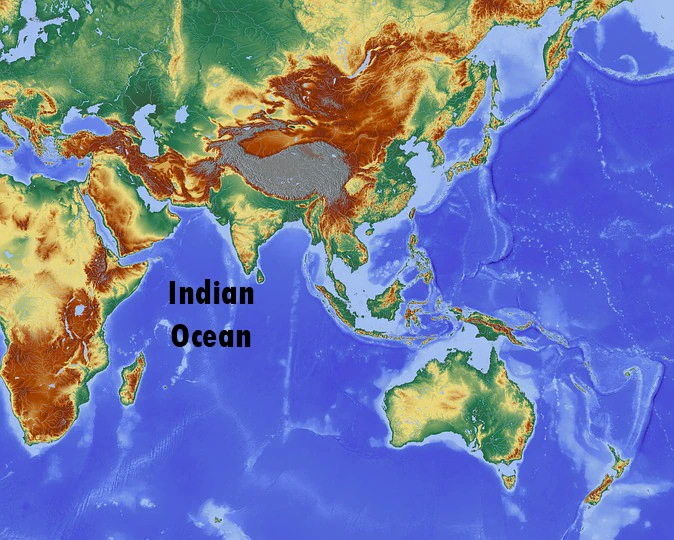
The Indian Ocean, the world’s third-largest after the Pacific and Atlantic, extends about 9,600 km from the Bay of Bengal to the Antarctic and around 7,800 km from South Africa to Western Australia. Covering an area of 21.45 million square nautical miles (approximately 20 per cent of the Earth’s water surface), it features a coastline of nearly 70,000 km. The Indian Ocean Region (IOR) comprises 36 countries and has a population of approximately 2.5 billion, accounting for 35 per cent of the global population and 40 per cent of the world’s coastline.[1]
The IOR is central to global trade, with nearly 100,000 ships navigating its waters annually. It accounts for approximately 30 per cent of worldwide container traffic and transports 42 per cent of crude oil, petroleum products, and distillates globally. The region possesses more than half of the world’s proven oil and gas reserves. It hosts approximately 20 per cent of global refining capacity, concentrated in hubs such as Jubail (Saudi Arabia), Jamnagar (India), and Singapore. Offshore exploration and production are extensive, with operations off the coasts of India, Iran, Saudi Arabia, and other Gulf Cooperation Council nations, as well as Western Australia, collectively contributing 40 per cent of global offshore output.[2]
The IOR is also home to some of the busiest and most strategic ports, including Singapore, which alone handles nearly one-seventh of global container transshipment. Among the world’s 20 largest merchant fleets, three (India, Malaysia, and Singapore) belong to Indian Ocean littoral states. The northern Indian Ocean hosts the busiest sea lane of the global east-west trade corridor, cementing its status as one of the world’s most critical maritime and geostrategic arteries.[3]
Therefore, securing the safety and stability of its shipping lanes and trade routes, primarily through chokepoints like the Straits of Hormuz, Bab el-Mandeb, and Malacca, is of global importance, extending well beyond regional concerns.[4]
However, beyond its economic and strategic significance, the IOR faces a rapidly deteriorating environmental and climate crisis with significant geopolitical and geoeconomic consequences. The Indian Ocean is warming at a faster rate than any other ocean, leading to increased sea level rise and exacerbating extreme weather events.[5] The increasing population, concerning pollution, ecological decline, and the cumulative effects of climate change, are increasingly shaping the futures of Indian Ocean states. These shared issues jeopardise the region’s environmental stability and future prosperity, highlighting the urgent need for united action and innovative solutions.
Climate Crisis in the IOR and Unfolding Geopolitical Saga in a Warming Ocean
The Indian Ocean is expected to warm by between 1.7°C and 3.8°C at a faster rate than previously predicted. In fact, sea surface temperatures in the IOR have already increased by over 1.5°C since the Industrial Era.[6] Without rapid reductions in greenhouse gases, such as carbon dioxide and methane, this warming trend is likely to continue at an accelerated pace throughout the century. Changes in the Asian monsoon system, shifting rainfall patterns, and disturbances to marine ecosystems are among the primary risks associated with climate change in the IOR.[7]
Other vulnerabilities include the increasing frequency and severity of tropical cyclones, flooding of low-lying coastal regions, shoreline erosion, saltwater intrusion, and the deterioration of coral reefs and fisheries due to ocean acidification. Collectively, these impacts pose serious threats to livelihoods as well as the food and health security of millions.[8]
Sea-level rise poses a significant threat to the very existence of low-lying island nations, such as the Maldives and Mauritius. At the same time, agriculture and freshwater supplies in many IOR states face mounting pressure from erosion and salinity. These climate stresses are already causing displacement and migration as communities lose their homes and incomes.[9]
A survey involving 24,000 internal migrants across Bangladesh, India, Indonesia, Nepal, and the Philippines reveals concerning patterns. Nine out of ten respondents reported experiencing extreme weather events, with heat identified as the greatest threat to livelihoods and household well-being in nearly every country. Extensive wage losses, severe health impacts, increasing food insecurity, rising medical costs, and inadequate housing further compound the hardships faced by these communities.[10]
Climate change also risks heightening existing geopolitical tensions caused by population displacement and competition over fisheries and seabed minerals. Countries are increasingly investing in deep-sea exploration and sustainable resource management to protect their economic interests.[11] Fishing disputes arising from boundary infringements and illegal, unreported, and unregulated (IUU) fishing are likely to escalate as fish stocks decline or shift due to changes in ocean conditions.[12] Countries like Sri Lanka are strengthening maritime security and coastal resilience to tackle issues such as illegal fishing and population displacement.[13] On the economic front, climate-related disasters threaten vital infrastructure, including ports, energy facilities, and coastal telecommunications, resulting in cascading effects on trade, supply chains, and national economies.[14]
Compounding these challenges, many IOR countries remain ill-equipped to adapt to global carbon market mechanisms, such as the European Union (EU)’s Carbon Border Adjustment Mechanism (CBAM). This introduces new structural, institutional, and financial obstacles for regional economies. Furthermore, land loss caused by rising seas and coastal erosion could complicate maritime governance by undermining existing boundaries and Exclusive Economic Zones (EEZs), within which states exercise jurisdiction over their resources.[15]
Protecting critical coastal infrastructure will require substantial investments in resilience and adaptation, supported by regional and global cooperation. Meanwhile, climate vulnerabilities could escalate geopolitical tensions, with major powers using climate initiatives to extend influence in vulnerable nations. For example, under the China–IOR Forum on Development Cooperation, Beijing has proposed launching a Disaster Prevention and Mitigation Alliance and an Early Warning System (EWS), while also increasing renewable energy investments in countries such as the Maldives and Bangladesh.[16] Recognising the magnitude of the challenge and to counter the growing influence of rival powers in the IOR, India’s Defence Minister has highlighted the need for a strong naval presence.[17]
Role of India
As a key regional player, India is spearheading climate diplomacy efforts, encouraging cooperation to protect shared resources and ensure a stable, sustainable future. Its Security and Growth for All in the Region (SAGAR) vision highlights climate resilience, ocean governance, and disaster preparedness, aiming to enhance the abilities of littoral states while promoting sustainable development and deeper regional integration.[18] India is working to strengthen clean energy partnerships with its IOR neighbours, including Sri Lanka and Mauritius.[19] Its Deep Ocean Mission aims to explore and sustainably utilise ocean resources.[20]
The country has played a vital role in establishing multilateral platforms such as the International Solar Alliance to promote the solar sector, the Coalition for Disaster Resilient Infrastructure to enhance disaster resilience, the International Big Cat Alliance to support big cat conservation, and the Global Biofuels Alliance to position biofuels as a key solution for the global energy transition and contribute to socio-economic growth[21].
India is also a leading member of the Bay of Bengal Initiative for Multi-Sectoral Technical and Economic Cooperation (BIMSTEC), where climate change and environmental sustainability are key areas of cooperation. India leads the security sector, which includes energy and disaster management sub-sectors closely linked to climate risks and responses, providing opportunities for collaborative solutions beyond purely military-to-military engagement. India has already initiated numerous efforts, including Indian Navy-led Humanitarian Assistance and Disaster Relief (HADR) operations and exercises. Additionally, India has led BIMSTEC Disaster Management Exercises in 2017 and 2020. The Indian National Centre for Ocean Information Services (INCOIS) supplies cyclone forecasts and tsunami alerts to countries in the Bay of Bengal, thereby strengthening regional disaster preparedness.[22]
The Indian Ocean Rim Association (IORA) serves as another key platform for fostering regional cooperation on security, trade, disaster resilience, and sustainable development. With 23 member states and 11 Dialogue Partners, many of which are highly vulnerable to climate change, IORA benefits from India’s initiatives in areas such as the blue economy, renewable energy, capacity building, marine biodiversity conservation, and climate resilience. As the chair of IORA from 2025 to 2027, India’s focus includes addressing resource constraints, ocean governance, and disaster risk reduction (DRR).[23]
Despite the presence of these regional institutions, there are gaps in infrastructure modernisation, such as ports, regional connectivity, and implementation, often limited by financial and technical constraints. Additionally, climate action is often fragmented and siloed. Furthermore, even with institutional mechanisms in place, issues like bilateral disagreements, political or economic instability, project delays, cost overruns, uneven burden-sharing, and limited sustainable financing hinder effective regional climate cooperation.
Against this backdrop, the lack of a coordinated regional framework leaves the IOR exposed to fragmented responses and strategic rivalry. Here, a set of climate cooperation principles could prove to be a decisive factor.
Climate Cooperation Principles for the IOR
Establishing climate cooperation principles for the IOR countries would create a shared roadmap for action, bridging fragmented efforts, reducing climate-driven geopolitical tensions, strengthening resilience, and enhancing sustainable development. These principles would serve as a foundation for harmonised policies, coordinated investments, and regional solidarity. They would facilitate turning climate vulnerabilities into opportunities for collective security, prosperity, and environmental stewardship. India’s SAGAR vision, IORA chairmanship, BIMSTEC involvement, and initiatives like the Deep Ocean Mission, INCOIS, CDRI, etc., could provide a strong platform to operationalise the climate cooperation principles for the IOR nations, which would bring substantial benefits across environmental, economic, social, and geopolitical dimensions, as explained below.
Strengthening Regional Coordination and Response
The IOR faces shared climate vulnerabilities, including rising sea levels, cyclones, shifting monsoons, coastal erosion, ocean warming, and ecological degradation. A set of joint climate cooperation principles could provide a common framework for coordinating disaster preparedness and EWSs, particularly for cyclones, tsunamis, and floods; harmonising climate policies, standards, and response protocols across countries, reducing duplication, and improving efficiency; and encouraging cross-border data-sharing and joint research on climate impacts, marine ecosystems, and oceanography. All this may pave the way for faster, more effective, and cost-efficient responses to climate crises that often transcend national borders.
Enhancing Climate Resilience and Adaptation
The principles could establish shared guidelines for resilience-building, including coastal infrastructure adaptation for ports, energy facilities, and transport corridors; ecosystem restoration and marine biodiversity protection; and community-level adaptation strategies for vulnerable populations – leading to reduced socioeconomic disruption, protected livelihoods, and strengthened regional food, water, and health security.
Mitigating Geopolitical Risks
Climate change is intensifying competition for resources, including fisheries, seabed minerals, and maritime boundaries. The shared principles could foster rules-based management of marine resources to minimise conflicts over fishing, seabed extraction, or maritime boundary disputes; support regional dialogue on climate-induced migration; and establish norms for joint disaster relief and humanitarian aid, preventing unilateral actions that might escalate tensions. Consequently, the region could see a reduced risk of climate-driven conflicts, enhanced regional stability, and a platform for cooperative security measures.
Facilitating Sustainable Economic Growth
Climate crises pose significant threats to trade, ports, supply chains, fisheries, tourism, and energy infrastructure. The principles could foster sustainable development policies and renewable energy investments, encourage climate-smart agriculture, fisheries management, and coastal urban planning, and support equitable participation in global carbon markets and mechanisms, such as the EU’s CBAM. This could lead to improved economic resilience, protection of critical infrastructure, and better integration of regional economies into global sustainability frameworks.
Promoting Inclusive and Equitable Action
Climate change impacts are uneven, with Small Island Developing States (SIDS), coastal communities, women, children, the elderly, and low-income populations being disproportionately affected. The principles could prioritise equity, social inclusion, and protection for vulnerable groups in adaptation planning; establish mechanisms for burden-sharing and funding allocation to ensure that all countries can implement necessary climate measures; and foster community-driven approaches and localised solutions in harmony with national strategies. This would ensure that no country or community is left behind.
Driving Innovation and Knowledge Sharing
The principles can promote regional cooperation on climate-resilient infrastructure and thoughtful urban planning, as well as renewable energy, biofuels, ocean-based technologies, and EWSs, DRR, and climate monitoring – thereby speeding up innovation, improving preparedness, and strengthening long-term adaptation strategies across the IOR.
Given the strong case for cooperation on climate issues among the IOR nations, the following principles for such collaboration are proposed to enhance regional coordination, resilience, and sustainable development in response to the escalating climate crisis in the IOR.
| # | Principle | Action | Objective |
| 1 | Shared Responsibility and Solidarity | a. Recognise climate change as a common but differentiated responsibility (CBDR), with wealthier and industrialised nations supporting the adaptation and mitigation efforts of vulnerable states b. Promote equitable burden-sharing for climate action, including financing, technology transfer and capacity-building. c. Facilitate triangular cooperation, leveraging multilateral platforms to address local vulnerabilities with global expertise and resources. | Ensure inclusivity and fairness in addressing climate risks while enhancing regional trust |
| 2 | Coordinated DRR | a. Develop and implement joint EWSs for cyclones, tsunamis, flooding and other extreme weather events b. Standardise disaster response protocols across borders, including evacuation, humanitarian assistance and post-disaster rehabilitation c. Conduct regular joint disaster management exercises and simulations among the IOR countries | Minimise loss of life and economic disruption by improving the speed and efficiency of collective response |
| 3 | Climate-Resilient Infrastructure | a. Prioritise climate-resilient ports, transport networks, energy facilities and urban planning b. Develop regional guidelines for coastal adaptation, including mangrove restoration, shoreline stabilisation and flood-resistant construction c. Support knowledge sharing and technical assistance to implement adaptation infrastructure in vulnerable countries | Safeguards critical economic and social infrastructure, ensuring continuity of trade and services |
| 4 | Sustainable Marine and Natural Resource Management | a. Cooperate on sustainable fisheries management, ocean conservation, and biodiversity protection b. Establish joint monitoring of fish stocks, seabed minerals, and marine ecosystems to prevent overexploitation and disputes c. Harmonise policies on IUU fishing and promote resource-sharing frameworks | Reduce conflict over dwindling resources and ensures long-term ecological and economic stability |
| 5 | Regional Climate Science and Data Sharing | a. Encourage joint research initiatives on climate change impacts, marine ecosystems and ocean warming trends b. Standardise data collection and climate monitoring protocols across the IOR countries c. Establish a shared regional knowledge platform for forecasts, adaptation strategies and best practices | Evidence-based policymaking strengthens adaptive capacity and regional coordination |
| 6 | Sustainable Economic Development and Energy Transition | a. Promote renewable energy cooperation, including solar, wind and ocean-based technologies b. Encourage climate-smart agriculture, fisheries and urban planning to enhance resilience. c. Facilitate equitable access to global carbon markets, technology and financing mechanisms | Support sustainable growth while reducing greenhouse gas emissions and enhancing energy security |
| 7 | Inclusive, Community-Focussed Adaptation | a. Prioritise vulnerable populations, including SIDS, coastal communities and low-income groups in adaptation planning b. Foster community-led climate initiatives to ensure solutions are locally relevant c. Promote gender-sensitive policies recognising the disproportionate impacts of climate change | Ensure social equity and strengthen local ownership of climate action |
| 8 | Integrated Governance and Institutional Coordination | a. Enhance coordination between security, climate, and disaster management sectors at regional institutions such as IORA and BIMSTEC. b. Establish mechanisms to align bilateral, multilateral and regional initiatives to reduce fragmentation. c. Promote monitoring and evaluation systems to track implementation progress and identify gaps | Improve coherence and efficiency of regional climate action |
| 9 | Climate Diplomacy and Geopolitical Cooperation | a. Use climate cooperation as a platform to build trust, reduce conflicts and manage transboundary climate risks b. Encourage joint climate diplomacy to attract investments, technology, and support from industrialised nations c. Promote peaceful resolution of resource-related disputes, leveraging multilateral agreements and shared principles | Strengthen regional stability and leverages climate initiatives as a diplomatic tool |
| 10 | Continuous Review and Adaptive Policy | a. Conduct periodic joint assessments of climate vulnerabilities, adaptation needs and progress on implementation of the climate cooperation principles b. Encourage adaptive governance, adjusting strategies based on emerging risks, scientific findings and lessons learned. c. Foster regional innovation networks to trial new technologies and approaches to climate resilience | Ensure principles remain dynamic, evidence-based and responsive to changing circumstances |
The above principles offer a comprehensive roadmap for cooperation, ensuring that the IOR countries act collectively to mitigate climate risks, protect vulnerable communities, safeguard economic interests, and maintain regional stability. By adhering to shared responsibilities, harmonising policies, and leveraging regional institutions, the IOR can turn climate vulnerability into an opportunity for sustainable growth, resilience, and geopolitical stability.
At first glance, a shared set of climate principles appears to be a clear benefit. It could enhance trust, draw climate finance, and facilitate the coordination of science and policy across borders. However, the IOR is among the most diverse regions in the world, including least developed countries, SIDS, and major emerging powers. Variations in capacity, priorities, and governance traditions mean that a one-size-fits-all approach to principles will not be effective.
The first warning, therefore, is to prevent reinforcing inequality. Regional frameworks that do not consider CBDR risk marginalise smaller states. Wealthier economies, such as India, Australia, and Saudi Arabia, must explicitly commit to supporting capacity-building, technology transfer, and concessional finance for island and coastal nations facing existential threats.
A second risk concerns overstepping national sovereignty. Climate cooperation involves sensitive areas such as energy systems, marine resources, and migration policies. If regional mechanisms are perceived as infringing on domestic control, they will be politically difficult to accept. Therefore, cooperation should be voluntary, transparent, and based on respect for national laws. Technical partnerships like joint marine observation systems or shared early warning networks can foster trust without encroaching on sovereignty.
Equally vital is avoiding institutional overlap. The IOR already has several platforms, such as the IORA, the Indian Ocean Commission, and various United Nations-led initiatives. Establishing yet another secretariat or declaration risks squandering resources. Instead, the emphasis should be on connecting the dots and creating a “network of cooperation” that addresses institutional gaps rather than adding to them.
Climate finance will serve as the key test for any regional effort. Many small island and coastal states still face difficulties in accessing global climate funds due to complicated procedures and weak institutional capacity. Principles that tie assistance to governance reforms or geopolitical interests could foster mistrust. Therefore, the financing structure must be simple, inclusive, and transparent, with clear eligibility criteria and an expedited support system for the most vulnerable. While private investment is crucial, market mechanisms such as regional carbon pricing or offsets must be carefully designed to prevent trade distortions or disadvantaging smaller economies.
Effective policy relies on shared science, but data-sharing introduces its own challenges. Some countries may consider environmental data a matter of national security; others might lack the capacity to collect or interpret it. The region requires common data standards, agreed-upon rules for use and access, and joint investments in research infrastructure. Simultaneously, scientific collaboration should not undermine local knowledge. Indigenous and coastal communities possess vital expertise in managing ecosystems and adapting to climate variability. Incorporating their voices into research and policy processes will enhance both legitimacy and effectiveness.
Perhaps the most delicate issue is the geopolitical context. The Indian Ocean is becoming more crowded with external powers, each advancing its own strategic agenda. If climate cooperation gets caught up with military or security rivalry, such as linking environmental aid to basing rights or maritime surveillance, it will damage trust. Therefore, climate cooperation must stay civilian, developmental, and sensitive to conflict.
Lastly, transparency in external financing is crucial. Any grants or loans should be accompanied by full disclosure of terms and conditions.
What should the climate cooperation principles actually look like?
They should serve as a blueprint for building trust. Firstly, they should be non-binding but politically significant to encourage buy-in without legal entanglement. Secondly, they should adhere to the principles of equity, transparency and adaptive governance, and be open to regular scientific reviews. Thirdly, they should only have a light regional secretariat or technical committee under the Indian Ocean Conference, IORA, or another trusted platform. Fourthly, they should facilitate the launch of pilot initiatives on mangrove restoration, cyclone early warning, blue carbon, etc., to demonstrate success and build momentum.
A Region at a Crossroads
The IOR’s climate crisis is already a geopolitical challenge. As sea levels rise and ecosystems weaken, the decisions nations make today will determine whether climate cooperation fosters solidarity or becomes a new area for competition.
Building regional climate principles offers an opportunity to demonstrate that cooperation need not entail coercion, and that sovereignty and solidarity can coexist. If the region manages to strike this balance, it will not only safeguard its shared ocean but also show the world that multilateralism can still succeed in a divided era.
Author Brief Bio: Shashvat Singh is a Senior Research Fellow at the India Foundation. He brings approximately 14 years of experience in applied research, systems thinking, and policy integration across the climate, energy, and development sectors. He has a deep grounding in India’s clean energy transition and the frameworks of the Sustainable Development Goals. He has contributed to national strategies and authored multiple reports and policy briefs on climate action. For his stellar contribution to policymaking, he has been recognised as a ‘Rising Star’ by NITI Aayog – the Government of India’s premier policy think tank. He may be reached at shashvat@indiafoundation.in.
References:
[1] Ahmad, Talmiz. “By The Numbers | Indian Ocean Region: Vital Hub for Global Commerce, With Strategic Chokepoints and Vast Oil Reserves.” Frontline, 15 Mar. 2024, frontline.thehindu.com/world-affairs/indian-ocean-region-by-the-numbers-vital-hub-for-global-commerce-strategic-chokepoints-vast-oil-reserves/article67891133.ece.; Last accessed on October 4, 2025
[2] Ibid; Last accessed on October 4, 2025
[3] Ibid; Last accessed on October 4, 2025
[4] The Geopolitics of Climate Change in the Indian Ocean Region | Planetary Security Initiative. www.planetarysecurityinitiative.org/news/geopolitics-climate-change-indian-ocean-region; Last accessed on October 4, 2025
[5] The Geopolitics of Climate Change in the Indian Ocean Region | Planetary Security Initiative. www.planetarysecurityinitiative.org/news/geopolitics-climate-change-indian-ocean-region; Last accessed on October 4, 2025
[6] “Warming Oceans Make Rainfall Intense.” The Times of India, 28 Oct. 2025, https://timesofindia.indiatimes.com/city/kolkata/warming-oceans-make-rainfall-intense/articleshow/124186153.cms; Last accessed on October 4, 2025
[7] The Geopolitics of Climate Change in the Indian Ocean Region | Planetary Security Initiative. www.planetarysecurityinitiative.org/news/geopolitics-climate-change-indian-ocean-region; Last accessed on October 4, 2025
[8] Ibid; Last accessed on October 4, 2025
[9] Ibid; Last accessed on October 4, 2025
[10] Kidwai, A., et al. Coping With Climate: How Extreme Weather Is Already Impacting Internal Migrants. 2024, www.peoplescourageinternational.org/pdfs/PCI%20RESEARCH%20REPORT%20FINAL.pdf; Last accessed on October 4, 2025
[11] Baruah, D. M., Labh. N., Greely, J. (2023). Mapping the Indian Ocean Region. Carnegie Endowment for International Peace
[12] The Geopolitics of Climate Change in the Indian Ocean Region | Planetary Security Initiative. www.planetarysecurityinitiative.org/news/geopolitics-climate-change-indian-ocean-region; Last accessed on October 4, 2025
[13] Rathnayake, P. (2025). Nexus of Climate Change and Maritime Security in Sri Lanka: Implications for Island States in the Indian Ocean Region. In: Maritime Security and Strategy. Springer, Singapore. https://doi.org/10.1007/978-981-95-2165-4_9
[14] The Geopolitics of Climate Change in the Indian Ocean Region | Planetary Security Initiative. www.planetarysecurityinitiative.org/news/geopolitics-climate-change-indian-ocean-region; Last accessed on October 4, 2025
[15] Ibid; Last accessed on October 4, 2025
[16] The Geopolitics of Climate Change in the Indian Ocean Region | Planetary Security Initiative. www.planetarysecurityinitiative.org/news/geopolitics-climate-change-indian-ocean-region; Last accessed on October 4, 2025
[17] Reuters. “Union Defence Minister Rajnath Singh Cites Power Rivalry in Indian Ocean Region.” The Economic Times, 15 Jan. 2025, economictimes.indiatimes.com/news/defence/union-defence-minister-rajnath-singh-cites-power-rivalry-in-indian-ocean-region/articleshow/117265537.cms; Last accessed on October 4, 2025
[18] The Geopolitics of Climate Change in the Indian Ocean Region | Planetary Security Initiative. www.planetarysecurityinitiative.org/news/geopolitics-climate-change-indian-ocean-region; Last accessed on October 4, 2025
[19] Ibid; Last accessed on October 4, 2025
[20] Baruah, D. M., Labh. N., Greely, J. (2023). Mapping the Indian Ocean Region. Carnegie Endowment for International Peace
[21] Biofuels Alliance Mission: Promote Renewable Energy Globally. biofuelsalliance.com/about-us; Last accessed on October 4, 2025
[22] The Geopolitics of Climate Change in the Indian Ocean Region | Planetary Security Initiative. www.planetarysecurityinitiative.org/news/geopolitics-climate-change-indian-ocean-region; Last accessed on October 4, 2025
[23] Ibid; Last accessed on October 4, 2025