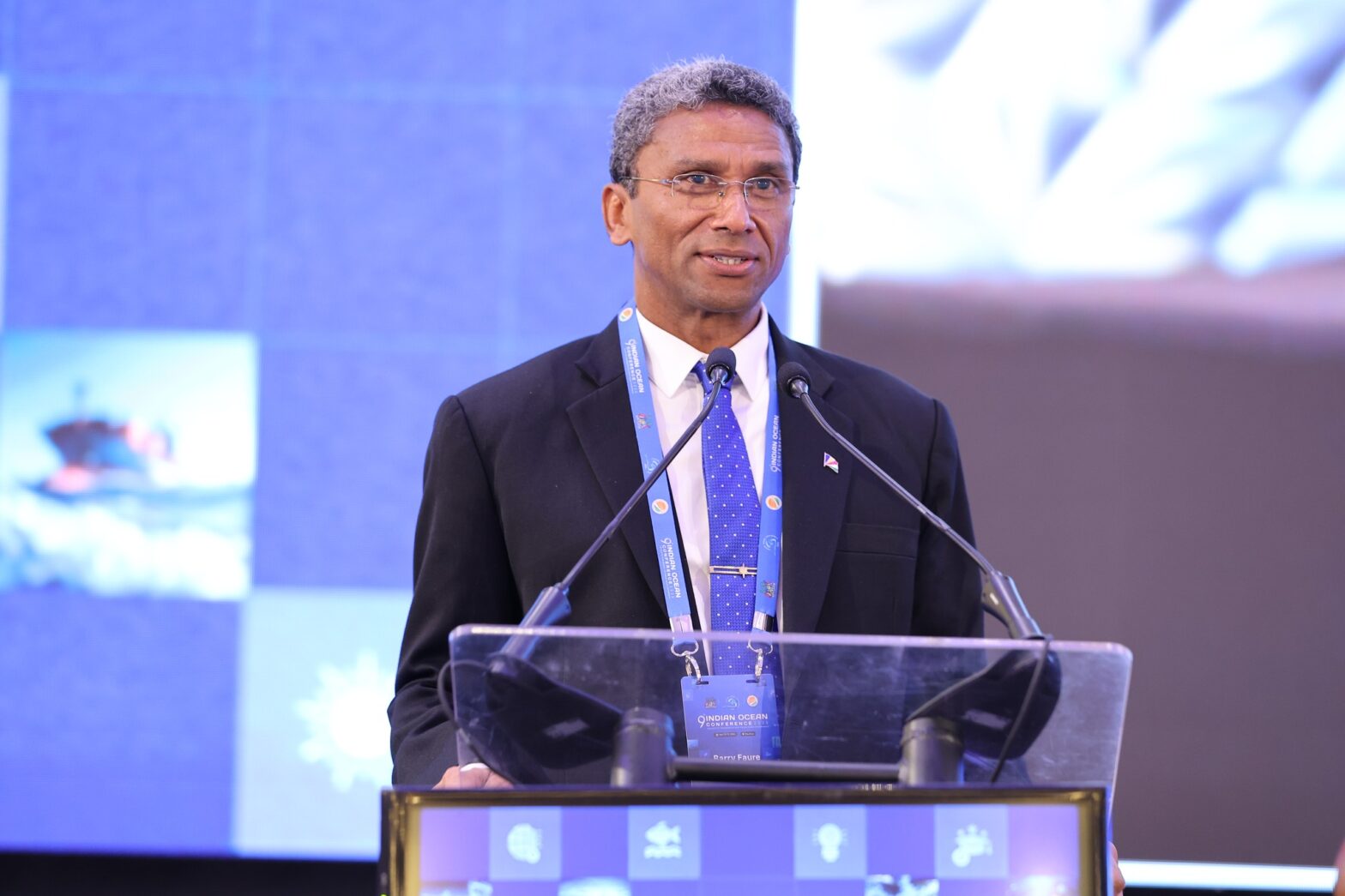
I wish to congratulate Mauritius, the first African country to host the Indian Ocean Conference. And yes, Mauritius and Seychelles together charted a path to collective stewardship in 2012, when we founded the Joint Management Area over approximately 400,000 square kilometres of ocean in the Saya de Malha, a key international example of ocean governance.
We must recognise a fundamental truth: while stewardship is a shared responsibility in principle, it is not a burden shared equally in practice. What is the reality for large ocean states? For nations like Mauritius and Seychelles, we are often labelled as Small Island Developing States, but in the context of this conference, we are large ocean states. While our landmasses may be modest, the maritime territories we manage are vast.
The Indian Ocean is not merely a strategic space; it is the shared economic lifeline sustaining our entire region. Today, that lifeline is under immense strain. Tensions in the Strait of Hormuz, the Red Sea and the Bab-el-Mandeb are reshaping maritime activity before our eyes. We see shipping routes adjusted, insurance conditions tightened, and transit times lengthened. For import-dependent economies like ours, these are not abstract geopolitical shifts; they translate directly into higher living costs and mounting pressure on our tourism, fisheries and food supply. What happens at sea shapes what happens on land.
Stewardship as a public good: Seychelles and our neighbours in the western Indian Ocean provide a public good to the public and the global community. We secure key corridors against sea piracy and maritime crime. We manage the health of the beating heart of our economies to ensure the ocean remains a space of shared opportunity. Yet the cost of this stewardship is immense. As shipping patterns shift, activity in our waters is increasing, placing growing demands on our port infrastructure, maritime services, and logistical coordination. Reliability is the currency of global trade, and for island states, that currency is under extreme pressure.
Redefining resilience, the Multi-Dimensional Vulnerability Index and climate justice are key foreign policy priorities for countries like ours. Governance cannot be effective if the stewards of the ocean are denied the tools to build resilience. The current global financial architecture often fails to recognise our reality. We are frequently penalised by traditional metrics that focus solely on income, ignoring the inherent fragilities of being an island nation. We call for the urgent and full implementation of the Multi-Dimensional Vulnerability Index, adopted a year ago by the United Nations General Assembly. We must move beyond an outdated obsession with GDP. Furthermore, we cannot discuss governance without addressing climate justice. Our people are on the front lines of a climate crisis they did not create. True stewardship requires that those who benefit most from these blue corridors contribute fairly to their protection. Security is the prerequisite for prosperity, but sustainability is the prerequisite for survival.
Seychelles remains committed to practical cooperation. We are honoured to chair the Contact Group on Illicit Maritime Activities. We recognise that partnerships multiply capacity and that shared challenges demand shared responses. However, collective stewardship must now move beyond principle and into practice. This requires: One, investment in infrastructure to strengthen port efficiency and sustainable maritime connectivity, reducing reliance on limited, vulnerable transit routes. Two, securing digital frontiers. Recognising that the maritime domain is now as much digital as it is physical, we must protect critical undersea cables that underpin global finance and communications. Three, unlocking the blue economy. Not simply using the ocean, but sustaining its value through marine innovation, sustainable aquaculture, and ocean-based services.
Effective enforcement to ensure operational responses is backed by strong legal frameworks. Without investigation and prosecution, there can be no deterrence, and without deterrence, no lasting stability.
In conclusion, the Indian Ocean does not divide us; it defines us. How we choose to govern it today will shape our region’s future for generations to come. Stability in this ocean cannot be taken for granted. The stakes could not be higher. Let us work together to ensure the Indian Ocean remains open, secure, and economically vibrant – a shared platform of opportunity for us all.
Author Brief Bio: H.E. Barry Faure is the Minister of Foreign Affairs, Seychelles