
29 July 2026 | Gulmohar Hall, India Habitat Centre, New Delhi
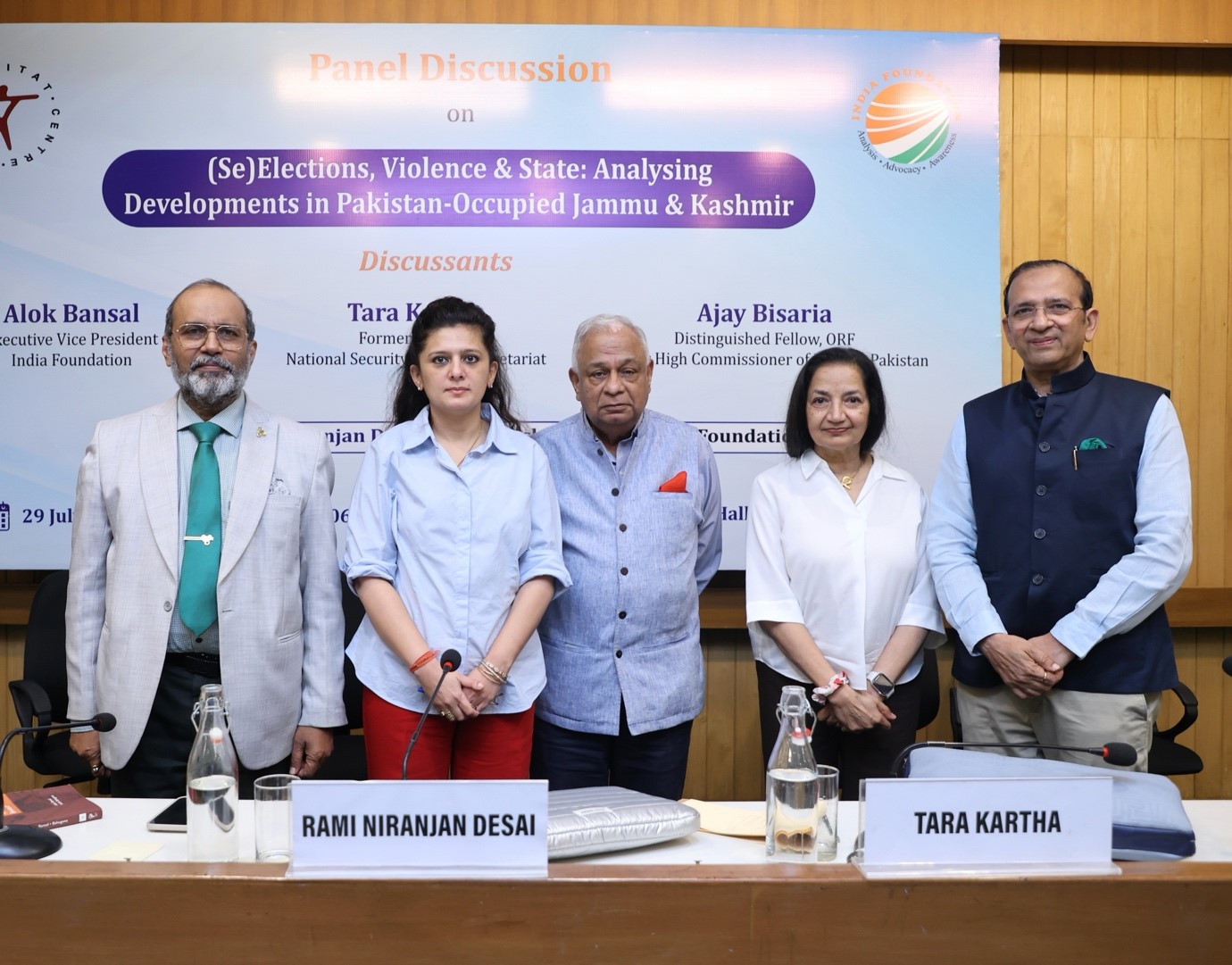
On 29 July 2026, India Foundation, in collaboration with India Habitat Centre, conducted a panel discussion on “(Se)Elections, Violence & State: Analysing Developments in Pakistan-Occupied Jammu & Kashmir” at Gulmohar Hall, India Habitat Centre, New Delhi. The discussion was prompted by the emerging political unrest, contested electoral processes and growing public mobilisation in Pakistan-occupied Jammu and Kashmir (POJK), and examined their implications for governance, legitimacy, regional stability and India’s policy approach.
The session was moderated by Ms Rami Niranjan Desai, Distinguished Fellow, India Foundation, and featured Capt. Alok Bansal, Executive Vice President, India Foundation; Dr Tara Kartha, former Director, National Security Council Secretariat; and Amb. Ajay Bisaria, former High Commissioner of India to Pakistan and Distinguished Fellow, Observer Research Foundation. In her opening remarks, it was observed that developments in POJK have conventionally been viewed primarily through the prism of the India–Pakistan dispute. However, the recent convergence of elections, violence and public protest required a wider assessment of political contestation, institutional credibility and the future of security and stability in the region.
It was discussed that electoral exercises in Pakistan, and particularly in POJK, have frequently resembled political “selections” rather than genuinely competitive elections. The discussion drew attention to the constitutional and administrative ambiguities surrounding the territory, noting the gap between the formal façade of autonomy and the decisive influence exercised by Pakistan’s political and military establishment. Referring to the public protests that gathered momentum from 2024 onwards, certain grievances were highlighted over electricity tariffs, prolonged power cuts, subsidised privileges for officials and the broader perception of economic exploitation despite the region’s substantial hydropower generation.
The discussion examined the growing political unrest, electoral controversies and governance crisis in Pakistan-occupied Jammu and Kashmir. Particular attention was given to the structure of the 53-member legislative assembly, in which only 33 representatives are directly elected from within the territory, while several seats are filled through constituencies located in Pakistan or through indirect elections. This arrangement was criticised for enabling external influence over electoral outcomes and weakening genuine local representation.
The panel also discussed allegations of electoral manipulation, low voter participation, political boycotts and the increasing alienation visible in public demonstrations. The scale and spontaneity of the protests were viewed as evidence of a genuine people’s movement rather than organised political mobilisation. Demands relating to electricity tariffs, resource distribution, political representation and the removal of externally elected seats reflected deeper dissatisfaction with the existing administrative system.
The discussion highlighted the contradictions within the constitutional framework of the territory. Although it is presented as possessing autonomous institutions, its political structure remains closely controlled by Pakistan, while constitutional provisions and official oaths bind its authorities to the Pakistani state. This creates uncertainty regarding the extent of self-government and the possibility of any meaningful change in political status.
The unrest was also placed within Pakistan’s broader governance challenges. Similar grievances over resource exploitation, centralised control and limited political participation have emerged in Balochistan, Khyber Pakhtunkhwa and Gilgit-Baltistan. The growing role of younger activists and decentralised civic movements was identified as an important development, while the state’s reliance on coercive measures rather than political dialogue was seen as further weakening its legitimacy.
The deliberations concluded that developments in the territory should not be treated merely as an electoral dispute. They reflect deeper concerns involving constitutional ambiguity, military dominance, resource inequality and the absence of accountable governance. India must therefore consistently articulate its constitutional position and develop a coherent approach towards the evolving political and security situation.