
The Question the Wires Ask
On 15 August 2026, from the ramparts of the Red Fort, Prime Minister Modi set out seven streams of strength for a developed India by 2047 and announced a compressed timetable. What could not be done in five to seven decades, he said, must now be attempted in five to seven years.[1] Gati Shakti and infrastructure is the fourth of those streams. Of the seven, it is also the one with the most machinery already built beneath it. The National Master Plan has been running since October 2021; it holds the planning data of most of the Union government and has given the country a habit of cross-ministry review that did not exist a decade ago. This paper is about one thing that machinery has not yet been asked to do.
India has also just finished electrifying its railways. More than ninety-nine per cent of the broad-gauge network now runs on electric traction, a programme completed at a pace few large railway systems have matched.[2] With that work done, the questions that follow concern supply: what flows through those wires, where it is generated, and the cost of getting it there.
I have spent a little over a decade working at the intersection of spatial planning, energy, and climate policy. I trained as an urban planner at the School of Planning and Architecture in Delhi and studied public administration at Columbia. I have advised the Government of India through the National Institute of Disaster Management on climate vulnerability and urban infrastructure, been nominated twice by the Government as a Chapter Scientist for the Intergovernmental Panel on Climate Change, and worked on mobility and electric transport policy in Europe, Southeast Asia, and the United States. I also lead the India programme at Riding Sunbeams, a British company that connects renewable generation directly to railway traction supply. The argument that follows draws on the planning side of that experience and on a question planners ask early: what does the system in charge actually see?
The argument is short. Indian Railways has large, concentrated and predictable electricity demand along a mapped corridor, alongside land it already owns. India has some of the cheapest solar generation in the world. The National Master Plan holds the spatial data for almost everything except the one element that would connect the two. Adding a traction energy layer to that plan, with a connection standard to accompany it, would turn a decarbonisation aspiration into a project pipeline. It needs no new scheme, no new ministry and no new statute.
What Electrification Achieved and What It Left Standing
Electrification was the right programme, and it was delivered. It cut the diesel bill, increased haulage capacity, reduced exposure to imported fuel, and gave the network a single energy carrier. It also shifted the point of combustion. A train drawing power from a grid that remains substantially coal-fired carries its emissions at the generating station rather than at the locomotive, and because electric traction is more efficient, the tonnage falls. What remains of it now depends on the generation mix, which is as much a matter of energy policy as of transport policy.
The scale is considerable. Traction and railway consumption reached about 34,500 gigawatt-hours in 2025, making Indian Railways the country’s single largest electricity consumer.[3] The Ministry of Railways expects traction demand to reach roughly 10,000 megawatts by 2030.[4] To meet its net-zero commitment for that year, the Ministry has estimated that it would need something close to 30,000 megawatts of renewable capacity.[5]
Work towards that requirement has been underway for some years. In 2020, the Ministry of Railways set out a plan for 20 gigawatts of solar generation on about 51,000 hectares of vacant railway land, alongside rooftop installations at stations.[6] By November 2025, installed solar capacity across railway land and buildings stood at roughly 898 megawatts, with about seventy per cent of it serving traction.[7] In absolute terms, that is a substantial estate for any railway in the world to own and operate. Measured against a 30-gigawatt requirement, it also shows how far the distance remains and how much depends on the instruments available to bridge it.
Those instruments were designed for a different kind of buyer. The Railways procures power much as any large consumer does, through wholesale tenders and state-by-state wheeling, and that machinery assumes a load sitting in one place. Indian Railways has a load drawn along a thin line across the whole country, at traction substations spaced along every electrified route, each of them beside land the Railways owns and a distribution network it does not control. Buying for that shape means paying for transmission the load may not need and negotiating open access in every state the line crosses.
The consequence is structural. An organisation with a strong land position, a highly predictable demand curve and a sound balance sheet ends up buying clean electricity through a route that prices in transmission, firmness and regulatory charges alongside the power itself. The constraint lies in the route, and the route can be changed without altering how the Railways is run.
Three Things That Changed in Eighteen Months
Three developments since the start of 2025 have reshaped what the Railways can sensibly do next. The first is legal. In May 2026, the Supreme Court held that Indian Railways is not a deemed distribution licensee under the Electricity Act, 2003. The Court reasoned that, because the Railways uses the electricity it buys to operate an extensive internal electrical network and for its own traction, signalling and station operations, without supplying consumers, it remains a consumer itself and is liable for cross subsidy surcharge and additional surcharge when it procures through open access.[8] The judgment closed a dispute that had run for more than a decade and, in doing so, settled the cost of the open access route.
It is worth putting alongside a second event from the same year. In April 2026, the Government of Andhra Pradesh granted a distribution licence to Google’s Indian subsidiary for its gigawatt-scale data centre campus in Visakhapatnam, allowing the company to procure and distribute power for its own operations outside the conventional utility chain.[9] Read together, the two decisions show how the Electricity Act allocates standing based on the function of supplying others. A railway consumes what it draws. The practical implication concerns where the electricity is generated, and the Railways can act on that while the statutory question remains where the Court has left it.
The second change is regulatory. The full waiver of inter-state transmission charges for solar and wind, which underpinned a decade of low tariffs for distant generation, ended for projects commissioned after June 2025. It is now being withdrawn in stages, with seventy-five per cent relief for projects commissioned by June 2026, fifty per cent by June 2027, twenty-five per cent by June 2028, and nothing thereafter.[10] Industry estimates suggest the impact on delivered cost is roughly forty to fifty paise per unit. Generation built a thousand kilometres from the load is about to become measurably more expensive than it has been at any point in the past ten years.
The third change concerns prices, and it is the most striking. In November 2025, the Railway Energy Management Company awarded a gigawatt of round-the-clock renewable supply at 4.35 rupees per unit.[11] In August 2026, the Solar Energy Corporation of India found a tariff of 5.25 rupees per unit in a comparable firm and dispatchable tender.[12] Over the same period, plain solar delivered through the inter-state system was clearing at between 2.48 and 2.52 rupees per unit, and solar paired with four hours of storage was clearing at 2.86 rupees.[13]
Read together, those figures show where the money now goes. Firmness, transmission and regulatory charges have come to cost more than the electricity itself. On a load of 34,500 gigawatt hours and rising, a premium approaching two rupees per unit is a large annual sum spent on delivery rather than generation.
Round-the-clock contracting remains necessary and will continue to be so. A railway draws power at four in the morning, when solar does not supply it. The open question concerns the daylight portion of the load, which is the larger share and is currently procured at firm power prices.
The Layer the Master Plan Does Not Yet Have
The National Master Plan was designed to solve a coordination problem. Ministries planned separately, roads were dug up after they were laid, and projects were cleared without anyone able to see what else was happening on the same ground. The plan addressed this with geography. Put every ministry’s assets and proposals on one spatial platform, let them see each other, and the sequencing improves on its own.
It has grown considerably. The platform now integrates more than 1,700 data layers across fifty-seven ministries and departments, and a public-facing interface makes 230 datasets available to private users for investment and logistics planning. Twenty-seven states have notified their logistics policies, and a district module is being extended to all 112 aspirational districts.[14] The Network Planning Group has taken more than 350 major projects through multimodal appraisal.[15] By any international comparison, this is an unusual planning asset for a country of India’s size.
What it does not yet hold is the railway seen as an energy system. The traction network is recorded on the plan as track. A traction energy layer would describe the same network as a set of electrical connection points, using four things that already sit in departmental records and have never been spatialised: the location and rating of traction substations and feeding posts; the demand profile at each one, which for a railway is unusually predictable because it follows a published timetable; the vacant and encumbrance-free railway land parcels within connecting distance of each substation; and the available headroom, meaning how much generation each point could physically absorb.
Overlay that on the data the platform already carries, namely irradiance, terrain, existing distribution infrastructure and land use, and the output is a ranked national list of sites where generation could be built and connected, with an indicative capacity for each. That list is what a developer needs to price a project and what a lender needs to appraise it. No such list exists today.
The land position gives this practical weight. The Comptroller and Auditor General reported that of about 4.88 lakh hectares held by Indian Railways in March 2023, 62,740 hectares were identified as vacant, of which a little under eighty-eight hectares had been awarded to developers.[16] Commercial land monetisation and energy siting are distinct exercises with different requirements, and the latter has never had a national dataset behind it. Visibility, title clarity and a route to market are the kinds of problems the National Master Plan was built to address.
No new invention is required for this. The Bhaskaracharya National Institute for Space Applications and Geoinformatics builds and maintains the platform; the Ministry of Railways holds the substation and land data; the Central Electricity Authority sets connection standards; and the Network Planning Group already convenes the ministries that would need to agree. This layer is an act of publication by existing bodies and could be completed within a single financial year.
Connecting Generation Where the Demand Already Is
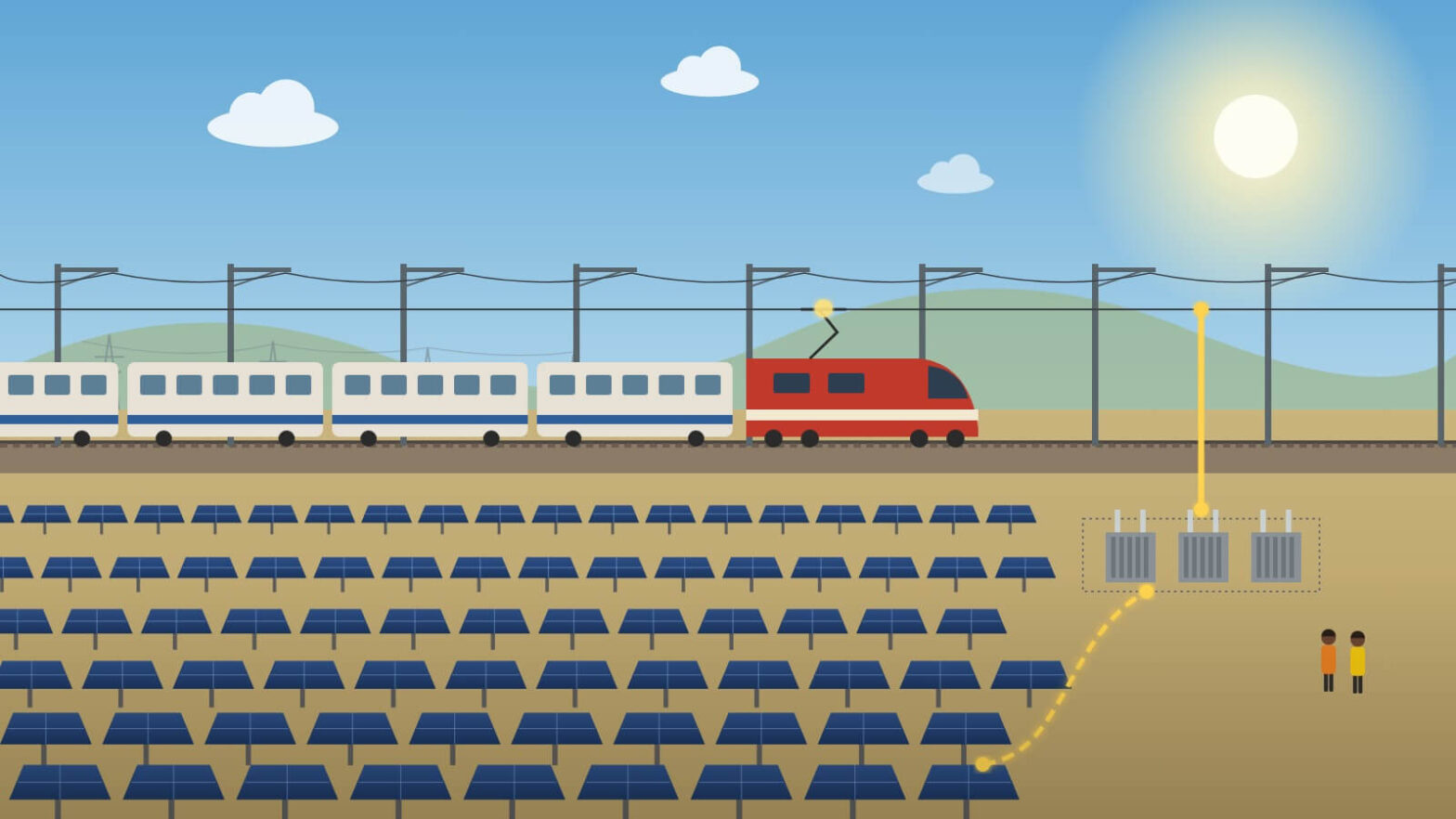
The method proposed here is well established in engineering terms. Generation is built on or beside railway land and connected to the traction supply at or near a substation. The electricity travels only a few hundred metres rather than several hundred kilometres. It never enters a distribution licensee’s network, so wheeling charges, banking arrangements, open access applications and cross-subsidy surcharges do not arise, as none of those instruments is engaged. The Railways pays only for the electricity and the connection.
The substation keeps its existing supply throughout. Generation displaces purchased units while the sun is up, and the grid continues to balance the system, carry the night load and handle every contingency. In commercial terms, it resembles a factory building a captive plant within its own compound.
India has already built one. In 2020, the Ministry of Railways commissioned a 1.7-megawatt installation at Bina in Madhya Pradesh, with direct connectivity to the 25-kilovolt traction system, the first plant anywhere to feed a railway overhead line in this way.[17] It has been operating since then. What the past six years have lacked is the standard documentation that would allow a second, a third, and a fiftieth project to proceed without reopening the engineering case each time.
The United Kingdom took the idea further. In 2019, a demonstrator at Aldershot, developed by Riding Sunbeams with Network Rail and community energy partners and funded by the Department for Transport through Innovate UK, connected a solar array directly to a live railway traction system, building on earlier work with Imperial College London’s Energy Futures Lab.[18] The most useful finding was procedural. Once an infrastructure manager has a written protocol for connecting third-party generation to traction supply, projects shift from bespoke negotiations to repeatable transactions. That protocol is what turns a working installation into a programme.
The limits are real and worth setting out. Solar without storage delivers only in daylight, which covers a substantial share of railway load but not all of it. The land has to be near a substation, which rules out many parcels, however large. Protection coordination, harmonics and fault behaviour on a 25-kilovolt single-phase system are genuine engineering questions that need settled standards rather than case-by-case judgement. Direct connection will not take Indian Railways to net zero on its own, and it should not be presented as though it could.
What it will do is take the cheapest portion of the load off the most expensive procurement route. If direct connection covers the daylight block at around 2.50 rupees per unit, while round-the-clock contracts cover the remainder at 4.35, the blended cost falls materially below what the Railways pays today, and it does so without waiting for a change in the law, a reversal of the Supreme Court’s reading, or the restoration of a transmission waiver that is on its way out.
From Proposition to Programme
Five things would need to happen, roughly in this order. None of them requires primary legislation.
A connection standard. The Central Electricity Authority and the Research Designs and Standards Organisation should jointly publish a protocol for connecting third-party generation to the 25-kilovolt traction supply, covering protection, metering, fault ride-through, islanding behaviour and commissioning tests. This is the highest-value intervention on the list. Without it, each project requires a full engineering assessment at its own expense, and each zonal railway conducts its own assessment separately. The Bina installation has six years of operating experience, and together with published international practice, this is sufficient to draw on. A standard could be issued within a year.
A published pipeline. The traction energy layer should be integrated into the National Master Plan, with the non-sensitive part released via the public interface that already serves 230 datasets. Developers are not short of capital or appetite. They are short of sites they can price. A ranked list of connection points, with indicative capacity, land status and demand profile, gives a project finance team something to work with.
A contracting route. The Railway Energy Management Company has the mandate, the tendering record and the counterparty relationships. What it lacks is a contract designed for generation at the point of use rather than for generation delivered across the country. A standard direct-connection power purchase agreement, tendered corridor by corridor, would let developers bid against a known site with a known offtake and a known connection standard, and would let the Railways concentrate engineering supervision instead of spreading it across sixteen zones at once.
Capital that suits the asset. The financing architecture is largely in place. In January 2025, the Indian Railway Finance Corporation and the Railway Energy Management Company signed a memorandum to collaborate on financing renewable projects for the Railways, explicitly including captive structures.[19] To this can be added the sovereign green bond programme and a structure not yet used at scale: contributing land as equity in corridor-level project vehicles rather than leasing it. Land as equity gives the Railways a share of generation revenue, lowers the project’s land cost, and turns idle parcels into revenue-earning assets on the Railways’ own books.
Sequencing. The first corridors should be selected where four conditions coincide: high irradiance, substantial vacant railway land near substations, a dense concentration of traction load, and a state administration willing to move quickly. All four can be tested against data, and the master plan layer is what tests them. A first tranche through the Network Planning Group would carry out the multimodal appraisal that the Gati Shakti process already applies to rail and road projects, and would set the precedent that traction energy belongs in infrastructure planning as well as in procurement.
There is a reasonable objection from the distribution companies, and it deserves an answer. Indian Railways is a large paying customer, and a utility that loses daylight sales without losing the obligation to serve the evening peak is worse off. The answer lies in the same geography. A corridor project sized above the substation’s own daylight requirement can export surplus power to adjacent rural and agricultural feeders, which are the feeders that cost utilities most to serve and are hardest to strengthen. Handled that way, the railway becomes a source of rural supply along its alignment rather than a competitor for it, and the utility gains capacity it would not have had to build. That bargain belongs in the model state agreement from the outset, not offered later as a concession.
Why This Matters Beyond the Railway
The first gain is competitiveness. A government-commissioned assessment by the National Council of Applied Economic Research placed India’s logistics cost at 7.97 per cent of gross domestic product in the 2023 to 2024 financial year, or about 24 lakh crore rupees, the first systematic estimate the country has had and considerably lower than previously circulated figures.[20] Traction energy is a real component of rail freight cost, and the National Rail Plan commits to raising rail’s share of freight to forty-five per cent.[21] Cheaper traction power serves both objectives. Freight moving on generation built beside the track is also insulated from fuel import prices and exchange rate movements, which is an energy security argument as much as an economic one. There is a resilience dimension as well. Generation at the substation can be designed to hold up local supply when the wider network is disturbed, which matters on corridors that carry relief movements after floods and cyclones.
The second gain is that the method generalises. Gati Shakti covers far more than railways. Ports, metro systems, inland waterway terminals and highway charging share the same characteristic: concentrated electrical load at fixed points along corridors already mapped in the National Master Plan. A traction energy layer is the first instance of a broader idea: that the master plan can describe infrastructure as a pattern of electrical demand with known coordinates, alongside the movement network it already describes. Once the platform can answer where demand sits and what could be built beside it, the same query serves a port electrification programme or a highway charging rollout.
The third gain belongs to the seventh stream as much as the fourth. Most of the world’s railway electrification over the next two decades will occur outside the wealthy economies, in countries facing the same combination as India: a strong solar resource, constrained transmission, distribution utilities under financial pressure, and a railway that owns a great deal of land. A connection standard, a contracting template and an operating record at scale are exportable instruments. The International Solar Alliance, which India hosts, is a natural vehicle for that transfer. A country that has completed the world’s largest railway electrification programme and then shown how to power it cleanly can offer its partners a working method that outlasts a target.
A Schedule, Not A Horizon
Seven streams spread over twenty-one years is a vision. Seven streams over five to seven years is a schedule, and a schedule can be checked. On the Gati Shakti stream, one useful check is whether the infrastructure already built is earning its full economic value. India has shown it can build at pace. The next margin lies in the returns from the built network.
The traction network is a case in point. It is a national-scale electrical asset, mapped, owned end to end, and running alongside idle land in some of the sunniest districts in the country. National planning currently records it as a transport network. Recording it as an energy corridor as well is what enables everything else on this list to follow.
Four actions would change that, and all four fall within the powers of existing bodies. Publish a connection standard for generation feeding traction supply. Build a traction energy layer into the National Master Plan and release what can be released. Tender a first corridor tranche under a standard direct connection agreement. Let the Railways hold equity through land rather than rent through leases.
The cost of doing this is the cost of a data exercise and a standards process. The cost of not doing it is a decade of buying daylight electricity at firm power prices, on a load heading towards 10,000 megawatts, while the transmission waiver that made the old route affordable is withdrawn year by year.
The master plan already records where the trains run. The next step is to record the energy that the land beside the trains could carry.
Author Brief Bio: Mahak Agrawal is Head of India at Riding Sunbeams Apollo Ltd, leading its work on wiring renewable generation directly into rail traction networks. She founded All Bits Count, a climate research and communications practice working with the City of Amsterdam, the University of Exeter and the British Council. Twice nominated by the Government of India as an IPCC Chapter Scientist, she has served as Subject Matter Expert at the National Institute of Disaster Management and as Principal Assessor for the Research Council of Norway. She holds an MPA from Columbia University and gold medals in planning from the School of Planning and Architecture, Delhi.
References:
[1] “PM Modi Unveils Seven-Pillar ‘Sapta Dhara’ Roadmap for Viksit Bharat,” Business Standard, 15 August 2026, https://www.business-standard.com/india-news/modi-sapta-dhara-seven-pillar-roadmap-viksit-bharat-2047-126081500804_1.html.
[2] Ministry of Railways statement on capital expenditure and electrification, reported in “Railways Spent 80% of Gross Budgetary Support in First Three Quarters of Current Fiscal,” Deccan Herald, January 2026, https://www.deccanherald.com/india/railways-spent-80-of-gross-budgetary-support-in-first-three-quarters-of-current-fiscal-3852442.
[3] Ministry of Statistics and Programme Implementation, “Electricity Consumption: Utilities: Traction and Railways,” CEIC Data, accessed 26 September 2026, https://www.ceicdata.com/en/india/electricity-consumption-utilities/electricity-consumption-utilities-traction-and-railways.
[4] “Railways Will Achieve 100% Electrification in FY26: Ashwini Vaishnaw,” Deccan Herald, February 2025, https://www.deccanherald.com/amp/story/india%2Frailways-will-achieve-100-electrification-in-fy26-ashwini-vaishnaw-3419068.
[5] Press Information Bureau, Government of India, “Indian Railways to Become Net Zero Carbon Emitter by 2030,” press release, 9 March 2023, https://www.pib.gov.in/PressReleaseIframePage.aspx?PRID=1907230.
[6] “Indian Railways Plans to Set Up 20 GW of Solar Projects on Its Vacant Lands by 2030,” Mercom India, 31 August 2020, https://www.mercomindia.com/indian-railways-solar-projects-vacant-lands.
[7] “Indian Railways Nears Full Electrification amid Disruption to Gulf Oil Routes,” Railway-News, March 2026, https://railway-news.com/indian-railways-nears-full-electrification-amid-disruption-to-gulf-oil-routes/.
[8] J. Sagar Associates, “Supreme Court of India Holds That the Indian Railways Is Not a Deemed Distribution Licensee under the Electricity Act, 2003,” June 2026, https://www.jsalaw.com/articles-publications/supreme-court-of-india-holds-that-the-indian-railways-is-not-a-deemed-distribution-licensee-under-the-electricity-act-2003/. The judgment in Indian Railways v. West Bengal State Electricity Distribution Company Ltd. was delivered on 8 May 2026.
[9] “Andhra Pradesh Grants Discom Licence to Google for Vizag Data Centre Hub,” Power Peak Digest, April 2026, https://powerpeakdigest.com/andhra-pradesh-grants-discom-licence-to-google-for-vizag-data-centre-hub/.
[10] “Why Phasing Out ISTS Waiver Is a Step towards Equitable Energy Development,” pv magazine India, 19 September 2025, https://www.pv-magazine-india.com/2025/09/19/why-phasing-out-ists-waiver-is-a-step-towards-equitable-energy-development/.
[11] “REMCL Awards 1,000 MW RTC Tender at Rs 4.35/kWh,” Saur Energy International, November 2025, https://www.saurenergy.com/solar-energy-news/remcl-awards-1000-mw-rtc-tender-at-rs-435kwh-to-acme-renew-jindal-green-and-others-10801932.
[12] “SECI’s 1 GW FDRE RTC Power Tender Discovers INR 5.25/kWh Tariff,” pv magazine, 10 August 2026, https://www.pv-magazine.com/2026/08/10/secis-1-gw-fdre-rtc-power-tender-discovers-inr-5-25-kwh-tariff/.
[13] “India Discovers $0.03 per Unit Solar Tariffs in Two Auctions,” REGlobal, February 2026, https://reglobal.org/india-discovers-0-03-per-unit-solar-tariffs-in-two-auctions/; “SECI Auction Discovers Lowest Tariff for 2 GW Solar with 1 GW/4 GWh Storage,” Power Peak Digest, October 2025, https://powerpeakdigest.com/seci-auction-discovers-lowest-tariff-for-2-gw-solar-with-1-gw-4-gwh-storage/.
[14] India Brand Equity Foundation, “PM Gati Shakti Yojana,” accessed 26 September 2026, https://www.ibef.org/government-schemes/pm-gati-shakti-yojana.
[15] India Brand Equity Foundation, “PM Gati Shakti Yojana.”
[16] Comptroller and Auditor General of India, report tabled in the Lok Sabha, reported in “Railways Failed to Monetise Vacant Land: CAG,” Deccan Herald, https://www.deccanherald.com/india/railways-failed-to-monetise-vacant-land-cag-3835917.
[17] “Indian Railways Plans to Set Up 20 GW.”
[18] Possible, “World First as Solar Connected to Railway Line in Aldershot,” press release, 23 August 2019, https://www.wearepossible.org/press-releases/world-first-as-solar-connected-to-railway-line-in-aldershot.
[19] “IRFC Edges Higher on Inking MoU with REMCL,” Business Standard, 3 January 2025, https://www.business-standard.com/markets/capital-market-news/irfc-edges-higher-on-inking-mou-with-remcl-125010300317_1.html.
[20] National Council of Applied Economic Research and Department for Promotion of Industry and Internal Trade, Assessment of Logistics Cost in India, reported in “India’s Logistics Cost Pegged at 7.97% of GDP in First Systematic Study,” Outlook Business, September 2025, https://www.outlookbusiness.com/economy-and-policy/indias-logistics-cost-pegged-at-797-pc-of-gdp-in-first-systematic-study.
[21] Press Information Bureau, Government of India, “National Rail Plan (NRP) for India 2030,” press release, February 2022, https://www.pib.gov.in/Pressreleaseshare.aspx?PRID=1797575.