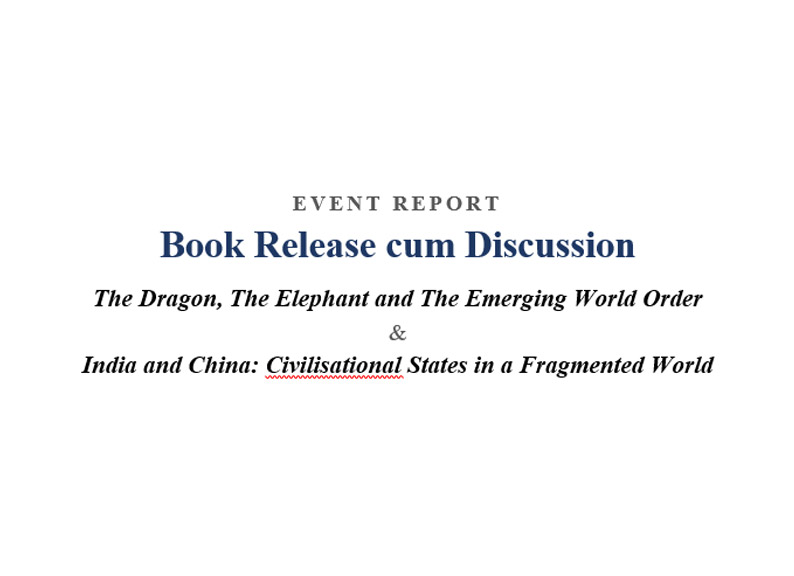
Book Release cum Discussion
The Dragon, The Elephant and The Emerging World Order
&
India and China: Civilisational States in a Fragmented World
| Event | Book Release cum Discussion |
| Date | 28 September |
| Organiser | India Foundation |
| Books Released | The Dragon, The Elephant and The Emerging World Order India and China: Civilisational States in a Fragmented World |
| Released by | Shri Harsh Vardhan Shringla, former Foreign Secretary and Member of Parliament (Rajya Sabha) |
| Editor | Capt Alok Bansal, Executive Vice President, India Foundation |
| Discussants | Ambassador Jaideep Mazumdar Prof Alka Acharya Prof Happymon Jacob |
| Moderator | Ms Rami Desai, Distinguished Fellow, India Foundation |
Overview
On 28 September, India Foundation released an edited volume comprising two books defining the India-China relationship: The Dragon, The Elephant and The Emerging World Order and India and China: Civilisational States in a Fragmented World. Shri Harsh Vardhan Shringla, former Foreign Secretary and now a Member of Parliament in the Rajya Sabha, released the books. The book launch was followed by a book discussion on the subject, moderated by Ms Rami Desai, Distinguished Fellow, India Foundation.
The discussion was led by the Editor of both the books, Capt Alok Bansal, Executive Vice President, India Foundation. The discussants were Ambassador Jaideep Mazumdar, Prof Alka Acharya and Prof Happymon Jacob.
Release Address
Shri Harsh Vardhan Shringla | MP (Rajya Sabha) and former Foreign Secretary
I am delighted to share a few broad thoughts with you before our eminent panel delves into a detailed discussion of these two important publications on the India-China relationship. The release of these two volumes comes at a pivotal moment in our bilateral relations. We are at a critical juncture when both nations must step back and re-evaluate where the relationship stands.
The two volumes address distinct yet complementary aspects of the bilateral equation:
- The Emerging Nations Perspective: Examining the relationship through the lens of contemporary global power dynamics.
- The Civilisational Perspective: Analysing the long-term historical and cultural ties linking the two nations.
As highlighted in the publications, it is vital to remember that long before either India or China became modern nation-states, our intrepid traders, monks, and voyagers laid the foundations for peaceful, mutually enriching exchanges. At one point, our two civilisations together accounted for more than half of global GDP. This interaction was not limited to commerce; it was a profound exchange of ideas. On a personal note, my parents named me after King Harshavardhana, the great 7th-century ruler of Northern India. During his reign, the Chinese scholar Xuanzang visited India and met King Harsha, who gave him priceless Buddhist texts to take back to China.
Similarly, coming from a region near Kalimpong in the Darjeeling district, I am acutely aware of the historical significance of trans-Himalayan trade. Kalimpong was a bustling hub for border trade between India and Tibet for centuries. It is encouraging to see that trade across border passes such as Nathu La has resumed, reviving a centuries-old tradition of exchanging both goods and ideas.
Framing India and China as “civilisation states in a fragmented world” is apt. It captures the depth of the relationship—its endurance, its demands, and, inevitably, its occasional friction. Unlike governments, civilisations think in centuries rather than 24-hour news cycles. I broadly agree that a relationship grounded in civilisational depth has the resilience to absorb strategic competition without being consumed by it.
So, where do we stand today? As Foreign Secretary during the 2020 Galwan border standoff, I witnessed firsthand the acute challenges along the Line of Actual Control (LAC). Through sustained military and diplomatic efforts, we achieved a level of disengagement that enabled high-level dialogue to resume. Since then, we have seen pivotal interactions: Prime Minister Narendra Modi’s meeting with President Xi Jinping in Kazan, followed by bilateral engagements and high-level summits.
Furthermore, the 25th round of Special Representative talks on the boundary question produced an eight-point consensus, including a commitment to achieve an early and substantive outcome on boundary delimitation. We have also achieved important practical successes:
- The resumption of the Kailash Mansarovar Yatra.
- The restoration of direct commercial flights.
- The reopening of selected border trade routes.
These may seem modest, but they are vital because they rebuild the relationship from the ground up rather than from the top down.
The Government of India’s position, reiterated by the Prime Minister, rests firmly on three pillars: Mutual Respect, Mutual Sensitivity, and Mutual Interest. The border question must be placed in its appropriate context within the broader bilateral matrix:
- It cannot be allowed to hold the entire bilateral agenda hostage.
- Nor can it be treated as fully resolved before a final agreement is reached.
Progress on boundary delimitation and border management should proceed in tandem with cooperation in other domains, rather than serving as an absolute precondition. We must calibrate our approach carefully—neither jumping the gun nor obstructing constructive progress.
On the economic front, bilateral trade has surpassed $150 billion. However, the widening trade deficit—now over $112 billion—remains a serious structural concern. Although Indian exports to China have grown in recent quarters, an unaddressed imbalance of this magnitude is increasingly unsustainable. During their bilateral meetings, Prime Minister Modi and President Xi agreed to address structural trade imbalances, ensure predictable market access, and resolve supply-chain bottlenecks. Narrowing this gap is essential for long-term stability.
Beyond traditional diplomacy, there are several key sectors in which both nations can foster constructive engagement:
- Artificial Intelligence & Frontier Tech Governance
- Clean Energy Transition & Energy Security
- Public Health Collaboration
- Multilateral & Global South Advocacy (within frameworks like the G20, BRICS, and space exploration)
- Hydrological Data Sharing (particularly concerning transboundary rivers like the Brahmaputra/Yarlung Tsangpo)
Technical cooperation in areas like hydrology builds genuine practical trust—something that political statements alone cannot accomplish.
Prime Minister Modi has observed that India-China dialogue and cooperation are essential to global stability, prosperity, and peace. Similarly, when President Xi Jinping visited India, he noted that cooperation between our two nations benefits not only our people but also Asia and the world at large. India continues to test this proposition in practice, rather than merely accepting it as a theoretical principle.
To close with a timeless reflection:
“Coming together is a beginning; keeping together is progress; working together is success.”
India and China have spent decades coming together and keeping together. We now need to work together effectively. That effort will define the 21st century. Both nations have deliberately chosen to invest in stabilising this relationship. If sustained and reciprocated, that choice will determine whether we remain caught in a fragmented global order or help build a genuinely cooperative one.
I once again congratulate the editors and contributors for bringing scholarly rigour to a narrative too often dominated by episodic headlines. I am confident this work will inform a policy towards China that is grounded, patient, and clear.
Thank you very much.
Editor’s Remarks
Capt Alok Bansal | Executive Vice President, India Foundation
The trajectory of India-China relations will arguably define the 21st century. The Westphalian model of the nation-state—premised on rigid borders, homogeneous national identities, and fixed institutional structures—is yielding to a shifting global order. As the geopolitical and economic centre of gravity moves eastwards, fragmentation across the globe is giving rise to a new multipolar reality.
Both India and China are not merely modern nation-states; they are civilisational states whose traditions far predate Westphalian governance. However, their foundational political philosophies differ sharply:
- India’s Ethos: Shaped by Vedic philosophy and cultural pluralism, India seeks to be a “friend to the world” (Vishwamitra) and a benign, moral force (Vishwaguru). India’s unity has long been sustained by a shared cultural geography and philosophical inclusivity, not centralised coercion. Today, this is evident in a vibrant democracy that champions the Global South, as shown by India’s leadership in including the African Union in the G20—a move acknowledged even by our Chinese contributors.
- China’s Ethos: China’s civilisational identity is tied to a centralised, monolithic tradition of statehood shaped by Confucian ethics and the historical concept of Tianxia (“All Under Heaven”). The Chinese state views itself as the primary custodian of cultural and social harmony.
While both nations now seek to articulate the aspirations of the Global South, these differing civilisational impulses create distinct approaches to global governance. This publication reflects these dual perspectives across 36 chapters—18 by Indian scholars and 18 by Chinese scholars. Originally conceived as a single book, it was split into two volumes to accommodate its scope. For an Indian audience, engaging with the Chinese perspectives in these pages is crucial. Understanding how Chinese scholars view bilateral issues—including where they acknowledge Indian leadership and where their assessments diverge—is essential to moving beyond fixed mindsets. The same holds for the international community: examining both viewpoints side by side reveals the precise gaps that diplomacy must bridge.
For thousands of years, India and China coexisted in relative harmony, separated by the Himalayas. The mountains allowed the flow of ideas and trade while preventing the movement of large armies. Modern technology has breached that physical barrier, bringing long-standing boundary disputes to the fore. While these border issues may not be resolved in the near future, managing them responsibly remains the immediate priority.
Furthermore, we must account for regional dynamics. Shifts in India-China relations send ripples across neighbouring states. Just as Western powers monitor Beijing-New Delhi dynamics, smaller neighbours in South Asia—accustomed to balancing between both giants—also recalibrate their positions whenever India and China draw closer. In an era increasingly defined by transactional nationalism, India and China must develop a strategy for coexistence and for shaping a more equitable, multipolar world order. Grounding our understanding in deep civilisational analysis, rather than reactive headlines, is the first step towards that goal.
Panel Discussion
Ambassador Jaideep Mazumdar
For more than five years, the world’s two most populous nations and fastest-growing economies coexisted without a single direct commercial flight between them. During the same period, Indian flight connections to Singapore expanded to more than 200 per week, and to Vietnam to more than 120 per week. This context explains why even a modest thaw in India-China relations has sparked cautious euphoria in India—particularly in the wake of recent geopolitical friction with traditional partners.
After four years of deep mistrust following the 2020 border standoff, “cooperation” has returned to the bilateral lexicon. However, it is revealing that an external shock to the international system was required to restart direct dialogue. While diplomatic practitioners tend towards scepticism, the scholarly contributions in The Dragon, The Elephant and The Emerging World Order reflect a genuine search for common ground.
The academic contributions offer valuable insights into the bilateral dynamic:
- Absence of Rancour: Unlike the sharp rhetoric often seen on mainstream and social media, the contributions maintain a constructive, measured tone. Scholars from both sides independently reach similar conclusions about their respective regional roles across South Asia, Southeast Asia, and East Asia.
- Limits of Cooperation: While convergence exists, cooperation on dual-use technologies—such as Artificial Intelligence, space, and cybersecurity—remains a significant challenge given their inherent national security implications.
- Differing Perspectives on Multipolarity: Shared concepts often obscure distinct strategic priorities. For example, Chinese scholars often portray Beijing as the primary champion of global governance while viewing India merely as a supporting stakeholder.
The popular narrative that India and China are poised strictly between “competition and cooperation” requires critical examination. True competition requires parity across key domains. India pursues its own strategic space and core national interests; when those interests conflict with Beijing’s actions, it represents a divergence of worldviews rather than head-to-head competition. External shifts—such as Western policy unpredictability—have created space for tactical alignment. However, the fundamental takeaway for Beijing should be that India remains strictly non-aligned, cooperating with partners based on security and economic well-being.
Despite ongoing diplomatic engagements, the fundamental structural pressures shaping the relationship remain unchanged. China continues to hold significant strategic levers along the shared border, within India’s immediate neighbourhood, through targeted supply-chain disruptions, and via massive bilateral trade surpluses. None of these leverage points has disappeared, nor has Beijing shown any incentive to forgo them. Meanwhile, India is still building the counter-leverage needed to deter their potential use.
Professor Zhang Yadong’s characterisation of the current trajectory as a “cold peace”—the absence of hot conflict—is hardly a permanent or satisfactory state. While China advocates a multipolar global order, it remains doubtful whether Beijing is willing to accept a multipolar Asia. As a civilisational state, India cannot accept a hierarchical regional order. Rebuilding long-term stability requires recognising these structural realities with clarity, patience, and realistic expectations.
Prof Alka Acharya
As a lifelong researcher and observer of India-China relations—a field often shaped by the political vicissitudes of the bilateral relationship—I am delighted to see these two volumes brought to fruition. Co-edited by scholars from both nations and featuring an equal number of contributions from Indian and Chinese authors, this effort provides a critical platform for exploring convergences, understanding divergences, and building a corpus of literature that addresses our mutual knowledge deficit. For most people in India, China remains a black hole. Bridging this gap is essential if our two nations are to shape the 21st century responsibly.
In diplomatic discourse and joint summit declarations, leaders routinely invoke the phrase “two great civilisational powers.” Yet applying a civilisational category of analysis differs fundamentally from examining realpolitik, power plays, and geopolitical manoeuvres. While the civilisational concept is ancient, its application to post-independence and post-liberation Sino-Indian relations is relatively recent.
Over the past three to four decades, Indian scholarship explicitly applying a civilisational lens to China has been scarce. By contrast, Chinese scholars have engaged with this paradigm far more extensively. Western intellectual history often grounds civilisational theory in cultural conflict, hierarchy, and imperialist notions of superiority. By contrast, Asian scholars—such as Professor Tan Chung—have long argued that civilisations do not clash. Instead, historical India-China interactions reflect a process of cross-fertilisation and mutual enrichment.
A key distinction must be drawn between Western geopolitical frameworks and an Asian geo-civilisational framework:
- Geopolitical Framework: Its foundational premise is that it is driven by national interest, resource monopolisation, consumerism, and spatial expansion. It views diversity as hierarchical and cultural differences through the lens of dominance and conflict.
- Geo-civilisational Framework: It is premised on the conceptual unity of the world and of human fulfilment. It views diversity as integrative and emphasises coexistence, composite culture, and cross-pollination.
While both volumes offer valuable insights into civilisational heritage—referencing concepts such as Tianxia and Vasudhaiva Kutumbakam—a persistent analytical challenge remains. Too often, scholarship celebrates civilisational glory in the abstract, then analyses contemporary bilateral relations in isolation from those philosophical underpinnings. The real academic task is not merely to acknowledge that India and China are ancient civilisations, but to systematically show how these civilisational frameworks shape foreign policy, the exercise of power, and neighbourly engagement today. Moving from grand civilisational rhetoric to practical policy application remains the central hurdle for scholars on both sides.
Prof Happymon Jacob
As global power shifts eastward, the fundamental question facing international relations is not merely that power is shifting, but in whose favour it is shifting. While both India and China are proud civilisation states, history shows that ancient civilisations living side by side do not automatically coexist in harmony. Civilisations, like states, have historically been driven by power, hierarchy, interest, and conflict.
Applying Mao Zedong’s framework from his 1937 treatise On Contradiction, foreign policy requires identifying a nation’s primary contradiction—its principal strategic challenge—and distinguishing it from secondary derivative issues.
For India, China is the primary contradiction. Everything else in Indian grand strategy is secondary or derivative:
- The Pakistan Factor: The security challenge along India’s western border is largely derivative of the threat from China. Beijing actively leverages Pakistan to keep India tied down in South Asia, enabling China to expand its footprint in India’s regional backyard.
- The U.S. Dynamic: While Washington presents its own set of policy challenges, the United States is not India’s primary contradiction. Rather, the U.S. is a critical balancing partner that India can utilise to manage its primary challenge from Beijing, without entering a formal military alliance.
Conversely, Beijing regards its rivalry with the United States as its primary strategic axis. Consequently, Chinese scholars and policymakers assess the Sino-Indian relationship almost entirely through the lens of their competition with Washington.
When evaluating whether China helps or hampers India’s core national objectives, the structural friction becomes clear:
- A Multipolar Asia: India seeks a pole position in a multipolar Asia, while China resists sharing regional leadership.
- Territorial Integrity: China actively hampers India’s desire for a settled border by exploiting ambiguity over the LAC to maintain strategic pressure.
- Regional Primacy: Beijing actively challenges and erodes India’s traditional primacy in South Asia.
- Global Governance Autonomy: China consistently blocks India’s aspirations to secure permanent membership of the UN Security Council and the Nuclear Suppliers Group (NSG).
- Industrial Sovereignty: India’s critical import dependencies on China create structural vulnerabilities across manufacturing and supply chains.
- Global South Leadership: Rather than partnering with New Delhi, China seeks to displace India as the Global South’s leading voice.
- Western Governance Reform: While both nations advocate reform of Western-dominated institutions, Beijing works within groupings such as BRICS and the SCO to advance its own hierarchy rather than equal partnership.
- Strategic Autonomy: Beijing favours India’s distance from Washington purely because it weakens India’s leverage, not because it seeks a genuine partnership with New Delhi.
Strategic autonomy cannot be sustained by rhetoric alone; it requires internal capability. India’s current strategic autonomy is constrained by four key structural dependencies: manufacturing dependence on China, technological reliance on the West, defence hardware ties with Russia, and exposure to regional security risks.
Furthermore, while some scholars argue that Westphalian nation-states are giving way to civilisational states, these two concepts are not mutually exclusive. Even as civilisational states, India and China must operate within the hard realities of power politics. China functions as a revisionist power, masquerading as a reformist one, seeking to build an Asian order centred on Beijing.
The true test of India-China relations will not be found in joint summit declarations at BRICS or the SCO, but along the Line of Actual Control. A strategy towards China must be grounded in hard-nosed realism—acknowledging the strategic competition for what it is, utilising external balance to protect Indian interests, and ensuring that civilisational rhetoric does not obscure geopolitical reality.