
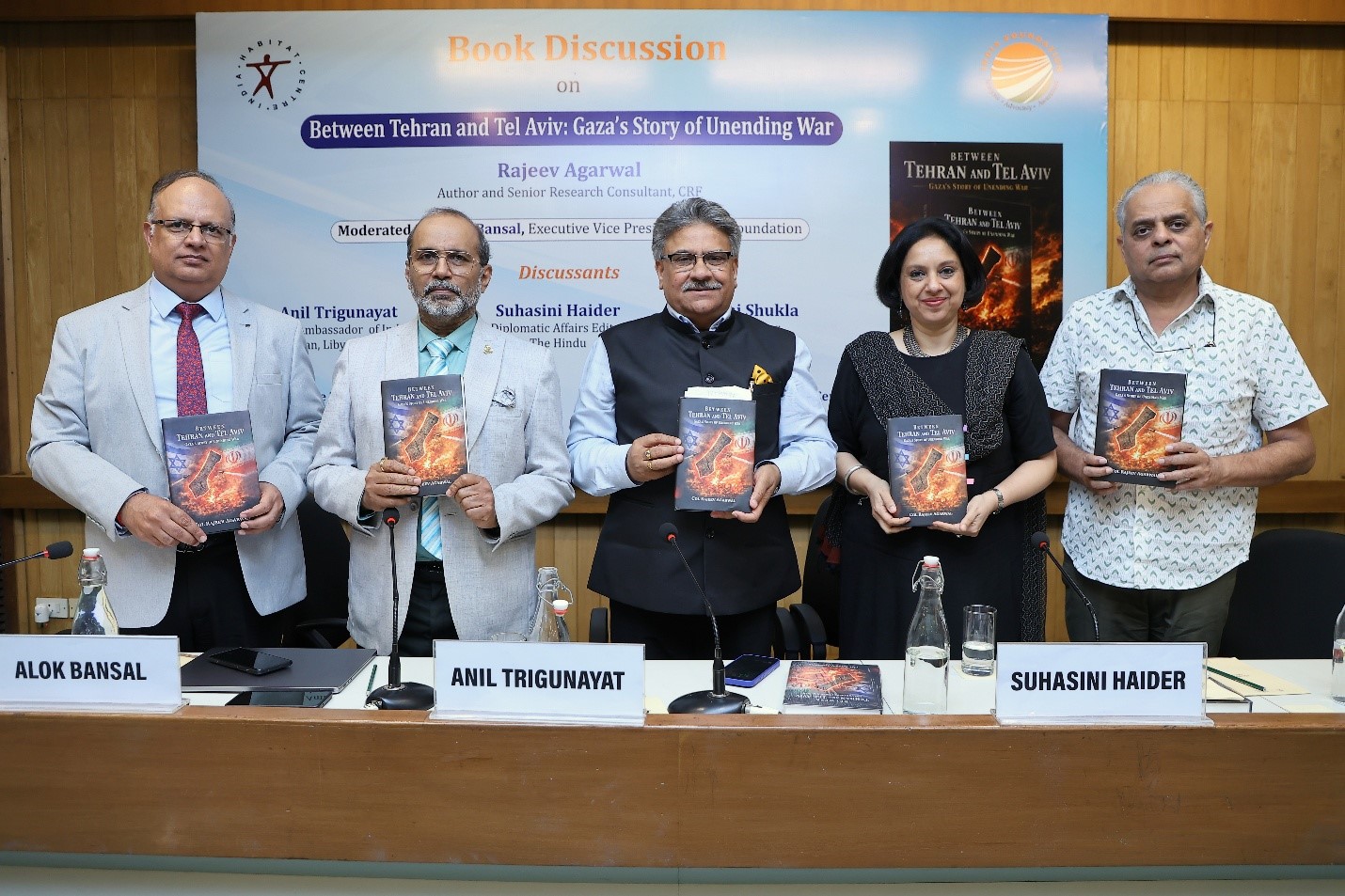
India Foundation, in collaboration with the India Habitat Centre, organised a book discussion on the book ‘Between Tehran and Tel Aviv: Gaza’s Story of Unending War’ by Col. Rajeev Agarwal, Author and Senior Research Consultant, Chintan Research Foundation, at the India Habitat Centre, New Delhi, on 10 June 2026. The session was moderated by Capt. Alok Bansal, Executive Vice President, India Foundation. The panel featured Amb. Anil Trigunayat, Former Ambassador of India to Jordan, Libya and Malta; Ms Suhasini Haidar, Diplomatic Affairs Editor, The Hindu; and Lt. Gen Raj Shukla, Member, UPSC, as the discussants for the book, along with the author.
The discussion brought together diplomats, military thinkers, and journalists to examine a conflict that continues to unfold even as the book attempts to chart its course. Col. Agarwal shared that the work, though centred on Gaza, is deeply connected to the wider war, arguing that the war in Iran could not have unfolded as it did without the events of 7 October 2023. He described the book as an effort to combine smaller articles into groups that explain a conflict and human tragedy whose full meaning will only be understood with the passage of time.
The panel further deliberated upon the limits of force and deterrence, how Israel achieved operational successes, like targeted assassinations and the limiting of adversary capabilities, while it failed to lay out clear military and political objectives. The discussion highlighted how deterrence is no longer absolute, that even nuclear deterrence has lost its certainty, and that the strategic conversion of military victory remained underwhelming. The conversation situated the conflict within an emerging Cold War 2.0, marked by active external involvement and a contest over the very nature of global order.
The panel also dwelt on the question of where India stands. They further remarked on how a decade of shocks, from the Ukraine war to the conflicts in Gaza and Iran, has damaged India’s connectivity ambitions, with plans such as Chabahar, IMEC, the INSTC, and I2U2 now appearing far less feasible. The dialogue drew lessons for India in strategic communication, the auditing of defence priorities, and a decisive turn towards the sea and the Indian Ocean, while suggesting that any future Indian role in Gaza would lie in reconstruction rather than direct involvement.
The session ended with a recognition of the humanitarian impact of the conflict and the extended repercussions of Israel’s tactical successes for regional stability. The panelists also discussed the viability of the two-state solution, the shift from multipolarity to bipolarity and the importance of international institutions, along with social media and how it influences global sentiment. Through Col. Agarwal’s remarks and the panel’s varied viewpoints, the panel stressed the importance of strategic and macro analysis in understanding a conflict whose final chapter remains unwritten.