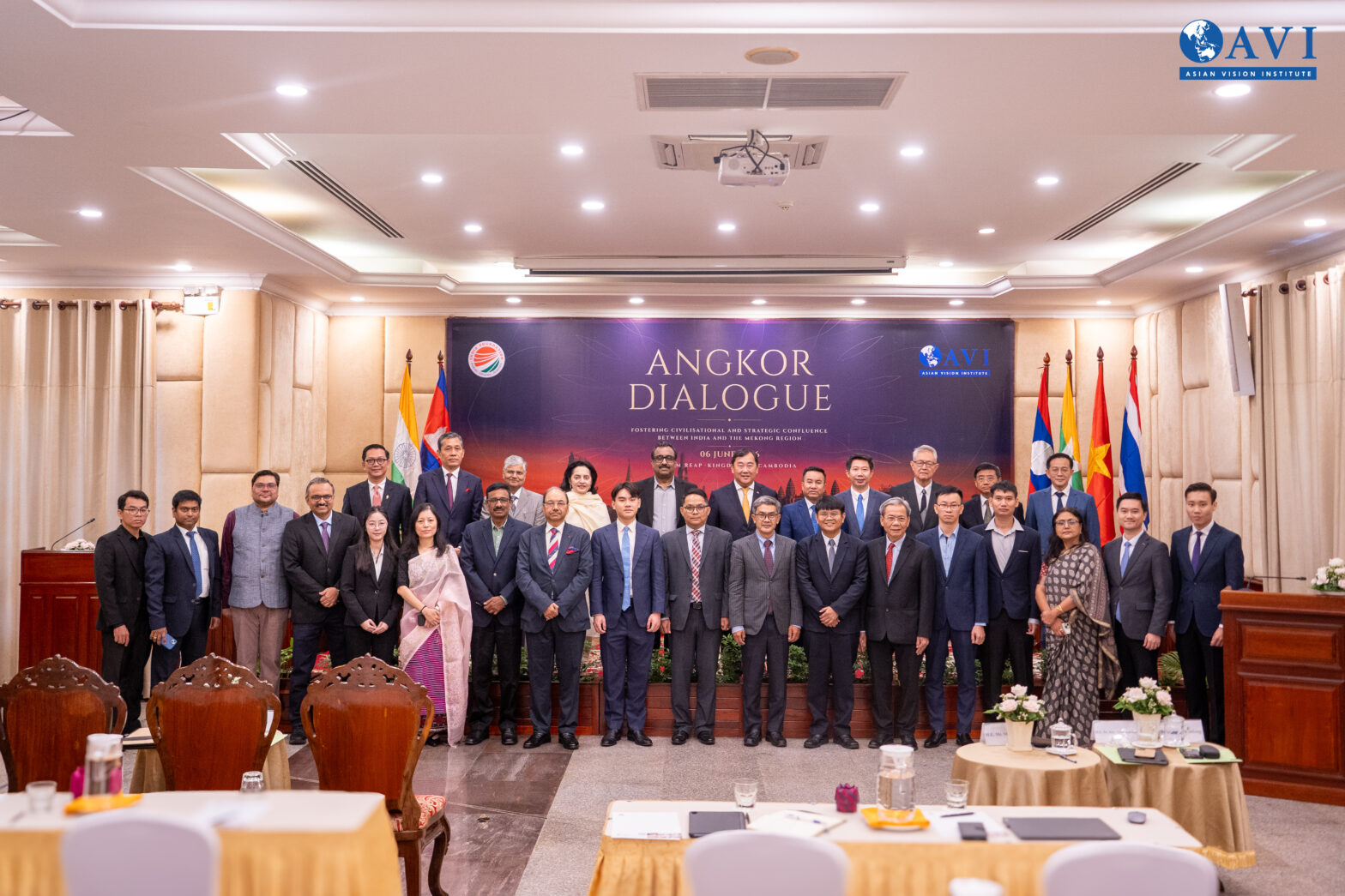
India Foundation in collaboration with the Asian Vision Institute of Cambodia organised the Inaugural Angkor Dialogue under the theme of “Fostering civilisational and strategic confluence between India and the Mekong region” on 06 June 2026 in Siem Reap, Cambodia. The dialogue gathered policymakers, diplomats, and scholars from India and Mekong countries to rigorously evaluate the geoeconomic and geopolitical integration between India and the Mekong sub-region. The discussions in dialogue signaled a definitive evolution in bilateral relations, transitioning from a reliance on historical and civilisational goodwill toward the operationalisation of concrete strategic objectives under the frameworks of India’s Act East Policy (AEP) and the Mekong-Ganga Cooperation (MGC) mechanism. The dialogue was structured around four comprehensive plenary sessions that meticulously mapped this trajectory, spanning from civilisational cartography and Indic heritage to the contemporary imperatives of trade, sustainable connectivity, and the Mekong’s role as a strategic pivot in India’s Act East Policy and Indo-Pacific architectures.
Dr. Chheng Kimlong, President of Asian Vision Institute, welcomed all delegates to Siem Reap, Cambodia. In his welcome address, Dr. Ram Madhav, President of the India Foundation, articulated the foundational civilisational bonds uniting the two regions, utilizing the cultural parallels between India’s veneration of the Ganges and the Mekong, translated as “Mae Khong” or Mother Khong and Maa Ganga. The discourse deliberately pivoted from historical romanticism to pragmatic developmental and economic cooperation. Dr Madhav said that “Southeast Asian countries are looking towards the West alongside looking North. India has its own Act East initiative through which we focus heavily on our relations with the East.” To address the connectivity deficit and institutionalise the strategic convergence of the Mekong region’s “Look West” inclination with India’s “Act East” mandate, Dr Madhav proposed that the Angkor Dialogue transition into a reciprocal annual mechanism, with Varanasi suggested as the prospective host city for 2027.
Providing a macro-strategic perspective, H.E. Vanlalvawna Bawitlung, Ambassador of India to Cambodia, anchored the dialogue firmly within the ASEAN-India Comprehensive Strategic Partnership. His remarks underscored the high-level political capital invested in this relationship, evidenced by Prime Minister Narendra Modi’s participation in the 22nd ASEAN-India Summit in October 2025 – marking his twelfth such engagement – and his subsequent first state visit of 2026 to Malaysia. A critical geopolitical alignment was emphasized by Ambassador Bawitlung between the ASEAN Outlook on the Indo-Pacific (AOIP) and India’s Indo-Pacific Oceans Initiative (IPOI). This institutional convergence is deemed essential for advancing shared interests in maritime security, capacity building, and sustainable development across Indo-Pacific sea lines of communication. Furthermore, Ambassador Bawitlung also spoke on forward-looking mechanisms, including the ASEAN-India Digital Work Plan 2026 and proposed collaborative frameworks on green hydrogen, indicating a strategic shift toward high-tech, resilient geoeconomic statecraft.
The Keynote Address at the inaugural Angkor Dialogue was delivered by His Excellency Suos Yara, who serves as the Chairman of the Committee on Foreign Affairs, International Cooperation, and Information of the National Assembly of Cambodia, as well as the Chairman of the Asian Cultural Council (ACC). His keynote address emphasised on strengthening strategic partnerships, economic cooperation, and connectivity through collaborative frameworks like India’s Act East Policy and the Mekong-Ganga Cooperation.
The inaugural session was followed by four thematic plenary sessions. The discussions in the plenary session mapped the strategic evolution of India-Mekong relations, transitioning from historical foundations to contemporary geopolitical architectures. Beginning with an examination of shared Indic heritage, Plenary session I established a civilisational baseline of mutual trust by mapping the region’s cultural cartography. Plenary session II focused on geoeconomic imperatives, specifically the necessity of building an India-Mekong developmental corridor focused on trade, connectivity, resilient supply chains, and sustainable developments. Plenary session III elevated the analysis to the traditional and non-traditional security domains, critically assessing the Mekong sub-region as a vital strategic pivot for maritime security, peace, and stability. Finally, Plenary session IV synthesised these cultural, economic, and security dimensions by evaluating the overarching institutional policy architectures – mainly India’s Act East Policy (AEP) and the Mekong-Ganga Cooperation (MGC) mechanism – required to formalise a rules-based, forward-looking integration strategy for the road ahead.
The Angkor Dialogue concluded with the closing remarks by H.E. Khy Sovanratana, Secretary of State, Ministry of Foreign Affairs and International Cooperation, Cambodia, who contextualized the partnership against the backdrop of complex regional transformations. He emphasised on the vulnerability of the Mekong sub-region to non-traditional security threats and also spoke on the escalating climate crisis and the urgent need for robust trans-boundary water management protocols.
Overall, the inaugural Angkor Dialogue successfully positioned itself as a vital intellectual incubator designed to complement existing multilateral frameworks, transforming shared riverine and maritime heritage into a modernised and resilient strategic partnership.