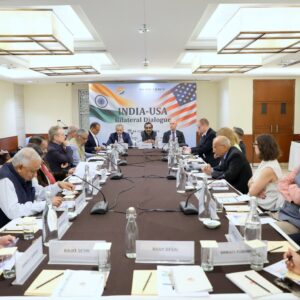
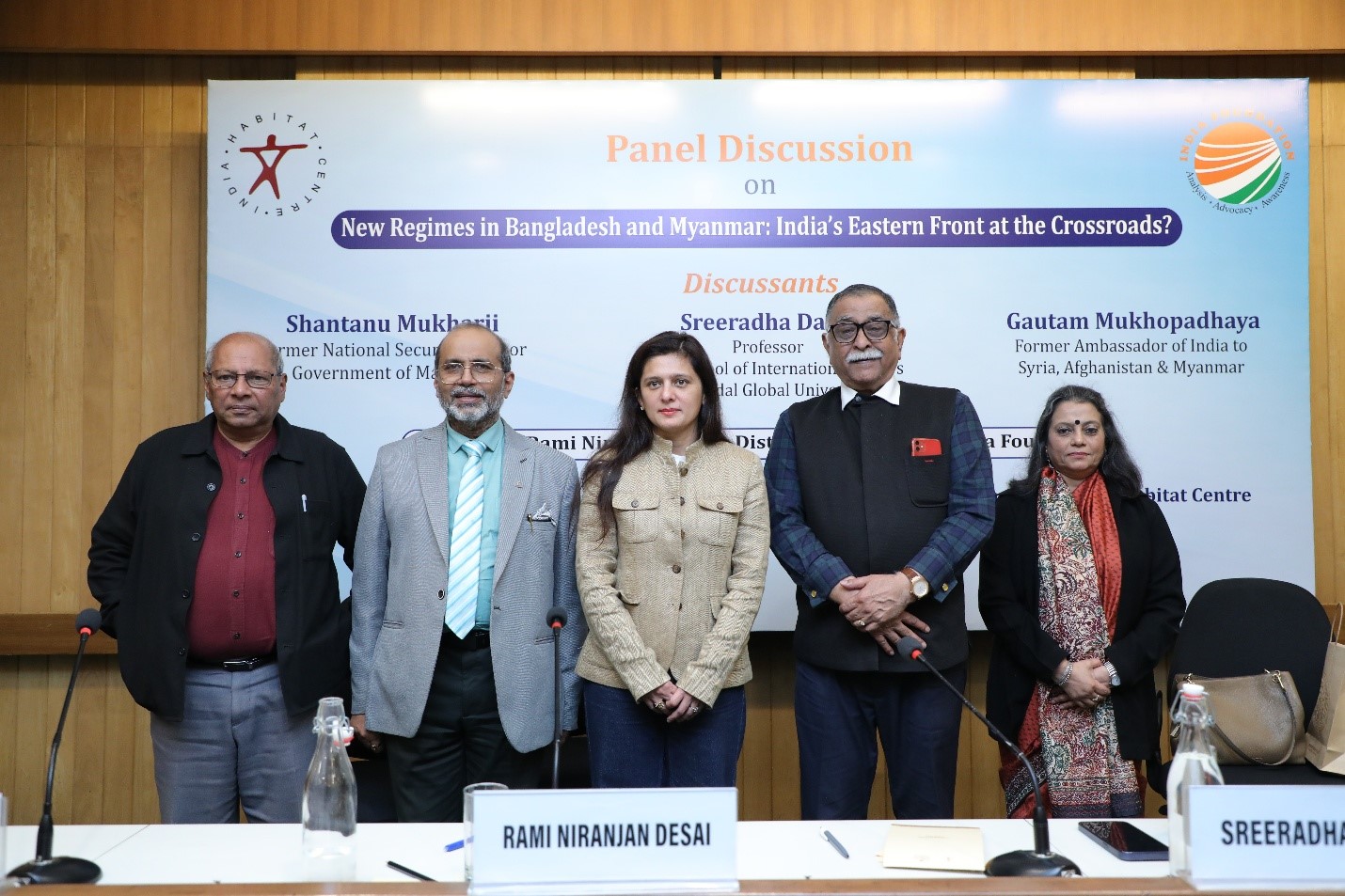
India Foundation, in collaboration with India Habitat Centre, organised a panel discussion on “New Regimes in Bangladesh and Myanmar: India’s Eastern Front at the Crossroads?” at Gulmohar Hall, India Habitat Centre, New Delhi, on 18 February 2026. The session was moderated by Rami Niranjan Desai, Distinguished Fellow, India Foundation and featured Shri Rajinder Khanna, Former Additional National Security Advisor of India; Professor Sreeradha Datta, Professor, Jindal School of International Affairs, O.P. Jindal Global University; Shree Gautam Mukhopadhyaya, former Ambassador of India to Syria, Afghanistan & Myanmar.
The discussion started by examining Myanmar’s internal political situation, noting that recent elections held under military control lacked legitimacy due to the exclusion of opposition parties and the coercive environment in which the elections took place. It was also mentioned that these elections were unlikely to change the reality on the ground significantly, and the resistance against the military regime remains widespread and deeply rooted in society, including by the pro-democracy groups and ethnic armed organisations that continue to challenge the regime, even with limited coordination and resources, thereby reflecting a greater demand for democratic governance and federal restructuring.
A major concern raised during the conversation was the role of external actors, especially China. It was pointed out that China has intervened strategically to protect its economic and geopolitical interests, influencing developments on the ground and complicating the conflict dynamics. It was suggested that India should rethink its approach, engage more actively with a broader range of stakeholders in Myanmar instead of just focusing on the regime.
The discussion then turned to Bangladesh’s recent elections. It was argued that although the electoral process was relatively orderly and used modern technology, it was not inclusive due to the absence of major opposition parties; there were concerns about the legitimacy and long-term stability of the political system due to the exclusion of key opposition groups, but the voter turnout, especially among young people, was significant, showing ongoing political engagement. It was also noted that social media is becoming an influential factor in shaping political narratives, often leading to misinformation and polarisation. Despite this, Bangladesh continues to focus on economic growth and regional cooperation, expanding its diplomatic ties beyond traditional partners.
The panel also explored the implications of these events for India, emphasising that political changes in neighbouring countries can offer chances for extremist groups or foreign powers to increase their influence, making it crucial to maintain strong intelligence cooperation, effective border management, and ongoing diplomatic engagement. Although Bangladesh is trying to balance its relations with various global actors, India remains an important partner in trade, connectivity, and security.
At the end of the discussion, the panelists concluded that the ongoing political changes in Bangladesh and Myanmar present both challenges and opportunities for India. As these countries go through complex transitions, a balanced and forward-looking strategy based on cooperation, engagement, and strategic awareness will be key to ensuring regional stability and strengthening India’s eastern frontier.