
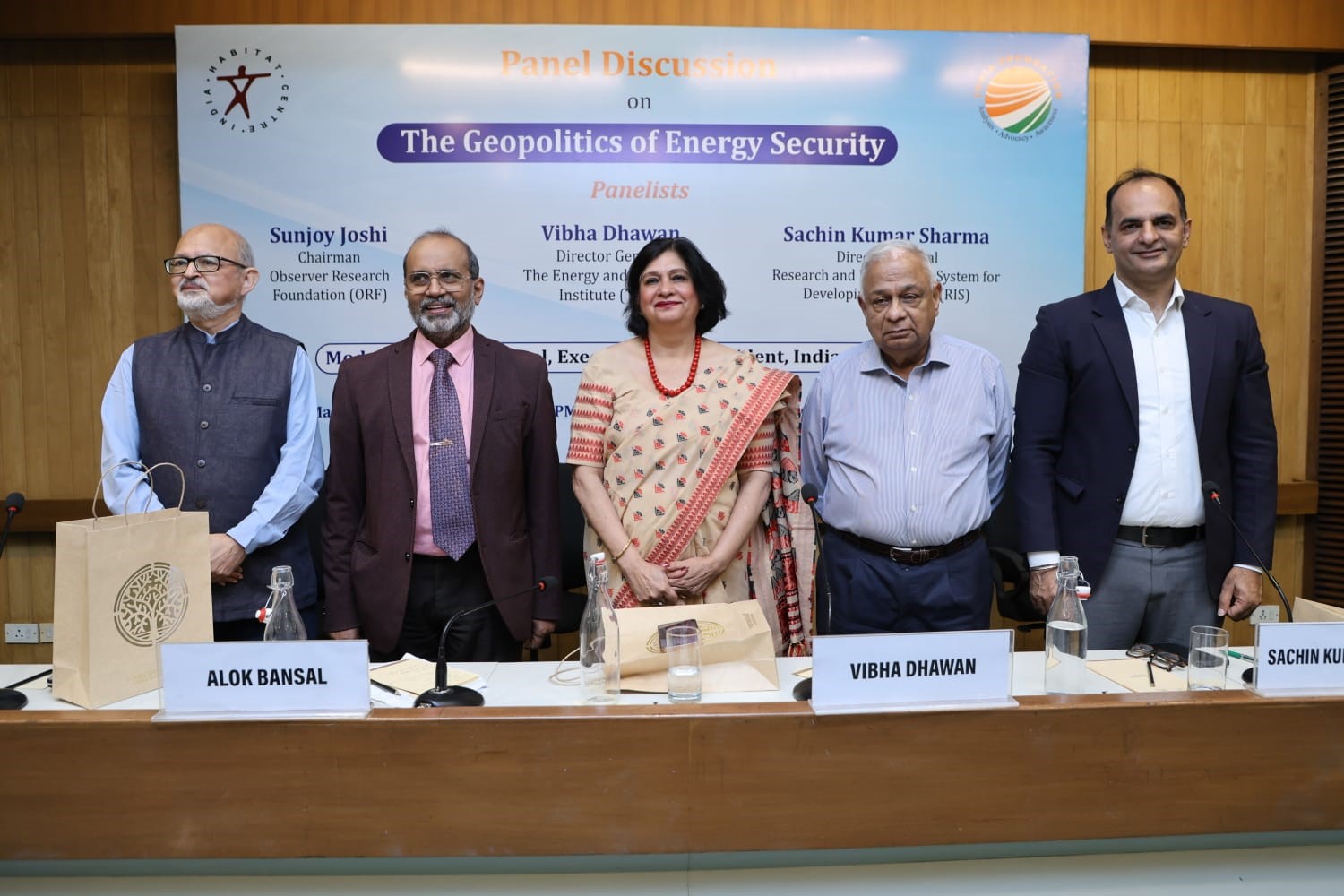
On 26 May, 2026, India Foundation, in collaboration with India Habitat Centre, organised a panel discussion on ‘The Geopolitics of Energy Security’, bringing together Shri Sunjoy Joshi, Chairman, Observer Research Foundation; Dr Vibha Dhawan, Director General, The Energy and Resources Institute; and Professor Sachin Kumar Sharma, Director General, Research and Information System for Developing Countries as the discussants for the event. The session was moderated by Captain Alok Bansal, Executive Vice President, India Foundation.
The discussion examined the growing impact of geopolitical conflicts and global market disruptions on India’s energy security. It was observed that India remains significantly dependent on imported hydrocarbons, making developments in key energy-producing regions and strategic maritime routes critical to the country’s economic and strategic interests. Particular attention was drawn to the implications of disruptions in oil and natural gas supplies, which have direct consequences for inflation, fertiliser production, industrial activity, and overall economic stability.
The panel highlighted that energy security has evolved beyond the question of supply and affordability to become closely linked with sovereignty and strategic autonomy. It was noted that sanctions, financial restrictions, and control over critical maritime choke points increasingly shape global energy flows. In this context, countries dependent on energy imports must reassess long-held assumptions about global markets and strengthen their resilience against external shocks.
The discussion also focused on India’s long-term energy transition. While acknowledging the continued importance of conventional energy sources in the foreseeable future, emphasis was placed on expanding renewable energy, strengthening nuclear power generation, and investing in storage technologies. The importance of developing diversified and reliable energy systems capable of supporting sustained economic growth was highlighted.
The role of decentralised and clean energy solutions in supporting rural development was also discussed. Renewable energy technologies, biofuels, biomass-based systems, and localised energy infrastructure were identified as important tools for enhancing energy access, reducing wastage, supporting livelihoods, and promoting sustainable development.
The economic dimensions of energy security were also examined. Rising global energy prices, growing domestic demand, and dependence on imported fuel were identified as significant challenges. It was observed that as India advances towards the goal of becoming a developed economy, energy demand will continue to rise substantially, requiring a balanced approach that combines energy security, economic growth, and environmental sustainability.
The discussion concluded with the observation that India’s energy future will require a multi-pronged strategy based on diversification, technological innovation, domestic capacity building, and international cooperation. Ensuring secure, affordable, and sustainable energy supplies was identified as a critical prerequisite for India’s long-term economic development and strategic resilience.