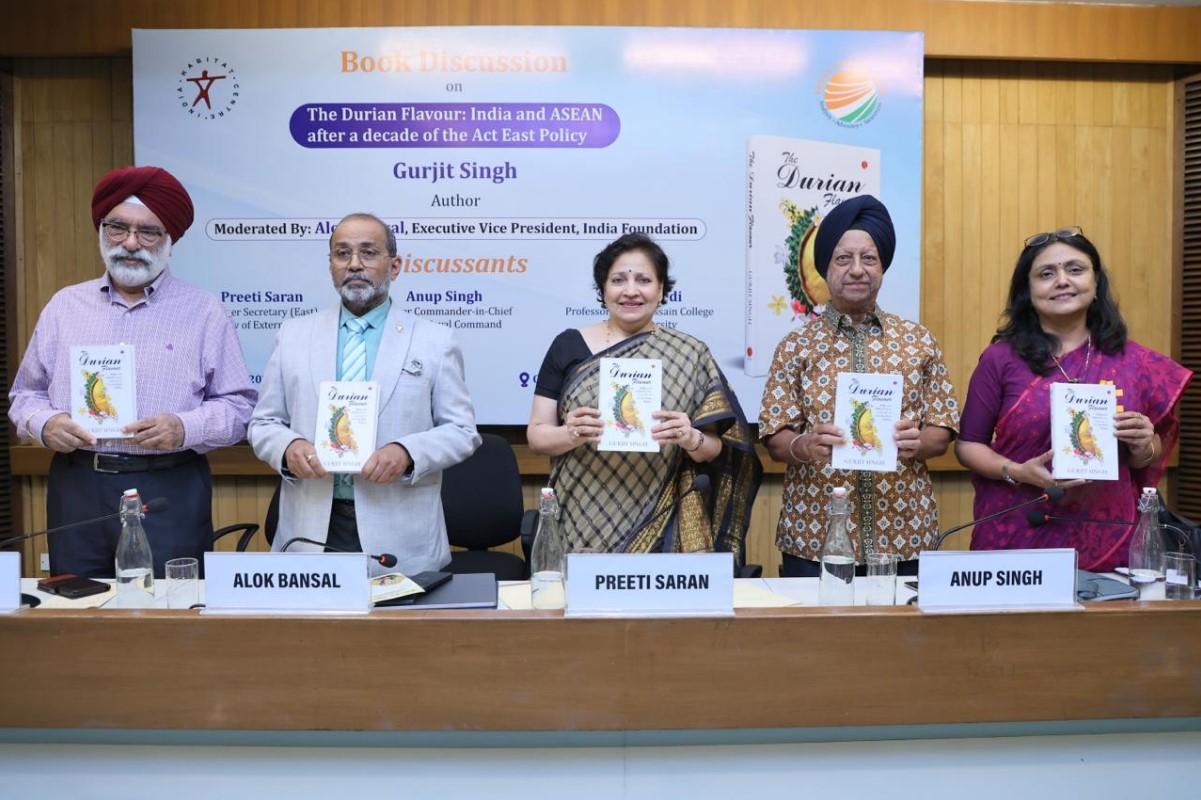
On 8th July 2026, India Founda on, in collabora on with India Habitat Centre, organised a book discussion on ‘The Durian Flavour: India and ASEAN a er a Decade of the Act East Policy’ by Ambassador Gurjit Singh, former Ambassador of India to Germany, Indonesia, ASEAN and the African Union. The Panellists for the event were Ambassador Pree Saran, former Secretary East, Ministry of External Affairs; Vice Admiral Anup Singh, former Commander-in-Chief, Eastern Naval Command; and Professor Sonu Trivedi, Professor at Zakir Hussain College, University of Delhi. The session was moderated by Captain Alok Bansal, Execu ve Vice President, India Founda on.
The session underscored India’s deep civilisa onal links with Southeast Asia, no ng the spread of Hinduism, Buddhism and Islam from India to the region and Indonesia’s interest in BrahMos missiles as an important indica on of India’s growing defence-export profile and strategic engagement with ASEAN. The central metaphor of the book focused on the durian, ASEAN’s “King of Fruits,” which has a hard, spiky exterior but a so core. India-ASEAN rela ons carry a similar character: the rela onship has a valuable civilisa onal and strategic core, but it requires pa ence to work through ins tu onal, poli cal and economic difficul es. It was discussed that the book is not a celebra on of Act East, but a candid assessment of what India achieved in the last decade, where it took shortcuts, and where work remains unfinished. Furthermore, the poli cal-security pillar has been observed to be the strongest, especially through defence coopera on, mari me exercises and growing interest in BrahMos, while the economic pillar remains weak due to limited business familiarity, insufficient a en on to the trade agreement, and underdeveloped services and investment engagement.
The discussion described the book as a mely, candid, and forward-looking assessment of India–ASEAN rela ons, rooted in first-hand diploma c experience and prac cal policy insights. It highlighted the improvement in India’s trust levels among ASEAN percep ons, from 16.6 per cent in 2022 to 25.7 per cent in 2023, while tracing India’s formal engagement with ASEAN from a sectoral partnership in 1992 to a strategic partnership in 2012. The presence of all ten ASEAN leaders as chief guests at India’s Republic Day in 2018 was recalled as a significant diploma c milestone. The discussion also underlined that India should not compete with China on iden cal terms, but instead develop its own approach based on strategic autonomy, development coopera on, cultural strengths, and long-term trust-building. At the same me, a en on was drawn to ASEAN’s ins tu onal complexity, India’s missed opportuni es in earlier decades, China’s con nuing influence, India’s withdrawal from RCEP, weak industry preparedness, and gaps in tourism and connec vity infrastructure. The book was further appreciated for revealing the inner workings of diplomacy and for highligh ng India’s civilisa onal and cultural presence across Southeast Asia, from Bagan to Ayu haya and Indonesia. Overall, the discussion concluded that India–ASEAN rela ons require pa ence, strategic clarity, stronger connec vity, youth engagement, educa onal coopera on, so power outreach, and a dis nct Indian approach rooted in complementarity and sustained regional engagement.