
Abstract
The India–Middle East–Europe Economic Corridor (IMEC), announced at the 2023 G20 Summit, has emerged as a major connectivity initiative linking India to Europe via the Arabian Peninsula and the Eastern Mediterranean. While supporters present IMEC as a framework to enhance trade, supply chains, energy connectivity, and regional integration, Iran has responded with considerable scepticism. This article examines the geopolitical, economic, and strategic factors underpinning Tehran’s reservations. It argues that Iran views IMEC not merely as a commercial project but as part of a broader geopolitical realignment associated with the Abraham Accords and emerging minilateral frameworks such as I2U2.
From Tehran’s perspective, the corridor is an exclusive model of regional connectivity that strengthens the strategic positions of the United Arab Emirates, Saudi Arabia, and the Israeli regime while bypassing Iranian territory. Iranian policymakers also view IMEC within an emerging “war of corridors,” in which competing infrastructure initiatives—including the International North–South Transport Corridor (INSTC) and China’s Belt and Road Initiative (BRI)—serve as instruments of geopolitical competition. Beyond concerns about lost transit revenues and reduced strategic influence, Iran advocates a more inclusive model of Eurasian connectivity in which IMEC complements rather than competes with the INSTC. Such an approach, Tehran argues, would promote regional interdependence, improve transport efficiency, and contribute to a more stable and cooperative regional order.
Keywords: IMEC; Iran; International North–South Transport Corridor; Belt and Road Initiative; regional connectivity; geopolitics; West Asia
Introduction
Connectivity has become a central instrument of geopolitical competition in the twenty-first century. Infrastructure projects increasingly shape not only trade and investment but also political influence, strategic partnerships, and the regional order. Railways, ports, logistics hubs, and digital networks are now regarded as tools of geoeconomic statecraft, enabling states to enhance resilience, strengthen supply chains, and expand their regional influence.[1]
The announcement of the India–Middle East–Europe Economic Corridor (IMEC) at the 2023 G20 Summit illustrates this transformation. Backed by India, the United States, the European Union, Saudi Arabia, the United Arab Emirates (UAE), France, Germany, and Italy, IMEC aims to connect India to Europe through integrated maritime and rail networks spanning the Arabian Peninsula and the Eastern Mediterranean. Beyond facilitating trade, the initiative promotes cooperation in energy, digital infrastructure, customs harmonisation, and resilient supply chains.[2]
While participating governments emphasise the corridor’s economic benefits, Iran interprets IMEC through a broader geopolitical lens. Iranian policymakers argue that major transport corridors are inherently non-neutral, as they determine which states become indispensable transit hubs, attract foreign investment, and occupy strategic positions within regional supply chains.[3] Consequently, Tehran views IMEC not merely as a transport project but as part of a wider geopolitical realignment reshaping West Asia.
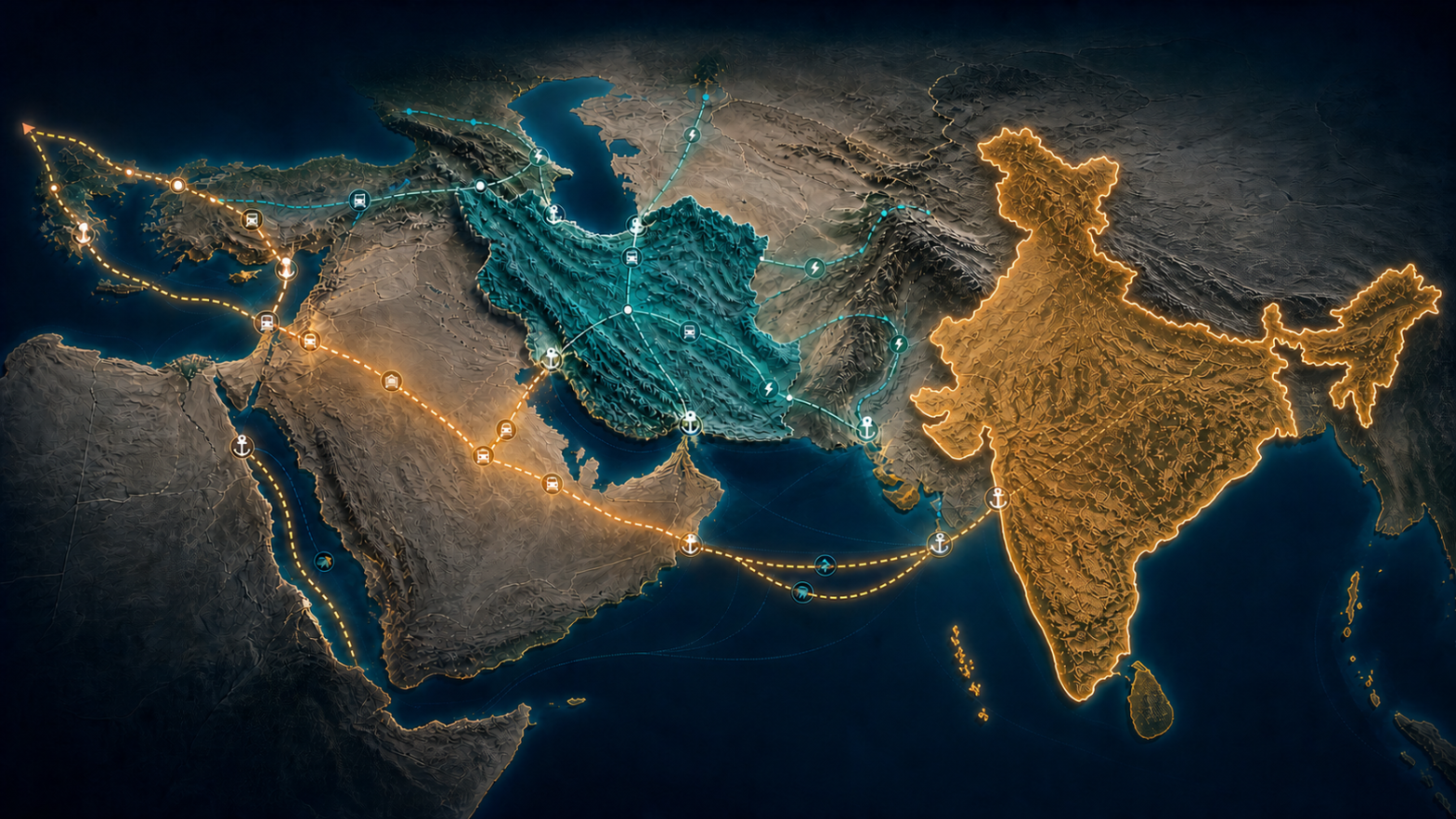
These concerns are closely linked to Iran’s long-term connectivity strategy. Over the past two decades, Tehran has invested heavily in developing the International North–South Transport Corridor (INSTC), Chabahar Port, Bandar Abbas, and related infrastructure to position Iran as a principal gateway linking the Indian Ocean to Central Asia, the Caucasus, Russia, and Europe.[4] From this perspective, initiatives that bypass Iranian territory have implications that extend beyond commerce, affecting the country’s long-term geopolitical influence.
Iranian analysts increasingly characterise this competition as a “war of corridors,” in which infrastructure projects embody competing visions of regional order. Alongside the INSTC and China’s Belt and Road Initiative (BRI), IMEC is regarded as one of several major connectivity initiatives through which states pursue strategic influence and institutionalise new political partnerships.[5]
Another factor shaping Tehran’s assessment is the broader political context of the Abraham Accords and the expanding cooperation among Israel, several Arab states, India, and the United States. Iranian officials argue that IMEC should be understood within this evolving regional architecture rather than as an isolated economic initiative. The inclusion of Israeli Mediterranean ports in the proposed corridor reinforces Tehran’s perception that IMEC supports an exclusive model of regional integration that marginalises Iran.[6]
This article argues that Iran’s scepticism towards IMEC is best understood through the lens of geopolitical exclusion. Tehran views the corridor as an infrastructure project that reroutes trade flows, strengthens rival regional actors, and diminishes Iran’s strategic importance in emerging Eurasian transport networks. Nevertheless, Iran does not reject regional connectivity. Instead, it advocates a more inclusive framework in which IMEC complements existing transport initiatives, particularly the INSTC, thereby maximising regional economic integration while minimising geopolitical fragmentation.[7]
The article is organised into five sections. It first examines Iran’s understanding of connectivity as an instrument of geopolitical power, then analyses Tehran’s interpretation of IMEC as an exclusive regional project. It then explores the concept of the “war of corridors,” assesses Iran’s economic and security concerns, and concludes by evaluating Tehran’s alternative vision for inclusive regional connectivity.
-
1. Iran’s Geopolitical Understanding of Connectivity
Iran’s response to the India–Middle East–Europe Economic Corridor (IMEC) reflects a strategic understanding of connectivity that extends well beyond economic considerations. In Iranian foreign policy, transport infrastructure is viewed not merely as a means of facilitating trade but as an instrument of national power. Railways, ports, logistics hubs, energy corridors, and digital networks shape regional influence, economic resilience, and political partnerships. Consequently, connectivity has become a key component of Iran’s geoeconomic and security strategy.[8]
This perspective reflects Iran’s geographical position at the intersection of South Asia, Central Asia, the Caucasus, the Persian Gulf, and the Middle East. Historically, the Iranian plateau was a major crossroads linking East and West along the Silk Roads. Iranian policymakers continue to regard this location as a key strategic asset and argue that geography can confer long-term political and economic leverage when supported by modern transport infrastructure.[9]
The importance of connectivity became even more pronounced after the expansion of international sanctions in the 2000s. As sanctions restricted Iran’s access to international finance and markets, Tehran increasingly viewed transit diplomacy as a means to reduce economic vulnerability. By positioning itself as an indispensable transit hub linking the Indian Ocean to Eurasia, Iran sought to strengthen economic resilience while raising the geopolitical costs of its international isolation.[10]
These developments coincided with broader shifts in the global political economy. Major infrastructure initiatives, including China’s Belt and Road Initiative (BRI), the International North–South Transport Corridor (INSTC), and the European Union’s Global Gateway, demonstrate that connectivity has become a central arena of geopolitical competition. Infrastructure increasingly serves both economic and strategic objectives by shaping trade routes, investment flows, and regional political relationships.[11]
In this context, the International North–South Transport Corridor (INSTC) plays a central role in Iran’s foreign and economic policy. Established in 2000 by India, Iran, and Russia, the INSTC aims to link the Indian Ocean with the Caspian Sea, Russia, Central Asia, and Northern Europe through integrated maritime, rail, and road networks. For Tehran, the project is more than a transport route; it is a long-term strategy to transform Iran into a major Eurasian transit hub and to capitalise on its geographical advantages.[12]
Iran has complemented the INSTC by making substantial investments in Chabahar Port, Bandar Abbas, the Makoran coast, and national railway infrastructure. These projects aim to connect southern ports with inland markets and neighbouring regions, thereby strengthening Iran’s role in regional logistics. These investments demonstrate that Tehran views infrastructure as a source of strategic influence rather than merely a source of commercial revenue.[13]
Iranian officials also link connectivity to strategic autonomy. Diversified transport corridors reduce reliance on vulnerable maritime chokepoints and provide alternative trade routes during periods of geopolitical tension. In this sense, transport infrastructure contributes directly to national security by strengthening economic resilience and mitigating the effects of sanctions and political pressure.[14]
This strategic outlook explains why Tehran assesses new regional transport initiatives primarily on their geopolitical consequences. Major corridors shape patterns of investment, industrial development, and diplomatic engagement by determining which states become indispensable transit hubs. Countries along these routes often gain political influence alongside economic benefits, whereas those bypassed risk a gradual decline in strategic relevance.[15]
Accordingly, Iran interprets IMEC not merely as another commercial route linking India and Europe, but as an initiative that redistributes geopolitical influence towards rival regional actors while excluding Iranian territory. Although Tehran does not oppose new transport corridors in principle, it argues that infrastructure projects should promote inclusive regional connectivity rather than reinforce geopolitical divisions. From this perspective, IMEC is assessed primarily by its implications for Iran’s long-term strategic position rather than by its immediate economic benefits.[16]
Ultimately, Iran’s understanding of connectivity underpins its scepticism towards IMEC. Infrastructure is viewed as an instrument of geopolitical competition that shapes the regional order, political partnerships, and economic influence. This perspective also underpins Tehran’s growing characterisation of contemporary Eurasian infrastructure development as a “war of corridors,” in which competing transport networks increasingly serve as tools of strategic rivalry rather than merely facilitating international commerce.
-
2. IMEC through Tehran’s Strategic Lens: Geopolitical Exclusion and Regional Realignment
Iran interprets the India–Middle East–Europe Economic Corridor (IMEC) differently from its principal sponsors. While participating governments present the initiative as a means to improve trade, supply-chain resilience, digital connectivity, and sustainable economic development, Tehran views it primarily as a geopolitical project within a broader regional realignment. From the Iranian perspective, transport corridors are not politically neutral; they shape regional power relations, institutionalise strategic partnerships, and influence the distribution of economic and political power.[17]
This interpretation is closely linked to Iran’s long-standing effort to capitalise on its strategic geography. Successive governments have sought to transform Iran into a major Eurasian transit hub by investing in the International North–South Transport Corridor (INSTC), Chabahar Port, Bandar Abbas, and related transport infrastructure. Consequently, a major corridor connecting India and Europe, which bypasses Iranian territory, is perceived not merely as an alternative commercial route but as a challenge to Iran’s long-term geoeconomic strategy.[18]
A central concept shaping Tehran’s assessment is geopolitical exclusion. Iranian analysts argue that transport corridors create durable patterns of economic interdependence by channeling trade, investment, logistics, and diplomatic engagement towards participating states. Countries along these routes often gain greater strategic importance, whereas those excluded risk gradual marginalisation. From this perspective, IMEC redistributes regional influence by strengthening alternative transit hubs and reducing Iran’s potential role in Eurasian connectivity.[19]
Iranian concerns are reinforced by the political context in which IMEC emerged. Tehran associates the corridor with broader regional developments following the Abraham Accords and the expansion of cooperation among India, the United States, Israel, Saudi Arabia, and the United Arab Emirates. Although IMEC is officially presented as an economic initiative, Iranian policymakers contend that its implementation depends on sustained political cooperation among these partners. As a result, the corridor is interpreted as an institutional expression of an emerging regional order rather than a purely commercial undertaking.[20]
Within Iranian strategic discourse, IMEC therefore represents an exclusive model of regional connectivity. Tehran argues that economically efficient transport networks should include all geographically relevant states, regardless of political differences. Iranian officials contend that excluding countries occupying central geographic positions reduces economic efficiency and reinforces geopolitical divisions. In this view, connectivity should function as a regional public good that promotes interdependence and stability rather than political polarisation.[21]
A particularly significant concern is the role assigned to Israel within the proposed corridor. Under IMEC, Israeli Mediterranean ports, especially Haifa, would become major gateways linking the Arabian Peninsula with European markets. Iranian policymakers believe that such a role would strengthen Israel’s position in regional logistics, attract investment, and deepen its integration into regional supply chains. Beyond economic implications, Tehran views this development as enhancing Israel’s strategic influence within West Asia.[22]
Iranian analysts further argue that infrastructure fosters long-term institutional relationships. Transport corridors promote customs harmonisation, regulatory cooperation, investment coordination, and technological integration among participating states. Over time, these arrangements strengthen political partnerships and enhance their resilience. Consequently, Tehran regards IMEC as reinforcing the broader political consequences of Arab–Israeli normalisation by embedding the Israeli regime more deeply in the region’s economic architecture.[23]
International sanctions have further intensified Iran’s concerns. As sanctions have constrained foreign investment and economic integration, Tehran has increasingly relied on transit diplomacy to preserve its regional relevance. Becoming a major transit hub has therefore become an important element of Iran’s strategy to mitigate economic isolation. Exclusion from a high-profile initiative such as IMEC is viewed not only as a potential loss of transit revenue but also as a weakening of one of Iran’s principal geopolitical assets.[24]
Nevertheless, Iran does not reject regional connectivity. Iranian officials consistently emphasise that expanded transport infrastructure can promote trade, economic development, and regional cooperation. Their principal criticism concerns the design of IMEC rather than the broader objective of connectivity. Tehran argues that integrating existing infrastructure—including the INSTC, Chabahar Port, and Bandar Abbas—into wider Eurasian transport networks would yield greater economic efficiency while reducing geopolitical fragmentation.[25]
In sum, Iran’s interpretation of IMEC reflects a broader understanding of infrastructure as a strategic instrument. The corridor is seen not merely as a transport project but as part of an evolving regional order that strengthens rival actors, institutionalises new political partnerships, and diminishes Iran’s geopolitical significance. These concerns underpin Tehran’s broader conception of an emerging “war of corridors,” in which competing connectivity initiatives increasingly serve geopolitical as well as economic objectives.
-
3. The Emerging “War of Corridors”: Iran’s Perception of Strategic Competition
The announcement of the India–Middle East–Europe Economic Corridor (IMEC) has reinforced an increasingly influential concept in Iranian strategic thinking: the “war of corridors.” Although not a formal theory of international relations, the term is widely used by Iranian policymakers and scholars to describe the growing competition among major transport and connectivity initiatives. In this view, infrastructure has evolved from a purely economic asset into a strategic instrument through which states compete for influence, shape regional integration, and redefine the political geography of Eurasia.[26]
This perspective reflects a broader transformation in international politics. Whereas geopolitical competition traditionally centred on military power and territorial control, contemporary rivalries increasingly focus on infrastructure, trade routes, logistics hubs, energy networks, and digital connectivity. Transport corridors shape not only the movement of goods but also patterns of investment, technological cooperation, and diplomatic engagement. As a result, geoeconomics has become an increasingly important dimension of statecraft, with infrastructure serving as a means of projecting influence without direct military confrontation.[27]
Iranian analysts argue that this evolution has produced competing visions of regional order. From Tehran’s perspective, the International North–South Transport Corridor (INSTC), China’s Belt and Road Initiative (BRI), and IMEC are not merely transport projects; they represent alternative geopolitical frameworks, each backed by distinct political coalitions and strategic objectives. The competition among these initiatives therefore concerns not only trade routes but also the future organisation of Eurasia’s political and economic landscape.[28]
For Iran, the INSTC remains the cornerstone of its connectivity strategy. Established in 2000 by India, Iran, and Russia, the corridor aims to link the Indian Ocean with the Caspian Sea, Russia, Central Asia, and Northern Europe via integrated maritime, rail, and road infrastructure. Tehran regards the project as the most effective way to utilise Iran’s geographical position while strengthening economic resilience and regional influence. Since 2022, cooperation with Russia has further heightened the INSTC’s strategic significance as both countries seek alternatives to Western-controlled transport routes and financial networks.[29]
Against this backdrop, IMEC is seen as a competing connectivity architecture. Iranian officials generally avoid portraying the initiative as a direct replacement for the INSTC, yet they recognise that both projects seek investment, cargo flows, and international political support. Tehran therefore fears that future infrastructure financing and commercial traffic may increasingly favour routes that bypass Iranian territory, thereby reducing the strategic value of decades of domestic investment in ports, railways, and logistics infrastructure.[30]
Iran also assesses IMEC in the broader context of China’s Belt and Road Initiative. Since deepening its strategic partnership with Beijing, Tehran has viewed the BRI as complementary to its ambition to become a principal Eurasian transit hub. Some Iranian analysts therefore interpret IMEC as part of a wider effort by the United States and its partners to promote alternative connectivity networks that reduce dependence on Chinese-led infrastructure and, indirectly, on Iran’s strategic location.[31]
Nevertheless, Iranian scholarship generally avoids reducing this competition to a simple binary choice between rival blocs. Many analysts argue that Eurasia is witnessing the emergence of multiple, overlapping connectivity initiatives that both compete and coexist. The central concern is therefore not the existence of alternative routes but whether they are designed to encourage cooperation or geopolitical fragmentation. This distinction explains why Iranian commentators increasingly describe connectivity itself as the principal arena of strategic competition in the twenty-first century.[32]
Another important theme in Iranian strategic discourse is the securitisation of connectivity. Tehran argues that transport infrastructure can become an instrument of political pressure if participation depends on strategic alignment rather than universally accepted commercial principles. In such circumstances, connectivity ceases to function as a regional public good and instead becomes a mechanism for strengthening preferred political coalitions while excluding rival states. Iranian analysts believe that IMEC reflects this trend, as participating countries have simultaneously expanded cooperation across economic, technological, and security domains.[33]
From Tehran’s perspective, exclusion from major transport networks has consequences that extend beyond commerce. Countries along strategic corridors often attract manufacturing investment, logistics, financial services, and diplomatic engagement, thereby enhancing their geopolitical influence. States outside these networks risk a gradual decline in regional relevance, regardless of their geographical advantages. Consequently, Iran views the “war of corridors” as a competition for long-term strategic influence rather than merely for transport efficiency.[34]
At the same time, Iranian scholars acknowledge that connectivity need not be a zero-sum contest. Several analysts argue that Eurasian transport would benefit more from complementarity than from rivalry. Integrating the INSTC, IMEC, and other regional initiatives into a broader multimodal network could diversify trade routes, improve supply-chain resilience, and reduce unnecessary duplication of infrastructure investment. Such a framework, however, would require a more inclusive approach to regional connectivity than Tehran currently adopts in the design of IMEC.[35]
In summary, Iran’s concept of the “war of corridors” reflects a broader transformation in international politics, in which infrastructure has become a central instrument of geopolitical competition. Transport corridors increasingly shape regional influence, economic partnerships, and strategic alignments. From Tehran’s perspective, IMEC is therefore not merely a commercial initiative but part of a wider contest over the future political and economic order of Eurasia.
-
4. Iran’s Security Concerns: IMEC, Regional Realignment, and the Politics of Connectivity
Iran’s scepticism towards the India–Middle East–Europe Economic Corridor (IMEC) goes beyond concerns about trade diversion and transit competition. Tehran regards the initiative as part of a broader transformation of the security and political landscape of West Asia. In Iranian strategic thinking, infrastructure projects increasingly shape regional alliances, economic interdependence, and security arrangements. Consequently, IMEC is viewed not merely as a transport corridor but as part of an emerging geopolitical architecture involving the United States, India, Israel, and several Arab states.[36]
A key factor shaping this perception is the evolving political landscape following the Abraham Accords and the expansion of minilateral initiatives such as I2U2. Iranian analysts argue that these developments show that economic cooperation, technology, infrastructure, and security are increasingly interconnected. From Tehran’s perspective, transport corridors institutionalise political partnerships by creating long-term networks of trade, investment, and regulatory cooperation. Accordingly, IMEC is seen as reinforcing a regional order in which Iran plays only a limited role.[37]
The most sensitive aspect of the corridor concerns the enhanced position of the Israeli regime. Under the proposed route, Israeli Mediterranean ports—particularly Haifa—would serve as gateways linking the Arabian Peninsula to European markets. Iranian policymakers believe this role would significantly strengthen Israel’s geoeconomic position by integrating it more deeply into regional supply chains and logistics networks. Beyond commercial gains, Tehran argues that infrastructure generates lasting political influence by encouraging sustained diplomatic, technological, and institutional cooperation among participating states.[38]
Iran also views IMEC as reinforcing the broader political consequences of Arab–Israeli normalisation. Increased economic interdependence, supported by shared infrastructure, may deepen cooperation among participating governments and make these partnerships more durable. From Tehran’s perspective, the corridor therefore contributes to the consolidation of a regional order that is increasingly independent of Iranian influence.[39]
Another important concern is the securitisation of connectivity. Iranian scholars argue that transport infrastructure has become closely linked to national security because it determines access to markets, technology, investment, and strategic partnerships. In an era of geopolitical competition, railways, ports, digital networks, and energy corridors influence not only economic development but also diplomatic leverage and crisis resilience. Consequently, infrastructure planning has become an integral part of national security policy.[40]
Closely related is the notion of the weaponisation of connectivity. Tehran argues that transport networks may increasingly be organised along political lines rather than by commercial efficiency, rewarding strategic partners while excluding rival states. Although governments supporting IMEC reject this characterisation, Iranian officials contend that the composition of participating countries reinforces perceptions that geopolitical considerations played a decisive role in the corridor’s design.[41]
These concerns are closely linked to Iran’s transit strategy. Over the past two decades, Tehran has invested heavily in Chabahar Port, Bandar Abbas, and the Makran coast, which are key components of the International North–South Transport Corridor. Chabahar, in particular, is regarded as the cornerstone of Iran’s eastern connectivity strategy because it provides direct access to the Indian Ocean outside the Strait of Hormuz. Iranian policymakers fear that if IMEC attracts future investment and cargo flows, the strategic and commercial potential of these infrastructure projects could be significantly diminished despite their favourable geographic location.[42]
Iran also assesses IMEC in light of the Strait of Hormuz’s long-term significance, one of the world’s most important maritime chokepoints. Although IMEC is unlikely to replace maritime trade through the Persian Gulf, Iranian analysts argue that expanding overland transport corridors could gradually diversify regional logistics. Over time, this diversification may reduce the Strait’s geopolitical importance and, by extension, diminish one of Iran’s longstanding strategic advantages.[43]
Overall, Tehran regards IMEC as more than an infrastructure initiative. It is seen as part of a broader restructuring of regional politics, combining economic integration, political realignment, and strategic competition. This perspective explains why Iran continues to advocate an alternative model of regional connectivity based on inclusiveness and complementarity rather than on competing geopolitical blocs.
-
5. Iran’s Alternative Vision of Regional Connectivity: From Strategic Competition to Inclusive Regionalism
Although Iran has consistently criticised the India–Middle East–Europe Economic Corridor (IMEC), it does not oppose regional connectivity per se. On the contrary, Iranian policymakers argue that expanding transport networks is essential to promote trade, economic growth, and regional stability. Their principal objection concerns what they perceive as the corridor’s exclusive institutional design, which favours politically aligned states while bypassing geographically central actors such as Iran. Tehran therefore advocates a more inclusive model of Eurasian connectivity in which transport initiatives complement rather than compete with one another.[44]
This vision is rooted in Iran’s longstanding aspiration to serve as a bridge between South Asia, Central Asia, the Caucasus, the Persian Gulf, and Europe. Successive governments have regarded the country’s strategic location as one of its greatest comparative advantages and have invested in railways, ports, highways, and logistics infrastructure to translate that geographic position into sustainable economic and political influence.[45]
The cornerstone of this strategy is the International North–South Transport Corridor (INSTC). Linking the Indian Ocean with the Caspian Sea, Russia, Central Asia, and Northern Europe, the INSTC remains central to Iran’s economic diplomacy. Tehran argues that the corridor offers one of the shortest and most cost-effective routes between South Asia and Eurasia, while diversifying regional supply chains and reducing dependence on traditional maritime routes.[46]
Within this broader framework, Chabahar Port holds a particularly important position. Situated on the Gulf of Oman, outside the Strait of Hormuz, Chabahar provides direct access to the Indian Ocean and serves as the focal point of Iran’s eastern connectivity strategy. Together with Bandar Abbas and the ongoing development of the Makoran coast, these projects aim to integrate maritime trade with inland transport networks extending towards Central Asia, the Caucasus, and Russia.[47]
Rather than viewing IMEC and the INSTC as inherently incompatible, many Iranian analysts argue that the two corridors could complement each other within a wider Eurasian transport network. Linking these initiatives through multimodal infrastructure would offer greater flexibility for international trade, strengthen supply-chain resilience, and maximise the economic benefits of existing investments. From Tehran’s perspective, cooperation among regional transport projects would yield greater long-term efficiency than competition among rival corridors.[48]
This approach reflects Iran’s broader preference for inclusive regionalism. Iranian officials maintain that connectivity initiatives should remain open to all geographically relevant states, regardless of political disagreements. They argue that infrastructure should serve as a regional public good, encouraging economic interdependence, reducing political tensions, and supporting sustainable development. Excluding countries from major transport networks on geopolitical grounds risks increasing regional fragmentation and reducing overall economic efficiency.[49]
Iran has sought to reinforce this vision through a more diversified approach to regional diplomacy. Improved relations with several Arab neighbours, stronger partnerships with Russia and China, and participation in emerging Eurasian institutions all reflect Tehran’s effort to promote a multipolar regional order based on overlapping economic partnerships rather than exclusive geopolitical blocs.[50]
Iranian strategic discourse therefore distinguishes between competitive and cooperative connectivity. The former emphasises infrastructure as a tool for strategic rivalry and political exclusion, whereas the latter views transport networks as mechanisms for promoting shared prosperity and regional stability. Tehran consistently presents the INSTC within this second framework, arguing that long-term regional development depends on integrating rather than dividing Eurasian transport systems.[51]
Nevertheless, Iranian policymakers recognise that this vision faces substantial obstacles. International sanctions, geopolitical rivalries, unresolved regional conflicts, and competing interests among major powers continue to impede the development of an integrated Eurasian transport architecture. Despite these challenges, Tehran maintains that sustainable regional stability ultimately requires greater economic interdependence rather than competing geopolitical corridors.
In this sense, Iran’s response to IMEC should not be read as a rejection of connectivity. Rather, it reflects a preference for a regional order in which transport infrastructure promotes cooperation, inclusiveness, and mutual economic benefit, rather than reinforcing political divisions.
Conclusion
The India–Middle East–Europe Economic Corridor (IMEC) is one of the most significant connectivity initiatives to emerge in West Asia in recent years. While its supporters emphasise trade facilitation, supply-chain resilience, and economic integration, Iran interprets the project within a broader geopolitical framework. As this article has argued, Tehran regards IMEC not merely as a transport corridor but as part of an evolving regional order that redistributes strategic influence and reshapes Eurasian connectivity.
Iran’s scepticism stems from its view of infrastructure as an instrument of geopolitical power. Transport corridors shape not only the movement of goods but also patterns of investment, political cooperation, and regional influence. Because Iran has invested heavily in the International North–South Transport Corridor (INSTC), Chabahar Port, Bandar Abbas, and related infrastructure, initiatives that bypass its territory are seen as challenges to its long-term geoeconomic strategy rather than merely alternative commercial routes.
The article shows that Tehran interprets IMEC through the lens of geopolitical exclusion. Iranian policymakers associate the corridor with broader regional realignments, including the Abraham Accords, expanding Arab–Israeli cooperation, and emerging minilateral partnerships. From this perspective, IMEC reflects an exclusive model of connectivity that strengthens rival regional actors while diminishing Iran’s strategic role in Eurasian transport networks.
The analysis has also shown that Iranian strategic thinking increasingly frames contemporary infrastructure development as a “war of corridors.” Competing initiatives—including IMEC, the INSTC, and China’s Belt and Road Initiative—offer alternative visions of regional order in which connectivity serves both economic and geopolitical objectives. Infrastructure has therefore become a central instrument of geoeconomic competition.
At the same time, Iran does not oppose regional integration. Rather, it advocates an inclusive model of connectivity in which major transport corridors complement one another and foster broader regional interdependence. Such an approach, Tehran argues, would improve economic efficiency while reducing geopolitical fragmentation.
Ultimately, the debate over IMEC reflects a broader transformation in international politics. Connectivity is no longer merely an economic issue but a key dimension of strategic competition and regional governance. The future success of Eurasian transport initiatives will depend not only on infrastructure investment but also on their ability to reconcile competing geopolitical interests. Whether regional actors pursue rivalry or complementarity will significantly shape the evolving political and economic landscape of West Asia.
Author Brief Bio: Prof. Mohammad Reza Dehshiri is the Dean of the School of International Relations (SIR), since 25 July 2023 and Full Professor of Political Science and member of Scientific Board at School of International Relations (SIR), Ministry of Foreign Affairs, Islamic Republic of Iran (Since Sep. 2004)
Endnotes:
[1] Robert D. Blackwill and Jennifer M. Harris, War by Other Means: Geoeconomics and Statecraft (Cambridge, MA: Harvard University Press, 2016); Parag Khanna, Connectography: Mapping the Future of Global Civilization (New York: Random House, 2016).
[2] G20, “G20 New Delhi Leaders’ Declaration” (New Delhi: G20, 2023); G20, “Memorandum of Understanding on the Principles of an India–Middle East–Europe Economic Corridor” (New Delhi: G20, 2023).
[3] Khanna, Connectography.
[4] Hamidreza Azizi, “Iran’s Regional Connectivity Strategy and Eurasian Geopolitics,” Iranian Review of Foreign Affairs 15, no. 1 (2024): 23–49.
[5] Bruno Maçães, Belt and Road: A Chinese World Order (London: Hurst, 2018).
[6] Anoushiravan Ehteshami, “Iran and the Emerging Geopolitics of Connectivity,” Asian Affairs 54, no. 2 (2023): 185–205; Sanam Vakil, “Regional Order and Strategic Competition in the Gulf,” Survival 63, no. 2 (2021): 7–28.
[7] Seyed Hossein Mousavian, “Iran and Regional Connectivity in Eurasia,” Iranian Review of Foreign Affairs 14, no. 1 (2023): 45–72.
[8] Blackwill and Harris, War by Other Means.
[9] Richard N. Frye, The Heritage of Persia (London: Weidenfeld and Nicolson, 1962).
[10] Rouhollah K. Ramazani, Iran’s Foreign Policy: Both North and South (Charlottesville: University Press of Virginia, 1992); Shireen T. Hunter, “Iran’s Foreign Policy in a Changing Regional Environment,” Middle East Policy 27, no. 3 (2020): 28–45.
[11] Blackwill and Harris, War by Other Means; Khanna, Connectography.
[12] International North–South Transport Corridor Coordination Council, “Agreement on the International North–South Transport Corridor” (St Petersburg, 2000).
[13] Azizi, “Iran’s Regional Connectivity Strategy.”
[14] Mousavian, “Iran and Regional Connectivity.”
[15] Ehteshami, “Iran and the Emerging Geopolitics of Connectivity.”
[16] Maçães, Belt and Road.
[17] Blackwill and Harris, War by Other Means.
[18] Azizi, “Iran’s Regional Connectivity Strategy.”
[19] Blackwill and Harris, War by Other Means.
[20] Vakil, “Regional Order and Strategic Competition.”
[21] Ehteshami, “Iran and the Emerging Geopolitics of Connectivity.”
[22] Jonathan Fulton, “The Gulf, China, and Emerging Connectivity Corridors,” Asian Affairs 51, no. 3 (2020): 347–65.
[23] Vali Nasr, The Dispensable Nation: American Foreign Policy in Retreat (New York: Doubleday, 2013).
[24] Hunter, “Iran’s Foreign Policy in a Changing Regional Environment.”
[25] Mousavian, “Iran and Regional Connectivity.”
[26] Blackwill and Harris, War by Other Means.
[27] Khanna, Connectography.
[28] Maçães, Belt and Road; Nadège Rolland, China’s Eurasian Century? Political and Strategic Implications of the Belt and Road Initiative (Seattle: National Bureau of Asian Research, 2017).
[29] INSTC Coordination Council, “Agreement on the INSTC”; Azizi, “Iran’s Regional Connectivity Strategy.”
[30] Fulton, “The Gulf, China, and Emerging Connectivity Corridors.”
[31] Mohsen Shariatinia, “Iran and China’s Belt and Road Initiative: Opportunities and Challenges,” China and Eurasia Forum Quarterly 18, no. 2 (2021): 59–81.
[32] Ehteshami, “Iran and the Emerging Geopolitics of Connectivity.”
[33] Henry Farrell and Abraham L. Newman, Underground Empire: How America Weaponized the World Economy (New York: Henry Holt, 2023); Vakil, “Regional Order and Strategic Competition.”
[34] Blackwill and Harris, War by Other Means.
[35] Mousavian, “Iran and Regional Connectivity.”
[36] Vakil, “Regional Order and Strategic Competition.”
[37] Jonathan Fulton, The Gulf and the New Regionalism (London: Routledge, 2022).
[38] Jonathan Fulton, “China, the Gulf, and the Belt and Road Initiative,” Asian Affairs 50, no. 1 (2019): 84–103.
[39] Vali Nasr, The Shia Revival (New York: W. W. Norton, 2006).
[40] Blackwill and Harris, War by Other Means.
[41] Farrell and Newman, Underground Empire.
[42] Azizi, “Iran’s Regional Connectivity Strategy.”
[43] Geoffrey Kemp and Robert E. Harkavy, Strategic Geography and the Changing Middle East (Washington, DC: Carnegie Endowment for International Peace, 1997).
[44] Mousavian, “Iran and Regional Connectivity.”
[45] Ramazani, Iran’s Foreign Policy.
[46] INSTC Coordination Council, “Agreement on the INSTC.”
[47] Azizi, “Iran’s Regional Connectivity Strategy.”
[48] Khanna, Connectography.
[49] Ehteshami, “Iran and the Emerging Geopolitics of Connectivity.”
[50] Hamidreza Azizi, Iran’s Regional Policy after the Arab Uprisings (Cham: Palgrave Macmillan, 2024).
[51] Blackwill and Harris, War by Other Means.