

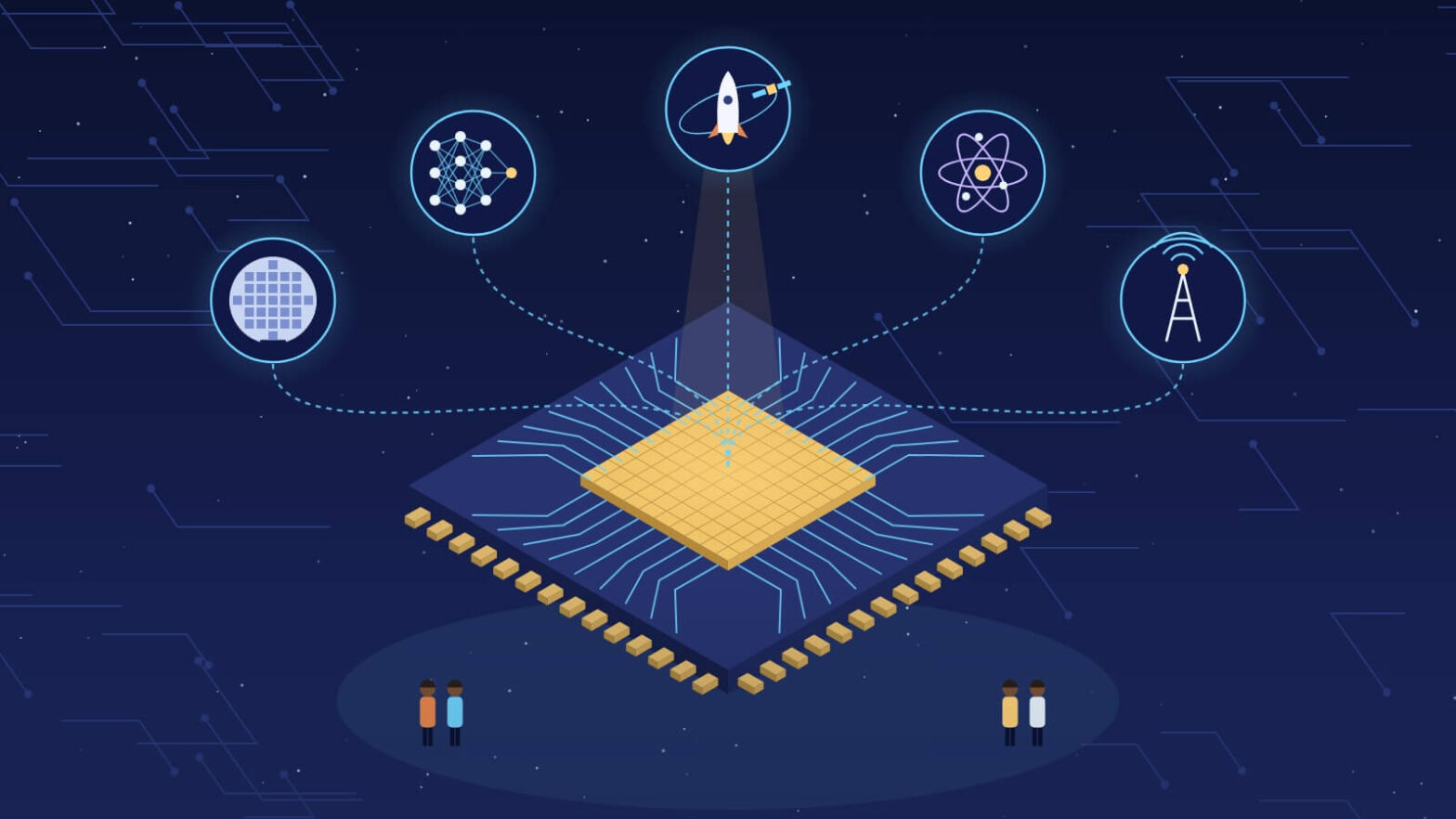
In a rapidly changing world, the criteria used to measure a country’s strength are also evolving. Earlier, measures such as a country’s economic size, the strength of its armed forces, and the availability of natural resources were used to gauge a country’s power. Increasingly, a country’s strength is determined by its capacity to create, control, and use technology. Today, a country that develops tomorrow’s technologies will play a greater role in shaping the global economy, supply chains, international standards, and the balance of power. In other words, technology has become a significant factor in assessing a country’s strength.
We are entering a period in which Artificial Intelligence (AI) is influencing decisions across industries, quantum technologies are reshaping communication and computing, space tech is becoming an important part of our connectivity and surveillance, telecom technologies such as 5G and 6G are providing high-speed networks, and semiconductors are powering almost all of these technologies and every modern device. These developments cannot be ignored; they are not distant possibilities. They are becoming part of everyday life and the global economy.
Footprints of the past offer a clear lesson. Countries that identified these sectors early and invested in them are now playing a greater role in commanding critical supply chains and setting the rules of engagement. Examples such as Taiwan’s semiconductor industry and South Korea’s electronics industry illustrate this reality. Today, the world depends heavily on these technologies, and reliance on certain nations for them creates vulnerabilities, as seen in recent supply-chain disruptions. For a country to become Viksit, achieving self-reliance in these domains is not optional; it is essential.
In contrast, India, despite considerable scientific talent, struggled to translate this into self-reliance and large-scale manufacturing in these advanced technologies. India had skilled engineers, design talent and a capable IT industry. Yet in certain critical sectors, India remained dependent on foreign equipment and technology. Over the past 12 years, however, India’s approach has shifted. The Modi government has recognised the importance of self-reliance in these sectors, prioritised research and development, provided the private sector with the support needed to promote domestic manufacturing, and encouraged greater coordination through PPPs.
The government’s flagship programmes, including the India Semiconductor Mission, IndiaAI Mission, the National Quantum Mission, space sector reforms, and the Bharat 6G Vision, reflect its vision to transform India from a service-oriented economy into a leading builder of deep technologies. Policy support initiatives such as PLI, DLI, and handholding for startups through programmes like Startup India have given the country the confidence to move ahead. The vision is to ensure that India has the capacity and capability to develop the technology domestically and to contribute to global solutions.
This paper examines the transformation of these sectors under the Technology and Innovation stream of the Sapt Dhara framework, showing how India is turning vision into outcomes while remaining rooted in the civilisational ideal of Sarvajan Hitaya, Sarvajan Sukhaya.
Shaping India’s future through semiconductors
Data is, today, an essential part of human life. We share and consume large amounts of data daily on devices such as mobiles, tablets, and laptops, and the devices that enable data transfer contain semiconductors. From mobile phones and televisions to defence systems, automobiles, medical equipment, modern machinery, and communication and network systems, semiconductors power them all. Hence, the significance of semiconductors.
The global semiconductor industry underscores the importance of early investment. Taiwan and India both began semiconductor efforts around the same time in the 1980s. Taiwan created the Taiwan Semiconductor Manufacturing Company (TSMC) in 1987, while India had Semiconductor Complex Limited in 1983. Today, Taiwan holds the strongest position in semiconductor manufacturing, but India has lost momentum. India had some of the finest design talent, yet it could not provide the support needed to turn that knowledge into a globally competitive industry.
Since 2014, however, the landscape has shifted, and the change over the past twelve years has been decisive. In 2021, the Union Cabinet approved the India Semiconductor Mission 1.0 (ISM 1.0) with a colossal outlay of ₹76,000 crore. But it is not a single-year effort; India started the semiconductor mission in 2021. The government has long envisioned India as a semiconductor powerhouse, long before the start of ISM 1.0. Since 2014, the government has been building the required foundation through various steps; in 2015, it formed an Empowered Committee to set up semiconductor wafer fabrication (FAB) manufacturing facilities, and in 2019 it introduced the National Electronics Policy.
The government not only allocated budget to ISM 1.0; it also introduced a pari-passu (on equal footing) co-investment model, rather than a reimbursement model. Under this model, the government committed to providing 50% fiscal support for project costs, while firms invested their own money. This approach has ensured better financial management and given the beneficiary company the freedom to scale expenditure, with the government matching it on an equal basis.
Alongside this, the government focused on another key pillar: building a skilled workforce. For a policy covering design, manufacturing, components, and related areas, a skilled workforce is essential. To build this workforce, it launched the Chips to Startup programme (C2S), targeting 85,000 design engineers over 10 years; 70,000 have already been trained in four years. In collaboration with electronics companies such as Siemens, AMD, and Renesas, the government provided industry-grade EDA tools to students from around 400 engineering colleges to design chips. To give students industry-level experience, the government also supported the fabrication and testing of these chips at the Semiconductor Laboratory (SCL), Mohali.[1] With over 1.85 crore hours of EDA tool usage, this initiative evolved into the world’s largest open-access EDA programme.
Who would have thought that student-designed chips would be fabricated and tested in a government complex at no cost? Then came the Design Linked Incentive (DLI) scheme, launched in 2021, which provided crucial financial backing and access to advanced design infrastructure for domestic industry and startups. The government also launched the Production Linked Incentive (PLI) scheme for Large Scale Electronics Manufacturing and the Electronics Component Manufacturing Scheme (ECMS). The government created a hub-and-spoke model for the semiconductor ecosystem, with the hub (such as IITs) connecting academic institutions, engineering colleges, and universities across the country. The government has a 100% FDI policy for electronics manufacturing.
This is the scale at which the government is working to realise the vision of making India a global leader in semiconductors and Atmanirbhar in this strategic sector. The results of these efforts are clearly visible; today, 12 semiconductor units have been approved across 6 states, including Gujarat, Assam, Odisha, Punjab, Andhra Pradesh and Uttar Pradesh, with investment commitments exceeding ₹1.64 lakh crore. In 2025
alone, India approved 5 semiconductor units. Within 6 years, 5 units started commercial production, and to level up, the government also launched ISM 2.0.
What India has achieved in the semiconductor sector over the past 6 years was widely regarded as unimaginable just a few years earlier. Use cases are already emerging. India’s electronics manufacturing increased sevenfold to ₹13.11 lakh crore in 2025-26, up from ₹1.9 lakh crore in 2014-15.[2] Electronics exports increased 11-fold, from ₹38,000 crore in 2014-15 to ₹4.25 lakh crore in 2025-26. Indigenous microprocessors are being used in space applications. The global semiconductor industry is projected to grow by 8.5% over the next 5–10 years, and India has seized this opportunity to expand its semiconductor ecosystem and contribute to global supply chains. India is now shaping its future through semiconductors.
Democratisation of AI, the Next-gen Technology
AI is shaping almost every aspect of human life. It powers our daily routines, from unlocking our phones with facial recognition and using AI tools in our offices to scrolling through social media apps before going to bed. AI has become part of every aspect of life. It has become a general-purpose technology, like the internet or electricity. Today, AI helps with medical diagnosis, industrial activities, automation, early warning systems, crop production, and accelerating scientific research. And nations that control compute infrastructure, advanced models, and AI talent will shape economic and strategic outcomes for decades.
For years, Indian professionals have played a major role in building digital infrastructure for companies worldwide. Yet India was often seen as a provider of technological services, not a creator. This perception is changing. India now competes on equal footing with technological leaders, especially in AI. The most striking example of this transformation is Stanford University’s AI Vibrancy Tool 2025, which ranks India third, surpassing countries such as the UK and South Korea. India climbed a phenomenal four places in this ranking, from seventh in the previous edition, and is now only behind the US and China.[3]
This is not just recognition; it reflects how seriously India is working in this field. This has been made possible by efforts over the past decade: policy support, a growing start-up ecosystem, expanding AI talent, improved infrastructure, better research and development opportunities, and government initiatives, all of which have contributed to this achievement.
The government has shaped policy to ensure the AI field is not dominated solely by tech giants and the privileged few. It has ensured that every researcher, small startup and student can access India’s world-class AI infrastructure. The IndiaAI Mission, launched in March 2024 with an outlay of ₹10,371.92 crore over five years, is that policy effort. The 7 pillars of the IndiaAI Mission address compute capacity, foundation models, datasets, application development, future skills, startup financing and safe and trusted AI. The mission has provided shared computing capacity of over 45,000 Graphics Processing Units (GPUs).
Through the mission, the government has opened the GPU marketplace, enabling small startups, innovators, researchers, and students to access an affordable research, testing, and computing facility at about ₹65 per hour, substantially lower than commercial cloud rates. Over 237 projects have accessed this subsidised AI computing, totalling over 93.14 lakh GPU hours.[4] This mission has eliminated the most significant barrier to AI development: the cost of computing. High-end GPU infrastructure is very expensive, and not everyone can afford it; remarkably, this historic initiative has removed that barrier.
Everyone knows data is the new fuel, and it also drives AI innovation. Can we imagine an AI model without data? No! Without rich, abundant datasets, even the most skilled innovators and developers face limitations. The government recognised this and launched the IndiaAI Dataset platform to streamline access to high-quality, non-personal datasets. This has enabled Indian startups and researchers to access data more easily through a unified platform. Under the IndiaAI Future Skills Initiative, the government is expanding AI courses across undergraduate, postgraduate, and PhD programmes. AI Kosh hosts over 14,000 datasets and 331 AI models, providing researchers, developers, and innovators with access to critical resources for building and scaling AI solutions.
A country’s data centre capacity plays a key role in supporting its AI infrastructure. These data centres are rapidly expanding in India, with major hubs in Delhi, Bengaluru, Mumbai, Chennai, Hyderabad, and Gujarat. These data centres are so integral that they are driving the overall Digital India Infrastructure; their capacity has grown from around 370+ MW in 2020 to 1500+ MW in 2026. Now, states such as Madhya Pradesh, West Bengal and Chhattisgarh are also being considered for setting up these centres.
The Modi government also places equal emphasis on indigenous and multilingual AI. One example is BharatGen, India’s first government-funded, sovereign generative AI initiative, which aims to build multilingual foundational AI models tailored to Indian languages and Bharatiya societal contexts. India’s approach to AI development has a civilisational dimension. It emphasises the phrase “Sarvajan Hitaya, Sarvajan Sukhaya”, meaning welfare for all, happiness for all. As PM Modi also said, “Technology exists to serve humanity, not to replace it.”[5]
Quantum Computing: The Next Computing Revolution will come from India
Standard computers struggle to solve highly complex scientific problems, while quantum technologies promise secure communication, high-precision sensing, and computational capabilities beyond those of classical computers. Early movers in the United States, Europe and China have invested heavily. Investment in quantum technology could enable precision development across sectors such as defence, pharmaceuticals and advanced materials.
2023 is a significant year for India, as the country launched its National Quantum Mission with an outlay of Rs 6000+ crore. This marks India’s first major effort to build domestic capabilities in quantum technology. The mission matters to India because it enables the country to develop capabilities in four sectors: quantum computing, quantum communication, quantum sensing and metrology, and quantum materials and devices. To this end, the mission has established four thematic hubs at IISC Bengaluru, IIT Madras & C-DOT, IIT Bombay, and IIT Delhi. These hubs serve as nodes, bringing together researchers from multiple institutions and, most importantly, fostering collaboration among government, industry, and academia.
India’s progress in the field is evident in its 2025 demonstration of a 6-qubit quantum processor based on superconducting circuit technology, achieved through a collaboration between DRDO and the Tata Institute of Fundamental Research. On World Quantum Day this year, India inaugurated its first Quantum Reference Facility at SRM University in Amravati. In 2026, India achieved another remarkable milestone by demonstrating a 1000-km quantum-secure communication network within two years of launching the National Quantum Mission. The milestone was achieved using indigenous technology developed by QNu Labs, a startup supported under the mission.
Startups supported under the NQM have delivered quantum processors, high-precision lasers, and diamond microscopes; the mission has supported more than 26 startups. Last November, India unveiled two quantum computing technologies: QSIP, India’s quantum security chip developed by QNu Labs, and a 25-qubit QPU, India’s first quantum computing chip, developed by QpiAI. The emergence of such deep-tech startups in India confirms that the government framework is supporting them at every stage, including funding, access to national infrastructure, and guidance.
Quantum technologies could help simulate complex molecules and support drug discovery. In long-range communication, quantum tech can make sensitive information more secure; high-precision sensors can improve satellite communication. Therefore, for a country with substantial infrastructure and a scientific and security environment, quantum tech could have strategic value. The Modi government’s National Quantum Mission aims to ensure India does not enter this transition only after global standards have already been established elsewhere.
Space Technology and the Making of New Indian Industry
Space technology has always signified more than scientific prestige. Early space initiatives by the US and the Soviet Union helped demonstrate the importance of space. Over time, several countries built their space ecosystems and expanded their capabilities. Similarly, India’s space programme has a distinguished history, from humble beginnings when rocket components were carried on a bicycle to its current status as one of the world’s most successful space agencies.
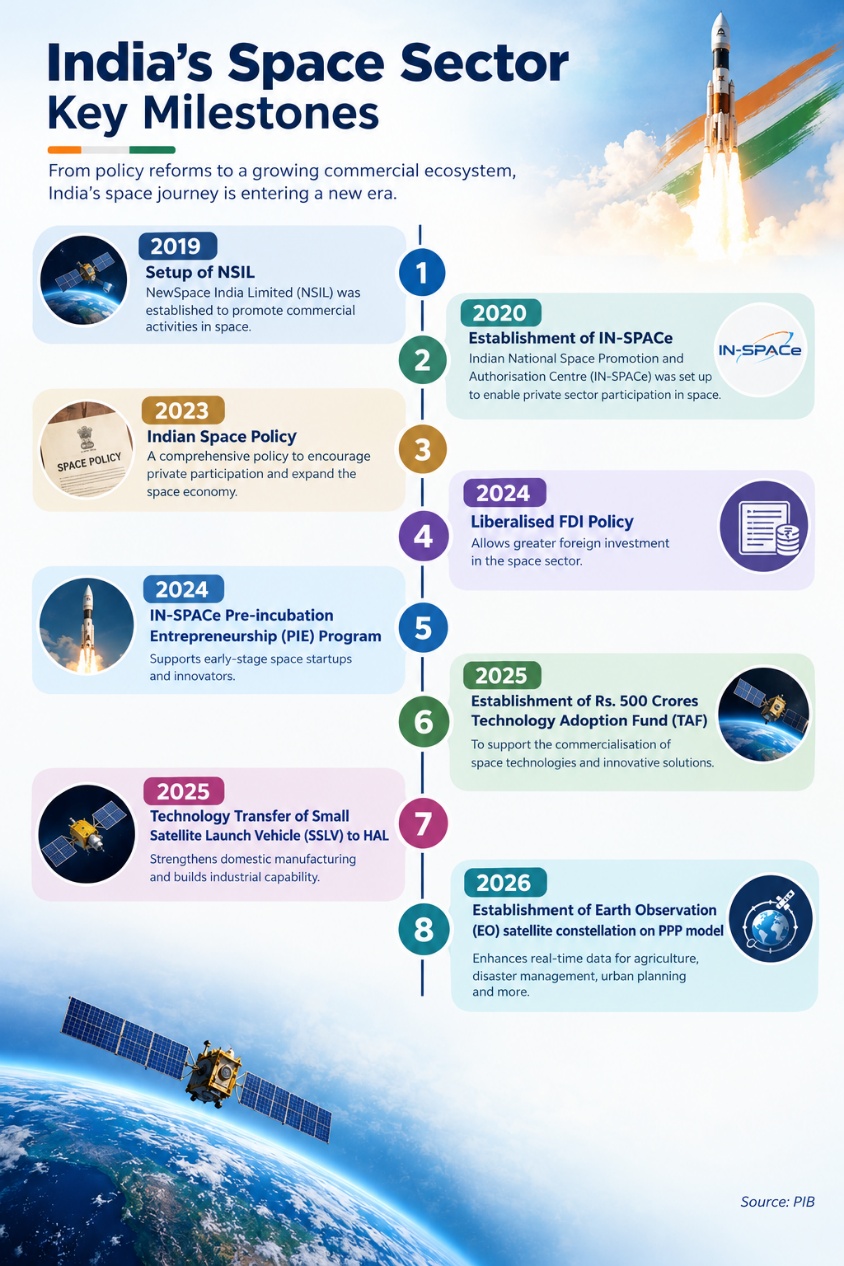
India’s space programme has achieved many milestones since its inception, pioneering the development of cost-effective equipment, satellites and launch vehicles. The major turning point came after 2014, when the government introduced space sector reforms. In June 2020, the Union Cabinet took a historic decision, approving the landmark space sector reforms and opening the sector to private companies for the first time. The government created IN-SPACe as an autonomous, single-window nodal agency under the Department of Space to act as a bridge between ISRO and private entities, setting an example by providing a level playing field.
IN-SPACe resolved the major problem for private companies: navigating the fragmented bureaucratic channels. The cornerstone of this reform was the government’s decision to allow private companies and startups to access ISRO’s world-class launch and testing facilities, data repositories, and expertise. Consider: if a startup is building a satellite, it has to build the infrastructure to test, analyse, and launch it, which is also very expensive and time-consuming. But these reforms removed all of this; now a startup or company only has to focus on building its project. It can use ISRO’s facilities to test the project, engine, and rocket; receive guidance from ISRO’s scientists; and use ISRO’s world-class launch pads. This was one of the most motivating factors behind the emergence of India’s space sector companies.
The government laid this foundation in 2019 by establishing New Space India Limited (NSIL). NSIL was created to commercialise ISRO’s technology and leverage its research and development. Following the 2023 reforms, the government introduced the Indian Space Policy 2023 and opened more of the space value chain to private participation. The overarching vision of this framework is to encourage companies to contribute to satellite manufacturing, launch-vehicle development, and applications, to cater to the needs of the Indian people first, and to bring aatmanirbharta to the space sector.
The results are remarkable; India’s space startup ecosystem has grown from just 1 startup in 2014 to 440+ space startups today. In 2024, the cabinet liberalised the FDI policy for space and approved a 1,000-crore-rupee venture capital fund. Private investment in the space sector surged to $600 million in 2026, a 6x increase from $100 million in 2021-22. These numbers reflect the industry’s transformation and growing confidence in the space ecosystem created by the government, both globally and domestically.
Indian space startups are now making history. Recently, a young private startup from Hyderabad has achieved what only a handful of companies and nations worldwide have managed. On its first orbital mission with the Vikram-1 rocket, space startup Skyroot Aerospace successfully reached a Low Earth Orbit of about 450 kilometres and deployed 6 payloads, making Skyroot the first Indian private company to place a rocket into orbit. This made India the third country where a private space company has independently placed payloads in orbit.
In 2024, Agnikul Cosmos became the first startup to launch the world’s first rocket powered by a single-piece 3D-printed engine. Pixxel Space became the first startup to secure an order from NASA. Several other startups, such as Dhruva Space, GalaxyEye, and Bellatrix Aerospace, are working in deep-tech areas such as hyperspectral imaging, satellite platforms, and other applications. Today, Indian startups are supplying components to ISRO. Over the past 12 years, India’s pace in the space sector has accelerated. India’s growing launch capabilities are attracting global demand, with foreign satellite launches increasing from 35 before 2014 to 399 as of January 2026.[6] India has over 300 space cooperation agreements with 61 countries. Chandrayaan-3 achieved a soft landing near the lunar south pole in 2023, making India the first country to succeed in that region. In 2017, ISRO successfully launched 104 satellites into space, beating the world record for the highest number of satellites launched in one go. With the SpaDex mission in 2025, India will become the fourth nation to perform space docking.
Gaganyaan, India’s human spaceflight programme, has reached an advanced stage. PM Modi set targets for ISRO to establish the Bharatiya Antariksha Station by 2035 and to land an Indian astronaut on the Moon by 2040. According to a report (Socio-Economic Impact Analysis of the Indian Space Programme) from August 2024, ISRO supports eight lakh fishermen daily and provides satellite-based weather forecasts to 140 crore Indians. For every dollar generated by the space sector, the Indian economy has seen a multiplier effect of $2.54.[7]
Bharat6G Vision: Building the Networks of the next Digital Economy
Under the Modi government, India has delivered one of the fastest 5G rollouts in the world; 5G services are now available in 99.6% of districts across the country. India is now working on next-generation 6G technology. In 2023, India released the visionary Bharat 6G vision document. The primary goal of this document is to be a front-line contributor to the design, development and deployment of 6G by 2030. Why did India suddenly start working on technologies like 5G and 6G? Because connectivity has become a very important requirement of the modern world. Mobile connectivity has played a major role in transforming communication, digitisation, entertainment and advertising.
Indian citizens remember the days when they had to go to the terrace to catch a signal, raising their hands in the sky and hoping for at least one bar. They had to stand still in the same place throughout the call; earlier, people avoided trips by saying ki “bhai udhar to network hi nahi aata”; internet was so costly, and remote areas suffered the most. But over the past decade, the connectivity sector has undergone a major transformation; India has achieved what once looked impossible. Today, India offers the world’s cheapest data: 1GB data for just under Rs 10, which means less than a cup of tea. India stands out globally in rolling out the 5G network. In just 5 years, India’s internet speed has increased 10x; more than 5.5 lakh base stations are currently operating the 5G network. Just look at the scale: within 22 months, India covered almost all districts with 5G.
Today, BSNL is moving towards a 5G network; in 2025, India will become the fifth country in the world to develop a fully indigenous 4G stack for BSNL. The Bharat6G Vision will take these efforts even further. It has expanded its membership to over 90 organisations, including 30+ deep-tech artificial intelligence companies. It has now secured 7,700 patents and involves over 1,800 organisations, including IITs and tech companies, focused on AI-native networking. The mission is ambitious, aiming to secure 10% of global 6G patents. For a country where citizens have to exercise to get a network, this has become a global example.
Conclusion
Countries that build technological capabilities early will be better placed to influence the industries, standards and institutions that shape the future global economy. To build Viksit Bharat, India is deliberately building its technological future first. Semiconductors, artificial intelligence, quantum systems, space capabilities, robotics and 6G connectivity are no longer distant ambitions; they are active programmes with plants, models, missions and rankings. Countries that mastered these domains early now exercise outsized influence. India is ensuring it does not remain a perpetual follower.
Author Brief Bio: Aniket Shrivastava is a content, research and policy professional with nearly 6 years of experience across public policy, governance and digital communications. He is currently working as a Senior Associate, in MyGov, a division in Ministry of Electronics and IT, Delhi. He leads research-driven projects spanning national policy, social and political issues, and geopolitics. His work focuses on translating complex policy questions, data and developments into clear, accessible and impactful narratives. His expertise includes policy research and analysis, analytical report writing, dashboard development, briefing notes, internal communications and data-led storytelling and his areas of interest include governance, technology, development, geopolitics and India’s evolving role in the global order.
References:
[1] Ministry of Electronics and Information Technology, Government of India, “Under Chips to Startups (C2S), India Made Significant Progress towards Its Target of Training 85,000 Semiconductor Engineers,” press release, Press Information Bureau, 7 March 2026, https://www.pib.gov.in/PressReleaseIframePage.aspx?PRID=2236290®=48&lang=2.
[2] Press Information Bureau, Government of India, “Electronics Components Manufacturing Scheme,” backgrounder, accessed 21 October 2026, https://www.pib.gov.in/PressReleaseDetail.aspx?PRID=2311234®=48&lang=1.
[3] India Today Education Desk, “India Climbs to 3rd in Global AI Ranking, Surpasses UK and South Korea,” India Today, 15 December 2025, https://www.indiatoday.in/education-today/news/story/india-overtakes-uk-south-korea-in-global-stanford-ai-competitiveness-index-2836025-2025-12-15.
[4] Press Information Bureau, Government of India, “Semiconductor and AI Revolution,” factsheet, 13 August 2026, https://www.pib.gov.in/FactsheetDetails.aspx?Id=150860®=48&lang=2.
[5] Prime Minister’s Office, Government of India, “‘India Should Be among the Top Three AI Superpowers Globally’: PM Modi Sets 2047 Vision,” 17 February 2026, https://www.pmindia.gov.in/en/news_updates/india-should-be-among-the-top-three-ai-superpowers-globally-pm-modi-sets-2047-vision/.
[6] Press Information Bureau, Government of India, “Strengthening India’s Space Sovereignty,” factsheet, 14 August 2026, https://www.pib.gov.in/FactsheetDetails.aspx?Id=150907®=20&lang=8.
[7] “For Every Dollar, India’s Space Sector Has Given Back $2.54 to the Economy: Report,” Moneycontrol, https://www.moneycontrol.com/news/business/economy/for-every-dollar-indias-space-sector-has-given-back-2-54-to-the-economy-report-12805458.html.