
Abstract
The Indo-Mediterranean has been formalised through high-level communication between New Delhi and Rome, yet scholarship has not kept pace: existing literature examines Italy’s Indo-Pacific tilt, India’s extended neighbourhood, IMEC’s economic architecture and Chinese port diplomacy in the Mediterranean, often in isolation. This article sits at the intersection of these themes, taking the Indo-Italian dyad as its unit of analysis. Drawing on neoclassical realism, it explains the causal mechanism by which two peninsular states at either end of the Suez–Red Sea–Arabian Sea continuum convert geography into strategic influence: independent doctrinal codification through India’s MAHASAGAR vision and Italy’s Enlarged Mediterranean, joint naming of the space between them, and material institutionalisation through naval, corridor, digital and industrial cooperation. Locating the drivers in domestic recalibration rather than great-power competition, it argues that IMEC’s under-institutionalised condition is not an obstacle to influence but its opportunity structure: in a corridor that carries no freight, agenda-setting and recognition accrue to whoever anchors the process.
Introduction
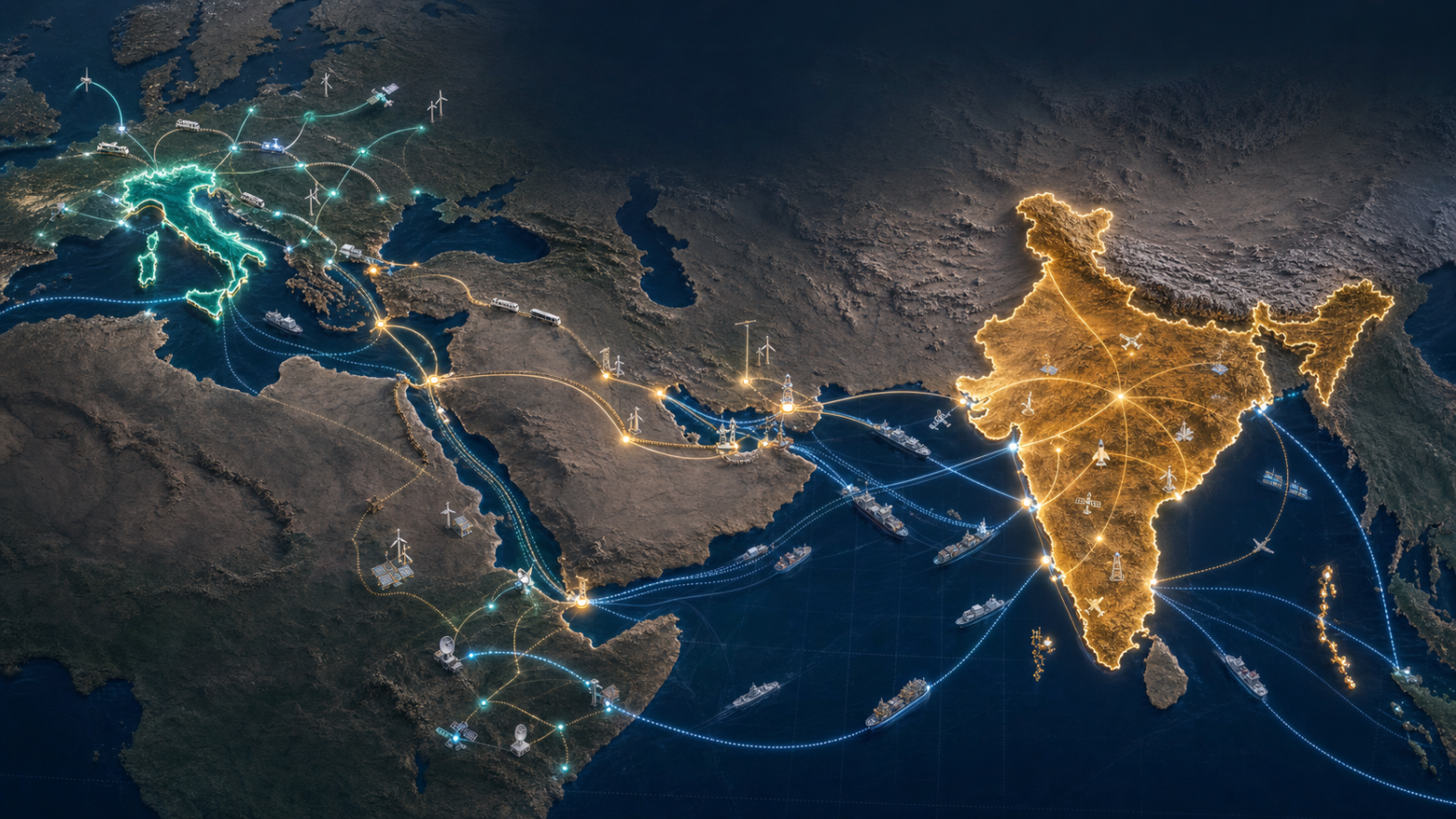
Prime Minister Narendra Modi’s state visit to Rome in May 2026, which elevated Indo-Italian relations to a ‘Special Strategic Partnership,’ marks the formal emergence of what both governments now call the ‘Indo-Mediterranean.’ The joint declaration signed by Modi and Meloni anchored this ambition, linking connectivity via the India–Middle East–Europe Economic Corridor (IMEC), maritime security, and industrial and energy cooperation, positioning the two states as co-architects of a maritime continuum stretching from the Arabian Sea to Southern Europe. Behind the diplomatic vocabulary lies a more substantive shift: two states, geographically distant and structurally different, are progressively building an infrastructure of cooperation across a space that neither had, until recently, treated as a shared strategic theatre.
Existing accounts explain this rapprochement largely in reactive terms – as Italian alignment with wider European engagement in the Indo-Pacific, or as Indian projection into an “extended neighbourhood” driven by strategic competition with China. These readings capture part of the picture but miss its most interesting dimension. The convergence between Rome and New Delhi is anchored in independent domestic recalibrations, with India’s MAHASAGAR vision and Italy’s Enlarged Mediterranean, resulting in a structural symmetry between two peninsular states that, from asymmetric positions of power, share an interest in managing the maritime space between them.
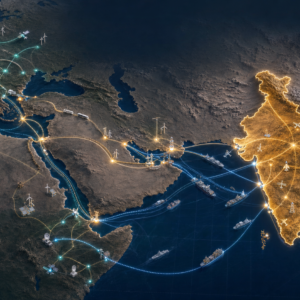
This article explains the causal mechanism by which geography is leveraged as a strategic influence: a peninsular position at either end of the Suez-Red Sea-Arabian Sea strategic space, leading to official renaming and bilateral material institutionalisation through naval deployments, connectivity, and economic and technological exchanges. Drawing on neoclassical realism, it examines how maritime cooperation, resilient supply chains, industrial co-development via IMEC, and technological connectivity via digital cables result in greater access, agenda-setting influence, and recognition for both states. It concludes by assessing the vulnerabilities of such bilateral strategies to regional turbulences such as Red Sea disruption, the 2026 Iran conflict, and IMEC’s structural fragilities.
Relevant Literature & Theoretical Framework
Scholarship on the ‘Indo-Mediterranean’ can largely be attributed to Scott, who analyses the term’s origin in his geopolitical account and grounds its contemporary use in the economic architecture of the IMEC.[1] Scott views India and Italy as “China-concerned states” that balance Beijing’s influence through their own maritime power projection, and concludes that the Indo-Mediterranean is a “strategic space” rather than a region, where realist competition prevails.[2] The rest of the relevant IR scholarship remains siloed, with Indian scholars theorising about Modi’s maritime policies, including IMEC in the Mediterranean, while Italian scholars explain Rome’s Indo-Pacific tilt and yet others measure Chinese port diplomacy.[3] However, the Indo-Mediterranean has not been analysed using the Indo-Italian dyad as the unit of analysis, and this article, which sits at the intersection of the above themes, aims to fill that gap. Applying a neoclassical realist lens,[4] it lays out the causal mechanism used by the two anchor states to leverage geography into strategic influence. This lens explains the role of domestic drivers in Rome and Delhi in the shared codification and material institutionalisation of the Indo-Mediterranean, as well as the role of their security elites in operationalising the architecture to secure greater status.[5] The ‘Indo-Mediterranean’ joint naming is essential here, as it lowers the legitimacy costs of the two anchors’ presence in each other’s home basin – what Larson and Shevchenko term ‘social creativity.’[6] This piece contributes by demonstrating the converging logic of Indo-Italian strategic, maritime, economic and technological architecture in the following sections.
Strategic Convergence: India
India’s westward maritime tilt is not merely a reaction to balance Chinese port diplomacy in the Mediterranean, but a continuation of the strategic tradition of securing the country’s western boundary. Scholars such as K. M. Panikkar insisted that Indian security rested on command of the Arabian Sea, a view echoed by the present crises in the Gulf and Red Sea littorals.[7] The current strategic apparatus has evolved from the “extended neighbourhood” framing, which extends from the Suez Canal to Singapore in the east, to the “Link West & Act West”[8] policies, which have led to expanded bilateral and multilateral cooperation in the Mediterranean, especially through IMEC in 2023.
The SAGAR doctrine, upgraded to MAHASAGAR (Mutual and Holistic Advancement for Security and Growth Across Regions) by PM Modi in 2025, is a holistic regional strategy to strengthen India’s maritime legacy beyond the Indo-Pacific.[9] The Modi–Meloni op-ed of May 2026 then codified the interconnectedness of the Indo-Pacific and the Mediterranean, giving official endorsement to a space whose emergence stemmed from Indian and Italian security elites’ framing of it as beneficial to its co-architects.
Three domestic factors contribute to the ‘Indo-Mediterranean’. The first is an energy and connectivity imperative. Europe is India’s largest trading partner, and the Red Sea disruptions of 2024–25, which tripled transport costs, followed by the closure of the Strait of Hormuz, made route diversification a necessity rather than a preference. IMEC is crucial to Indian economic growth, as a direct, secure link with Europe is the prerequisite for the institutional mechanism of the India-EU Free Trade Agreement (FTA) of January 2026 to operationalise.[10]
Secondly, the industrial and technological development of an Atmanirbhar Bharat greatly benefits from Italian defence, shipbuilding and energy partnerships – co-development and technology transfer in naval and defence equipment, and electrolyser manufacturing for a National Green Hydrogen Mission backed by 2.5 billion USD in investment.
Thirdly, it exemplifies a rising power’s drive for greater status by co-authoring a strategic corridor, thereby legitimising Indian agency to manage it more effectively, while quietly aligning with Italy to reshape the regional structure for mutual gain. Indian security elites, thus, invoke this strategic corridor at multiple international academic fora, such as the Indian Ocean Conference and the Mediterranean Dialogue, to gain legitimacy and a seat at the table deciding the future of a consequential strategic theatre.[11] Such power projection through MAHASAGAR is not without competition from Chinese port diplomacy and India’s own infrastructure being in the developing stages, but the bilateral commitment remains strong even from the western anchor, as discussed in the next section.[12]
Strategic Convergence: Italy
Italy’s turn towards the Indo-Mediterranean is best read not as an external adaptation to great-power competition, but as the outcome of a domestic recalibration of its strategic identity, which has been maturing for over a decade. The doctrinal antecedent is the older concept of the Enlarged Mediterranean (Mediterraneo allargato), developed within the Italian Navy in the 1980s and progressively adopted into official strategic doctrine from the 1990s – a framework that defines Italy’s maritime area of interest as a continuum extending from the central Mediterranean through the Red Sea into the western Indian Ocean and the Gulf.[13]
What is new is not the doctrinal framework but the seriousness of its operational and political mobilisation. Italy has not published a dedicated Indo-Pacific strategy comparable to those of France, Germany, or the Netherlands; its 2022 contribution to the EU Indo-Pacific strategy remains the closest formal statement of intent.[14] Yet the absence of a single doctrinal document coexists with a densely populated field of practice: naval deployments, ministerial visits, industrial agreements, and connectivity initiatives, taken together, mark a coherent reorientation.[15]
Three domestic drivers explain the trajectory. First, an energy and connectivity imperative: the post-2022 decoupling from Russian gas made the Mediterranean-African corridor central to Italian energy security, and the Mattei Plan for Africa was designed to consolidate Rome’s role as a southern hub for energy and infrastructure linking Europe, Africa, and the space beyond Suez.[16]
Second, an industrial and technological imperative: Italian defence, aerospace, and shipbuilding firms such as Leonardo and Fincantieri require growth markets and integration into resilient supply chains, which India – with its industrial scale, indigenisation drive, and stable demand pipeline – can offer on an unprecedented scale. Third, a status and positioning imperative: the exit from the Belt and Road Initiative in late 2023 opened both a symbolic and a strategic space that Rome has filled by reframing itself as a connecting middle power capable of anchoring the western end of a new corridor architecture, rather than as a marginal participant in projects designed elsewhere.[17]
Read together, the Indian and Italian doctrines describe the same water from opposite directions. MAHASAGAR extends India’s horizon westward beyond the Indian Ocean; the Enlarged Mediterranean extends Italy’s eastward past Suez into the Gulf and the Arabian Sea. Each had reached towards the other’s basin before either government named the space between them — which is why the joint naming in May 2026 codified a convergence rather than creating one. The India–Italy Joint Strategic Action Plan 2025–2029, adopted in November 2024 and reinforced by the elevation to a Special Strategic Partnership in May 2026, provides the diplomatic scaffolding.[18]
Building the Corridor
The corridor is built on three main pillars. These are
- Maritime cooperation.
- Industrial & technological architecture.
- From position to strategic influence & recognition.
Maritime cooperation
Maritime cooperation provides the clearest empirical evidence of Indo-Italian operationalisation in the Indo-Mediterranean. The pattern, consolidated since 2023, is one of reciprocal projection: Italian naval assets deploying into the Indian Ocean, Indian naval assets into the Mediterranean, with joint exercises, port calls, and now permanent consultation mechanisms formalising a continuum that both navies had treated as two separate theatres.
The Italian projection eastward peaked in 2024 with the deployment of a Carrier Strike Group centred on ITS Cavour and the frigate ITS Alpino, complemented by the independent deployments of ITS Raimondo Montecuccoli and the training ship ITS Amerigo Vespucci.[19] The five-month deployment crossed the Mediterranean, Red Sea, Gulf of Aden, and Indian Ocean, with port calls in ten countries and a joint exercise with the Indian aircraft carrier INS Vikramaditya and its air wing in October 2024. The Cavour deployment marked the first Italian carrier presence in the Indo-Pacific and translated the doctrinal notion of the Enlarged Mediterranean into operational reality, thereby merging the Mediterranean with the Indo-Pacific as a shared strategic theatre.
The reciprocal Indian projection into the Mediterranean follows a parallel logic. In August 2025, the Indian stealth frigate INS Tamal called at Naples and conducted a PASSEX with the Italian Landing Helicopter Dock ITS Trieste.[20] In September 2025, INS Trikand called at Taranto during its Mediterranean deployment and participated in Exercise Bright Star 2025 in Egypt – a US Central Command-led multilateral exercise involving Egypt, the United States, Italy, India, and others, thereby materially anchoring Indo-Italian maritime cooperation within a wider regional security architecture.[21] Earlier engagements, including the 2023 Passing Exercise between ITS Francesco Morosini and INS Sumedha off Sardinia, indicate that reciprocity has been a pattern since the early 2020s, rather than an isolated phenomenon.
Beneath these high-profile deployments lies a denser layer of routine cooperation: humanitarian and disaster-relief coordination, anti-piracy operations in the Gulf of Aden, and information exchange on maritime domain awareness. The institutional scaffolding was formalised in May 2026, when the Special Strategic Partnership introduced a bilateral Dialogue on Maritime Security and committed both governments to examining a feasibility framework for an annual, high-level, structured military dialogue.[22] Crucially, naval cooperation has now developed a distinctive industrial spine. Fincantieri’s long-standing partnership with Cochin Shipyard on Indian Navy fleet renewal, together with its subsidiary WASS’s ₹2,000 crore contract for Black Shark Advanced heavyweight torpedoes to equip India’s Kalvari-class submarines, signal that maritime interoperability is being embedded in shared production, technology transfer, and long-term rather than episodic industrial commitments.[23]
Industrial & technological architecture
Indo-Italian positioning across the corridor’s economic and technological layers has advanced considerably faster than the corridor itself. At the corridor’s Mediterranean exit, Adani’s 2023 acquisition of a controlling stake in Haifa Port established an Indian commercial presence where the northern land route returns to the sea. In February 2026, Adani Ports signed an MoU with the Port of Marseille Fos, explicitly framed around IMEC, proposing an “IMEC Ports Club” to coordinate ports along the route – Indian economic positioning convening the corridor’s European harbours.[24]
Italy has, in Trieste, a strong structural candidate for the corridor’s European terminus. Trieste is the northernmost Mediterranean port directly linked by rail to central Europe, and its free-port status allows goods to be stored and re-exported without entering EU customs territory. Rome sought to turn this into a strategic claim, appointing Ambassador Francesco Maria Talò as Italy’s IMEC special envoy in April 2025, one of only two appointments among the eight signatories. Indo-Italian efforts converged at an IMEC forum in March 2026, hosted in Trieste by Deputy PM Tajani and attended by India’s Deputy NSA Pavan Kapoor, to advance the Indo-Mediterranean strategy.[25] Though Trieste has unique advantages, it is a contested terminal, with France pushing for Marseille and Piraeus weakened by Chinese majority ownership.[26]
The digital layer is the corridor’s only functioning trans-regional infrastructure, jointly owned. Sparkle, in strategic partnership with Airtel, activated the Blue-Raman cable between India and Genoa, which is deeply embedded within the IMEC digital corridor.[27] Its routing bypasses the Egyptian chokepoint through which most Europe-Asia data has historically passed and stands against China’s PEACE cable, which bypasses India entirely, running from Gwadar to Djibouti up the Red Sea.[28] While the corridor’s overland segment remains politically foreclosed, data already flows along its projected geography, and the standards governing that traffic, like routing, interoperability, and data governance, are being bilaterally shaped now.
The corridor’s physical spine, meanwhile, has advanced unevenly and largely outside collective direction: Saudi Arabia’s north–south railway reached the Jordanian border at Al-Haditha in March 2026; the northern land bridge’s key prerequisite, built on national grounds rather than under an IMEC mandate. Beneath the corridor-specific machinery lies the commercial rationale that sustains it. Bilateral trade reached 14.25 billion euros in 2025, making Italy India’s fourth-largest EU trading partner. The May 2026 Summit set a 20 billion euros target for 2029, pending implementation of the India-EU FTA, which ensured demand for the corridor. The two also agreed to convene an IMEC Ministerial in 2026, alongside a Defence Industrial Roadmap committing both sides to co-production and a critical minerals MoU — supply-chain instruments for a corridor conceived to carry resilient trade rather than volume alone.[29] Energy follows the same logic, with jointly funded green hydrogen research linking India’s National Green Hydrogen Mission to Italy’s position as Europe’s southern energy gateway.[30] Thus, influence and agenda-setting power here precede freight; whoever supplies continuity to the strategic corridor will potentially shape construction timelines, financing mechanisms and administrative frameworks, with India and Italy in a position to exploit such opportunities.
From position to strategic influence & recognition
The mechanism’s output can be assessed against three indicators. Access is the most tangible: India holds a controlling commercial position at Haifa, and Italy has secured a carrier-level presence in the Indian Ocean, with reciprocal Indian port calls at Naples and Taranto. Neither state possessed operational reach into the other’s basin a decade ago; each now exercises it at the other’s invitation. Agenda-setting is where the dyad’s advantage is starkest. Of the eight IMEC signatories, only France and Italy have appointed special envoys, and the May 2026 declaration made Rome and New Delhi the visible sponsors of the corridor’s only scheduled collective decision-point. Where there is no secretariat, no financing mechanism and no construction timeline, continuity of political investment substitutes for institutions, and those supplying it shape what the corridor becomes.
Recognition is the most partial and the most instructive. External Affairs Minister Jaishankar invoked the Indo-Mediterranean in Rome in November 2024, eighteen months before the joint op-ed; C. Raja Mohan, writing from Singapore, identified a new Indo-Mediterranean region emerging through connectivity, commerce and geopolitics; and an American proposal for an “IndoMed Quad” comprising the United States, UAE, India and Italy treats the dyad as cornerstone actors in an Indo-Mediterranean order. Meloni’s invitation to the December 2025 GCC Summit and her proposed GCC-MED Summit indicate Gulf acknowledgement of Rome’s bridging role. Yet neither the European Union nor the Gulf states have adopted the term officially, and it has no institutional referent. A named space with two sponsors and no members remains a claim in progress — but the claim is being recognised by others, which is what distinguishes naming from assertion.
Limits and Fragilities
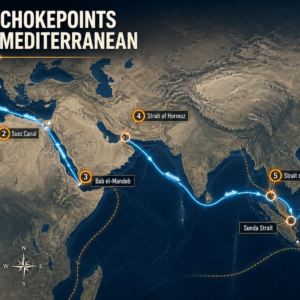
The Indo-Mediterranean is being constructed in an exceptionally hostile regional environment. Between February and July 2026, the corridor’s maritime segment came under sustained pressure at each of its critical junctures. The February 2026 Israeli-American air campaign against Iran, followed by Tehran’s partial closure of the Strait of Hormuz, constrained the corridor’s Gulf gateway.[31] In late July, after a nine-month pause, Houthi forces resumed attacks in the Red Sea, imposed a maritime embargo on shipping to and from Saudi ports, and drove traffic through Bab el-Mandeb down by over a third within days. A suspected Iranian drone strike on a floating LNG unit at the Egyptian port of Damietta then brought the disruption into the Mediterranean itself.[32] Overlaying these acute pressures is a structural one: the halt to Saudi-Israeli normalisation since October 2023, which has effectively frozen IMEC’s projected overland northern segment.[33]
The structural implications are significant. The Indo-Mediterranean, in its IMEC dimension, was conceived as a hedge against precisely the kind of chokepoint disruption that has now materialised on both ends of the corridor simultaneously. Its eastern segment depends on Gulf hubs located beyond Hormuz; its western segment depends on the Red Sea passage under Houthi pressure; and the Mediterranean terminal itself is no longer immune. A corridor designed to circumvent chokepoint risk finds itself materially dependent on the chokepoints most exposed to disruption, while the alternative overland routing remains politically foreclosed.[34]
Three further vulnerabilities qualify the anchors’ agency. First, the corridor’s middle belongs to others: its viability rests on the UAE, Saudi Arabia, Jordan, Israel and Egypt, sovereign actors whose calculations neither Rome nor New Delhi can control, and whose consent no bilateral partnership can substitute. Second, capability constrains ambition — India’s Mediterranean presence remains episodic, and its western port infrastructure is incomplete, while Italy’s naval commitments are stretched across the Enlarged Mediterranean and NATO’s eastern flank, and Rome cannot deliver on trade or customs commitments that lie with Brussels. Third, the partnership rests conspicuously on leadership convergence; personal alignment is an asset that institutions must outlast, and the Joint Strategic Action Plan’s review mechanisms remain young.
Cooperation has nonetheless deepened through the disruption rather than despite it: the elevation to Special Strategic Partnership was agreed while Hormuz was already constrained, the torpedo contract was signed as the Iran conflict escalated, and the Cavour deployment had already crossed the corridor amid active Red Sea hostilities.[35] This suggests the partnership is not contingent on the corridor’s original blueprint. Its viability will instead depend on the anchors’ capacity to co-architect the corridor’s evolution — including alternative routing through Fujairah, Salalah and Duqm outside Hormuz, hardened Mediterranean port infrastructure integrated with the Mattei Plan, and layered supply-chain redundancy under conditions of permanent instability — and on whether adaptive capacity outlasts accumulating stress.
Conclusion
The Indo-Mediterranean is not a region that India and Italy discovered, but a strategic space they are assembling — and the mechanism by which they do so runs from position through doctrine and naming to institutionalisation. Each state’s westward or eastward turn stemmed from domestic recalibration rather than external adaptation: MAHASAGAR and the Enlarged Mediterranean were codified independently and converged only when both governments named the water between them. That naming did work of its own, lowering the diplomatic cost of each navy’s presence in the other’s basin and creating a domain in which the two hold anchor position by definition.
What follows is an influence that does not wait for the corridor to open. In a space with no secretariat, no financing mechanism and no agreed terminus, the states that provide continuity—envoys, ministerial sponsorship, cable routing, port coordination—shape what the corridor becomes. Scott’s under-institutionalised strategic space is, on this reading, not an obstacle to influence but its opportunity structure.
The claim is testable and should be tested. If the first ministerial does not convene, if envoy-level commitment remains confined to Paris and Rome, if the European terminus settles elsewhere, or if the term is not adopted beyond its two sponsors, the anchoring argument fails. What the period since 2023 shows is not that the Indo-Mediterranean has been built, but that two states at its extremities have positioned themselves to determine how it is.
Author Brief Bio:
- Arnav Joshi is currently pursuing an MA in International Relations at King’s College London, with diverse research interests in Indian foreign policy, middle power politics and role of modern technology like AI in international affairs. He completed his BA in Political Science from St. Xavier’s College (University of Mumbai).
- Carlo Angrisani is an MA candidate in International Relations at King’s College London, with academic interests in foreign policy analysis, grand strategy, deterrence, and middle power politics. He previously earned a 5-year single-cycle master’s degree in law from the University of Naples Federico II.
Endnotes
[1] David Scott, “The ‘Indo-Mediterranean’: Strategic Space in the Making,” Journal of Territorial and Maritime Studies 13, no. 2 (2026): 88–89, https://doi.org/10.2307/JTMS.13.2.87.
[2] Scott, “The ‘Indo-Mediterranean,'” 93, 104–5.
[3] Nicola Casarini, Italy’s Pivot to the Indo-Pacific – Towards a Value-driven Foreign Policy?, IAI Commentaries 23|24 (Istituto Affari Internazionali, May 2023); Fabrizio Coticchia and Matteo Mazziotti di Celso, “Still on the Same Path? Italian Foreign and Defence Policy in the Enlarged Mediterranean,” Mediterranean Politics 30, no. 3 (2025): 650–59, https://doi.org/10.1080/13629395.2023.2294252; Lorenzo Termine and Giuseppe Natalizia, “Italy’s Indo-Pacific Tilt (2021–2024): Diving into the Determinants of a Security Policy Change,” Contemporary Italian Politics 17, no. 4 (2025): 1–19, https://doi.org/10.1080/23248823.2025.2543652; Sudeshna Banerjee and Surendar Singh, “Examining the India-Middle East-Europe Economic Corridor (IMEC) as a Collaborative Infrastructure for Transcontinental Policymaking: An ICIO-LP Analysis,” Asia Europe Journal 22 (2024): 481–506; Priyanshi Agrawal, “Material and Ideational Factors Behind Conceptualisation of the India–Middle East–Europe Economic Corridor,” Strategic Analysis 49, no. 6 (2025): 765–86, https://doi.org/10.1080/09700161.2026.2622789; Grant F. Rhode, “China’s Emergence as a Power in the Mediterranean: Port Diplomacy and Active Engagement,” Diplomacy & Statecraft 32, no. 2 (2021): 394–415, https://doi.org/10.1080/09592296.2021.1913352.
[4] Gideon Rose, “Neoclassical Realism and Theories of Foreign Policy,” World Politics 51, no. 1 (1998): 144–72; Norrin M. Ripsman, Jeffrey W. Taliaferro, and Steven E. Lobell, Neoclassical Realist Theory of International Politics (Oxford University Press, 2016).
[5] On status-seeking in Indian foreign policy, see Rajesh Basrur and Kate Sullivan de Estrada, Rising India: Status and Power (Routledge, 2017); Rohan Mukherjee, Ascending Order: Rising Powers and the Politics of Status in International Institutions (Cambridge University Press, 2022). On Italy’s, see Gabriele Abbondanza and Thomas Wilkins, eds., Awkward Powers: Escaping Traditional Great and Middle Power Theory (Palgrave Macmillan, 2022).
[6] J. Samuel Barkin, “Realist Constructivism,” International Studies Review 5, no. 3 (2003): 325–42; Deborah Welch Larson and Alexei Shevchenko, “Status Seekers: Chinese and Russian Responses to U.S. Primacy,” International Security 34, no. 4 (2010): 63–95.
[7] K. M. Panikkar, India and the Indian Ocean: An Essay on the Influence of Sea Power on Indian History (George Allen & Unwin, 1945), 15–16, 90–91.
[8] Anil Trigunayat, “Key Changes in India’s Approach Towards West Asia over the Last Ten Years: From Link West to Act West,” Vivekananda International Foundation, April 30, 2024, https://www.vifindia.org/2024/april/30/Key-Changes-in-India-s-Approach-Towards-West-Asia-over-the-Last-ten-Years.
[9] Durai, Suchitra. “India’s Maritime Vision: From SAGAR to Indo-Pacific to MAHASAGAR.” Articles Commissioned by XPD Division, Embassy of India, Dili, August 13, 2025. https://www.indembassydili.gov.in/section/articles-commissioned-by-xpd-division/india-s-maritime-vision-from-sagar-to-indo-pacific-to-mahasagar-by-amb-suchitra-durai/.
[10] The Paradox of Resilience: IMEC and the Iran Conflict (ORF Middle East, June 25, 2026), https://orfme.org/expert-speak/the-paradox-of-resilience-imec-and-the-iran-conflict/.
[11] Manjari Singh, IMEC as a Strategic Asset: Imperative of Security in a Multi-lateral, Multi-sectoral and Multi-stakeholder Connectivity Corridor, Issue Brief no. 429 (Centre for Land Warfare Studies, April 2025), 5–6; S. Jaishankar, The India Way: Strategies for an Uncertain World (HarperCollins India, 2020).
[12] Scott, “The ‘Indo-Mediterranean,'” 90.
[13] Marina Militare, “Editoriale: Il Mediterraneo Allargato,” Rivista Marittima, December 2021, https://www.marina.difesa.it/media-cultura/editoria/marivista/Pagine/2021_12_e.aspx; Ministero della Difesa, Documento Programmatico Pluriennale della Difesa 2022–2024 (Rome: Ministero della Difesa, 2022).
[14] MAECI (Ministero degli Affari Esteri e della Cooperazione Internazionale), Contributo Italiano alla Strategia Europea per l’Indo-Pacifico (Rome: Farnesina, 2022); Abbondanza, “Charting Italy’s Indo-Pacific Strategy,” 47.
[15] Leonardo Termine and Gabriele Natalizia, “Italy’s Indo-Pacific Tilt (2021–2024)”, 2025.
[16] Governo Italiano, “Piano Mattei per l’Africa,” Presidenza del Consiglio dei Ministri, 2024, https://www.governo.it/it/piano-mattei; Giovanni Carbone and Lucia Ragazzi, Il Piano Mattei: rilanciare l’Africa policy dell’Italia (Rome: ISPI–Aspen Institute Italia, 2024).
[17] Emanuele Rossi and Valbona Zeneli, “Italy’s ‘Global Mediterranean’ Turns to the Indo-Pacific,” Decode39, January 28, 2026, https://decode39.com/13280/italys-global-mediterranean-turns-to-the-indo-pacific/.
[18] MEA, “India–Italy Joint Statement,” May 20, 2026.
[19] Marina Militare, “Missione Indo-Pacifico 2024 del Carrier Strike Group Cavour” (Rome: Ministero della Difesa, 2024), https://www.marina.difesa.it/.
[20] PIB, “INS Tamal Concludes Port Call at Naples, Italy,” Government of India, August 16, 2025, https://www.pib.gov.in/PressReleasePage.aspx?PRID=2157270.
[21] PIB, “Indian Navy Ship Trikand visits Taranto, Italy,” Government of India, September 28, 2025, https://www.pib.gov.in/PressReleasePage.aspx?PRID=2174284.
[22] MEA, “India–Italy Joint Statement,” May 20, 2026.
[23] “Fincantieri and Cochin Shipyard Sign MoU for Indian Navy Fleet Renewal Programme,” Fincantieri press release, October 30, 2020.
[24] Adani Ports and Special Economic Zone Ltd., “Adani Ports & SEZ and Port of Marseille Fos Sign Strategic IMEC Partnership to Strengthen India–Europe Trade Connectivity,” media release, February 18, 2026, https://www.adaniports.com/newsroom/media-releases/adani-ports-and-sez-and-port-of-marseille-fos-sign-strategic-imec-partnership.
[25] Consulate General of India, Milan, “India–Italy Bilateral Relations,” https://www.cgimilan.gov.in/page/india-italy-bilateral-relations/; de Luca, “Converging Waters,” 41–42
[26] GIS Reports, “IMEC Could Reshape Europe’s Economic Dynamic,” April 2025.
[27] Consulate General of India, Milan, “India–Italy Bilateral Relations.”
[28] Scott, “The ‘Indo-Mediterranean,'” 99.
[29] Consulate General of India, Milan, “India–Italy Bilateral Relations.”
PIB, “Prime Minister Meets with Prime Minister of Italy.”
[30] C. Raja Mohan, “India and Europe: The Rise of the Indo-Mediterranean,” ISAS Brief no. 1187 (Institute of South Asian Studies, National University of Singapore, December 6, 2024), https://www.isas.nus.edu.sg/papers/india-and-europe-the-rise-of-the-indo-mediterranean; Emanuele Rossi, “The Case for an IndoMed Quad: India, Italy, UAE, and US Cooperation,” Foreign Policy Research Institute, December 2024, https://www.fpri.org/article/2024/12/the-case-for-an-indomed-quad-india-italy-uae-and-us-cooperation/.
[31] Nicole Grajewski and Ankit Panda, “The Stunning Failure of Iranian Deterrence: And Why It Augurs a More Dangerous World,” Foreign Affairs, March 19, 2026.
[32] Andrew Rugh, “A New Houthi Front and Expanded Iranian Attacks Risk Sinking Gulf Nations’ Choke-Point Workaround and Widening Shipping Risks,” The Conversation, August 3, 2026; “Red Sea Shipping Slows after Houthi Attacks on Saudi Arabia,” The Hill, July 27, 2026; “Houthis Deploy Missiles and Drones to Attack Ships in Southern Red Sea, Naval Group Says,” CNBC, July 22, 2026.
[33] Atlantic Council, A Network of Corridors Is the Only Reliable Hedge Against Middle East Chokepoint Disruptions (Washington, DC: Atlantic Council, 2026).
[34] Adam Levitan, Bernard Reich, and Jonathan Rynhold, “From Conflict to Connectivity: IMEC amid Geopolitical Turbulence” (SSRN Working Paper, 2025).
[35] Atlantic Council, A Network of Corridors.